
In this guide
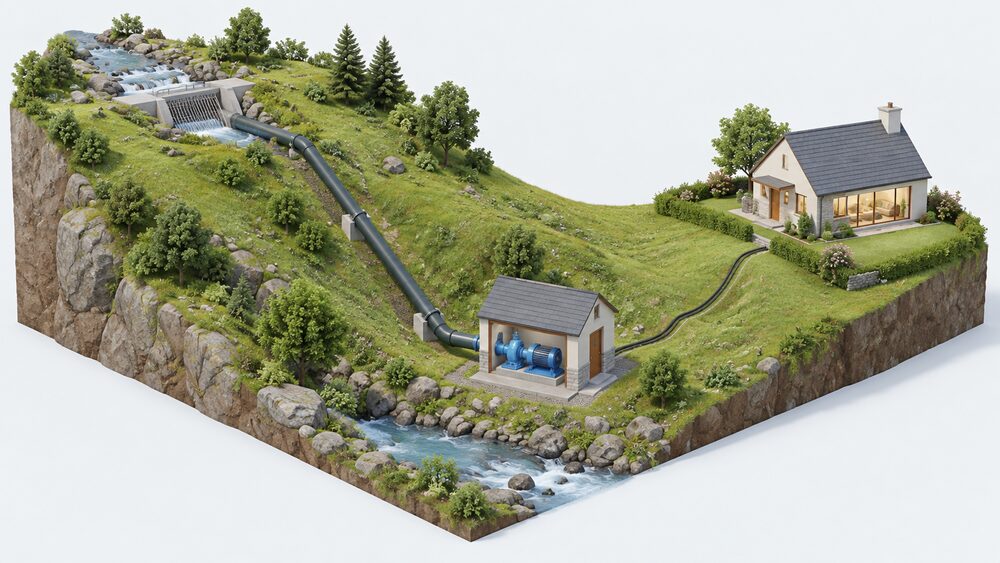
A micro hydro installation turns the fall of water on your land into a steady electrical supply. It is the only common home renewable that generates to order, day and night, because it depends on flow and head rather than weather at the moment of use. A micro hydro plant is one that generates less than 100 kilowatts1. Small hydroelectricity systems can produce enough electricity for all electrical appliances and lighting in your home, and any excess can heat the home and hot water too1.
The build is the short part. Most of the elapsed time goes on proving the resource, securing consents and agreeing a connection. Various consents and licences are required for a hydro project, and the viability of the installation will depend on whether there is enough water flowing per second and the height or head that it falls from2. A residual flow must also be left in the watercourse to maintain it2.
Once running, the economics are unusual. Most hydropower systems can last for 40 to 50 years, with low running and maintenance costs1. Energy Saving Trust gives around £5,000 to £6,000 for a small, 1kW off-grid generator, plus installation costs1. Total system costs can be high but are often less than the cost of a grid connection, with no electricity bills to follow1.
What a micro hydro system needs: flow, head and a watercourse you can use
A suitable site needs a water source with a combination of flow, meaning how much water is flowing through the system, and head, the difference in height between the water at the top of the system and the bottom1. Those two numbers, multiplied together with an efficiency factor, set the power available. Neither alone is enough: a steep drop with a trickle, or a wide lowland river with almost no fall, will both disappoint.
The viability of the installation will depend on whether there is enough water flowing per second and the height or head that it falls from2. That is the whole feasibility question in one sentence, and it is why a site visit and a flow measurement matter more than any catalogue.
There is a third requirement that catches out first-time schemes. There should also be enough residual flow to maintain the water course2. The whole stream cannot be abstracted, even where rights to take some of it are held. The water left behind keeps the channel, its bed and its ecology intact, and it is normally a condition of the abstraction licence rather than a matter of choice.
Useful power may be produced from even a small stream1. That is encouraging but not a promise: a small stream with good head can run a modest turbine, while a large stream with no fall cannot. The practical test is whether the combination of flow and head is available for most of the year, not just in spate.
For a household, this is the first point at which energy independence is either real or illusory. A scheme sized on a winter peak will sit idle in summer. A scheme sized on the dry-season flow will under-use the site for half the year. The honest position is that a run-of-river scheme follows the river, and the river does not follow the household's demand.
Surveying your site before you commit
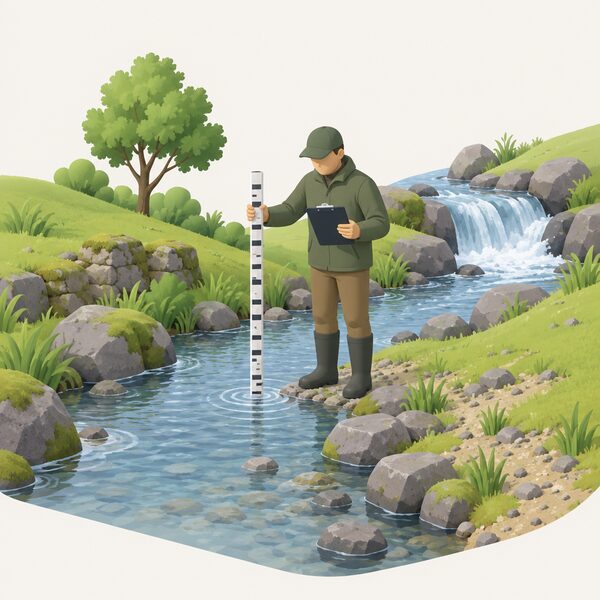
The surveying stage is where a scheme is made or lost, and it is the stage most often skipped. The pattern used for wind applies with equal force to water: ideally, a professional assessment of the local wind speed should be carried out for a full year at the exact location where a turbine is planned, before proceeding4. A hydro resource is measured in flow and head rather than wind speed, but the principle of a full-year record at the exact spot is the same, and it is the only way to know how the stream behaves across seasons.
Before installing a turbine, it is a good idea to check with your local council on the necessary planning permissions5. Always check with your Local Planning Authority about planning issues before you have a system installed6. Doing this early avoids designing a scheme that cannot be consented.
A professional survey of this kind is not a quick visit. After an initial free quote, they will visit your home to conduct a lengthy on-site survey7. For hydro, that survey covers the catchment, the fall available, the length of penstock required, access for machinery, and the position of the turbine house relative to the watercourse and the connection point.
What the survey should produce is a defensible estimate of annual generation, not a peak figure. It should also identify the constraints that will shape the design: the residual flow condition, any protected species or designated habitat, flood risk, and the route the cable or pipe will take. A household that commissions this work before buying anything has a scheme it can consent, finance and maintain. One that buys a turbine first has an expensive ornament.
Consent and approvals: who owns the water and who must agree
Water is not owned in the way land is. The right to take it is licensed, and various consents and licences are required for a hydro project2. A preliminary accreditation application for a hydro installation must include planning permission, a grid connection agreement, and licences and consents (hydro only)8. Those three items are the gate: without them, no scheme proceeds to accreditation or payment.
Planning permission is the first. Where a building is listed or in a designated area, even if permitted development rights apply, it is advisable to check with your local planning authority before a flue is fitted, and consent is likely to be needed for internal alterations9. Consent is also likely to be needed for internal alterations in a listed building or designated area10. For works to a listed building, central heating or other flues, solar panels, air con and heat recovery units and pipework may require listed building consent11. The same principle extends to plant and pipework associated with a hydro scheme.
Abstraction licensing sits with the environmental regulator for the nation. The requirement to leave residual flow in the watercourse is normally written into that licence, and it is the condition most likely to reduce the output a household had assumed.
Where the electricity is to be exported, the connection agreement is a separate approval. An energy device owner must ensure the DNO has granted authorisation before the work is carried out for apply to connect devices12. That authorisation is not a formality: it confirms the network can accept the generator and sets the protection settings the inverter or controller must use.
Choosing the turbine type to match your flow and head
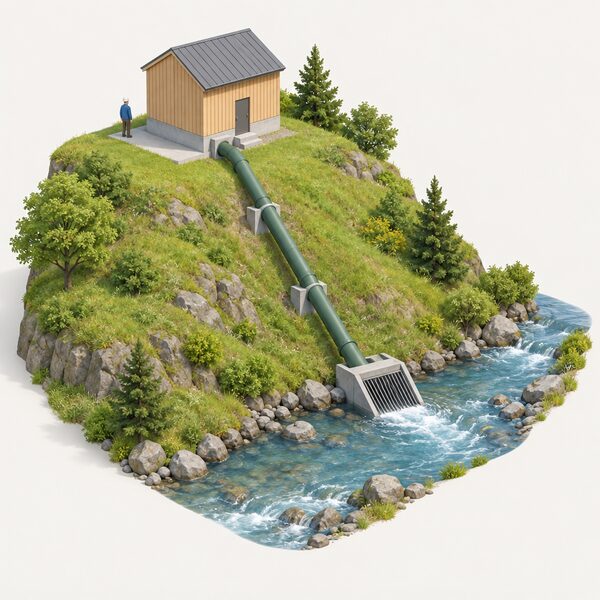
Turbine choice follows directly from the two site numbers. High head and low flow points to an impulse turbine; low head and high flow points to a reaction machine. The wrong match does not fail outright, it simply runs outside its efficient band, and the loss shows up as generation that never reaches the survey estimate.
The same logic governs siting elsewhere in microgeneration. Small wind turbines should ideally be located on a hilltop or raised structure, away from obstructions like trees or other buildings5. For hydro, the equivalent discipline is placing the intake where it captures flow cleanly, keeping the penstock route as short and straight as the ground allows, and putting the turbine house above flood level.
Hybrid thinking is common in off-grid generation, and it applies here. It is common to run this system with a diesel generator for use during periods of low wind speeds4. A hydro scheme that carries the base load through most of the year may still need a backup source for dry spells or maintenance shutdowns, and a battery bank smooths the difference between what the river gives and what the house draws.
The choice also fixes the maintenance regime. An impulse runner in clean, high-head water sees less abrasion than a reaction machine in a silty lowland stream, and screens do more work where the catchment carries debris. Selecting the turbine is therefore selecting the servicing pattern for the next four decades.
The main components: intake, penstock, turbine, generator and controls
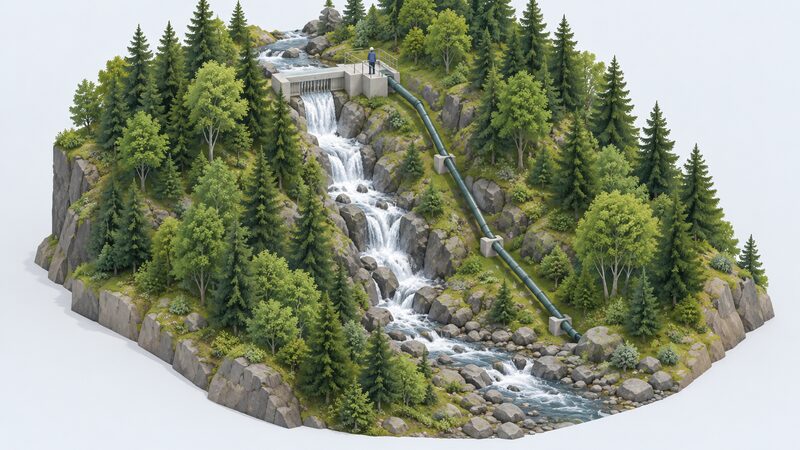
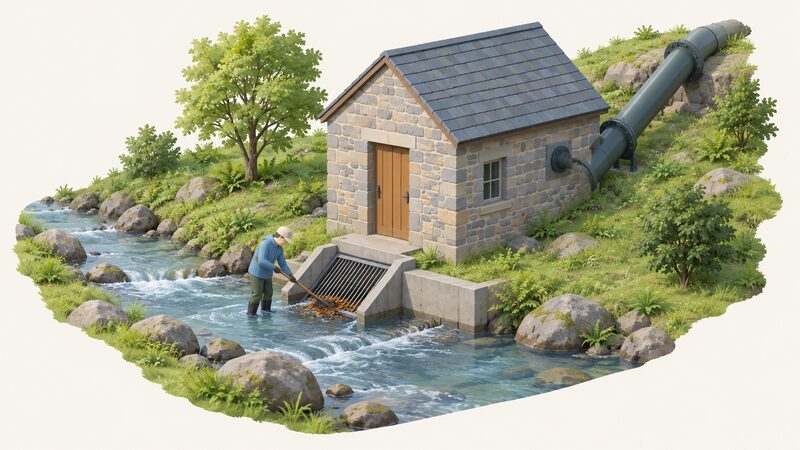
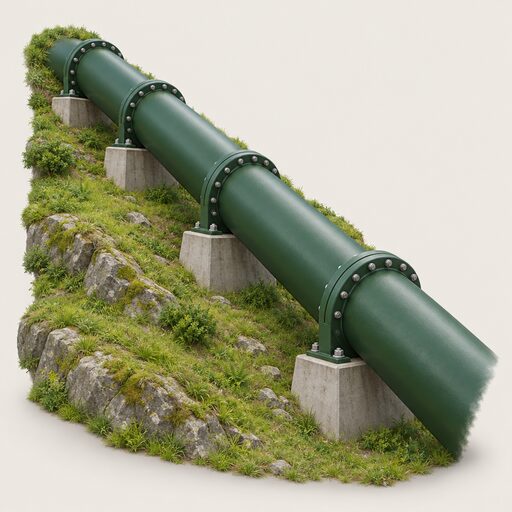
A scheme is a chain, and the weakest link sets the output. The intake diverts water from the watercourse and passes it through a screen that keeps debris, leaves and gravel out of the pipe. The penstock carries water downhill to the turbine, and its diameter and smoothness decide how much energy is lost on the way. The turbine converts the fall into rotation, the generator turns that rotation into electricity, and the controls govern voltage, frequency and connection to the load or the grid.
Water turbines are treated as energy-saving materials in the relevant VAT legislation13. That matters for the price a household actually pays, because the reduced rate applies to qualifying installations rather than to the equipment alone.
The electrical side is not an afterthought. Building regulations will normally apply to aspects of the work such as electrical installation6. Building regulations also apply to other aspects of the work such as electrical installation and plumbing work14. The same statement appears across the guidance for wind, biomass and micro-combined heat and power, and it applies to hydro: the civil and hydraulic works may be outside building control, but the wiring is not.
| Component | Function | What drives its specification |
|---|---|---|
| Intake and screen | Diverts water, excludes debris | Catchment debris load, residual flow condition2 |
| Penstock | Carries water to the turbine | Head, flow, route length, ground conditions |
| Turbine | Converts fall into rotation | Flow and head combination1 |
| Generator and controls | Produces and regulates electricity | Load, grid or off-grid operation1 |
| Connection and protection | Links to the network or the house | DNO authorisation before work12 |
Grid connection or off-grid: how the electricity gets used
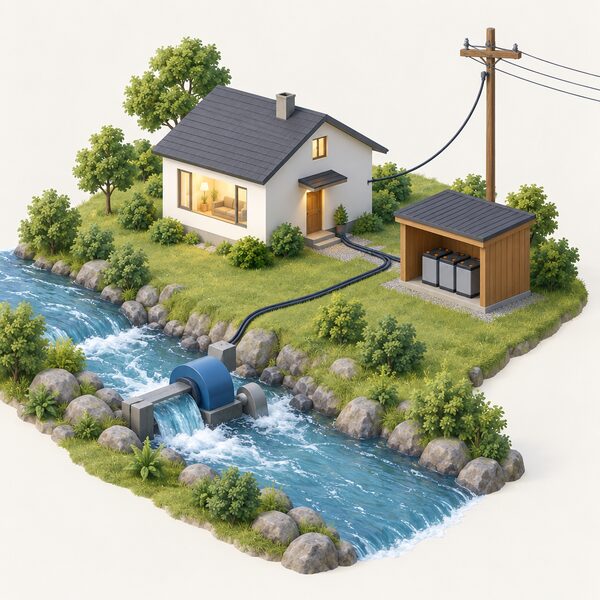
Hydroelectrical power systems use running water turning a turbine to produce electricity1. Where a grid connection exists, the scheme can run alongside it. Any unused or excess electricity can be exported to the grid and sold to the local electricity supply company4. The Smart Export Guarantee requires licensed electricity suppliers to offer export tariffs to anaerobic digestion, hydro, onshore wind and other eligible technologies, with hydro eligible up to 5MW total installed capacity3.
Where there is no mains connection, the picture changes. For houses with no mains connection but with access to a micro hydro site, a good hydro system can generate a steady, more reliable electricity supply than other renewable technologies at a lower cost1. Micro-hydro systems generate power from running water and are ideal for off-grid homes, offering long-term savings despite high initial costs15. In off-grid applications the power is used for lighting and electrical appliances, and space and water heating can be supplied when available power exceeds demand1.
That last point is the one households underestimate. An off-grid hydro scheme with a battery bank can run far more than lights: when the river is high and the batteries are full, the surplus can be diverted to heating. The limit is the dry season, when the same scheme may barely cover the base load.
The dependence that remains is worth stating plainly. A grid-connected scheme still relies on the network for import when the river is low and for the export payments that make the numbers work. An off-grid scheme still relies on a battery bank, a controller and the manufacturer's continued support for both. Hydro reduces dependence on a supplier and on fuel deliveries; it does not remove dependence on equipment, spares and the water itself.
Installation: the civil works, electrical work and who does what
Installation divides into civil works, hydraulic works and electrical works, and the split matters because different rules and different trades apply to each.
The civil works cover the intake structure, the penstock trench or support, the turbine house and access. These are groundworks, and they usually dominate the cost and the programme. The hydraulic works cover the pipe, valves and the turbine installation itself. The electrical works cover the generator, controls, cabling, protection and the connection to the house or the network.
On the electrical side, the rules are explicit. Building regulations will normally apply to aspects of the work such as electrical installation6. Building regulations also apply to other aspects of the work such as electrical installation and plumbing work14. The Building Regulations allow certain works, known as non-notifiable or minor work, to be carried out without having to notify building control or use a registered electrician16. A generator connection is not minor work.
The sequence that avoids trouble is: consents first, then DNO authorisation, then civil works, then the electrical connection and commissioning. An energy device owner must ensure the DNO has granted authorisation before the work is carried out12. Commissioning is the point at which the scheme is proved against the survey estimate, and any shortfall is investigated before the installer leaves site.
Maintenance: keeping the intake clear and the system running
Maintenance on a hydro scheme is dominated by one task: keeping water flowing into the turbine. The intake screen collects leaves, branches and gravel, and a blocked screen reduces output immediately and can damage the runner if debris passes through. Screen clearing is therefore a routine, seasonal job, heaviest in autumn leaf fall and after spates.
The mechanical side follows a longer cycle. Maintenance checks for small wind turbines are generally needed every few years5, and hydro plant of comparable scale follows a similar pattern for bearings, seals, alignment and the runner. Between those checks, the household watches for changes in noise, vibration and output, which are the early signs of wear.
The safety principle is stated for combustion appliances and applies to any plant that runs continuously: it is essential that they are adequately and regularly serviced and maintained18. A turbine house is a wet, remote, sometimes unattended space, and the servicing regime is what keeps it safe and productive.
"Most hydropower systems can last for 40-50 years, with low running and maintenance costs."
That lifespan is the strongest argument for hydro, and it is also a commitment. Forty to fifty years of low running costs assumes the intake is cleared, the bearings and seals are renewed, the controls are supported and the civil works are kept in repair. A scheme that is neglected does not fail gracefully; it silts up, corrodes and stops.
Costs, payback and what a hydro scheme earns
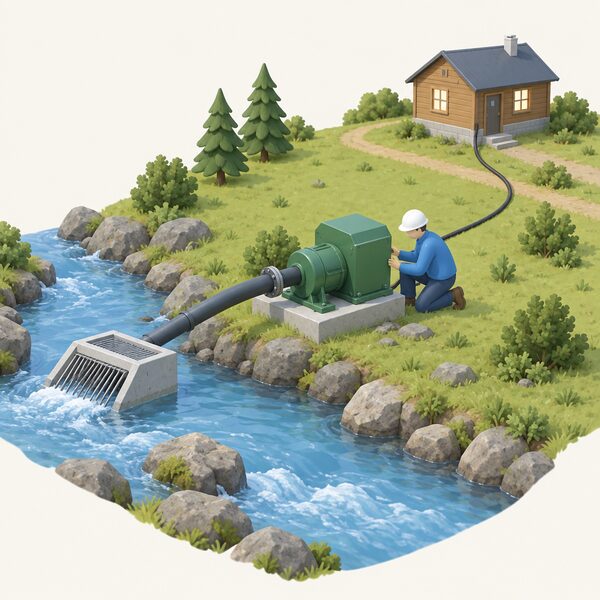
Energy Saving Trust gives around £5,000 to £6,000 for a small, 1kW off-grid generator, plus installation costs1. That figure covers the generator, not the scheme. Total system costs can be high but often less than the cost of a grid connection and with no electricity bills to follow1. For a remote property, the comparison that matters is not against a retail electricity tariff but against the cost of bringing a supply to the site at all.
For larger, grid-connected schemes, prices are installer-quoted and depend on the civil works, the penstock length and the connection. No published range is given for those, and none should be assumed.
What the scheme earns depends on how the electricity is used and whether it is exported. The Smart Export Guarantee requires licensed electricity suppliers to offer export tariffs to hydro installations up to 5MW total installed capacity3. The Feed-in Tariff, which paid a set rate for hydro generation over a long period, is closed to new applicants; its tariff period for solar PV, wind, hydro and AD installations was a repeating three month period19.
| Item | Figure | Source basis |
|---|---|---|
| Small 1kW off-grid generator | around £5,000 to £6,000, plus installation | Energy Saving Trust1 |
| Total system cost | can be high, often less than a grid connection | Energy Saving Trust1 |
| Running and maintenance costs | low | Energy Saving Trust1 |
| Export eligibility | hydro up to 5MW total installed capacity | Ofgem3 |
The payback case rests on three things: the resource, the capital cost of the civil works, and the value of the electricity generated or displaced. Where a grid connection would have cost more than the scheme, the payback is immediate in cash terms. Where a connection already exists, the case rests on generation over decades and on export payments that depend on a supplier's tariff.
How micro hydro fits into household energy independence
Hydro does something no other home renewable does as reliably: it generates on demand, through the night, in still air and in overcast weather. Small hydroelectricity systems can produce enough electricity for all electrical appliances and lighting in your home1. For a household with a suitable watercourse, that is a genuine step away from reliance on a supplier and on the gas network for electricity.
The dependence that remains is specific and worth naming. The scheme depends on the river, and the river varies; a dry summer reduces output whatever the household needs. It depends on a grid connection for import and export in most cases, and on a supplier for export payments. It depends on a manufacturer for the turbine, generator and controls, and on spares and servicing for decades. It depends on consents that can carry conditions, including the residual flow that must be left in the channel2.
There is also a practical limit on what hydro can do for heat. Space and water heating can be supplied when available power exceeds demand1, but that is a surplus condition, not a guarantee, and it is most likely in winter when flows are highest. A household that wants heat from hydro needs storage and a diversion controller, and should expect the shoulder months to be lean.
Set against those limits, the case is strong where the site is right. A scheme that lasts 40 to 50 years with low running and maintenance costs1, that can carry a whole house's electrical load1, and that can be sized to avoid a grid connection altogether1, is about as close to self-sufficiency as domestic generation gets. The work is in the survey, the consents and the maintenance, not in the turbine.
Sources19 cited
- Hydroelectricity, Energy Saving Trust, 2025-11-06
- Hydropower, nidirect, 2026-09-17
- Smart Export Guarantee guidance for generators, Ofgem, 2019-12-12
- Wind, nidirect, 2026-05-18
- Small wind turbines, MCS Certified, 2026-08-18
- Building regulations: hydro electricity, Welsh Government, 2026-09-17
- Five top tips from Which? to cut your energy bills, Welsh Government, 2026-03-18
- Feed-in Tariffs: guidance for renewable installations, Ofgem, 2021-12-13
- Planning permission: micro-combined heat and power, Planning Portal, 2026
- Planning permission: micro combined heat and power, Welsh Government, 2026-09-17
- Making alterations to a listed building, Bristol City Council, 2026-09-17
- Register energy devices in homes or small businesses, GOV.UK, 2021-03-31
- VAT Act 1994, Schedule 8, Part II, Chapter 23, legislation.gov.uk, 2026-09-17
- Building regulations: micro-combined heat and power, Welsh Government, 2026-09-17
- Sustainable home energy solutions, Planning Portal, 2024-09-02
- Building regulations: electrics, Welsh Government, 2026-09-17
- Electrical safety, Cumberland Council, 2026-09-17
- Building regulations guidance Part J: heat producing appliances, Welsh Government, 2026-09-17
- Key terms explained: Feed-in Tariffs, Ofgem, 2026-09-17
 Micro Hydro CostHow much does a micro hydro scheme cost to build and run, and what makes one worth it?
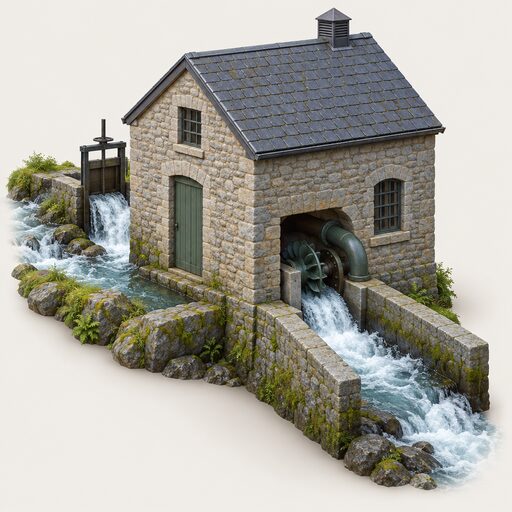 Micro Hydro Power for HomesA stream on your land that flows all year can make steady electricity, day and night, even when there is no sun or wind.
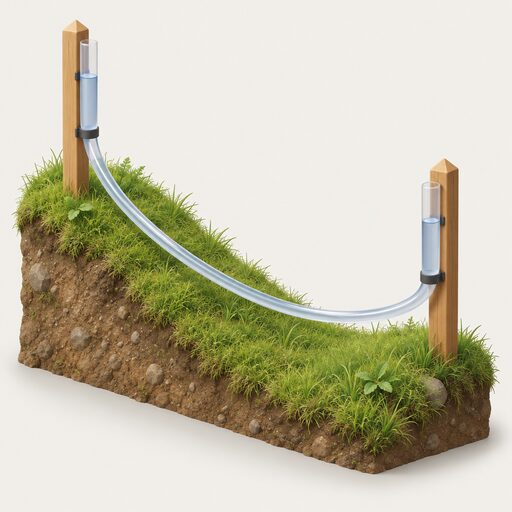 Micro Hydro Head and FlowHead is the drop from the top of your water supply to the bottom, and flow is how much water comes down.
 Abstraction Licences and PermitsTaking water from a stream to power a turbine needs permission, and where you live decides who grants it.
 Microgeneration and IndependenceWhat can you use when solar cannot cover winter evenings, and does it really make you independent?
 G98 and G99 Grid ConnectionConnecting a wind turbine, hydro turbine or micro-CHP unit at home raises the question of whether it needs G98 or G99.