

In this answer
Short answer
Micro hydro is priced by capacity, not by job. The Centre for Alternative Technology puts the total cost at £5,000 to £10,000 per kilowatt if professionally installed, which makes a small scheme a five-figure project before any grid or civil work is counted1. The Energy Saving Trust gives a narrower entry point: around £5,000 to £6,000 for a small, 1kW off-grid generator, plus installation costs2.
That gap between the two figures is the whole story of hydro budgeting. The 1kW off-grid unit is a turbine and generator package. The per-kilowatt figure covers a complete installed scheme, including the intake, pipeline, turbine house, electrical works and commissioning that turn a stream into a supply. For a household with water on its land, the question is rarely whether the turbine is affordable but whether the site works are.
What hydro buys is reliability. A water turbine run at about 70% capacity produces roughly seven times the output per kilowatt of a PV array, and it produces it continuously rather than only in daylight1. For a property with no mains connection, that changes the calculation entirely: total system costs can be high but often less than the cost of a grid connection, with no electricity bills to follow3.
Installation cost: £5,000 to £10,000 per kilowatt
The headline range comes from the Centre for Alternative Technology, which states that the total cost might be between £5,000 and £10,000 per kilowatt if professionally installed1. That is a wide band, and it is wide for a reason: it spans sites where a short pipeline and a modest head make for straightforward civil work, and sites where a long penstock, an access track and a new turbine house dominate the budget.
The Energy Saving Trust's figure of around £5,000 to £6,000 for a small, 1kW off-grid generator, plus installation costs, sits at the bottom of that band and describes a different thing: a generating package rather than a finished scheme2. A household comparing the two numbers is comparing a component with a project.
Scale works in the household's favour. CAT notes there is often an economy of scale, with a 5kW system maybe only costing 50% more than a 2kW system1. The reason is that intake structures, pipelines, access and electrical connections cost broadly the same whether the turbine is small or mid-sized, so the marginal cost of the extra capacity is lower than the average.
For comparison, the same source puts small PV installations at about £2,000 per kilowatt, and larger arrays of 10 to 50 kW at perhaps down to £1,000 per kilowatt5. Hydro's per-kilowatt cost is several times solar's, and the justification is not price but the shape of the output: continuous, predictable and independent of daylight and season in the way a river's flow is not.
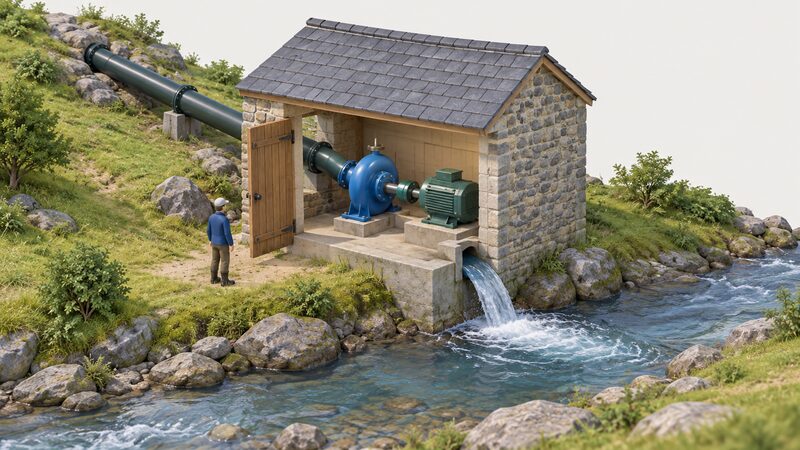
What drives the price per kilowatt up or down

The per-kilowatt figure is an average across very different sites, and the spread is driven by the civil engineering rather than the generating equipment. A scheme with a steep drop over a short distance needs less pipeline and can use a smaller, faster turbine. A scheme on a low-gradient river needs a much larger volume of water and a bigger, slower machine to extract the same power.
Fixed costs behave differently from variable ones. The Welsh Government's impact assessment for Part L of the Building Regulations breaks a comparable technology into a fixed cost of £1,200 per installation and a variable cost of £800 per kWp for systems under 4kWp, rising to £1,200 per kWp above that threshold6. The principle transfers: a fixed element is paid once regardless of size, and a variable element scales with capacity. Hydro's fixed element, the intake, pipeline and turbine house, is far larger than solar's mounting and wiring.
Site access matters as much as hydrology. Machinery, pipe and concrete all have to reach the intake and the turbine house, and on a wooded or steep site that access can be a substantial part of the bill. Environmental requirements add further fixed cost: screening, fish passage and flow controls are not optional extras on a watercourse.
The result is that two sites with identical head and flow can differ by a factor of two in cost per kilowatt. The published range of £5,000 to £10,000 per kilowatt is not a quotation, and no installer will price a scheme without a site survey1.
Grid connection versus off-grid use: how it changes the budget
For a property already connected to the mains, hydro is an export proposition. For a property that is not, it is a substitute for a connection, and that reframes the whole budget.
The Planning Portal states that for houses with no mains connection but with access to a micro hydro site, a good hydro system can generate a steady, more reliable electricity supply than other renewable technologies at a lower cost3. It adds that total system costs can be high but often less than the cost of a grid connection, and with no electricity bills to follow3. The Consumer Council for Northern Ireland makes the same point more briefly: this might be a cheaper option if your home is off the electricity grid7.
Home Energy Scotland's guidance agrees that installing a hydroelectricity system can be expensive but may still cost less than paying to connect to the grid8. Three separate bodies reaching the same conclusion is the strongest signal in the evidence: the comparison that matters is not hydro against solar, but hydro against a cable.
A grid connection is not mandatory for a behind-the-meter system, but it enhances value by enabling the export of surplus electricity9. That is the trade-off. Off-grid, every kilowatt generated has to be used, stored or dumped, and in off-grid applications the power is used for lighting and electrical appliances3. Connected, surplus output can be sold, but the connection itself carries cost and the scheme must meet the relevant connection standard.
Ongoing maintenance and running costs
Hydro's running costs are its strongest argument. Home Energy Scotland describes running and maintenance costs as low, which reflects a machine with few wearing parts, no fuel and no exposure to the weather in the way a turbine blade is8.
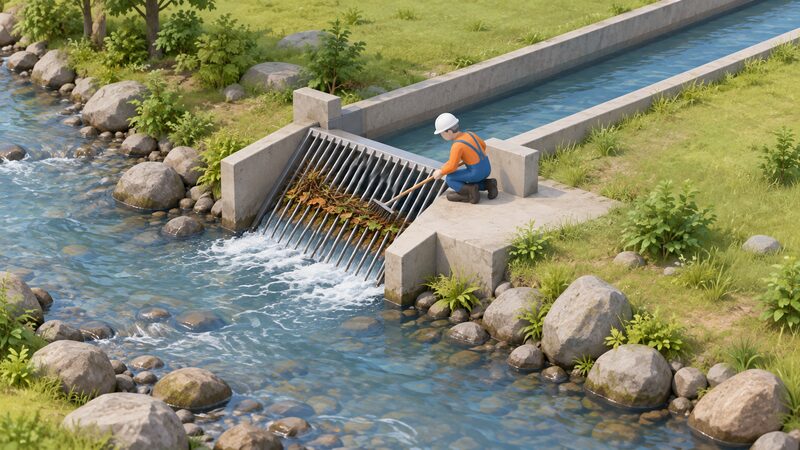
No annual maintenance figure for hydro appears in the published guidance. The nearest comparable figure is for small wind turbines, where maintenance typically costs between £100 and £200 depending on the size of the system11. Hydro's maintenance burden is different in kind: an intake screen has to be kept clear of leaves and debris, and that is a task measured in visits rather than in parts.
Where a scheme holds Feed-in Tariff accreditation, there is a small ongoing charge. The Feed-in Tariff determinations set the ongoing generator cost at £30 per generator for FIT year 1712. That is an administrative charge, not a maintenance cost, but it is a recurring line in the accounts of an accredited scheme.
The wider context is that hydro output is not free of grid-era costs even off-grid. Battery storage to carry a household through low-flow periods is priced separately: a 5kWh battery system costs around £4,60013. For comparison, solar water heating installation is around £5,30014, and a hot water solution of immersion heater, heat battery or hot water heat pump cylinder runs £1,000 to £4,00015. These are the costs of the systems hydro would displace or work alongside.
Grants and support for community and household schemes

There is no current grant in the published sources that is specific to household micro hydro. The schemes that exist are aimed at heating, and a household considering hydro should understand what they do and do not cover.
The Warm Homes: Social Housing Fund Wave 3 offers up to £20,000 per home for low carbon heating measures, available for up to 10% of the homes in an application, and for homes using that offer the total available grant funding per home is £20,000 instead of the base cost cap16. The same scheme provides an additional £7,500 of grant funding where low carbon heating measures are installed in homes off the gas grid16. That off-gas-grid uplift is the closest thing in the sources to support for a rural property without a mains connection, though it is a heating measure, not a hydro measure.
In Scotland, the Home Energy Scotland Grant and Loan includes an uplift of £1,500 for rural and island homes, applied to both the clean heating and energy efficiency grants17. The scheme terms confirm an extra £1,500 grant is available for heat pump installations and heat network connections and energy efficiency18. Again, this is heating and efficiency support rather than generation support.
For generation specifically, the relevant framework is the Smart Export Guarantee, which covers solar, small wind of 5MW or less and micro CHP of 50kW or less19. Hydro is not listed among the SEG technologies in that guidance, and the Feed-in Tariff that once covered hydro is closed to new applicants10. A household should therefore treat grant funding for a hydro scheme as unlikely and budget the full installation cost.
Is micro hydro worth it compared with solar or wind?
The comparison turns on output profile rather than headline cost. CAT states that if a water turbine can be run at about 70% capacity then the output per kilowatt will be about seven times that of a PV array1. A 1kW hydro turbine therefore does the annual work of a much larger solar array, and it does it in winter as well as summer.
Against wind, hydro has the advantage of predictability. Small wind turbines need maintenance typically costing between £100 and £200 depending on system size, and building-mounted turbines cost less to install than pole-mounted ones but tend to be smaller and less efficient11. Wind output varies with a resource that cannot be measured from a map; water flow varies with rainfall but is far more stable over a season.
The financial recovery period is long. The Renewable Energy Hub projects that it will take 20 years for a micro-CHP system to recover the cost of investment, and hydro is described as having high installation costs21. A 20-year horizon is not unusual for microgeneration, but it means hydro is a long-term asset rather than a quick return.
The case for hydro is strongest where the alternative is a grid connection, where the site has good head and flow, and where the household values a continuous supply over a cheaper but intermittent one. It is weakest where a mains connection already exists and the budget is being compared against solar, which costs a fraction per kilowatt5. The technology is not better or worse than its alternatives; it is suited to a narrower set of sites.
Sources22 cited
- Micro hydro, Centre for Alternative Technology, 2025-07-01
- Hydroelectricity, Energy Saving Trust, 2025-11-06
- Hydro electricity, Planning Portal, 2026
- Consumer code, Renewable Energy Consumer Code, 2026-07-01
- Solar photovoltaic, Centre for Alternative Technology, 2026-03-10
- Part L Wales impact assessment, Welsh Government, 2022-05
- Renewable energy, Consumer Council for Northern Ireland, 2026
- Hydroelectricity, Home Energy Scotland, 2026-09-20
- Behind-meter energy systems guidance, Welsh Government, 2026-06-29
- Key terms explained: Feed-in Tariffs, Ofgem, 2026-09-17
- Small wind turbines, MCS Certified, 2026-08-18
- Feed-in Tariffs determinations year 16, Department for Energy Security and Net Zero, 2026-02-26
- Battery storage, Energy Saving Trust, 2026-08-19
- Solar water heating, Energy Saving Trust, 2026-05-20
- Air to air heat pumps, Nesta, 2026-06-24
- Warm Homes: Social Housing Fund Wave 3 addendum, Department for Energy Security and Net Zero, 2026-06
- Scottish Government response to the Green Heat Finance Taskforce, Scottish Government, 2025-12-17
- Home Energy Scotland grant and loan terms, Home Energy Scotland, 2026-09-17
- Smart Export Guarantee, MCS Certified, 2026-04-27
- Wind turbines, Energy Saving Trust, 2026-05-20
- Micro CHP, MCS Certified, 2026-08-17
- Domestic hydropower, Uswitch, 2026-01-06
 Micro Hydro CostHow much does a micro hydro scheme cost to build and run, and what makes one worth it?
 Micro Hydro InstallationHow much water do you need, and how far does it have to fall, for a micro hydro system to be worth it?
 How Much Does a Heat Pump CostA heat pump usually costs around eleven thousand pounds installed, though quotes vary a lot depending on your home.
 Home Battery CostA home battery usually costs between one and a half and ten thousand pounds fitted, depending on size.
 Domestic Wind Turbine CostA home wind turbine usually costs between nine thousand and nineteen thousand pounds, but the real price depends on its size and how it is mounted.
 Micro-CHP Cost and OutputDomestic micro-CHP costs more than a conventional boiler and produces roughly 1kW of electricity alongside its heat.