
In this answer
Short answer
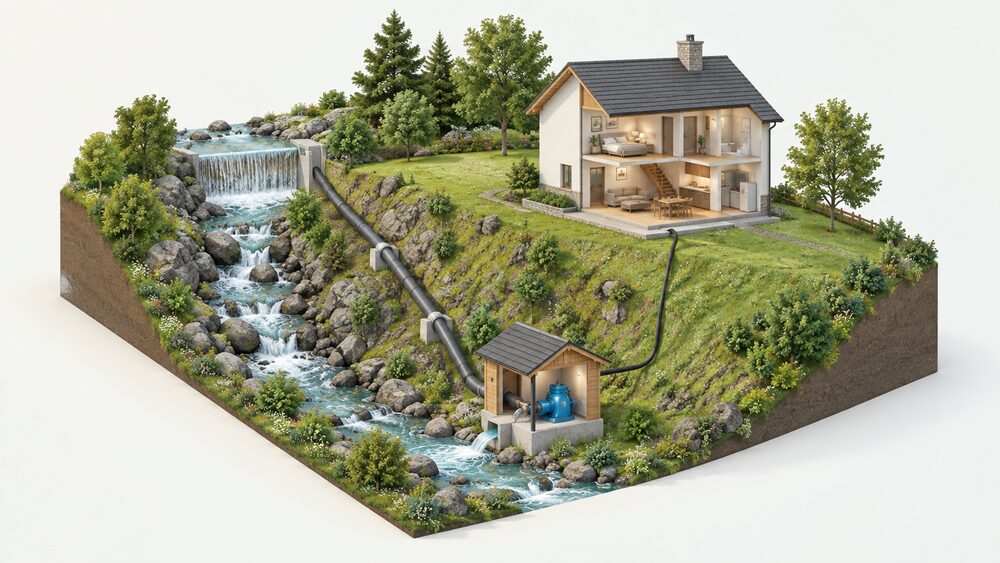
Micro hydropower can power a house, but only in a narrow set of circumstances. A micro hydro plant is defined as one generating less than 100 kilowatts, and very small systems below five kilowatts are known as pico-hydro1. For a household, the practical question is not the definition but the site: micro hydropower is only practical in very specific locations, usually requiring reliable water flow all year round, the right permissions and enough height difference2.
Where those conditions are met, the case is strong. A hydro system can operate 24 hours a day, often generating all the electricity you need, and small hydroelectricity systems can produce enough electricity for all electrical appliances and lighting in a home3. That continuous output is the feature that separates hydro from solar and wind, and it is why micro hydro is described as ideal for off-grid homes, offering long-term savings despite high initial costs4.
The limits are equally clear. Output depends on the water available, not on the size of the turbine chosen, and a scheme that cannot demonstrate year-round flow will underperform. Costs are high per kilowatt, consents are usually required, and the household remains dependent on the watercourse, the network operator if it exports, and the environmental regulator that permits the abstraction.
What micro hydropower can and cannot do for a house
Hydroelectrical power systems use running water turning a turbine to produce electricity, and useful power may be produced from even a small stream8. If you have a stream or river flowing through your land you could install a micro-hydro power system and generate enough electricity, and in theory a hydro system can generate 24 hours a day, which could provide all the electricity you need and more, without releasing any harmful CO2 or other pollutants into the atmosphere9.
That is the ceiling. The floor is set by the site. Micro hydropower for homes can be especially cost-effective for rural or off-the-grid homes, farms and businesses that are close to a suitable water source, which is a statement about a minority of properties rather than a general proposition2. For houses with no mains connection but with access to a micro hydro site, a good hydro system can generate a steady, more reliable electricity supply than other renewable technologies at a lower cost8.
In off-grid applications the power is used for lighting and electrical appliances, and space and water heating can be supplied when available power exceeds demand8. That last condition matters: heating is a large load, and a scheme sized for lighting and appliances will rarely have surplus to spare for it. Hydropower can produce more than enough electricity for lighting and household appliances, but the word "can" carries the whole qualification10.
For energy independence, the picture is mixed in a way that is worth stating plainly. A well-sited scheme removes most of a household's electricity dependence on a supplier, and it does so around the clock rather than only in daylight. What remains is dependence on the watercourse itself, on the abstraction consent that allows it to be used, on the network operator if the scheme exports, and on whoever maintains the turbine and its controls.
How much power a stream must deliver: head, flow and the maths
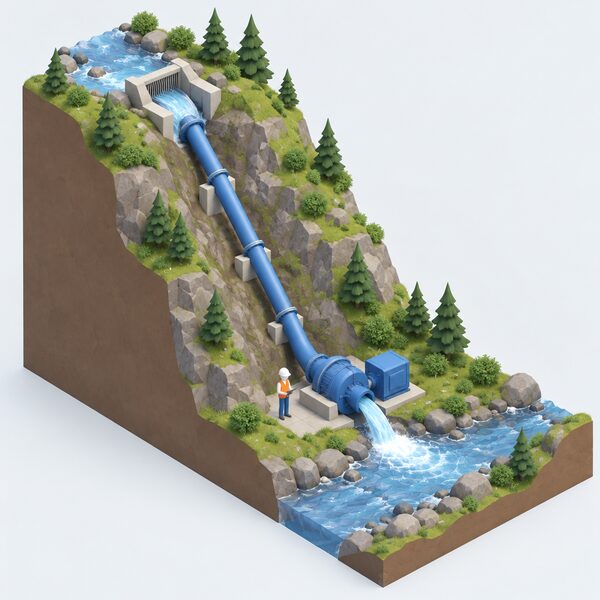
The greater the height and the more water there is flowing through the turbine, the more electricity is generated9. Those two variables, head and flow, decide everything, and they are measured on site rather than assumed.
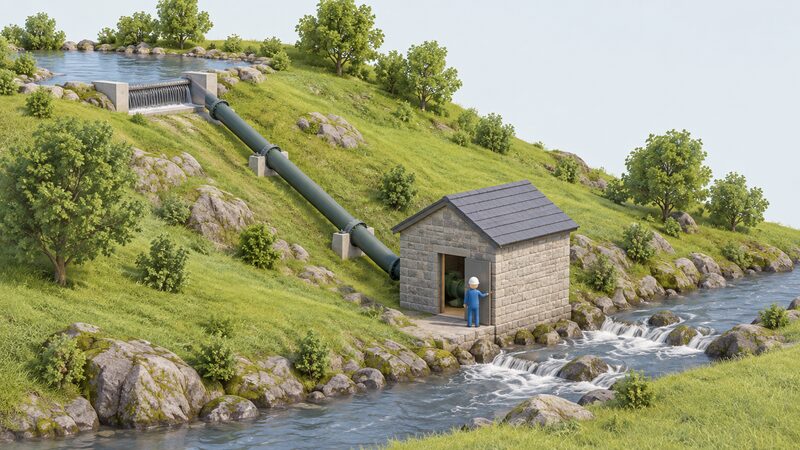
The standard estimate is straightforward. To estimate the energy that could be available, multiply the flow rate (in litres per second) by the head (in metres), multiply by 10, and then halve the result for losses, which gives watts5. The two variables pull in the same direction: the greater the height and the more water there is flowing through the turbine, the more electricity is generated, so a modest flow down a steep drop can match a larger flow across a shallow one2. Doubling the head doubles the estimate, as does doubling the flow.
This is why two neighbouring properties on the same stream can have wildly different prospects. A site with a steep drop and modest flow may outperform a site with a wide, slow river, because head is the multiplier. It is also why the assessment has to be done across the year: a figure taken in February will flatter a scheme that has to run in August.
"To estimate the energy that could be available, multiply the flow rate (in litres per second) by the head (in metres), a"
The practical consequence is that a household cannot decide whether hydro is viable from a map or a postcode. It needs measured head, measured flow over a full seasonal cycle, and a calculation that accounts for losses in the penstock, the turbine and the generator. The head and flow sizing guide sets out how that assessment is carried out, and the turbine types comparison explains which machine suits which combination of the two.
Typical output: a few hundred watts to a few kilowatts, not a full household supply
Domestic micro hydro spans a wide band. At the small end, pico-hydro covers systems below five kilowatts1. At the top, a micro hydro plant runs to just under 100 kilowatts, which is a scale well beyond a single house8. Most domestic schemes sit somewhere in the low single kilowatts.
For comparison, individual wind turbines vary in size and power output from a few hundred watts to two or three megawatts, where one megawatt equals 1,000 kilowatts11. That range illustrates how modest a domestic hydro output is in absolute terms, even though its continuity makes it more valuable per kilowatt than an intermittent source.
| Scale | Capacity | Typical use |
|---|---|---|
| Pico-hydro | Less than five kilowatts4 | Lighting, appliances, battery charging3 |
| Micro-hydro | Less than 100 kilowatts4 | Small-scale generation, including domestic and community schemes |
| Small wind (for comparison) | A few hundred watts to two or three megawatts6 | Domestic to commercial |
The honest summary is that a domestic micro hydro scheme is unlikely to cover a whole modern household's demand on its own, particularly where heating and hot water are electric. It can cover lighting and appliances comfortably, and it can cover more where the household's demand is modest and the site is good. Where a scheme does produce surplus, the options are storage, a dump load, or export.
Grid connection and G99: what exporting your hydro requires
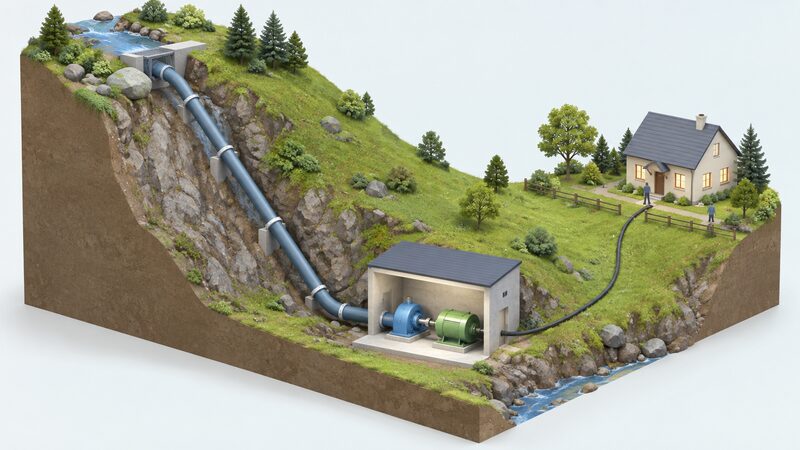
Exporting changes a hydro scheme from an off-grid installation into a grid-connected generator, and that brings the distribution network operator into the project. Systems with an export capacity greater than 3.68kWp need pre-approval via the apply to connect process, known as G99, before connection to the network7. Below that threshold, the simpler G98 process applies.
The direction of travel in network planning is towards earlier engagement. All-electric homes require greater electrical capacity for heating, hot water, EV charging and the export of PV generation, and early engagement with network operators is essential12. A hydro scheme that exports sits in the same conversation, and the connection application is often the longest lead item in the project.
Hydropower is one of the technologies eligible for the Smart Export Guarantee, alongside solar photovoltaics, wind, micro-combined heat and power and anaerobic digestion, with capacity up to 5 megawatts, or up to 50kW for micro-CHP, and installations must be located in Great Britain6. A separate source confirms the same technology list and adds that hydro is included13. The scheme pays for electricity exported to the grid; it does not pay for generation consumed on site.
The closed Feed-in Tariff scheme, which no longer accepts new applications, had a capacity limit of up to 5 megawatt, or 2 kilowatt for Micro CHP14. Hydro schemes up to 5MW were eligible for accreditation through the ROO-FIT process, which covered anaerobic digestion up to 5MW, hydro up to 5MW, PV over 50kW up to 5MW, and wind over 50kW up to 5MW15. Those routes are historical, but they explain why so much of the published guidance on hydro payments refers to a scheme that is no longer open.
For a household, the practical sequence is: establish the export capacity, apply to the network operator before ordering equipment, and only then agree an export tariff. The G98 and G99 guide covers the application process in detail, and exporting electricity from wind, hydro and CHP covers how payment works once connected.
Costs, consents and environmental permits
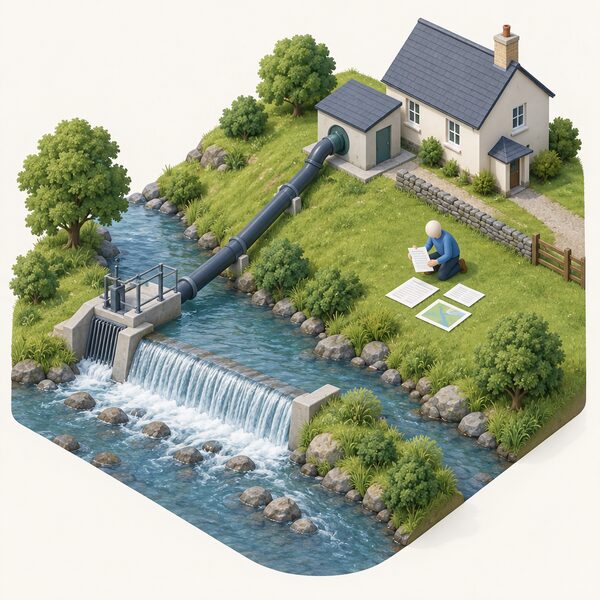
Cost is the first filter. The total cost might be between £5,000 and £10,000 per kilowatt if professionally installed, while it might be possible to DIY a small scheme for under £10,000, and in some situations this could be cheaper than paying a contractor5. A small, 1kW off-grid generator is quoted at around £5,000 to £6,000, plus installation costs3. These are installer-quoted figures and vary with site access, civil works and the length of pipeline required.
Consents are the second filter, and they are where hydro differs most sharply from other domestic renewables. Permitted development rights are generous for some technologies: the installation of a ground source heat pump or a water source heat pump on domestic premises is usually considered to be permitted development, not needing an application for planning permission16. The permitted development scope for water source heat pumps covers the installation, alteration or replacement of a microgeneration water source heat pump within the curtilage of a dwellinghouse or a block of flats17. Domestic wind turbines can in some cases be installed without an application for planning permission, so long as specified limits and conditions are met18.
Hydro does not enjoy an equivalent general right. A scheme that abstracts water, builds a weir or lays a pipeline across land normally requires planning permission, and abstraction itself is separately regulated. The water abstraction licences and permits guide and the environmental requirements guide cover those consents, including fish screening and passage.
Certification is a further consideration. Where Home Energy Scotland grant and loan funding is used to install a clean heating or renewable system, the installer and the product must be certified under the Microgeneration Certification Scheme, except for micro-hydro systems, which are assessed on a case-by-case basis20. The same exception appears in the Private Rented Sector Landlord Loan rules, where the installer and product must be MCS certified for the system being installed, except micro-hydro systems21. MCS certification is a requirement for heat pump installations made under the Domestic Renewable Heat Incentive, the Green Homes Grant and the Clean Heat Grant22, which shows how unusual the hydro exception is.
Does micro hydro work in winter or during drought?
A hydro system can operate 24 hours a day, often generating all the electricity you need3. That is the central advantage over solar, which produces nothing after dark, and over wind, which depends on a variable resource. In theory a hydro system can generate 24 hours a day, which could provide all the electricity you need and more9.
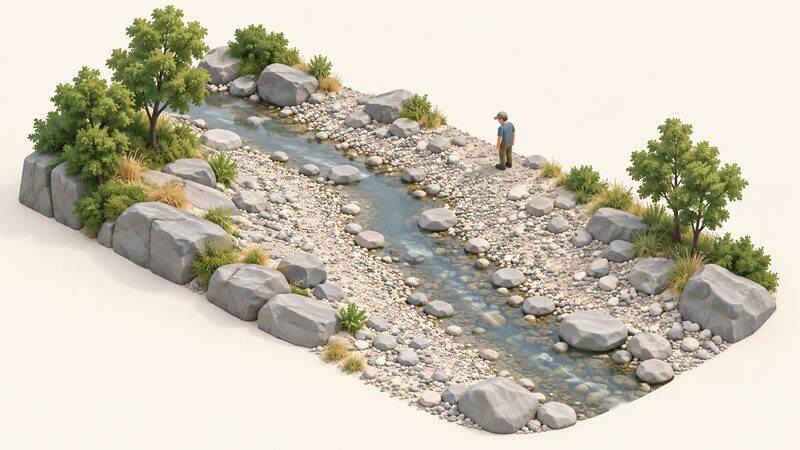
The qualification is water availability. Micro hydropower usually requires reliable water flow all year round2. A stream that runs hard in winter and dries to a trickle in late summer will not support a scheme sized on its winter flow, because the turbine has to keep turning through the dry months. Sites are therefore assessed on their minimum flow, and the output figure that matters is the one the scheme can hold for most of the year.
This is also why hydro is described as a steady and more reliable supply than other renewable technologies for houses with no mains connection but with access to a micro hydro site8. Reliability here is a statement about the pattern of output, not a guarantee of a particular number of kilowatt hours.
Micro hydro versus solar and other options for household independence
Hydro is not the only route, and for most households it is not the first one. Self-build sustainability guidance advises considering solar panels to generate electricity or solar water heating systems for hot water, and exploring other renewable sources like wind or heat pumps if suitable for the location23. That ordering reflects availability: solar works almost anywhere, hydro works on a stream.
Where a stream exists, the comparison is genuinely close. Micro-hydro systems generate power from running water and are ideal for off-grid homes, offering long-term savings despite high initial costs4. The micro hydro versus solar PV comparison and the micro hydro versus micro wind comparison work through the trade-offs for a rural property.
Combining technologies is normal rather than unusual. Hydro and solar complement each other seasonally and across the day, and a battery stores surplus output for evening use. Domestic batteries are described in government scheme guidance as electrochemical batteries installed to be used in conjunction with solar PV panels in residential buildings24, and the same storage logic applies to hydro output. A diversion controller can send excess generation to a dump load such as water heating instead of wasting it.
On funding, the position is patchy. Those technologies may offer an attractive payback to homeowners without grant support25, which is a reminder that the economics have to stand on their own for many installations. The grants and funding guide sets out what is available, and the energy independence overview places hydro in the wider picture of what a household can and cannot control.
The dependence that remains is worth naming. A hydro household still relies on a watercourse it does not own outright, a consent that can be varied, a turbine supplier for parts, and, if it exports, a network connection and a tariff counterparty. What it gains is generation that does not stop at sunset.
Sources25 cited
- Micro hydro and pico hydro capacity definitions, Renewable Energy Consumer Code, 2026
- Micro hydropower for homes, Smart Energy GB, 2026
- Hydroelectricity systems, Energy Saving Trust, 2025
- Sustainable home energy solutions, Planning Portal, 2024
- Micro hydro guidance, Centre for Alternative Technology, 2025
- Smart Export Guarantee eligibility, House of Commons Library, 2026
- G99 and the apply to connect process, Electrical Safety First, 2026
- Hydro-electricity, Planning Portal, 2026
- Hydro power, Electricity North West, 2026
- Could you generate your own energy, Energy Saving Trust, 2024
- Wind, nidirect, 2026
- Future Homes Standard ready, Future Homes Hub, 2026
- Energy incentives and schemes, South Cambridgeshire District Council, 2026
- Feed-in Tariffs, Ofgem, 2026
- FIT guidance for licensed electricity suppliers, Ofgem, 2024
- Heat pumps planning permission, Planning Portal, 2026
- Renewable energy planning advice, Rother District Council, 2026
- Wind turbine planning permission, Planning Portal, 2026
- Wind turbines, Planning Portal, 2026
- Home Energy Scotland grants and loans, Home Energy Scotland, 2026
- Private Rented Sector Landlord Loan, Home Energy Scotland, 2026
- MCS and government schemes, Public Accounts Committee, 2026
- Self-build homes sustainability, Planning Portal, 2026
- Warm Homes Social Housing Fund scheme guidance, Department for Energy Security and Net Zero, 2026
- Support to generate your own electricity, nidirect, 2025
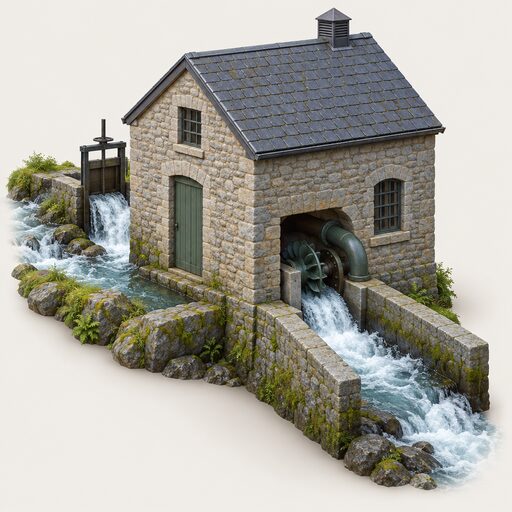 Micro Hydro Power for HomesA stream on your land that flows all year can make steady electricity, day and night, even when there is no sun or wind.
 Abstraction Licences and PermitsTaking water from a stream to power a turbine needs permission, and where you live decides who grants it.
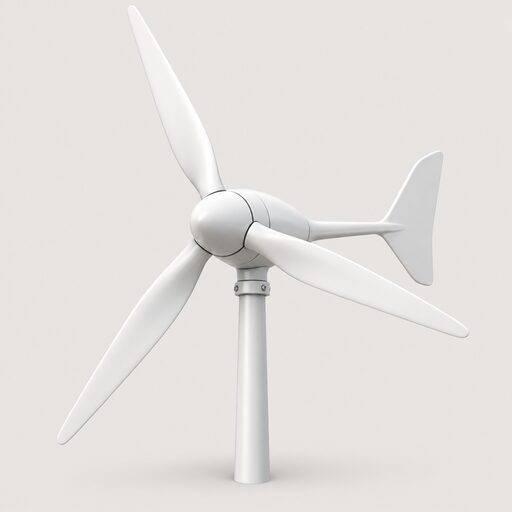 The Full Wind, Hydro and Micro-CHP GuideCould a small wind turbine or water wheel work at your home, and what about boilers that make their own electricity?
 Microgeneration by Home TypeA stream running through your land, a windy exposed spot, or a gas boiler that runs almost all day: each points to a different technology.
 Micro Hydro InstallationHow much water do you need, and how far does it have to fall, for a micro hydro system to be worth it?
 Microgeneration and IndependenceWhat can you use when solar cannot cover winter evenings, and does it really make you independent?