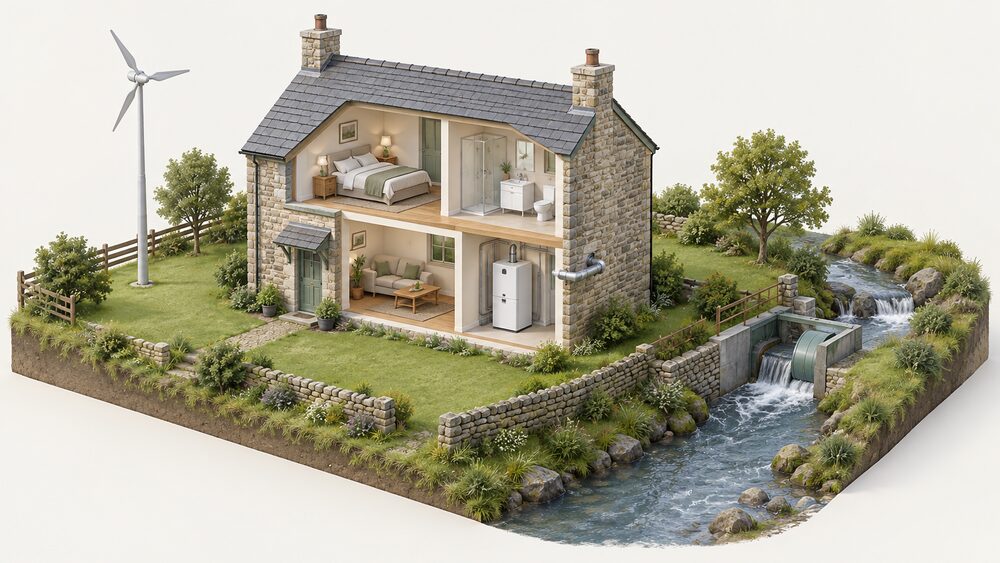
In this guide
Four million UK households, 15% of the total, are off the mains gas grid, and they heat their homes with heating oil, liquefied petroleum gas (LPG), solid fuels, mains electricity and microgeneration1. For those homes, and for anyone pursuing a measure of energy independence, the question is not whether solar helps but what covers the hours and seasons solar cannot. Micro wind, micro hydro and micro combined heat and power (micro CHP) are the three routes that answer that question, and each carries a different kind of dependence with it.
Micro hydro is the strongest of the three for a genuinely off-grid property. For houses with no mains connection but with access to a micro hydro site, a good hydro system can generate a steady, more reliable electricity supply than other renewable technologies at a lower cost2. Micro wind and micro CHP are more conditional. Micro CHP is a gas-fired technology that produces heat and hot water and also generates electricity, about 1kW while it is running3. It reduces the amount of electricity a home buys, but it does not remove the fuel supply.
The distinction that matters throughout this page is between self-supply and independence. A technology that generates on site cuts the units bought from a supplier. It does not, on its own, cut the connection. Micro CHP runs on mains gas or LPG4. Micro wind and hydro can island a property with batteries, but most installations remain grid-tied, and the Smart Export Guarantee pays for exported electricity rather than replacing the grid5.
What off-grid generation means for a UK household
Off-grid generation is often described as though it were a single decision. In practice it is a set of separate ones: what generates, what stores, what remains connected, and what fuel still arrives at the door. Approximately 15% of the 28 million properties in the UK are off the grid, according to evidence submitted to a parliamentary committee9. That is a large minority, and it is not evenly distributed: rural Scotland, Wales, Northern Ireland and parts of England carry most of it.
The statutory definition of microgeneration is broad. It covers biomass, biofuels, fuel cells, photovoltaics, water including waves and tides, wind, solar power, geothermal sources, combined heat and power systems, and other sources which in the opinion of the Secretary of State would cut greenhouse gas emissions in Great Britain10. That breadth matters because it means micro wind, micro hydro and micro CHP sit inside the same regulatory family as solar, and share much of its certification and grid-connection apparatus.
What these technologies do for independence depends on their fuel. Micro wind and micro hydro take energy that arrives free and locally, from wind and from falling water. Micro CHP takes delivered gas and converts part of it to electricity on site. The first two reduce dependence on a supplier; the third reduces the quantity bought but keeps the supply relationship intact. A household that wants to know which applies to it should start by asking what arrives at the property now, and what could arrive without a network.
The scale limits are worth knowing early. Microgeneration heat technologies are defined up to 45kW7, and micro-CHP technologies need to have an electricity capacity of 50kW or less6. Those ceilings are far above any domestic installation, which means the constraint on a home is physical and financial rather than regulatory.
The three routes: micro wind, micro hydro and micro CHP
The three technologies differ in almost every respect except one: each can produce power when solar cannot. Micro hydro runs continuously where water flows. Micro wind runs at night and in winter. Micro CHP runs whenever the heating runs, which in a UK climate means the coldest and darkest months.
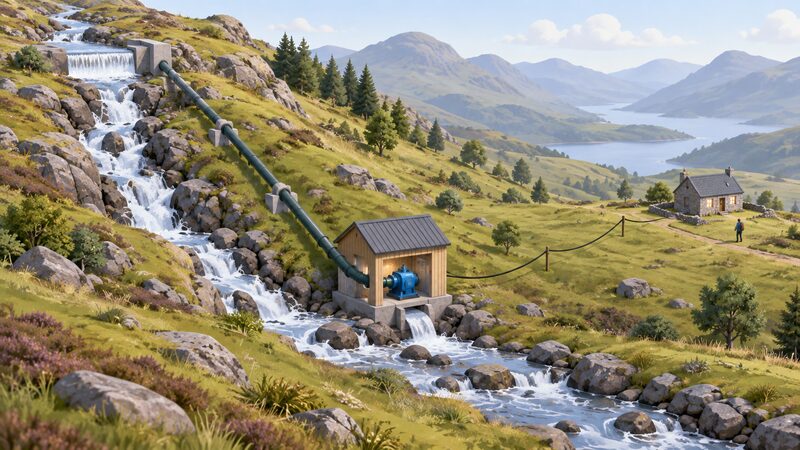
Micro hydro is the most dependable where a site allows it. Micro-hydro systems generate power from running water and are ideal for off-grid homes, offering long-term savings despite high initial costs11. The Planning Portal's guidance is more specific still: for houses with no mains connection but with access to a micro hydro site, a good hydro system can generate a steady, more reliable electricity supply than other renewable technologies at a lower cost2. The qualification is the site. Head and flow are fixed by geography, and a stream that looks promising may carry too little of either.
Micro wind is the most site-sensitive of the three. Stand alone wind turbine development is permitted only if the installation complies with Microgeneration Certification Scheme Planning Standards or equivalent standards12, and permitted development rights for wind turbines and air source heat pumps will only be accorded for equipment installed by an installer who has been certificated through the scheme using a certificated product12. Wind speed, turbulence and obstructions decide output far more than the machine does.
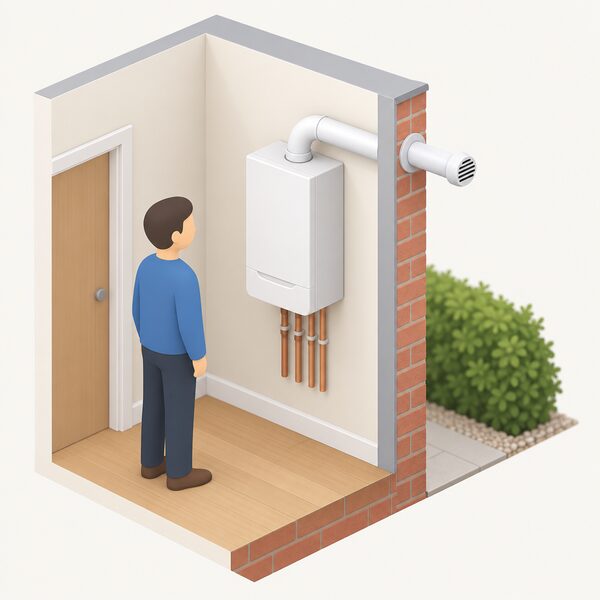
Micro CHP is the least site-dependent and the most fuel-dependent. It resembles a gas-fired boiler and produces electricity from mains gas or LPG4. It needs no stream, no mast and no exposed ridge, only a gas supply and a flue route. In exchange, it ties the household's electricity generation to its heating season and to a fossil fuel.
Micro CHP: heat first, electricity as a by-product
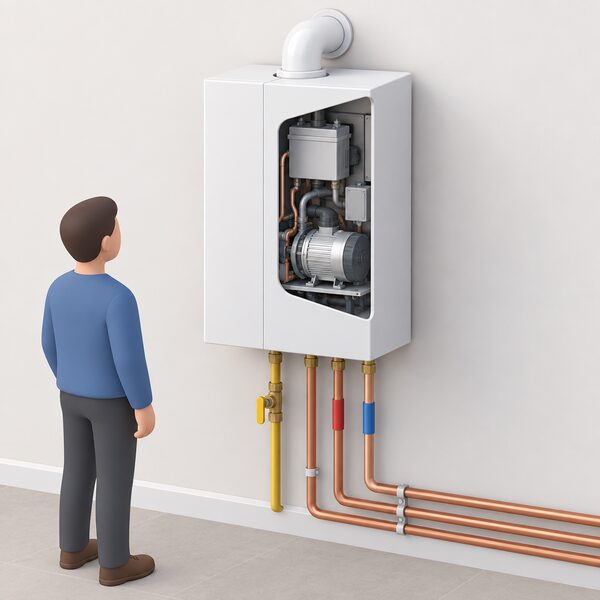
Micro CHP inverts the usual logic of generation. It is a heating appliance that happens to make electricity, not a power station that happens to make heat. A CHP unit is gas-fired, produces heat and hot water, and also generates electricity3. The electricity is a by-product of meeting a heat load, which means the unit's electrical output is governed by the household's demand for warmth and hot water.
The technology is not new. CHP systems have been in use for some time in Northern Ireland in large scale installations such as hospitals and leisure centres3. Domestic sized models are now available3. The Feed-in Tariff scheme defined micro-CHP as a technology that generates heat and electricity simultaneously, from the same energy source, normally natural gas13. The generating equipment is defined as the prime mover, generator, heat recovery equipment and associated pipework, valves and controls within the unit14.
That definition explains both the appeal and the servicing burden. A micro CHP unit contains a boiler plus a generator plus the machinery that connects them. The prime mover may be a gas engine, a small gas turbine or a fuel cell14. Each has different maintenance characteristics, and each adds components that a conventional boiler does not have.
For energy independence, the honest assessment is that micro CHP substitutes on-site generation for imported electricity while increasing reliance on imported gas. It is a partial measure. A household with a well-insulated home and a long heating season will run the unit for more hours and generate more electricity; a household with a short heating season or a heat pump will run it less. The technology rewards high, steady heat demand and penalises the opposite.
"A micro-CHP unit resembles a gas-fired boiler and produces electricity from mains gas or LPG."
Output in practice: up to 1 kW and a 6:1 heat-to-electricity ratio
The headline figure for domestic micro CHP is modest. A unit generates about 1kW of electricity while it is running3. That is roughly the draw of a kettle, a washing machine or a few domestic appliances at once, and it is produced only when the unit is firing for heat.
The consequence is that annual electrical output is a function of running hours, not of rated capacity. A unit meeting a steady winter heat load may run for many hours a day; a unit in a well-insulated home in a mild spring may barely run at all. The heat-to-electricity ratio implied by the technology's design is heavily weighted towards heat, which is why micro CHP is described as heat first: a system that generates heat and electricity from a single source where, usually, electricity is a by-product6.
For a household, the practical implication is that micro CHP is not a route to off-grid electricity. It is a route to reducing imported electricity during the heating season, offset by gas consumption. The electricity generated is consumed on site or exported, and the heat is used in the normal way. A home that already has a heat pump, or that heats with oil or solid fuel, has no gas supply for the unit to use.
| Measure | Figure | Source |
|---|---|---|
| Electrical output while running | about 1kW | 3 |
| Fuel | mains gas or LPG | 4 |
| SEG capacity limit for micro-CHP | up to 50kW | 6 |
| Microgeneration heat limit | up to 45kW | 7 |
Fuels and siting: gas, LPG and where a flue can go
Micro CHP's fuel requirement is the constraint that decides most installations. A CHP unit is gas-fired3, and it produces electricity from mains gas or LPG4. For homes on the mains gas grid, that is straightforward. For off-gas grid households, the position is harder: they use a range of other fuels to heat their homes including heating oil, liquefied petroleum gas (LPG), solid fuels, mains electricity, and microgeneration1, but there is limited opportunity for such consumers to switch fuel source1. LPG is the practical option for a micro CHP unit off the gas grid, and it means stored fuel on site.
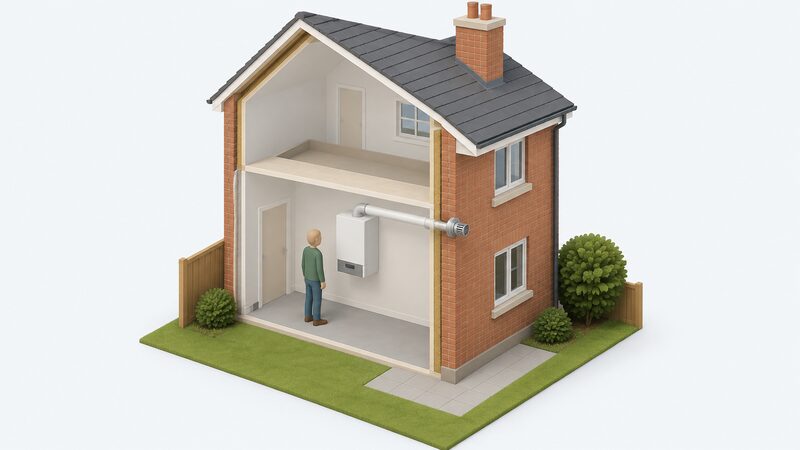
Siting turns on the flue. Planning permission is not normally needed when installing a micro-combined heat and power system in a house if the work is all internal15. Flues on the rear or side elevation of the building are allowed to a maximum of one metre above the highest part of the roof15. If the project also requires an outside building to store fuel or related equipment, the same rules apply to that building as to other extensions and garden outbuildings15.
Where the building is listed or in a designated area, the position changes. Even where permitted development rights apply, it is advisable to check with the local planning authority before a flue is fitted, and consent is likely to be needed for internal alterations15. The legislation is explicit: permitted development for a microgeneration CHP flue does not apply where the flue would be installed on a listed building, within the curtilage of a listed building, or on a site designated as a scheduled monument16. In a conservation area or World Heritage Site, a flue on the principal elevation of the dwellinghouse is restricted17.
Cost, installation and servicing compared with a boiler
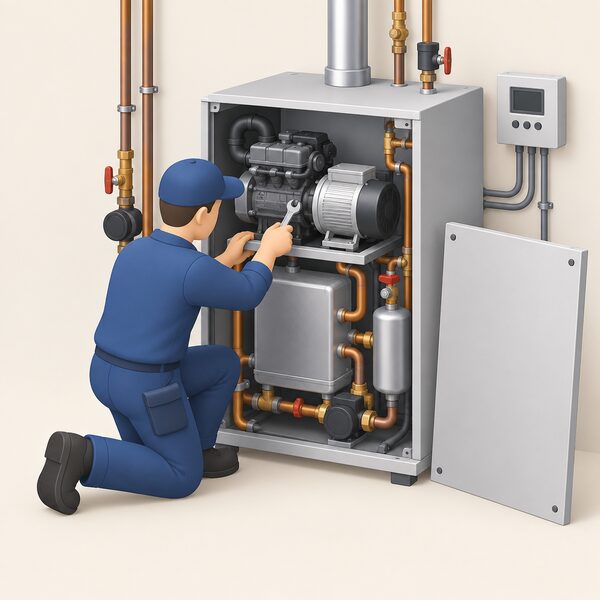
Published prices for domestic micro CHP are not available in the same way as for heat pumps, and any figure a household receives will be installer-quoted. What can be stated is the shape of the cost: a micro CHP unit contains a boiler plus generation machinery, so it carries more capital and more servicing than a condensing boiler of equivalent heat output.
The comparison with a boiler is the one households actually make. A micro CHP unit produces heat and hot water and also generates electricity18, so it replaces the boiler rather than adding to it. The additional components, the prime mover, generator, heat recovery equipment and associated pipework, valves and controls14, are what a service visit has to cover. No published servicing price is available, and a household should expect the figure to be quoted by the installer.
Grant funding sits elsewhere. The Boiler Upgrade Scheme offers £9,000 off the cost and installation of air-to-water or ground source heat pumps in eligible off-gas grid properties, available until 31 March 202719. That is a heat pump grant, not a micro CHP grant, and it illustrates where current public support is directed. Scheme statistics for the Boiler Upgrade Scheme draw on the Ofgem and Microgeneration Certification Scheme installation databases20.
For scheme eligibility on low carbon heating, installations must use an MCS approved product, fitted by an MCS certified installer, to the relevant MCS installation standard, except high heat retention storage heaters covered by PAS 203021. MCS is the leading quality assurance organisation for microgeneration, meaning small scale renewable technologies of 50kW or smaller21. Micro-renewable heat technologies are defined up to 45kW22.
Selling surplus electricity under the Smart Export Guarantee
The Smart Export Guarantee is the route by which a micro CHP, wind or hydro installation can be paid for what it exports. It is designed to ensure small-scale generators are paid for the renewable electricity they export to the national grid8. The eligible technologies are solar photovoltaic, wind, micro combined heat and power, hydro and anaerobic digestion6, and the capacity limit is up to 50kW for micro-CHP6.
The scheme was introduced on 1 January 2020 for eligible small generators23. It requires licensed electricity suppliers to offer export tariffs to anaerobic digestion, hydro, onshore wind and other technologies up to 5MW24. Payment rates are set by individual suppliers rather than by the scheme, so the value of an export depends on which supplier a household signs with.
Take-up has been uneven across technologies. In the scheme's third year there were 30 installations for other technology types, 23 micro-combined heat and power and seven wind25. That is a small base, and it reflects how few micro CHP and wind installations are commissioned relative to solar. For a household, the practical point is that export payments are a modest supplement, not a route to independence. The electricity still flows through a metered connection to a licensed supplier.
The wider grid context is worth stating plainly. It is estimated that about 42% of the UK power grid comes from renewable sources, with wind being the biggest contributor26. Low carbon sources made up 65.9% of electricity generation by Major Power Producers in the three months from September to November 2025, up 5.5 percentage points on the same period a year earlier, while fossil fuels accounted for 33.4%27. The phase out of coal from UK electricity generation and the ongoing expansion of the second largest national offshore wind capacity have reshaped the supply a household is connected to28. A home generating on site is displacing a grid that is already decarbonising, which changes the emissions case for microgeneration without changing the independence case.
How much micro CHP actually contributes to UK generation
The contribution of micro CHP to national generation is very small, and the Feed-in Tariff statistics show why. In Scheme Year 14, the 0-50kW microgeneration band accounted for 862,944 installations, 99.21% of the total, and 3,489.9 MW, 53.78% of installed capacity8. In Scheme Year 13 the equivalent figures were 3,490.21 MW and 53.82% of installed capacity, with 863,166 installations13. Micro scale installations make up over 99.21% of installations but only 53.82% of installed capacity, while installations over 50kW make up less than 1% of installations yet account for 46.18% of installed capacity13.
Those figures cover the whole Feed-in Tariff scheme, dominated by solar. Within them, micro CHP is a rounding error. The scheme's own annual report for Year 3 recorded 23 micro-CHP installations against seven wind installations in the "other technology types" category25. The technology has never reached the volumes its advocates expected.
The reason is structural rather than technical. Micro CHP's electrical output is tied to heat demand, and the UK's heating stock has been shifting towards heat pumps, which the Boiler Upgrade Scheme supports with £9,000 off air-to-water or ground source heat pumps in eligible off-gas grid properties until 31 March 202719. A technology that generates electricity as a by-product of gas heating competes poorly against one that replaces the gas entirely.
For a household, the national picture is a caution rather than a prohibition. A micro CHP unit will generate electricity and reduce imports. It will not generate much, and it will not generate in summer. The Feed-in Tariff scheme's own definition, a technology that generates heat and electricity simultaneously from the same energy source, normally natural gas13, describes a fossil fuel appliance with a generation side-effect.
Small wind and hydro: standards and guidance to check before you buy
Both micro wind and micro hydro carry certification and planning requirements that decide whether an installation is lawful and whether it can be connected. For wind, development is permitted only if the stand alone wind turbine installation complies with Microgeneration Certification Scheme Planning Standards or equivalent standards12. Permitted development rights for wind turbines and air source heat pumps will only be accorded for equipment installed by an installer who has been certificated through the scheme using a certificated product12.
For hydro, the planning position is set out by the Planning Portal, which notes that micro-hydro systems generate power from running water and are ideal for off-grid homes, offering long-term savings despite high initial costs11. The Scottish Government's microgeneration planning advice describes a micro-CHP unit as resembling a gas-fired boiler and producing electricity from mains gas or LPG4, and the same body of guidance covers the other technologies. Updated householder permitted development guidance was published on 1 April 2021, replacing the 2009 and 2010 domestic microgeneration planning circulars29.
The statutory definition of microgeneration in Northern Ireland covers biomass, biofuels, fuel cells, photovoltaics, water including waves and tides, wind, solar power, geothermal sources, combined heat and power systems and other sources of energy or technologies for the production of electricity or heat30. In relation to the production of heat, the limit is 45 kilowatts thermal29, and microgeneration refers to micro-renewable technologies used for zero or low carbon generation of heat up to 45kW31.
Northern Ireland has taken a different view of which technologies are worth supporting. The Northern Ireland Sustainable Energy Programme states that solar PV, micro CHP, micro hydro and micro wind are not considered as cost effective at this time32. That is a funding judgement rather than a prohibition, but it signals how these technologies have been assessed in one part of the UK.

Where these technologies fall short of true energy independence
None of the three delivers independence on its own, and the reasons differ by technology.
Micro CHP keeps the household on gas. It produces electricity from mains gas or LPG4, so the fuel supply, the supplier relationship and the price exposure all remain. It generates about 1kW while running3, which is a fraction of a typical home's demand, and it generates nothing when the heating is off. A household with micro CHP has reduced its electricity imports and increased its gas dependence.
Micro wind and micro hydro can island a property, but only with storage and only where the resource is reliable. Micro hydro is the better of the two for continuous supply: a good hydro system can generate a steady, more reliable electricity supply than other renewable technologies at a lower cost2. Micro wind is intermittent and site-sensitive, and its permitted development route depends on MCS certification of both product and installer12.
The grid remains the backstop for most installations. The Smart Export Guarantee pays for exported electricity8, which presupposes a connection. A household exporting under the SEG is trading with a licensed supplier, not operating independently of one. The wider picture is one of partial independence: renewables have cut the UK's dependence on foreign fuels for electricity generation from 65% in 2014 to under 50% today9, and only around 2.5% of households use renewable technology to generate their own electricity10.
The honest summary is that these technologies shift the balance of a household's energy supply rather than removing its dependence. Micro hydro comes closest to genuine self-supply where the site allows it. Micro wind contributes when the site is exposed and the load is matched to storage. Micro CHP reduces electricity imports during the heating season at the cost of continued gas dependence. A household weighing them should start from the resource it actually has, the fuel it can actually store, and the connection it intends to keep.
Sources32 cited
- Constituency data: energy efficiency and fuel poverty, House of Commons Library
- Hydro electricity, Planning Portal
- Micro combined heat and power, nidirect
- Microgeneration planning advice, Scottish Government, 4 March 2013
- Smart Export Guarantee, Ofgem
- Smart Export Guarantee guidance for generators, Ofgem
- Energy incentives and schemes, South Cambridgeshire District Council
- Feed-in Tariffs annual report, Scheme Year 14, Ofgem, December 2024
- Written evidence on small-scale low carbon generation, UK Parliament
- Microgeneration, Hansard, 13 July 2004
- Sustainable home energy solutions, Planning Portal, 2 September 2024
- Planning permission for wind turbines, Welsh Government, 12 December 2019
- Feed-in Tariffs annual report, Scheme Year 13, Ofgem, December 2023
- Feed-in Tariffs consultation on replacement generating equipment: decision, Ofgem, 13 December 2021
- Micro combined heat and power: planning permission, Planning Portal
- The Town and Country Planning (General Permitted Development) (England) Order 2015, Class O, legislation.gov.uk
- The Town and Country Planning (General Permitted Development) Order 1995, Classes 6C and 6F, legislation.gov.uk
- VAT energy saving materials and grant funded heating supplies, HM Revenue and Customs
- Boiler Upgrade Scheme, Ofgem
- Boiler Upgrade Scheme statistics, July 2026, Department for Energy Security and Net Zero, 27 August 2026
- Warm Homes: Social Housing Fund wave 3 scheme guidance addendum, Department for Energy Security and Net Zero, May 2026
- Heat in Buildings quality assurance statement, Scottish Government
- Renewable energy good practice guidance, Local Government Association
- Electricity prices in Great Britain, House of Lords Library
- Smart Export Guarantee annual report 2022-23, Ofgem, September 2023
- Home energy efficiency key terms explained, Development Bank of Wales, 17 October 2024
- Energy trends and prices statistical release, Department for Energy Security and Net Zero, 29 January 2026
- Progress in reducing emissions: 2025 report to Parliament, Climate Change Committee, 25 June 2025
- Householder permitted development rights guidance, Scottish Government, 1 April 2021
- Microgeneration (Northern Ireland) Regulations 2015, legislation.gov.uk
- Consultation on Scottish skills requirements for energy efficiency and microgeneration, Scottish Government, 5 February 2021
- Northern Ireland Sustainable Energy Programme framework document, Utility Regulator, September 2009
 The Full Wind, Hydro and Micro-CHP GuideCould a small wind turbine or water wheel work at your home, and what about boilers that make their own electricity?
 Micro Hydro Power for HomesA stream on your land that flows all year can make steady electricity, day and night, even when there is no sun or wind.
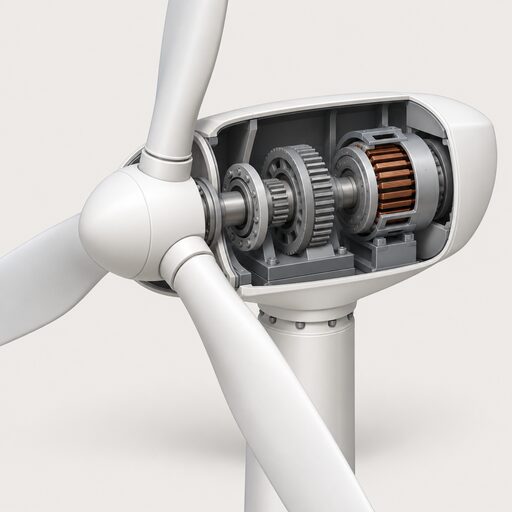 Domestic Wind TurbinesCan a wind turbine really power a home, and is your site windy enough?
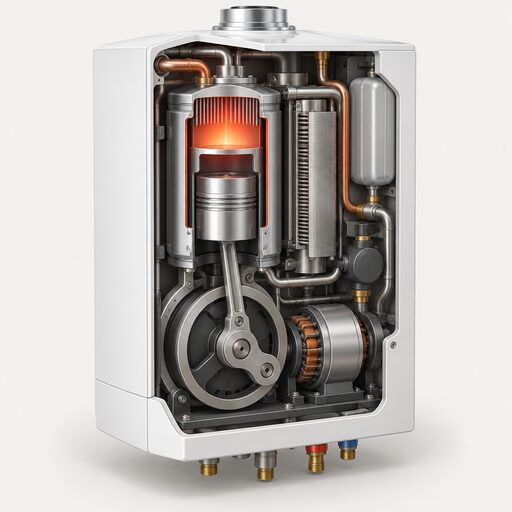 Micro-CHP TypesWhich type of micro-CHP actually gets fitted in UK homes, and how much electricity does one make while it heats your house?
 Off-Grid Wind PowerHow much power can a small wind turbine actually make for a house, boat or caravan that is not on the grid?
 G98 and G99 Grid ConnectionConnecting a wind turbine, hydro turbine or micro-CHP unit at home raises the question of whether it needs G98 or G99.