
In this guide
Flogas is a bulk LPG, cylinder and metered estate gas supplier serving homes and businesses in off-grid areas of the UK, where mains gas is not an option1. It has supplied bulk LPG to off-grid UK homes and businesses for over 35 years, and describes itself as having more LPG depots in the UK than any other supplier1. For a household with no mains connection, Flogas is one of the small number of companies that can put a tank in the garden and keep it filled.
The commercial shape matters more than the brand. Bulk LPG is not sold on a published tariff: Flogas offers a bespoke quote for a bulk tank price rather than a rate card, and cylinder prices are the only ones listed openly, in an online shop3. The tank itself normally remains the property of Flogas, while the household is responsible for keeping the tank and its surroundings safe and compliant with the Code of Practices governing the installation4.
That split defines the relationship. A Flogas household gains a fuel supply independent of the mains gas network, but remains dependent on a single supplier for deliveries, on a tanker fleet reaching a rural address, on a gauge reading being submitted, and on a company that owns the tank on the property. The sections below set out what is supplied, how pricing and ordering work, what the safety duties are, and what the sustainability claims cover.
What Flogas supplies: bulk tanks, cylinders and metered estates
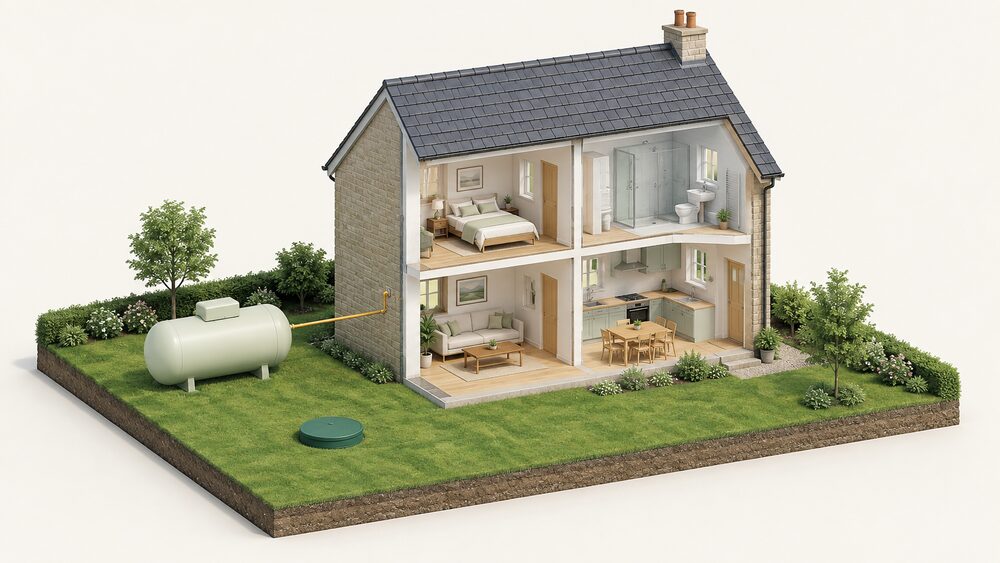
Flogas covers three domestic supply routes: metered estates, LPG cylinders, and bulk supply9. The bulk route is the one most off-grid houses use. Tanks can be installed as a single tank or as a larger tank array serving anything from the smallest home to large country estates and large industrial processing, and Flogas states it can manage all aspects of the installation10. A site visit is offered to assess whether the solution will work at a given property1.
Cylinders serve homes and premises where a tank is impractical. Flogas supplies four 47kg gas bottles in a storage unit for home heating, with automatic changeover valves so the supply continues when one bottle empties2. Smaller cylinders are aimed at gas powered stoves, portable heaters and barbeques2. Exchange categories include 47kg, 19kg, 18kg FLT and 11kg FLT propane, 11kg and 6kg Leisure Gas, and 10kg and 5kg Gaslight11.
Metered estates are the third route: a communal tank or series of tanks serving a group of properties, with individual metering. Identifying which of the three applies is the first practical question on moving in. Flogas advises checking for a Flogas sticker on the tank; if there is no sticker, note the tank serial number from the silver plate and contact the company13. An underground tank is marked by a green lid somewhere on the property13.
| Supply route | What it is | Typical use |
|---|---|---|
| Bulk tank | Single tank or tank array, owned by Flogas4 | Off-grid homes, estates, industrial sites10 |
| Cylinders | 47kg bottles in a storage unit with changeover valves2 | Home heating without a tank2 |
| Metered estate | Communal tank or series of tanks13 | Groups of properties on one installation13 |

Bulk LPG pricing: bespoke quotes and no published rate
There is no published bulk LPG price. Flogas directs anyone wanting a bulk tank price to a bespoke quote, and the only prices listed openly are for butane, propane and Gaslight bottles in the online shop3. That is the central commercial fact about the product: a household cannot compare bulk LPG the way it compares a mains gas tariff, because there is no unit rate on a page to compare.
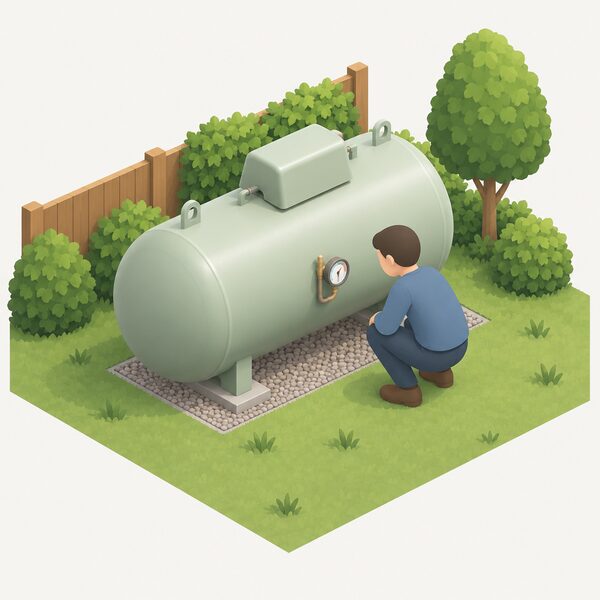
What a household can control is when it orders and how it pays. Flogas offers two ordering modes: Auto-ordering, where its systems calculate usage and plan orders, and Manual ordering, where the customer monitors the tank and places orders on demand10. Manual ordering customers are advised to reorder at a 40% gauge reading6. Bulk customers only need to call if the tank falls below 5% remaining14. Deliveries take up to 7 working days11.
The gauge itself is a fixed reference point. A tank is normally filled to 85%, not to the top, to allow for expansion and contraction of the gas in different weather6. That means the usable range between a 40% reorder point and an 85% fill is narrower than the tank's nominal capacity suggests, and it is the reason ordering discipline matters in cold spells.
Flogas also states that it may not deliver on a request if the reading provided and the usage history suggest the tank does not yet need filling, and that it will deliver when the tank requires it14. Delivery dates and notifications can be requested by email or SMS through My Account14. Spreading payments is a matter for the account arrangement rather than a published tariff, since no bulk rate is published to spread.
Tanks, depots and supply infrastructure
Flogas describes a national network of depots across England, Wales and Scotland, and states it can deliver wherever a customer is1. It claims more LPG depots in the UK than any other supplier, and says its gas bottle delivery service covers the majority of Britain with the largest network of Flogas owned depots and third-party stockists of any LPG supplier2. It also reports more employed tanker drivers and significant investment in the LPG supply chain10.
The depot footprint is the practical measure of resilience for an off-grid household. Two named sites illustrate the spread: Ridham Dock in Sittingbourne, Kent, and Bluebridge Industrial Estate in Halstead, Essex, with a further site at Barton Industrial Estate in Bedfordshire15. A household's delivery reliability depends on which depot serves its postcode and how far a tanker has to travel, not on the national total.
Flogas also states that it has been supplying LPG to customers across the UK for over 35 years, with hundreds of stockists, and separately describes 40 years supplying Britain's off-grid homes with LPG2. The two figures appear on different pages and are not reconciled. On composition, Flogas states that 34% of LPG comes from oil refining3, which is the point at which the fuel's price exposure to crude markets enters the household's bill.
The wider context is that off-grid homes are a distinct and often overlooked segment. The Energy Utilities Alliance describes them as out of sight and out of mind, and the parliamentary library briefing on the off-grid market records that it is regulated by the Office of Fair Trading, enforcing consumer protection and competition law16. That is a different regulatory regime from the mains gas market, and it is why bulk LPG contracts, tank ownership and delivery terms carry more weight than a tariff comparison would.
Switching to Flogas: tank takeover and oil-to-LPG conversion
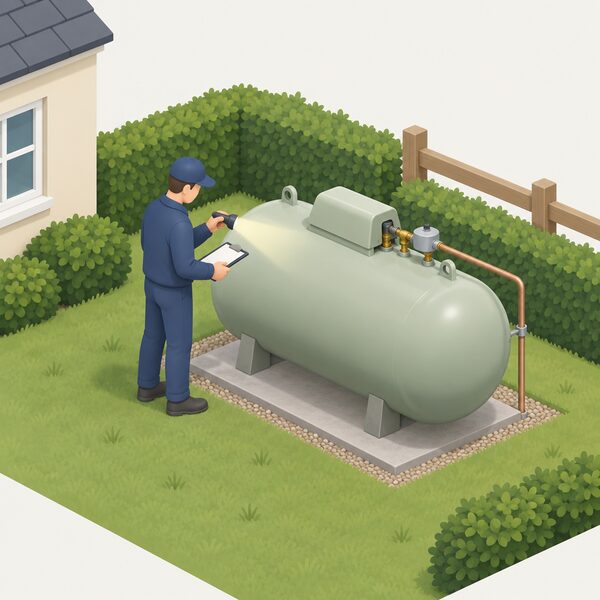
Switching to bulk LPG is not a matter of changing a direct debit. Where a tank already exists, Flogas states that as long as the existing tank passes a few simple safety checks, it will take over ownership from the existing supplier8. That is the tank takeover route, and it depends on the condition of hardware the household does not own.
Cylinder customers have a simpler path. Flogas accepts returns of over 70 different cylinder brands, so a bottle from another supplier can generally be exchanged rather than scrapped12. Exchange eligibility is set by category: 11kg and 6kg Leisure Gas, and 10kg and 5kg Gaslight12. Orders can be placed online or by calling the customer service team10.
For a household currently on heating oil, the switch means new infrastructure rather than a fuel swap: a tank installation, a site visit to confirm the solution works at the property, and management of the installation by Flogas1. Independent guidance on liquid fuel heating notes that a fuel tank should be inspected every year as part of the annual heating system service, and that a technician will advise on condition18. That annual inspection habit carries across to LPG storage.
Safety, maintenance and the household's responsibilities
The division of responsibility is set out in the Technical Manual issued when a customer joins. Flogas states that bulk domestic customers are responsible for ensuring the LPG tank and surroundings are kept safe and compliant with the Code of Practices governing the safety of the installation, and that full details of what is the customer's responsibility and what is Flogas's are in that manual5. Commercial customers are told which parts they are responsible for when they join5.
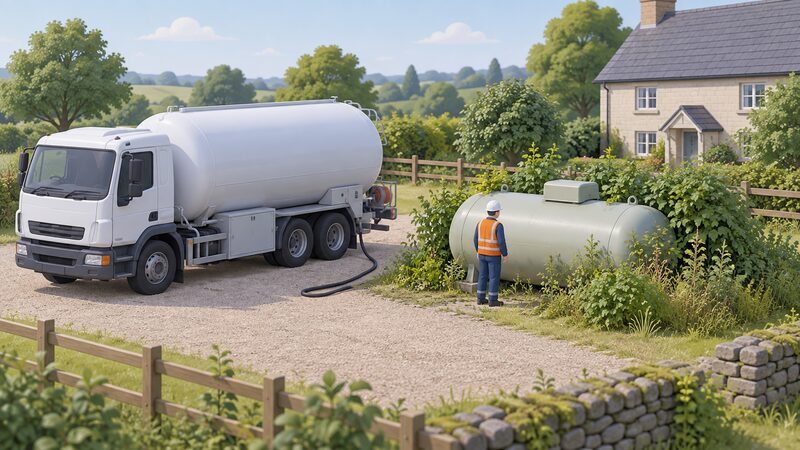
Inspection runs on two clocks. Drivers visually inspect the tank at each delivery and report back to the tank maintenance team, and Flogas engineers perform a statutory inspection every 10 years7. All tanks undergo a full test and re-qualification on their 10th anniversary, and a tank that does not meet the detailed periodic safety inspection criteria may be exchanged sooner4. Hazards the customer is expected to report include overgrown vegetation or hedges near the tank7.
Independent guidance on tank ownership sets out the legal framework: the Pressure Systems Safety Regulations and the Gas Safety (Installation and Use) Regulations, under which a supplier has a legal duty to make safe, with any rectification work at the customer's expense19. That is the sharpest limit in the arrangement. The tank belongs to the supplier, but the cost of putting right a problem on the customer's side of the boundary falls on the household.
Flogas runs a safety programme called SAFETY F1RST and publishes videos covering portable heater maintenance, commercial installation care, and screening and protection for domestic LPG tanks20. The 24-hour emergency team can be reached on 03457 200 1007. General enquiries use 0800 023 23 32, and the safety line is 0800 574 574; the two general numbers appear on different Flogas pages and the company has not reconciled them8.
Flooding is covered explicitly. If gas appliances are flooded, Flogas advises not using them and not turning on the gas supply; the same applies if a tank or bottles are submerged21. A qualified gas engineer should check appliances before use, and tanks and bottles should be checked regularly for rust, corrosion or cracks, with any damage reported immediately21. Independent electrical safety guidance adds that electrical appliances in a flooded area should not be switched on until tested and assessed as safe by a registered electrician22.
Sustainability: a 2040 renewable target and BioLPG
Flogas states that it endeavours to supply customers with 100% renewable energy solutions by 20408. The pathway it points to is renewable liquid gas. Industry body Liquid Gas UK states that renewable liquid gases offer up to 90% carbon emissions reductions and carry the same low nitrogen oxides, sulfur oxides and particulate profile as conventional LPG, and that bioLPG offers up to a 90% reduction in carbon emissions23. A feasibility study concluded that a full switch from fossil LPG to BioLPG by 2040 is feasible25.
Those are industry and feasibility findings, not a description of what is in a tank today. The distinction matters for a household weighing independence: a Flogas tank holds fossil LPG, and the renewable target is a commitment about the future of the fuel, not a property of current deliveries. The Energy Utilities Alliance lists renewable liquid fuels, blending and hybrids among the decarbonisation options for off-grid homes, all offering choice to the consumer16.
The wider policy backdrop is set by international commitments rather than by the LPG sector. The UK is obliged under the COP28 global goals to support tripling renewable capacity and doubling the annual rate of energy efficiency improvements by 2030, and the Global Stocktake sets the same objectives26. Government commitments also target more than 2 GW of carbon capture, usage and storage projects by 203028. None of these directly determines what a rural LPG household burns, but they frame the direction of travel for off-grid heat.
Customer service and what Flogas supply means day to day
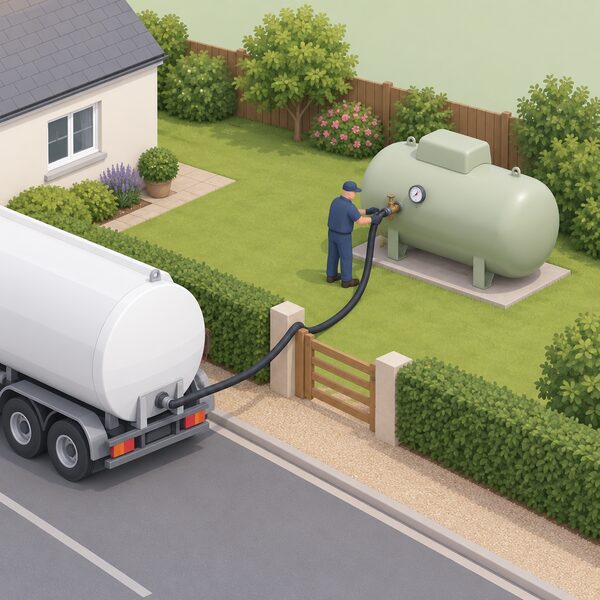
Flogas states it has been supplying customers for over 35 years with continuous and reliable service, and that it offers unrivalled delivery to all customers in Great Britain9. Customer service is available 24/7, and the company says it is ready to help in any weather situation21. Delivery notifications can be set by email or SMS through My Account14.
Day to day, the arrangement asks three things of a household: keep the gauge reading updated in My Account, order at the right point, and keep the tank and its surroundings clear and safe. Flogas states that manual ordering customers, and Auto-ordering customers without telemetry, should keep My Account updated with regular tank readings6. The 40% reorder point and the 5% emergency threshold are the two numbers that govern whether a home runs out6.
Where a complaint arises, the route is the supplier first. Ofgem monitors energy suppliers and network operators to make sure they meet the rules set out in licences, regulations and law, provide good customer service, and reply quickly to customers who contact them17. Ofgem also publishes guidance for households on complaining about an energy supplier17. For work carried out in the home, TrustMark is a government-endorsed quality scheme providing assurance, certainty and protection to consumers29, and trade bodies state that product suppliers should supply products meeting all required standards and support installers and customers in supply and after-sales service26.
The independence picture is straightforward. A Flogas bulk tank removes a household from the mains gas network and from a gas supplier's tariff, and replaces it with a fuel delivered by road, a tank owned by the company, a gauge the household must read, and a contract that is quoted rather than published. The fuel itself remains a fossil product today, with a renewable target set for 2040. For households comparing off-grid options, LPG and heating oil suppliers sets out how contracts, tanks and deliveries differ, and Calor and AvantiGas cover two other bulk LPG routes.
Sources29 cited
- Bulk LPG, Flogas, 2026-09-20
- Gas bottles, Flogas, 2026-09-20
- LPG prices, Flogas, 2026-09-20
- What is a standing charge, Flogas, 2026-09-20
- What part of the equipment is my responsibility, Flogas, 2026-09-20
- How do I read my gauge, Flogas, 2026-09-20
- When do you carry out maintenance, Flogas, 2026-09-20
- New off-grid home, Flogas, 2026-09-20
- Switch LPG supplier, Flogas, 2026-09-20
- What delivery service do you offer, Flogas, 2026-09-20
- 37mbar propane regulator, Flogas, 2026-09-20
- 6kg Propane Gas Cylinder, Flogas, 2026-09-20
- I've just moved into a house, how do I know if you are the supplier, Flogas, 2026-09-20
- I was told I would receive a delivery but it's not turned up, Flogas, 2026-09-20
- Cylinder recall, Flogas, 2026-09-20
- Out of sight, out of mind: off gas grid homes, Energy Utilities Alliance, 2026-04-20
- Complain about your energy supplier, Ofgem, 2026
- Your home guide to liquid fuel heating, OFTEC, 2026-09-20
- Can I own my own bulk LPG tank, Liquid Gas UK, 2026-09-20
- Safety, Flogas, 2026-09-20
- What should I do if rain or flooding is forecasted in my area, Flogas, 2026-09-20
- Flood damage and electrical safety, Electrical Safety First, 2026-09-19
- What is LPG, Liquid Gas UK, 2026-09-20
- BioLPG, Liquid Gas UK, 2026-09-20
- Biomass strategy, Liquid Gas UK, 2026-09-20
- HHIC guidance, Heating and Hotwater Industry Council, 2026-09-17
- Scotland's carbon budgets, Climate Change Committee, 2025-05-21
- Cutting the bills: UK clean power, Ember, 2023-10-18
- Great British Insulation Scheme: homeowners and tenants, Ofgem, 2026-09-17