

In this guide
Calor is the best known LPG supplier in the UK, in a market with few suppliers overall1. It supplies homes that sit off the mains gas grid, which is a larger group than it sounds: 85% of UK homes are heated by gas, and the rest are not on that network2. For those households, LPG is the closest thing to mains gas, because it fuels the same appliances, including central heating boilers, gas fires, gas ranges, AGAs and cookers3.
What Calor sells comes in three shapes. Bulk LPG stored in a tank in the garden, cylinders for smaller or intermittent use, and metered estates, where a shared storage installation feeds individual meters at each property. Calor states it has over 85 years of experience and over 100,000 homes relying on it, running over 680 vehicles that drive over 43,000 miles a day4.
The independence question is the one that matters most here. LPG removes a household from the mains gas network, but it does not remove dependence on a supplier: the tank is refilled by Calor, the price is set by Calor, and the storage usually belongs to Calor. What it does change is the fuel itself, and BioLPG, a chemically identical renewable version, can be added into the supply chain with no need to change storage tanks or adjust appliances5.
Bulk LPG, cylinders and metered estates: what Calor supplies
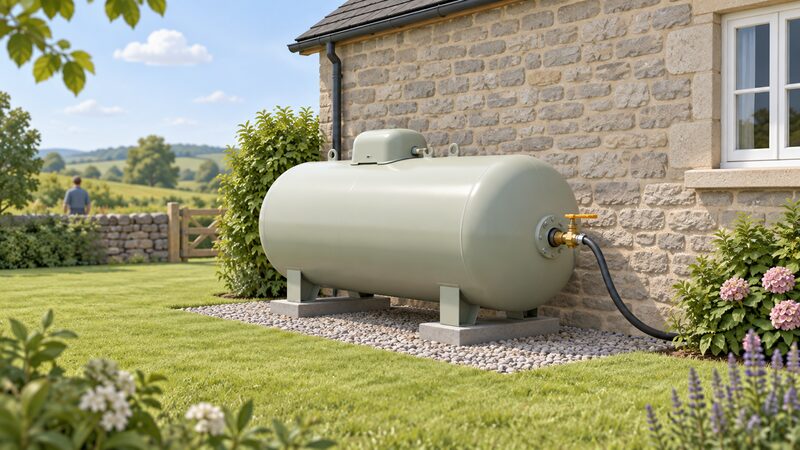
Bulk LPG is the option for a home that uses gas for central heating and hot water year round. The storage is a tank sited outside, filled by road tanker, and the household draws gas through pipework into the same kinds of appliance a mains gas home would have. LPG fuels central heating boilers, gas fires, gas ranges, AGAs and cookers, so a conversion does not mean replacing the kitchen or the heating system, only the fuel supply behind it3.
Cylinders suit homes with lower or seasonal demand, or where a tank cannot be sited. They are also the route for portable appliances: Calor sells a Rustic Brown Provence portable gas heater at £290.83 excluding VAT, with Klarna and PayPal offered as spread-the-cost payment options7. That is a retail purchase rather than a bulk supply account, and the two are priced and contracted separately.
Metered estates are the third model, and they work like a small private gas grid. Each property on the estate has its own meter and is billed individually by the LPG supplier for the amount of gas consumed8. That matters because it separates the estate's shared storage from the household's own bill: residents pay for what they use rather than splitting a communal charge.
| Supply type | Storage | Who it suits | Billing |
|---|---|---|---|
| Bulk LPG | Tank in the garden, filled by road tanker | Year-round central heating and hot water | Account with the supplier |
| Cylinders | Cylinders at the wall or for portable appliances | Lower or seasonal demand, awkward sites | Retail or account purchase |
| Metered estate | Shared installation, individual meter per property | Communities without a tank in each garden | Billed individually for gas consumed8 |
For a household weighing independence, the distinction between these three is really about who owns what. Bulk tank storage is normally supplied and maintained by the LPG company, cylinders are the household's to manage, and on a metered estate the infrastructure is shared. In all three cases the fuel comes from a single supplier relationship, and that relationship is the dependence that remains. The wider picture of how LPG and heating oil supply is contracted is covered in LPG and heating oil suppliers.
Delivery: auto-ordering or on demand, with a 14-day lead time
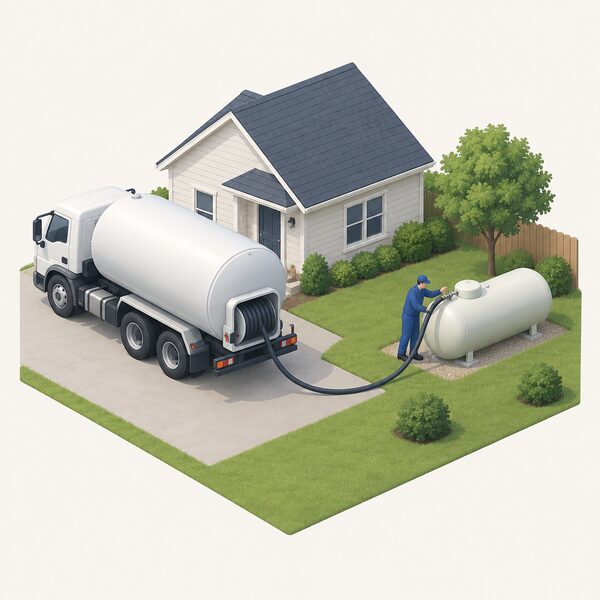
Calor's default arrangement for bulk LPG is automatic. Its auto-ordering technology is designed to let the supplier know when a delivery is next needed, so the household does not have to watch the tank level or place an order9. That is a genuine convenience for a fuel that cannot be bought at a moment's notice, and it is also the clearest expression of the supplier relationship: the refill decision sits with Calor's monitoring rather than with the household.
Where a household orders on demand instead, the first delivery is arranged by Calor once everything is installed and ready to go9. After that, deliveries run to the account's terms. The practical point for anyone moving in is that a tank reading or an order is not something the household has to initiate under auto-ordering, but it does need to know which arrangement applies to the property.
Consumer cancellation rights apply to services arranged at a distance. A service arranged online, over the phone or by mail order carries a 14 day cooling-off period10. Where an order covers several deliveries of the same items over a period of time, the cooling-off period starts the day after the first delivery11. That is a meaningful distinction for a fuel contract, because it means the clock does not necessarily run from the day the agreement is signed.
Safety: annual tank inspections and checks on every delivery
Calor states that its drivers carry out safety inspections at every delivery, so a bulk tank is looked at each time it is topped up4. That is a supplier-side check on the storage and the delivery, not a substitute for the household's own obligations on the appliances inside the house.
Those obligations are set by gas safety rules rather than by the supplier. A gas safety check must be done every year on each gas appliance and flue12, and gas appliances should be safety checked once a year13. In rented property the duty is explicit: all permanent and portable gas appliances and flues require an annual gas safety check12, carried out every 12 months by a Gas Safe registered engineer14. For homeowners, the position is that all gas appliances or flues are regularly maintained and a safety check is carried out annually, or at any other time if there is a safety doubt, by a Gas Safe registered installer15.
There is some flexibility on timing. An annual gas safety check can be carried out up to 2 months before the date it needs to be carried out while retaining the original deadline date14. That is useful for scheduling around a delivery or a service visit.
Northern Ireland has its own guidance on domestic gas installation and health and safety, which applies to households there rather than the GB framework16. For oil tanks, which some off-grid homes use instead of LPG, the guidance is different again: tanks, pipes and other equipment should be inspected for leaks, damage and interference once a month, with any problems fixed promptly17.
BioLPG: the renewable option alongside LPG
BioLPG is the part of the Calor offer that speaks most directly to energy independence, because it changes what the fuel is made from without changing anything in the house. Chemically BioLPG is identical to LPG, though it is created using a variety of biological feedstocks including waste streams5. Because it is chemically the same, it behaves the same in the appliance.
The environmental case is set out alongside the practical one. Just like LPG, BioLPG offers cleaner air with low NOx, SOx and particulate matter5. On compatibility, Liquid Gas UK states:
That is the significant claim: a household does not have to replace a tank or a boiler to take a renewable blend.
What this means in practice is that an LPG home is not locked into a fossil fuel in the way a mains gas home is. The storage, the pipework and the appliances all remain valid if the fuel blend changes. The limit is that BioLPG is a blend into an existing supply chain rather than a fuel a household can specify and receive on demand, and the proportion available at any time is not something a customer controls. The dependence on a supplier remains; what changes is the carbon content of what that supplier delivers.

Metered estates: a mini gas grid for communities
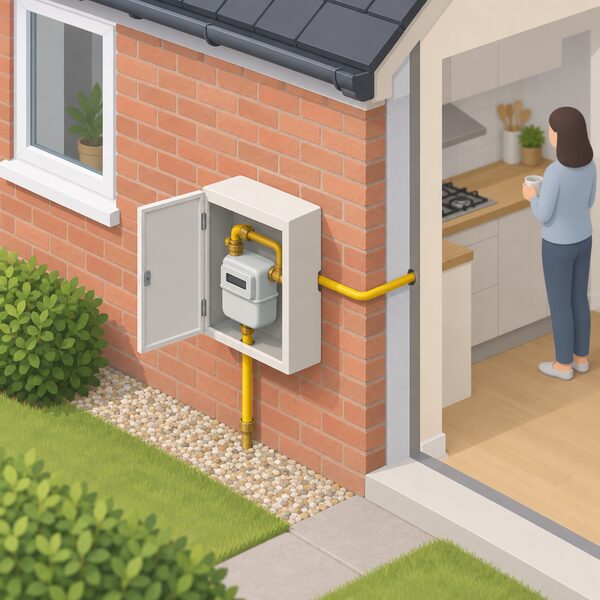
A metered estate is the closest thing LPG offers to a mains gas connection. The estate shares a storage installation, and each property on it has its own meter and is billed individually by the LPG supplier for the amount of gas consumed8. Residents get a gas supply without a tank in their own garden, and they pay for their own usage rather than a share of a communal bill.
Switching an estate to Calor follows a defined process:
- Email or call for a personalised home energy quote9.
- Calor's energy specialists advise on gas storage options and the location of the storage9.
- Calor's experts install the LPG storage and external pipework for the home energy supply9.
So the estate does not have to source and manage the infrastructure itself; the supplier does that side.
The planning position is worth knowing for anyone considering storage. A container used for domestic heating purposes for the storage of oil or liquid petroleum gas falls within permitted development under Class E18. That means a domestic LPG storage container does not normally need a householder planning application, though other consents can still apply depending on the site. General householder planning consent covers small extensions to a home, which is a different matter from fuel storage19.
For a community, the appeal is straightforward: a shared installation spreads the infrastructure cost and gives every home an individual meter and an individual bill. The dependence is also shared, in the sense that the estate's supply runs through one supplier relationship and one storage installation. If that relationship changes, every household on the estate is affected at once.
Moving in or out of a Calor-powered home
A Calor-supplied home comes with physical infrastructure and a supply arrangement, and both need attention at a move. The storage is the first thing to identify: a bulk tank in the garden or cylinders at the wall, and whether that storage is rented from the supplier or owned by the household. The account attached to the property is the second.
On the appliance side, building regulations apply when a household installs, replaces or alters the position of any type of gas, solid fuel and oil appliance, including boilers20. That means a new boiler or a relocated one needs notification, not just an installer's visit. There is also a room restriction that catches some LPG installations: a gas fire, gas space heater, or a gas water heater including a gas boiler of 14 kilowatts gross input or less, or any instantaneous water heater, is not allowed in a bedroom unless it is room sealed or has an atmosphere-sensing device21.
Where a home is on mains gas rather than LPG, moving a meter or increasing supply is handled through the network operator, and a service alteration is required to relocate a gas meter, increase supply, or move pipework for renovations22. That is the mains gas equivalent of the work an LPG home does through its supplier.
On support for heating costs, the Warm Home Discount regulations for England and Wales include a condition that a boiler or central heating system fuelled wholly or partly by mains gas must replace an existing mains gas system, alongside a resident aged 65 or over, under compulsory school age, or with significant health problems or a disability23. That condition is framed around mains gas, which is a reminder that off-grid households sit outside some of the standard support routes. The broader question of who supplies a home and how accounts transfer is covered in Moving home: setting up and closing energy accounts.
Cost, quotes and price locking

Calor does not publish a list price for bulk LPG or for a delivered cylinder refill. The figures that exist are for retail products and for comparison purposes. The Rustic Brown Provence portable gas heater is listed at £290.83 excluding VAT7, which is a shop purchase rather than a supply contract.
For context on what gas costs when it comes through a pipe rather than a tank, the price-capped gas rate is £0.0604/kWh, which works out at £769 a year from a 92% efficient gas boiler or £823 a year from an 85% efficient one24. That is mains gas, not LPG, and LPG is not covered by the price cap, so it is a reference point rather than a comparison a household can apply directly.
VAT treatment matters for off-grid fuels. Heating equipment and connection of gas supply attract a 5% rate where they are grant-funded for people aged over 60 or in receipt of certain benefits, and that reduced rate covers gas-fired boilers, gas room heaters with thermostatic controls, radiators, and the installation, repair and maintenance of a boiler, radiators, pipework and controls forming a central heating system25. Outside those conditions the standard rate applies.
Grant funding for off-grid and low carbon heating runs through local authorities. The Warm Homes: Local Grant funds energy-saving home installations to reduce energy bills, lower carbon emissions and improve home heating, administered by local authorities26. The Warm Homes: Social Housing Fund requires installation of a low carbon heating measure in each home, with energy efficiency measures such as solar PV or insulation also expected so that bills do not go up28. For non-social homes, the fund is available for insulation, associated ventilation, and communal low carbon heating, with additional measures on an exceptional basis with justification28. Approved Document L sets a minimum efficiency of 70% net for gas-fired independent space heating appliances in existing dwellings, for primary and secondary space heating29.
On price locking specifically, no published Calor terms are available in the material here, so the position is that bulk LPG pricing is agreed with the supplier and confirmed in the account terms rather than published. Where a household is comparing fuels, the honest position is that LPG prices are supplier-set and quoted, and the mains gas price cap does not apply to them.
Sources29 cited
- Heating fuel guide, Uswitch, 2026-01-27
- Domestic retrofit, UKGBC, 2024-08-15
- New to LPG, Liquid Gas UK, 2026-09-20
- My options, Calor, 2026-09-20
- BioLPG, Liquid Gas UK, 2026-09-20
- LPG boiler installation, Calor, 2026-09-20
- Calor Gas Provence portable gas heater, Calor, 2026-09-20
- Metered estates: what are my supply options, Liquid Gas UK, 2026-09-20
- Switching to LPG process, Calor, 2026-09-20
- Cancelling a service you've arranged, Citizens Advice, 2026-09-17
- Cancelling building or decorating work, Citizens Advice, 2026-09-17
- Safety checks: what you need to know, Health and Safety Executive, 2026
- Gas Safety Week, Cadent Gas, 2026-09-20
- Gas safety FAQs, Health and Safety Executive, 2026
- Domestic gas installation and health and safety, nidirect, 2025-10-28
- Check your oil tank, nidirect, 2026-09-17
- Boilers and heating, Planning Portal, 2026
- Class E: buildings incidental to the enjoyment of a dwellinghouse, legislation.gov.uk, 2026-09-17
- Householder planning consent, Planning Portal, 2026-09-17
- Gas safety advice, Cadent Gas, 2026-09-20
- Service alterations, Cadent Gas, 2026-09-20
- Warm Home Discount (England and Wales) Regulations 2026, legislation.gov.uk, 2026-03-27
- Heat pumps vs boilers, Which?, 2025-09-22
- VAT rates on different goods and services, GOV.UK, 2026-07-10
- Warm Homes: Local Grant successful local authorities, GOV.UK, 2025-03-11
- Energy saving grants: Portsmouth, Warmer Homes, 2026-09-20
- Energy saving grants: East Hampshire, Warmer Homes, 2026-09-20
- Warm Homes: Social Housing Fund wave 3 scheme guidance addendum, Department for Energy Security and Net Zero, 2026-06
- Approved Document L: conservation of fuel and power, Volume 1: dwellings, Department for Levelling Up, Housing and Communities, 2026-09-17