In this guide
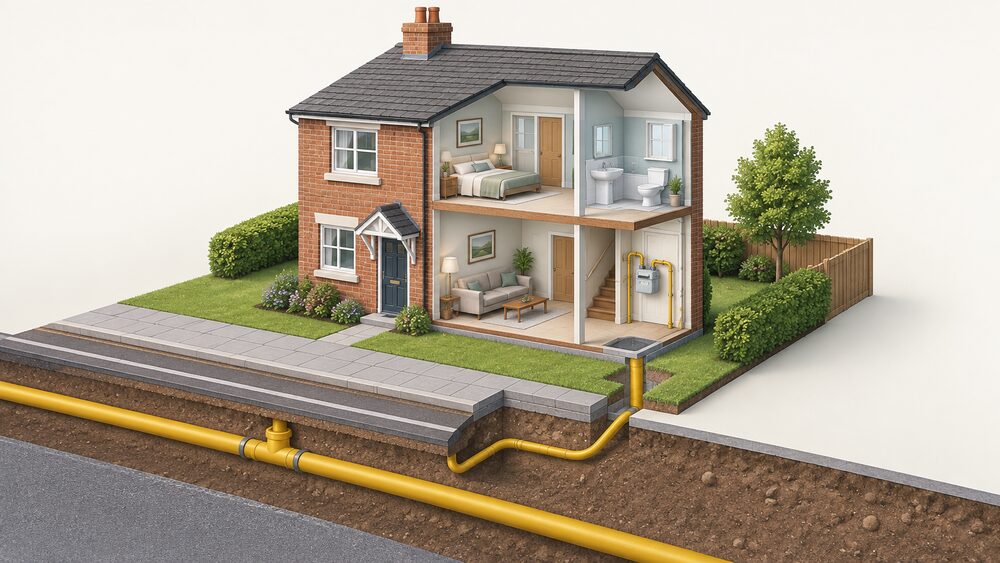
The gas that reaches a home in Great Britain travels through two distinct systems. The high pressure pipelines that move gas from terminals and ports around the country are the National Transmission System, owned and operated by National Grid Gas1. Everything downstream of that, the medium and low pressure mains that run under streets and into individual properties, belongs to the gas distribution networks. Those networks carry gas at lower pressures and speeds to individual households2.
There are eight gas distribution network operators in Great Britain, owned by four ownership groups: Cadent Gas Ltd, Northern Gas Networks Limited, SGN, and Wales & West Utilities Limited1. The four Gas Distribution Networks themselves are Cadent, Northern Gas Networks, SGN and Wales and West Utilities3. They own and operate the networks of medium and low pressure pipelines that receive gas from the National Transmission System3.
The practical consequence for a household is a split in responsibility. The network operator owns the pipes, maintains them, responds to emergencies on them and is regulated by Ofgem under the Gas Act 19863. The company that sends the bill is a supplier, and it is a different and separate company from the network operator4. Gas reaches some 85% of dwellings in England, so for most homes the network is the default, not a choice5.
What a gas distribution network is, and what it does
A gas distribution network is the local half of the gas grid. The grid as a whole is a network of gas pipelines across Great Britain, and it splits into a transmission layer and a distribution layer2. The transmission layer is the National Transmission System, a system formed of high pressure gas pipelines that transport gas from terminals and ports, owned and operated by National Grid Gas3. The distribution layer takes that gas and delivers it at lower pressure to homes, businesses and other connected premises.
The Gas Act 1986 requires all Gas Transporters, including Gas Distribution Networks, to carry a relevant gas transporter licence imposing certain regulatory and financial conditions3. That licensing requirement is what makes a GDN a regulated monopoly rather than an ordinary utility business. A household cannot choose which pipes run down its street, and the network operator cannot refuse to serve a property in its area on commercial grounds in the way a retailer might.
What the network does, in practice, is four things. It owns and maintains the pipes. It manages the pressure and flow so that gas arrives at appliances at a usable rate. It responds to escapes, interruptions and emergencies on its own infrastructure. And it plans and funds replacement and reinforcement of ageing mains, subject to the price control that Ofgem sets.
What it does not do is sell gas, bill a household, or set the unit rate. Those sit with the supplier. The network's costs reach a household indirectly, through the standing charge and unit rate the supplier applies, which is why regional network costs show up as regional differences in standing charges rather than as a separate line item from the network operator.
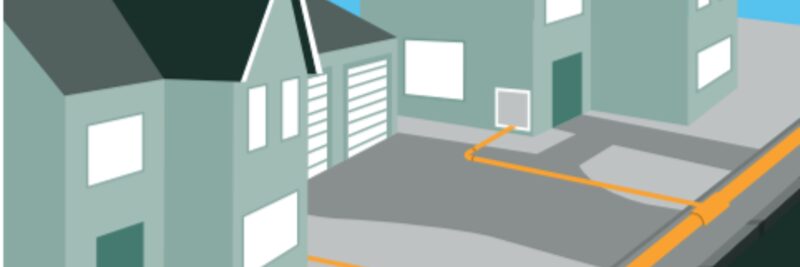
The four GDNs: Cadent, Northern Gas Networks, SGN and Wales & West
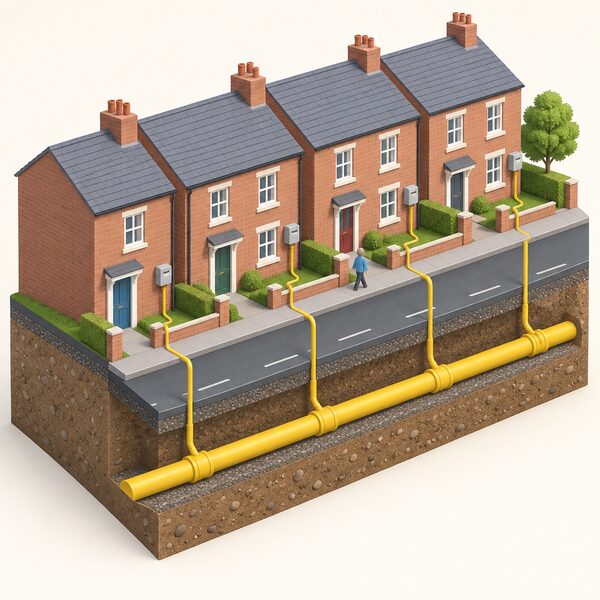
The four Gas Distribution Networks are Cadent, Northern Gas Networks, SGN and Wales and West Utilities3. They are the operating companies behind the eight licensed gas distribution network operators, which are owned by four ownership groups: Cadent Gas Ltd, Northern Gas Networks Limited, SGN, and Wales & West Utilities Limited1.
| Ownership group | Network operator | Typical area |
|---|---|---|
| Cadent Gas Ltd | Cadent | East of England and other regions1 |
| Northern Gas Networks Limited | Northern Gas Networks | Northern England |
| SGN | SGN | Scotland and southern England |
| Wales & West Utilities Limited | Wales & West Utilities | Wales and the South West |
The distinction between eight operators and four groups matters when a household is trying to work out who to contact. The name on the licence may be one of the eight operators, while the group that owns it is one of the four. For a supply problem, the relevant entity is whichever operator holds the licence for the pipes serving the property.
Each network has its own area page on this site: Cadent, Northern Gas Networks, SGN and Wales & West Utilities. A direct comparison of the two largest by coverage sits at SGN vs Cadent, and the postcode route to identifying a network is set out in how to find your gas and electricity network by postcode.
Who owns the networks, and why natural monopoly matters
The ownership structure is not a market. A gas distribution network is a natural monopoly: duplicating the pipes under a street to create competition would be wasteful and disruptive, so instead the network is regulated. The Gas Act 1986, its subordinate legislation and related statutory instruments, namely licences and industry codes, form a regime of economic regulation for Gas Transporters which Ofgem monitors and enforces3.
That regime has two consequences for a household. The first is that the network operator has an obligation to serve, backed by licence conditions, rather than a commercial choice about which streets are worth connecting. The second is that the money the network spends is recovered through regulated charges, not negotiated with each customer. Ofgem's principal objective is set out in the Electricity Act 1989 and Gas Act 1986, and its monitoring role covers both suppliers and network operators, checking that they meet the rules set out in licences, regulations and law, provide good customer service, and reply quickly to customers who contact them7.
Ownership of the networks has changed hands over the years, and the corporate parent of a network is a financial matter rather than something a household can act on. What a household can act on is the licence obligation: the network must maintain and operate its pipes to the standards set, and Ofgem can enforce against failure.
Licensing and regulation: the Gas Act 1986 and Ofgem's role

The Gas Act 1986 is the foundation. It requires all Gas Transporters, including Gas Distribution Networks, to carry a relevant gas transporter licence imposing certain regulatory and financial conditions3. Alongside the Act sit subordinate legislation, licences and industry codes, together forming the Gas Laws, a regime of economic regulation for Gas Transporters which Ofgem monitors and enforces3.
Ofgem's powers are not limited to gas networks. Its market monitoring legal basis includes section 34 of the Gas Act 1986 and section 47 of the Electricity Act 19899. Notices under section 23(2) of the Gas Act 1986 have been used to modify gas supply licence conditions, for example in the extension of the smart meter data privacy framework to remote access meters10. The Energy Price Guarantee domestic scheme was enforced by Ofgem through amendments to the Electricity Act 1989 and the Gas Act 198611.
The regulator's remit has widened. The Energy Act 2023 named Ofgem as the regulator for heat networks in England, Scotland and Wales, and from January 2026 Ofgem began regulating heat networks, with its formal role as regulator of heat networks beginning with the initial set of rules in place12. That matters to gas distribution because heat networks are an alternative to individual gas connections in some developments, and the same regulator now oversees both.
For a household, the practical effect of the licensing regime is that the network operator's obligations are enforceable, and complaints can escalate. Ofgem monitors suppliers and network operators to make sure they meet the rules set out in licences, regulations and law, provide good customer service, and reply quickly to customers who contact them8. Where a network operator falls short, the complaint route runs through the operator first and then to the energy ombudsman.
How gas reaches your street: from the National Transmission System to your meter
The journey has four stages. Gas enters the National Transmission System, a system formed of high pressure gas pipelines that transport gas from terminals and ports, owned and operated by National Grid Gas3. The transmission system is the exception to the distribution ownership pattern: gas transmission is owned and operated by National Grid Gas1.
From the transmission system, gas passes into the networks of medium and low pressure pipelines owned and operated by the four Gas Distribution Networks, namely Cadent, Northern Gas Networks, SGN and Wales and West Utilities3. Those networks carry gas at lower pressures and speeds to individual households2. The final stage is the service pipe and meter at the property, where the supplier's metering arrangements begin.
The pressure reduction is the reason for the split. High pressure is efficient for moving large volumes over long distances, but it is not usable in a domestic appliance. Each network reduces pressure progressively through tiers of mains, so that gas arrives at the meter at a rate the boiler or cooker can use.
The scale of the distribution layer is what makes it the household's actual point of dependence. The gas network provides for some 85% of dwellings in England5. For those homes, the network is the physical route by which heat is possible at all, and the transmission system, the interconnectors and the storage sites are upstream of it. The wider picture of where the molecules originate is covered in where Britain's gas comes from and gas pipelines and interconnectors serving the UK.
Finding your MPRN and the checks before a new connection
MPRN stands for Meter Point Reference Number, and energy suppliers use it to identify the gas supply at a property15. It is the identifier that ties a meter, an address and a supply point together in the industry's systems, and it appears on a gas bill and in a supplier account.
Northern Ireland works on a different basis. A gas supply there is identified by its Gas Point Reference Number, or GPRN15. The MPRN in Northern Ireland is an 11-digit number used to identify an electricity supply, following the Irish system15. A household in Northern Ireland therefore needs to be careful about which number it is being asked for, because the same abbreviation refers to a different fuel.
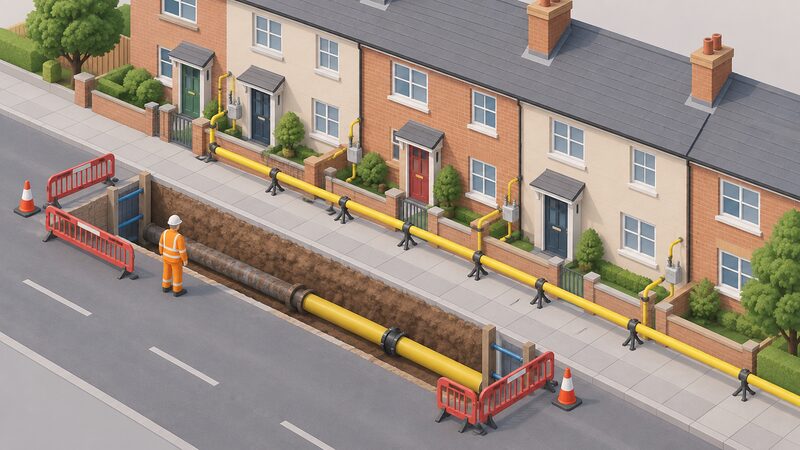
For a new connection, the checks sit with the network operator for the area, and the process is set out in getting a new gas connection. The relevant questions are whether a main already runs past the property, what capacity is available, and what reinforcement would be needed. Where a property has no live supply, the check is covered in how do I check if my property has a live gas supply.
Disconnecting is the mirror image. If a household wants to disconnect from the gas network, the first step is to contact the energy supplier, and the network operator is a different and separate company from that supplier4. The full route, including the point at which the network operator becomes involved, is set out in how do I disconnect my gas supply permanently.
Regional differences in network charges: standing charges and annual bills compared
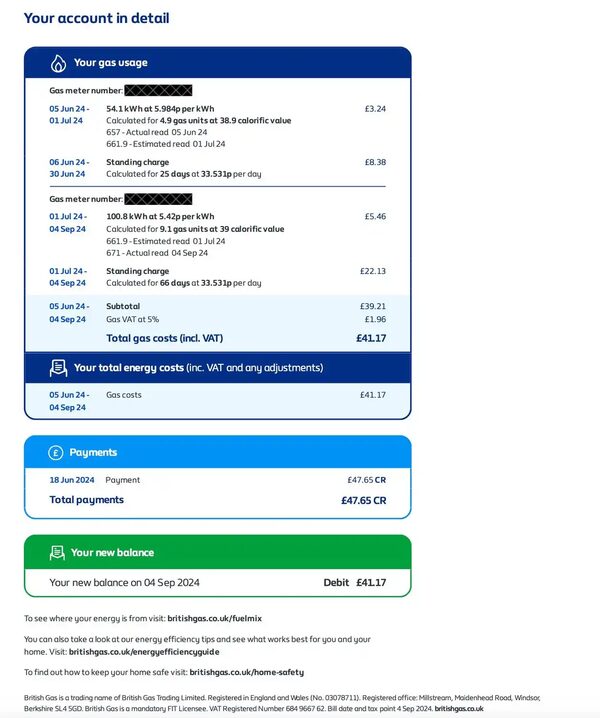
Network costs differ by region, and that shows up in the standing charge and in the benchmark annual bill. Ofgem publishes benchmark maximum charges for the charge restriction period, and the figures vary by region and by payment method.
| Region | Payment method | Annual benchmark at 12,000 kWh |
|---|---|---|
| Northern | Other payment method | £821.7316 |
| Northern | Prepayment | £796.9216 |
| East Midlands | Other payment method | £806.1016 |
| Northern Scotland | Other payment method | £813.9316 |
| Northern Scotland | Prepayment | £786.0316 |
| Eastern | Prepayment | £791.2716 |
Standing charges show the same pattern at a smaller scale. Published regional figures include 30.20 pence per day for London, 29.06 pence per day for the Midlands, 28.63 pence per day for the South East and 28.53 pence per day for the Southern region17. 20 pence per day and 29.52 pence per day, and East Midlands as both 28.78 pence per day and 29.41 pence per day, and those conflicts are unresolved17.
The reason for the variation is the cost of the network in each area. Sparser populations, longer mains runs and different levels of reinforcement all raise the cost per customer, and the price control allocates those costs to the regions that cause them. Ofgem has consulted on mandating lower or zero standing charge tariffs, which would change how those network costs reach a household bill7.
The wider question of how network charges sit inside a bill is covered in TNUoS, BSUoS and the network charges behind your bill. For gas specifically, the standing charge is the visible part of the network cost, and it is set regionally rather than nationally.
Guaranteed Standards of Performance: what your network owes you
The Guaranteed Standards of Performance set out what a network operator must pay a customer if it fails to meet specified standards. The payments stipulate what an electricity distribution network operator must pay to a customer or relevant authority as appropriate if they fail to meet specified standards of performance18. Ofgem issued a decision on updating the Guaranteed Standards of Performance for Distribution Network Operators by amending the Electricity (Standards of Performance) Regulations 201519.
For gas, the published figures are specific. For planned gas cuts, the figure is £506. For unplanned gas cuts, £70 extra applies for every additional 24 hours the supply is off6. If no notice is given for planned gas works, a further £40 may be payable6. These rules cover England, Scotland and Wales6.
The amounts are not fixed forever. Ofgem reviews and updates the amount paid for a power cut each year based on inflation6. The same inflation-linked approach applies across the standards, which means a figure quoted in one year may differ in the next.
Awareness of the standards is low. Research commissioned to help inform Ofgem's review of energy supplier Guaranteed Standards of Performance found low awareness among participants, though there was widespread agreement that compensation is an important element of responding to service failings when guarantees are breached21. Service failings related to loss of supply were typically seen as the most severe, and views on the appropriate level of compensation varied widely amongst the sample21.
Compensation for supply failings: amounts, timescales and how payments are made
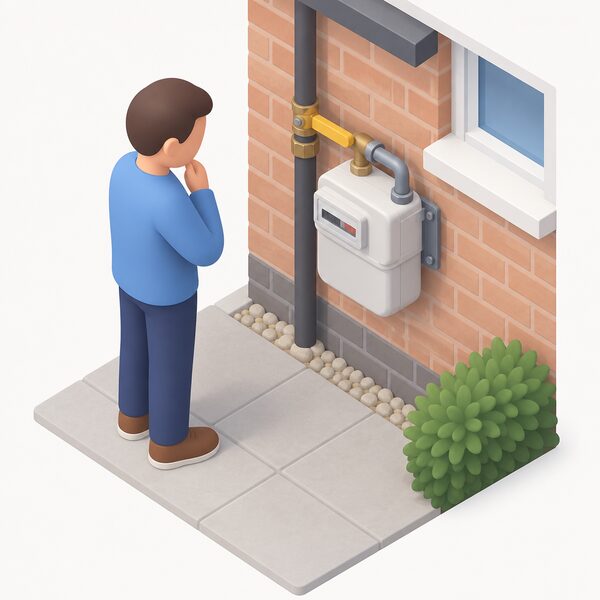
The gas compensation figures are set out in the standards and are payable when the relevant failure occurs. For planned gas cuts, the figure is £506. For unplanned gas cuts, £70 extra applies for every additional 24 hours the supply is off6. Where no notice was given for planned gas works, a further £40 may be payable6.
There is also a penalty for late payment. If a payment has been missed, the network operator may owe an extra £4020. That provision exists because the standards are meant to be automatic in effect, and a payment that does not arrive is itself a failure.
The supplier side has its own figure. The supplier Guaranteed Standards of Performance set minimum standards of performance that all suppliers must meet for specific services or pay £40 automatic compensation per breach22. The Electricity and Gas (Standards of Performance) (Suppliers) Regulations 2015 provide that a supplier must, for each such failure, make a payment of £40, an additional standard payment, to the customer23.
Some claims are not automatic. For the frequent cuts payment, a claim must be made with the local network operator, which will decide whether the payment is due6. That is a different process from the automatic payments, and it is the point at which a household has to act rather than wait.
The rules cover England, Scotland and Wales6. Northern Ireland sits outside this regime, and its arrangements are covered in energy supply in Northern Ireland. The wider context of how interruptions are managed is set out in gas supply emergencies and how much compensation for a gas outage over 24 hours.
Where GDN obligations fall short: priority services and vulnerable customers
The Priority Services Register is the main mechanism for protecting customers who are at risk during an interruption. Gas and electricity suppliers, distribution network operators and gas distribution networks are required by their licences to offer specified sets of services to disabled, chronically sick and pensionable age customers, and to blind, partially sighted, deaf and hearing impaired customers24.
The reason the register matters specifically for networks is that a network operator needs to know who is behind a meter when supply is interrupted. It is critical that distribution network operators and gas distribution networks know if customers attached to their networks have special communication needs or are at particular risk if their supply is interrupted24.
The services offered are specified. Companies must offer the following services to their Priority Services Register customers, free of charge: password schemes, accessible communications, network advice about supply interruptions, accessible complaint facilities, meter reading arrangements, safe access to prepayment meter functionality, and redirection of communications to a nominated person on request25. Performance monitoring for networks continues through the Stakeholder Engagement Incentive for distribution network operators and gas distribution networks, and the Discretionary Reward Scheme for gas distribution networks25.
The gap is in coverage and awareness. The same consultation noted that LPG and heating oil distributors typically have more contact with consumers during the delivery process and are arguably better placed than energy companies to identify vulnerability24. Households off the gas network therefore sit outside the register's main route, which is a limit on how far the protection reaches.
Customer satisfaction data suggests the wider service picture is uneven. A significantly lower proportion of EDF Energy, E.ON / E.ON Next, OVO Energy and Scottish Power customers reported they were satisfied or very satisfied with customer service than the average, in findings covering July to August 202526. That is supplier performance rather than network performance, but it shapes how a household experiences a problem that starts on the network.
Connections and network improvement works: targets and fuel poor households
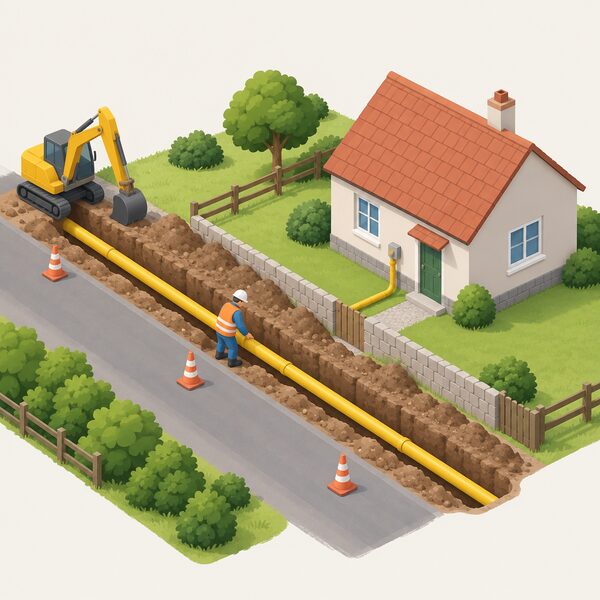
Network improvement work is funded through the price control and delivered against targets that include support for fuel poor households. Ofgem has published new targets for gas network companies on support for fuel poor and vulnerable households27. The Fuel Poor Network Extension Scheme enables households that are eligible for assistance to switch to natural gas, and the scheme is delivered by the gas distribution networks28.
The scheme's purpose is to extend the network to households that would not otherwise be connected. Ofgem's review of the scheme found that it enables households eligible for assistance to switch to natural gas, with the gas distribution networks as the delivery body28. Network companies have been asked to work more closely with suppliers and fuel poverty groups on improvement works, such as new boilers, radiators and internal pipework27.
In Scotland, the policy context differs. The Scottish Government's heat and buildings strategy work has included support for fuel poor households, including households in island, rural and remote communities29. That matters because rural and island households are the least likely to be on the gas network at all, and the cost of extending mains to them is highest.
The limits are structural. A network extension only reaches a household if a main can be run to it at a cost the scheme can bear, and the scheme is aimed at households eligible for assistance rather than at all off-gas homes. For a village considering a connection, the route is set out in can I get my village connected to the gas network, and the support available is covered in can I get help paying for a new gas connection.
What the network means for a household's energy independence
The gas distribution network is the clearest example on the energy system of a dependence a household cannot remove by changing behaviour. The pipes are a natural monopoly, the network operator is licensed and regulated rather than chosen, and the gas itself arrives from a transmission system owned and operated by National Grid Gas1. A household can change supplier, change tariff and change payment method, but it cannot change the network that serves its street.
What a household can control is narrower and worth stating plainly. It can know which network operator serves it, which determines who responds to an interruption. It can be on the Priority Services Register if it qualifies, which determines whether the network knows about a vulnerability before an interruption rather than after24. It can know the compensation figures, which are £50 for a planned gas cut, £70 extra for every additional 24 hours off supply, and £40 extra where no notice was given for planned works6. And it can know that the supplier, not the network, is the first point of contact when something goes wrong4.
The dependence that remains is physical. Some 85% of dwellings in England are on the gas network, and for those homes heat depends on a chain that runs from import terminals and interconnectors through the National Transmission System and into the local mains5. The network operator's obligations cover the last link in that chain, not the whole of it. The wider picture of what a household can and cannot control is set out in energy security and household independence, and the upstream half of the chain in UK energy supply.
Sources30 cited
- Energy terms explained, Ofgem, 2026
- Gas distribution networks and the gas grid, House of Commons Library, 2026-09-17
- Call for input: disconnections, Ofgem, 2025-01-13
- Disconnecting from the gas network, IGEM, 2026-09-20
- Building regulations discussion document, Northern Ireland Department of Finance, 2023-10-11
- Check if you can get payment for a power cut, Ofgem, 2026
- Mandating lower or zero standing charge tariffs: technical working paper, Ofgem, 2025-09-24
- Complain about your energy supplier or network operator, Ofgem, 2026
- Statement on deemed contracts, Ofgem, 2010-06-24
- Final proposals and statutory consultation on data privacy, Ofgem, 2014-08-29
- Energy Price Guarantee domestic scheme, UK Parliament, 2022-10-18
- Heat networks regulation: consumer protection guidance decision, Ofgem, 2026-01-13
- Heat networks regulation, House of Commons Library, 2026-02-26
- Heat networks policy, Scottish Government, 2026-01-27
- MPAN and MPRN numbers explained, Uswitch, 2026-07-02
- Benchmark maximum charges for the charge restriction period 13a, Ofgem, 2025
- Regional energy prices, Uswitch, 2026
- Adjustments to Guaranteed Standards of Performance 2025, Ofgem, 2025-03-12
- Final decision and statutory instrument: Guaranteed Standards of Performance, Ofgem, 2023-09-01
- Plan for a power cut, Ofgem, 2026
- Energy consumer experiences of customer service standards, Ofgem, 2026-06-23
- Energy Consumer Outcomes: proposed implementation, Ofgem, 2026-06-23
- The Electricity and Gas (Standards of Performance) (Suppliers) Regulations 2015, legislation.gov.uk, 2025-01-02
- Priority Services Register review: consultation, Ofgem, 2014-06-30
- Priority Services Register final proposals, Ofgem, 2015-12-17
- Customers' satisfaction with their supplier: July to August 2025, Ofgem, 2025-07
- More support for fuel poor and vulnerable households: new Ofgem targets for gas network companies, Ofgem, 2015-09-30
- Findings of the review of the Fuel Poor Network Extension Scheme, Ofgem, 2015-03-26
- Heat and buildings strategy: fairer Scotland duty assessment, Scottish Government, 2021-11
- The Gas Safety (Installation and Use) Regulations 1998, legislation.gov.uk, 1998
 Who Owns Which Energy SupplierWho is actually behind the company that sends your energy bill?
 The Full Energy Suppliers GuideWho the UK's domestic gas and electricity suppliers are, how the market is structured across Great Britain and Northern Ireland, what a supplier is licensed and obliged to do, how the price cap limits bills, what happens when a supplier fails, and who regulates it all.
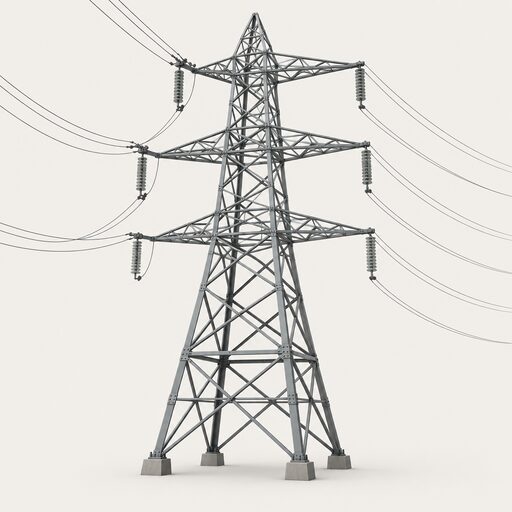 The Transmission NetworkWondering who owns the pylons near your house, or why the grid needs upgrading before you can run a heat pump or an electric car?
 Gas Pipelines and LinksWhere does the gas in your home actually come from, and what happens when it gets really cold and the wind stops blowing?
 The Full Where Our Energy Comes From GuideWhere does the gas in your boiler and the electricity in your sockets actually come from?
 Who Supplies Your Energy?Not sure who bills you for gas or electricity?