


In this guide
If you can smell gas, the number is 0800 111 999, free, answered 24 hours a day, 365 days a year1. Cadent manages that line on behalf of the whole gas industry, so it is the first point of call for any gas customer in the UK, not only Cadent's own2.
Cadent is the UK's largest gas distribution network, with a 200-year legacy, owned by a consortium of global investors3. It brings gas to 11 million homes and businesses across the North West, West Midlands, East Midlands, South Yorkshire, East of England and North London, an area running from Cumbria to North London and the Welsh Borders to East Anglia1. It owns the main pipe that supplies your street and the smaller pipe branching off it that brings gas to your door2.
What follows covers the areas served, what to do in an emergency, the Priority Services Register, new connections and mains work, the N10 incident and its compensation, water in the network, hydrogen plans, and who gets help first when the gas goes off.
What Cadent does and where it operates
Cadent looks after the gas pipes in your area, maintaining, repairing and replacing them8. It is one of four gas distribution networks in Great Britain, alongside Northern Gas Networks, SGN and Wales and West Utilities, which own and operate the medium and low pressure pipelines receiving gas from the national transmission system9.
The company's own list of areas is consistent across its pages: the North West, West Midlands, East Midlands, South Yorkshire, East of England and North London4. Its network reaches 11 million homes from Cumbria to North London and the Welsh Borders to East Anglia3. That is a wide footprint with no single centre: it takes in Manchester and Liverpool, Birmingham and the Black Country, Nottingham, Leicester and Derby, Sheffield and Doncaster, Norfolk, Suffolk, Essex and much of north London.
Two things follow for a household. First, Cadent is not your gas supplier. It does not sell gas, set your tariff or send your bill; it owns and maintains the pipes and responds to escapes and interruptions. Second, if you are outside those regions, Cadent is not your network. Scotland and the south of England are SGN's area, Wales and the South West are Wales and West Utilities', and the North East and Yorkshire outside South Yorkshire are Northern Gas Networks'. The gas distribution networks page sets out how the four fit together, and SGN vs Cadent covers the boundary directly.
Cadent also runs services beyond the pipe. It connects homes and renewable gas suppliers to its network2, and it operates a free locking cooker valve service for people who may leave a cooker on, offered nationwide in partnership with the other UK gas distribution networks12.

Emergencies: the national line and what happens next
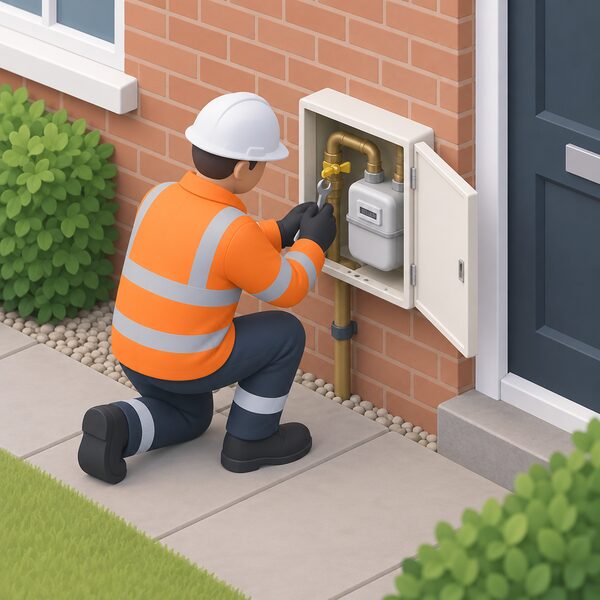
Cadent manages the National Gas Emergency Service for all gas customers in the UK and is the first point of call if something goes wrong2. The number is 0800 111 999, free and staffed around the clock1. Calls to the National Gas Emergency Service and National Enquiry lines may be recorded and monitored13.
For carbon monoxide, Cadent's advice is to open all doors and windows, move outside into fresh air and call the Gas Emergency Service; if someone has collapsed or is displaying severe symptoms, seek medical help by calling 999 or 11213. Carbon monoxide is the reason a gas emergency is treated as urgent even when there is no smell: the gas itself is odorised, but the products of incomplete combustion are not.
Once an engineer attends, the sequence depends on what is found. Where a street has lost supply, gas will not be restored to that street until all properties have been confirmed switched off safely, and reconnection must be done by a Cadent engineer rather than by the householder11. That is why a single incident can take days: every property has to be visited, isolated, and then visited again to be turned back on.
The scale of the everyday workload is considerable. Cadent's own reporting covers over 67,000 smell of gas calls in the North West and over 43,500 in the East Midlands during 202514. Those are calls about escapes, not supply interruptions, and they sit alongside the planned work.
Priority Services Register: free support and how your data is used
The Priority Services Register helps identify customers who need priority support in a gas emergency15. It is completely free and confidential15, and Cadent's registration line is 0800 389 80005. The register is a free service for consumers who may need extra support16, and Cadent's published promise is that it will never use register data for marketing purposes, never charge for services provided through it, do its best to ensure additional needs are supported, and only share data necessary to support you17.
What it provides, in Cadent's own terms, is alternative heating and cooking facilities should your gas supply be interrupted as part of its works5. More broadly, register benefits across the industry include bills in accessible formats, help with meter readings, free gas safety checks, and access to the nominee and password scheme18. Local authority guidance describes the same package as priority support with heating and cooking facilities if your supply is cut off, advance notice of power cuts, and an identification and password scheme for home visits19.
The password scheme matters in practice. Passwords registered against your Priority Services Register information will be shared with Cadent when an appointment is arranged through a gas supplier, so engineers can use them7. That gives a householder a way to check that someone at the door is genuine.
"It is free to join and once a member you are entitled, among other things, to a free annual gas safety check (unless you rent your home and it is your landlord's responsibility to arrange this)."
Registration is not automatic and not shared between utilities. To sign up you need to contact all your utility suppliers directly21, so registering with a gas supplier does not by itself put you on Cadent's register. Cadent's own route is a phone call to 0800 389 8000, where a member of the team will assist5. The Priority Services Register arrangements at other networks follow the same pattern, and SGN publishes its own version.
New connections, meter moves and mains upgrades
Cadent operates the main gas pipe that supplies your street and the smaller pipe branching off it that brings gas to your home or business2. Connecting a property to that pipe is a Cadent job, not a supplier's.
Before applying for a quote, Cadent asks for the full address; the property owner's full name and telephone number; the meter position; whether there is private land between the property and the nearest footpath or road; the distance in metres from the gas meter to the property boundary; and approved planning permission and site plans for new builds22. A pricing tool gives an indicative cost of a standard domestic new connection in your area and current work delivery timescales22. The new gas connection page covers the process in more detail.
Service alterations are a separate route. They are required if you need to relocate your gas meter, if you need to increase your gas supply, or if you are moving pipework to accommodate renovations or alterations to your home23. Where Cadent is asked to reconnect the meter, it needs the distance of internal pipework required to reconnect the gas boiler to the meter's new position23. A new meter box or parts can be arranged through your gas supplier, a Gas Safe registered installer with a MET1 certificate, or a local DIY or hardware store13.
In the street, Cadent's mains replacement programme is described as getting the network hydrogen ready7. Work in Maldon, Essex, began on 20 October 2025, decommissioning 670 metres of over-80-year-old metallic gas pipes on Wantz Road, with works running to 30 January 202624. Where a service pipe is replaced, Cadent needs access to the house throughout the day and an adult over 18 must be in the home8.

The N10 incident and how compensation was paid
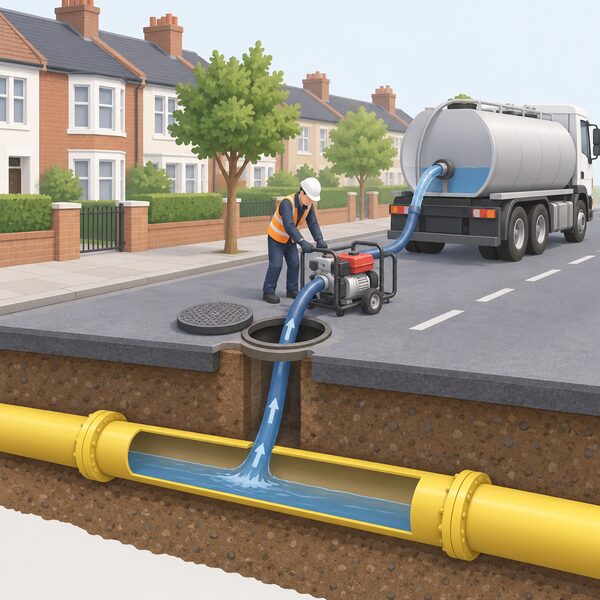
In January 2025, water entered the gas pipes in the N10 area of North London following a burst water main in the area11. The affected area ran roughly within N10: to the north the North Circular road (Bobby Moore Way and Orion Road), to the west Coppetts Road, to the east Alexandra Road, and down to Wilton Road in the south, with the west and east sides split roughly along Colney Hatch Lane11.
The response was large. On 14 January 2025 Cadent reported over 100 engineers and support staff on site and access gained to around two-thirds of impacted properties11. By 15 January every single affected property had been visited at least once, and 16,000 litres of water had been pumped out of the network11. By 16 January, 10% of properties in the west zone were back on gas at lunchtime11. Around 70 Cadent colleagues were on site on 17 January11. By 24 January, gas supply had been turned on to more than two thirds of the affected properties11.
The compensation position is the part most households want. Cadent has a statutory obligation to pay compensation to anyone who is without gas for more than 24 hours after the first complete 24 hour period11. For N10, Cadent decided to pay compensation directly to each affected bill payer once their gas supply had been restored, instead of the usual route via the gas supplier within ten days of the closure of the incident11. Affected bill payers needed to complete an online form by 10 February 2025 to receive direct payment11. If the form was not completed, compensation was automatically made to the gas supplier, which passed it on to the named account holder11.
More generally, Cadent states that a household may be entitled to a compensation payment if it fails to meet any of the Guaranteed Standards of Performance25, and that a supply off for 24 hours or more triggers an entitlement processed automatically once supply is turned on6. Claims are submitted through the compensation claims page25. The gas outage compensation page covers the 24 hour rule in detail.
Water in the gas network: Richmond Hill and Maldon
Water entering a gas network is not a rare curiosity. It blocks the flow of gas into local properties11, and clearing it means pumping the main and then visiting every affected property to restore supply.
The Richmond Hill event in south west London followed the same pattern as N10. On Sunday 20 July 2025 a Thames Water main burst and water got into the local gas network in the TW10 area of Richmond Hill26. Cadent completed a temporary repair on its gas pipe to ensure no more water could enter the network26. Three streets had customers impacted with no gas: Hill Road, Hill Street and Richmond Hill26. A small road closure was needed on Hill Rise near the junction with Petersham Road and The Vineyard to complete the repair safely26. Water pumping began on 22 July and gas supplies were restored to a small number of properties26. By 23 July the majority of affected properties were back on gas, with some properties at the bottom of the hill still without supply26.
The pattern is consistent across both incidents: a water main fails, water travels into the gas main through the damaged pipe, gas flow stops, and restoration runs street by street. In the N10 case, Affinity Water repaired its broken water pipe and Cadent repaired its damaged gas pipe to ensure no more water entered the gas network11.
For a household, the practical lesson is about time rather than risk. Water ingress is not a fault in your home and nothing inside the property causes it, but it can leave a street without gas for days while the main is cleared and every property is isolated and reconnected. If you are on the Priority Services Register, that is the point at which alternative heating and cooking facilities apply5.
Hydrogen: what Cadent plans for its network
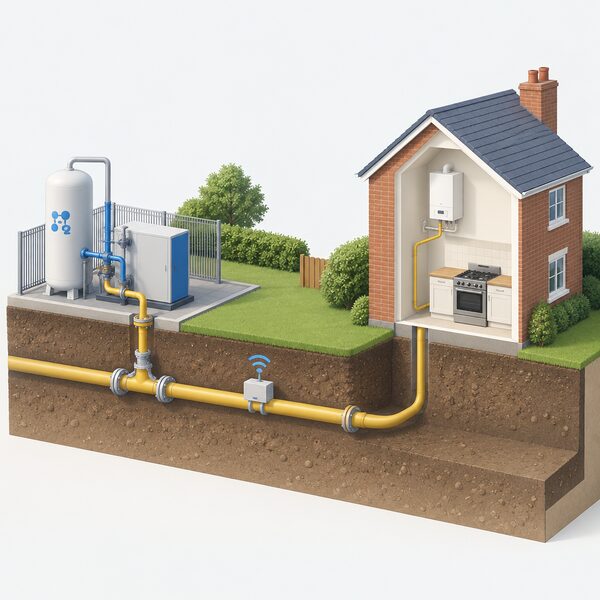
Cadent supports the government's plans to reach net zero by 205024. Its stated aim for the network is a move to 100% hydrogen by 2050, with hydrogen production becoming greener over time7. In the nearer term, following the government's decision on the UK heat strategy, Cadent seeks to blend 20% hydrogen into the network7. Hydrogen can be delivered through the existing gas network, keeping customer disruption to a minimum7.
The mains replacement programme is framed as preparation for that: Cadent describes it as getting the network hydrogen ready7. The argument for using the existing pipes is straightforward, since the alternative is a parallel infrastructure build.
There is a measurement problem to solve first. In August 2025 Cadent, SGN, Wales and West Utilities and Gas Networks Ireland announced work with Bohr, Renda and Thyson Technology to develop sensors measuring gas energy content, aiming for a small-scale pilot trial in 202627. Blending changes the energy content of the gas delivered, and billing and appliance performance both depend on knowing what is in the pipe.
For a household, the position is that a blend is not the same as a conversion. A 20% blend is tolerance of hydrogen within the existing gas supply, and no domestic 100% hydrogen supply exists to feed a converted network today. The hydrogen in the gas grid page covers where the trials stand, and biomethane and green gas covers the renewable gas Cadent already connects to its network2.
Support during an outage: who is prioritised and who helps
Cadent provides extra care for those who might need it in a gas emergency2. It is regulated by Ofgem and has a responsibility to offer Priority Service customers an alternative heating or cooking facility within four hours of being notified about an interruption to their gas supply6. That four hour figure excludes major gas incidents if over 250 homes are off gas, when the time increases to eight hours6.
Prioritisation within an incident follows need rather than address. Customers that Cadent is aware of having electrically dependent medical equipment or life-threatening illnesses are likely to be prioritised, in order of contact and the provision of services5. That is why registering matters: a household that has not told Cadent about a medical dependency is not in the queue for it.
Beyond the household, all networks work closely with third party agencies to help provide extra support, including your local authority, the emergency services and the British Red Cross5. Where a household needs support above and beyond the items Cadent has available, it works closely with a third-party supplier that looks for alternative accommodation6.
There is a wider support structure too. Disability Energy Support is funded by SGN, Cadent, Northern Gas Networks and Wales and West Utilities18, and Cadent provides safeguarding services through the Vulnerability and Carbon Monoxide allowance28. Cadent states it is now able to go beyond its core safeguarding work to support its customers to save energy28. On billing disputes that sit outside a network incident, the Energy Ombudsman offers advice for consumers worried about their energy bills29.
Visits are not always announced. Cadent will do its best to tell you in advance that someone is coming, but gas emergencies and other critical work may mean unannounced visits7. That is the practical reason the password scheme exists.
Sources29 cited
- Gas safety advice, Cadent Gas
- Who is my gas supplier, Cadent Gas
- What our summer customer insights tell us, Cadent Gas, 5 August 2026
- Theft of gas, Cadent Gas
- Priority Services Register, Cadent Gas
- Support if you are temporarily off gas, Cadent Gas
- Keeping you safe on your doorstep, Cadent Gas
- Under your feet, Cadent Gas
- Call for input on disconnections, Ofgem, January 2025
- Building regulations, Cadent Gas
- Loss of gas N10, Cadent Gas
- Locking cooker valves, Cadent Gas
- Frequently asked questions, Cadent Gas
- Ageing Essex gas main set for upgrade, Cadent Gas, 13 October 2025
- Priority Services Register, SGN
- Worried about your energy bills, Energy Ombudsman, 24 March 2026
- Priority Services Register promise, Cadent Gas
- Disability Energy Support, Scope
- Support schemes, Cheshire West and Chester Council, 17 September 2026
- Gas safety in catering and hospitality, Health and Safety Executive, September 2011
- Heating your home, Carmarthenshire County Council, 4 April 2026
- New gas connection, Cadent Gas
- Alterations, Cadent Gas
- New sensor technology could enable green gas to grow 10x in the UK, Cadent Gas, 20 August 2025
- Compensation claims, Cadent Gas
- Water in gas pipes, Richmond Hill TW10, Cadent Gas, July 2025
- Future of gas, Cadent Gas
- Cadent case study, Energy Saving Trust, 21 October 2025
- Flood advice, Cadent Gas