
In this guide
Anyone who works on gas appliances or fittings in your home as part of their business must, by law, be competent and registered with the Gas Safe Register1. That covers installing a boiler, servicing it, repairing a gas fire and working on the pipework between them. The register is described by official guidance as the official registration for all gas engineers, and by the heating industry as the only list of engineers qualified to work legally on gas appliances1. Registration is not a marketing badge: it is the mechanism by which the Health and Safety Executive approves who may lawfully touch domestic gas.
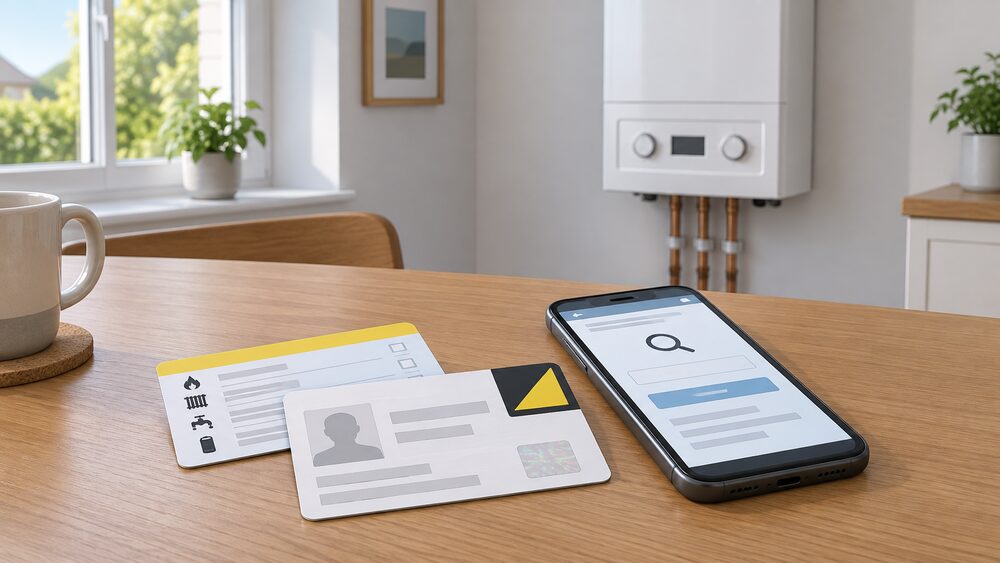
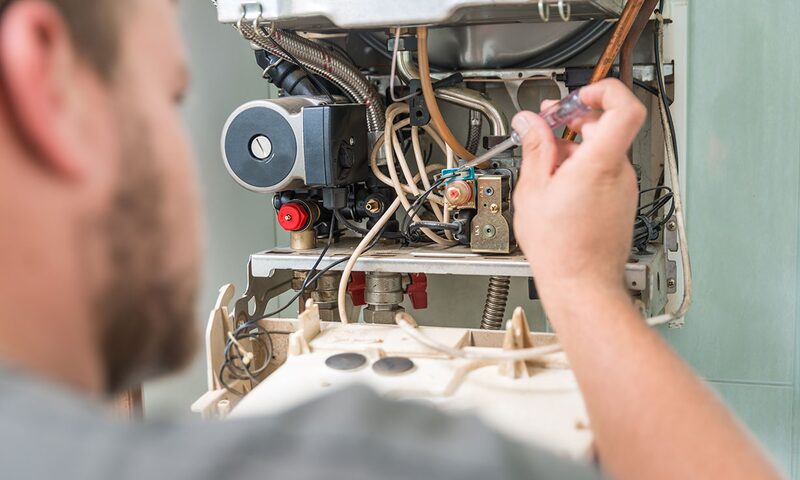
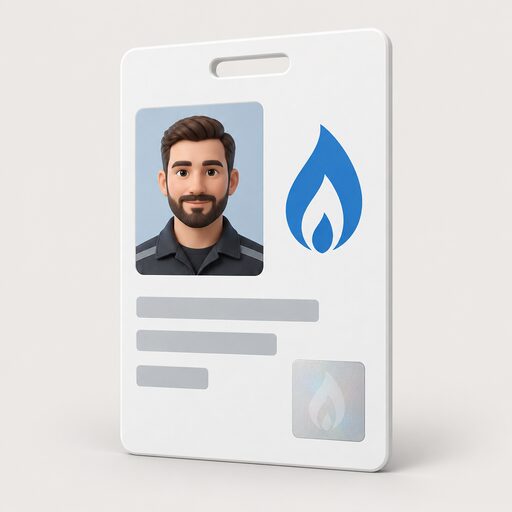
Checking takes a minute. Ask to see the Gas Safe ID card before any work starts, read the front for the photograph, dates, licence number, hologram and business name, then turn it over and read the back, where the categories of gas work the engineer is qualified to do are clearly marked1. Verify the details independently rather than relying on the card alone: the register can be searched by postcode online, checked on the freephone consumer line 0800 408 5500, or checked by texting the word Gas and the business registration number to 850801. Each year, registered engineers are issued with a new ID card carrying a unique seven-digit licence number8.
The second check matters as much as the first. Not all Gas Safe registered engineers are qualified to carry out all types of gas work9. A card that is current and genuine still does not mean its holder is signed off for your particular appliance, whether that is a combi boiler, a gas fire, a cooker or an LPG installation. The law requires the person to be registered and competent in the area of gas work being carried out2.
What the Gas Safe Register is and why the law requires it
The register exists because gas work carries a risk that a householder cannot inspect: a badly fitted flue, a disturbed seal or an incorrectly commissioned appliance can leak carbon monoxide without any smell or visible sign. The legal structure puts competence before the job rather than inspection after it. Health and Safety Executive guidance states that by law anyone carrying out work on gas appliances or fittings as part of their business must be competent and registered with the Gas Safe Register3. Welsh Building Regulations guidance on heat-producing appliances puts the same duty in its statutory form: any gas installation business, whether an employer or self-employed, must be a member of a class of persons approved by the Health and Safety Executive, and for the time being that means registration with Gas Safe Register12.
The older vocabulary still appears in legislation. The 2006 regulations on gas appliance testing define a recognised engineer as one recognised by the Council of Registered Gas Installers as competent to undertake such testing13. That predecessor body's name survives in the statute book, but the current register is Gas Safe.
Registration applies across the United Kingdom. Official Northern Ireland guidance states plainly that Gas Safe Register is the official registration for all gas engineers in Northern Ireland, and that by law all gas engineers must be on the register and hold current qualifications to install, repair or maintain domestic gas appliances1. So while Building Regulations differ between the nations, the gas competence requirement does not.
Gas heating is the default in most British homes: in the Winter 2025 public attitudes tracking, three quarters of people, 75%, said they used a gas boiler as their main method of heating the home10. For those households, the register is the single gatekeeper standing between the mains gas supply and the appliance in the kitchen or airing cupboard.
The Gas Safe ID card: what each part tells you
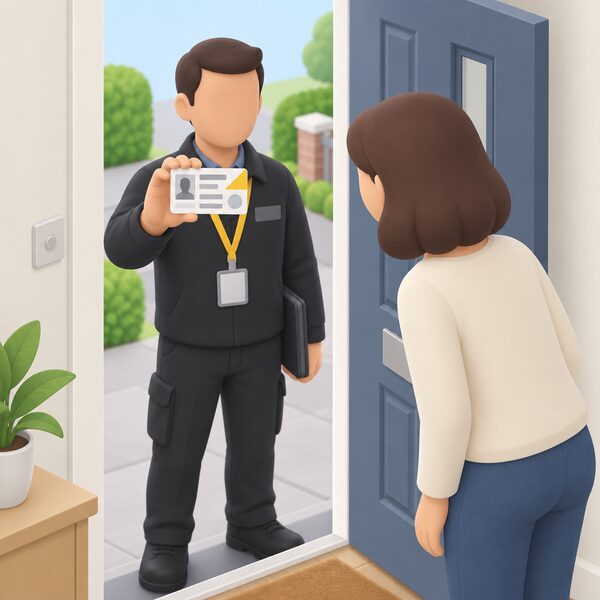
Every gas engineer carries a Gas Safe Register ID card, and registration comes with one14. It may be a hard copy or held on a phone, and either can be verified with Gas Safe if there is any doubt16. The card is issued annually, which is why the expiry date matters: a card from a previous year proves nothing about current standing8.
| Part of the card | What to read |
|---|---|
| Front: photograph | Matches the person at the door1 |
| Front: start and expiry dates | Registration is current1 |
| Front: licence number | Unique seven-digit number8, quotable when checking7 |
| Front: security hologram | Card is genuine1 |
| Front: business name | The engineer is from the business you contacted1 |
| Back: qualifications | The categories of gas work the engineer is qualified to do, and whether they are current1 |
Businesses on the register must register any engineers so they can carry out gas work under a Gas Safe ID card8. That is why the front of the card names a business: an individual's card is tied to the firm that employs or engages them, and a mismatch between the card and the company that quoted is a discrepancy worth resolving before work begins.
The back of the card does the work most householders skip. The engineer's competencies are clearly marked there, and the two checks official guidance sets out are whether the engineer is qualified to do the gas work you asked for, and whether those qualifications are current1. Checking the card is an identity and scope check; the register check confirms the card's claims against the official record.
Checking the engineer is qualified for the specific job
Registration proves a floor of competence, not universal competence. Which? has pointed out directly that not all Gas Safe registered engineers are qualified to carry out all types of gas work9. The Heating and Hotwater Industry Council sets out the sequence for a householder: ask to see the engineer's Gas Safe ID card, check they are qualified for the specific type of gas work, and verify the registration on the Gas Safe Register website17. Northern Gas Networks gives the same instruction in the same order: before any work starts, ask to see the card and check the engineer is qualified for that appliance or job18.
This bites hardest on appliances outside the boiler mainstream. Gas fires, cookers, warm-air units and LPG installations are separate categories of work. Liquid Gas UK, the LPG trade body, points householders to the same register and the same ID card, describing Gas Safe as the official register for gas engineers14: for an LPG appliance the question is whether the LPG competency appears on the back of the card, not simply whether the card exists.
To join the register at all, an applicant must prove they have the necessary qualifications and experience to carry out gas work, provide National Insurance numbers for any engineers being registered, and pay by credit or debit card; new registrations sit on probation for three months15. The register is therefore a record of assessed and re-assessed competence rather than a directory anyone may pay to enter.
- Before work starts: ask for the card; read the back for the category that matches the appliance.
- Verify independently: postcode search on the register website, 0800 408 5500, or text Gas and the business registration number to 850801.
- On pricing: Gas Safe Register has no control over engineers' charges, and official guidance advises obtaining quotes from three different engineers before hiring19. The Energy Saving Trust likewise recommends at least three quotes from different installers20.
There is a related page on checking an installer before you buy and on getting installation quotes.
When registration applies: installation, servicing and repairs
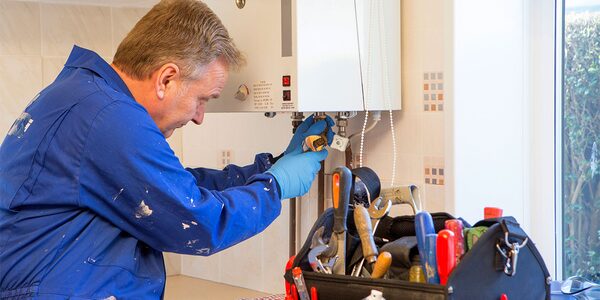
The duty is not limited to fitting a new boiler. It attaches to work on gas appliances and fittings generally, which in a household means four recurring situations.
Installation. Only a qualified Gas Safe registered engineer should carry out gas installation, repair or service work17. Welsh guidance on boiler replacement states that for a gas boiler an installer should be Gas Safe registered from 1 April 200921. Appliances should be installed and serviced by a registered engineer as a basic precaution against leaks22, and anything fitted should be fitted by an accredited registered engineer23.
Annual servicing. The Health and Safety Executive strongly advises that all gas appliances, flues and pipework should be installed, regularly maintained and serviced at least annually by a Gas Safe registered engineer2. Gas networks and consumer bodies repeat the interval: a gas boiler should be checked by a registered engineer once a year24; an annual service should be arranged for the boiler or other gas appliances18; all gas appliances should be serviced and safety-checked annually6; and for a gas fire, an annual service by a registered engineer is described as vitally important25. During a service, a registered engineer carries out maintenance checks on all the key parts of the boiler26.
Repairs after a fault or emergency. After a gas emergency has been made safe, further repairs to appliances or pipework may need a Gas Safe registered engineer27. The emergency response and the repair are different jobs done by different people.
Any tradesperson fitting a gas appliance. The Chartered Institute of Plumbing and Heating Engineering is blunt on the point: if they fit gas appliances then they must be Gas Safe registered28. A plumber, kitchen fitter or general builder is not exempt because gas is a small part of the job.
"Anyone employed to work on gas appliances in domestic premises must be a Gas Safe registered engineer and competent in that area of gas work"
Landlords, tenants and LPG
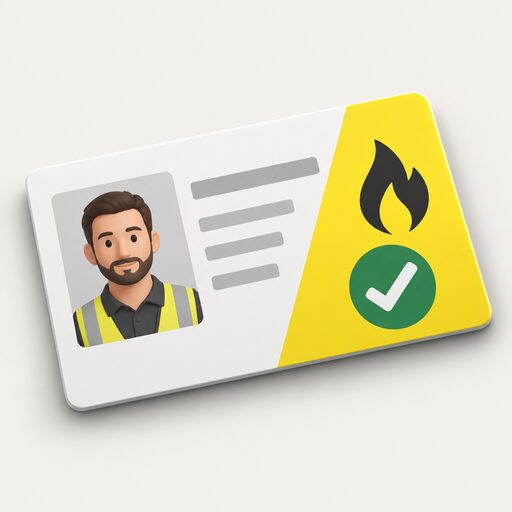
Where a property is let, the duty is the landlord's and it is time-bound. A landlord must have a Gas Safe registered engineer carry out a safety check at least once every 12 months, with an annual gas safety check carried out within 12 months of the installation of an appliance, and must ensure that anyone working on gas appliances, fittings or flues provided for tenants' use has the required competence2. SGN states the duty as making sure gas pipework, flues and appliances are in good condition and checked every year by a Gas Safe registered engineer29. Northern Ireland guidance frames it as making sure only Gas Safe registered installers are used5.
The same 12-month rule applies to LPG appliances owned and provided by the landlord19, which matters for off-grid and park-home lettings where mains gas is not in play at all.
Tenants have a corresponding entitlement and a corresponding limit. A landlord must provide proof that a Gas Safe registered engineer has safety-checked the appliances within the last 12 months6. Where a tenant wants a check on gas appliances and flues, the route is through the landlord rather than direct instruction: Cadent's guidance for its support scheme tells renters to contact their landlord to arrange a safety check for all gas appliances and flues by a Gas Safe registered engineer30.
Registration and Building Regulations: related, not the same
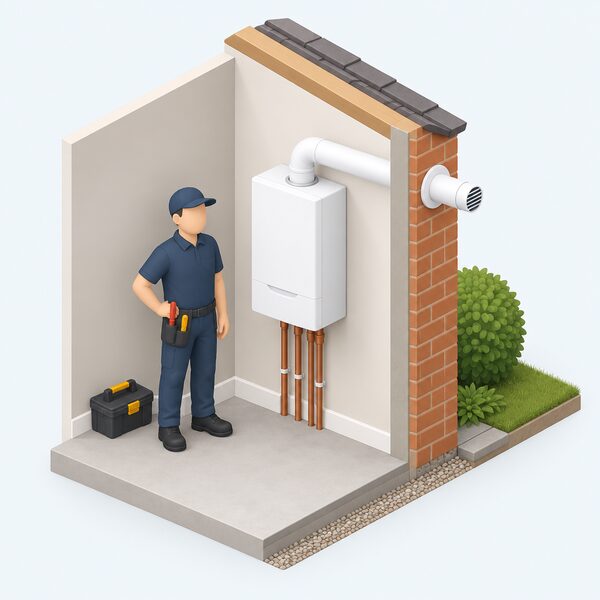
A householder who has a boiler replaced needs two things to be true: that the work was done by someone legally entitled to do it, and that the work is recorded as complying with Building Regulations. Gas Safe registration serves both, but through slightly different machinery.
Government guidance on competent person schemes notes that Gas Safe Register is not technically a competent person scheme, but that in practice its installers have the same responsibilities for complying with Building Regulations31. The Planning Portal states that if you employ a registered installer with the relevant competencies to carry out work on gas appliances, they should be able to self-certify the work without the need for close involvement of building control32. In other words, the registered engineer's own notification is the compliance route for most boiler replacements.
The regulations themselves set the technical bar. Welsh guidance requires a minimum efficiency of 86% for a gas boiler, and states that the replacement of a gas boiler will probably have to be a condensing boiler unless there is sufficient reason why one cannot be installed21. Installers must follow the guidelines in Approved Document J, covering air supplies, hearths, flue linings and chimney labelling, and where the flue outlet can be positioned33. Building Regulations apply to providing services and fittings in a building, including fuel burning appliances of any type, and to work affecting the thermal elements, energy status or energy performance of a building34.
Responsibility for compliance is worth being clear about. Where a builder is employed, the responsibility will usually be theirs, but this should be confirmed at the outset; ultimately, the owner of the building may be served with an enforcement notice if the work does not comply34. Non-compliant work may have to be corrected, or a fine paid35. Building Regulations also differ by nation: those in England and Wales are different to those in Scotland36. Further detail sits on the pages for competent person schemes and the Building Regulations Compliance Certificate.
Alongside regulatory paperwork, the industry asks that the installer completes the Benchmark commissioning documentation, which confirms the system has been cleaned4.
Reporting unregistered or unsatisfactory gas work
Gas Safe Register handles three things a householder may need: finding a registered gas engineer, reporting illegal gas work carried out by a person not registered with Gas Safe, and complaints about unsatisfactory gas work16. Reporting is the mechanism behind the legal duty; without it the requirement in the Health and Safety Executive's guidance, that anyone doing gas work as part of a business be competent and registered, has no household-level enforcement11.
Trade bodies encourage the check at the point of hiring rather than after a problem. The Association of Plumbing and Heating Contractors states that customers should always check that the engineer carrying out gas work is appropriately qualified and registered with the register37. The Energy Saving Trust's advice on rogue traders is that anyone working with gas should have Gas Safe registration38, and HHIC's gas safety guidance reduces it to checking credentials and always using Gas Safe registered professionals39.
| Contact | Number or route | Use |
|---|---|---|
| Consumer freephone helpline | 0800 408 55001 | Check an engineer, find one locally |
| Text check | Gas plus business registration number to 850807 | Confirm a business is registered |
| Technical enquiries | 0800 408 557715 | Registration and technical queries |
| Local engineer search by phone | 0800 408 557740 | Cadent publishes this for finding a local registered engineer |
| Postcode search | gassaferegister.co.uk24 | Registered engineers in your area |
The two published numbers do not fully agree in their described purpose: official registration guidance gives 0800 408 5577 for telephone enquiries and notes a 24-hour service for renewal by phone, while the gas distribution network Cadent lists 0800 408 5577 for consumers seeking a local registered engineer and other publishers list 0800 408 5500 for the same task15. The consumer freephone line consistently given in official and network guidance is 0800 408 55001.
What registration does, and does not, do for energy independence
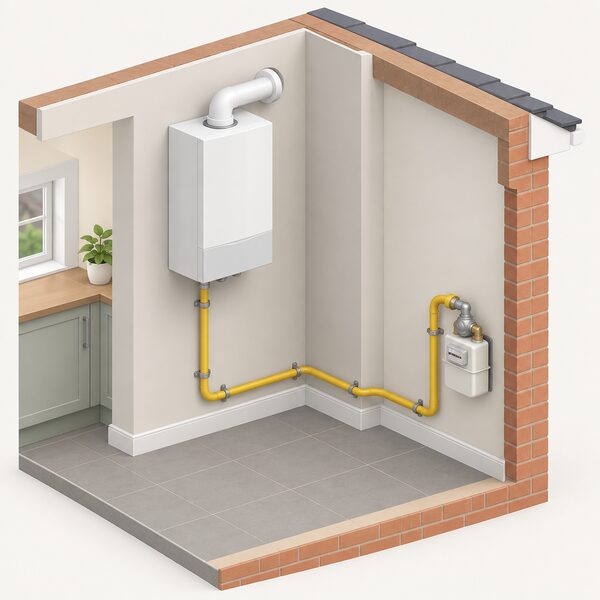
A gas-heated home is not an independent one. The boiler connects to the gas grid to provide fuel when it is needed20, which means a supplier relationship, a network, and exposure to the price of imported and traded gas. The Energy Saving Trust's position is that for a home with a mains gas connection, a modern condensing gas boiler is usually the cheapest to run compared with oil, electricity, LPG and house coal20, so the dependence is often an economically rational one, but it remains a dependence. Off-grid households using LPG trade the network for a tank that must be refilled periodically depending on use20.
What registration provides is a different kind of security: control over who is allowed into that system. The household cannot verify a flue seal or a combustion reading, so the register substitutes a verifiable credential for an unverifiable inspection. Gas appliances run in the background even when heating is off, and faulty appliances can release carbon monoxide23, which is why the annual check by a competent person is the practical safeguard rather than an administrative one.
The limits are worth stating as firmly. Registration confirms legal entitlement and assessed competence in named categories; it does not grade workmanship, guarantee price, or promise that any given engineer is suited to a particular appliance. Gas Safe Register has no control over engineers' charges19. Nor does registration change the underlying economics of gas heating: a gas boiler installation is reported at between £2,500 and £4,500, with a lifespan of 10 to 15 years41, so the same decision returns within a normal tenure of a home, and each time the check of card, categories and register has to be made again. For households considering moving off gas, the parallel credential is MCS certification, and the wider picture sits on the installers and retailers guide and on installers and energy independence.
Sources41 cited
- Gas Safe Register, nidirect, 2025-10-29
- Gas safety in domestic premises: frequently asked questions, Health and Safety Executive, 2026
- Gas appliances: get them checked, keep them safe (INDG238), Health and Safety Executive, 2011-09
- Guidance on system cleaning and commissioning, Heating and Hotwater Industry Council, 2026-09-17
- Domestic gas installation and health and safety, nidirect, 2025-10-28
- Carbon monoxide safety for customers, Energy UK, 2024-11-21
- Gas safety: questions from owner-occupiers, Health and Safety Executive, 2026
- Can you replace your own gas boiler?, Viessmann, 2024-09-30
- Half of households at greater risk of carbon monoxide poisoning, Which?, 2022-09-15
- DESNZ Public Attitudes Tracker: heat and energy use in the home, Winter 2025, Department for Energy Security and Net Zero, 2025
- Gas appliances: get them checked, keep them safe, Health and Safety Executive, 2011-09
- Building regulations guidance: Part J, heat producing appliances, Welsh Government, 2010
- The regulations on gas appliance testing, legislation.gov.uk, 2006-02-15
- Using a Gas Safe engineer, Liquid Gas UK, 2026-09-20
- Registration to carry out gas work, GOV.UK, 2026-09-17
- If you know or suspect you have a gas emergency, IGEM, 2026-09-20
- Gas Safety Week 2025: why it is vital to use a qualified gas engineer, Heating and Hotwater Industry Council, 2025-09-12
- Take no chances with gas safety, Northern Gas Networks, 2026-09-14
- Gas safety: domestic FAQs, Health and Safety Executive, 2026
- Boilers advice, Energy Saving Trust, 2026-05-20
- Building regulations: boilers and heating, Welsh Government, 2026-09-17
- Gas leaks and safety, Uswitch, 2026-06-01
- Summer carbon monoxide awareness, Cadent Gas, 2026-09-20
- My boiler isn't working, Northern Gas Networks, 2026-07-24
- Winter fire safety, Cadent Gas, 2026-09-20
- Boiler servicing, Confused.com, 2025-07-23
- Gas emergencies, Northern Gas Networks, 2025-10-22
- Rogue traders campaign, Chartered Institute of Plumbing and Heating Engineering, 2026-09-20
- Carbon monoxide safety, SGN, 2026
- Trace and Repair scheme, Cadent Gas, 2026-09-20
- Competent person scheme: current schemes and how schemes are authorised, GOV.UK, 2013-04-04
- Boilers and heating: building control, Planning Portal, 2026
- Boilers and heating: building regulations, Planning Portal, 2026
- Building regulations: when you need approval, Planning Portal, 2026
- Building regulations approval: use a competent person scheme, GOV.UK, 2026-09-17
- Choosing a registered electrician, Electrical Safety First, 2026-09-19
- Gas Safety Week 2026: keeping safety at the heart of a changing industry, Association of Plumbing and Heating Contractors, 2026-09-08
- Cold calling: top tips to avoid rogue traders and installers, Energy Saving Trust, 2026-05-20
- Gas Safety Week 2025: top gas safety tips, Heating and Hotwater Industry Council, 2025-09-14
- Under your feet: gas safety, Cadent Gas, 2026-09-20
- Heat pumps versus boilers, The CPA, 2025-02-18
 Gas Safety RulesAnyone working on gas in your home has to be on the Gas Safe Register, whether they are installing, fixing or servicing an appliance.
 Gas Safety in the HomeYour landlord has to arrange a yearly gas safety check by a Gas Safe registered engineer and give you the record if you rent.
 Finding an Insulation InstallerHow to find, verify and check an insulation, glazing or ventilation installer in the UK: the registration schemes, trade bodies and guarantee arrangements that cover the work, how to compare quotes, what a written specification should state, and how complaints and disputes are handled.
 Using an Installer in EnglandHow do you check an installer is registered to sign off their own work, and what happens if they are not?
 Installer QualificationsWhat training and qualifications should a heat pump installer actually have?
 Arrange an Electrical InspectionHow to find and check a registered electrician, what an Electrical Installation Condition Report covers and the intervals usually recommended for owner-occupied homes.