In this guide
HETAS is the only competent person scheme specialising in the installation of solid fuel and biomass appliances, and the only specialist organisation approving biomass and solid fuel heating appliances, fuels and services1. Installing a wood burning stove, a multifuel stove, a solid fuel boiler or a biomass appliance is work controlled under the building regulations, so it has to be signed off by somebody. Using a HETAS registered installer is the route that avoids a separate building control application: a registered installer can self-certify that their work complies, instead of the householder applying for building regulations approval, and there is then no need for a local council or a private approved inspector to check the work3.
In England and Wales it is a legal requirement to notify any solid fuel installation to the relevant Local Authority Building Control, either through a competent person scheme such as HETAS or directly to the council2. The HETAS Certificate of Compliance is the document that does that job: it demonstrates that the installation complies with the relevant building regulations, records the installation and notifies Local Authority Building Control, taking the place of a Local Authority Building Notice4. Competent person schemes issue a certificate within 8 weeks of completion, and that certificate can be used as evidence of compliance and shows up in solicitors' searches when a home is sold3.
Membership of a competent person scheme is voluntary, and HETAS describes itself as a voluntary scheme for installers to sign up to should they wish5. That matters: an installer who is not registered is not acting unlawfully by being unregistered, but the work still has to be notified, and in that case the installer cannot self-certify. The firm or the householder must give notice to the local authority in advance and pay a notification fee6. Ultimately, if the work does not comply, it is the owner of the building who may be served with an enforcement notice7.
What HETAS registration is: the competent person scheme for solid fuel and biomass
Competent person schemes are a way for tradespeople to prove their ability to carry out certain work to the required standards, instead of the householder applying for building regulations approval3. HETAS occupies that role for solid fuel and biomass: it is the only competent person scheme specialising in the installation of those appliances, and the only specialist organisation approving biomass and solid fuel heating appliances, fuels and services1. Government guidance listing the competent person schemes covering renewable technologies including heat pumps names APHC, BESCA, Certsure, HETAS, NAPIT and OFTEC8.
Approval is not a one-off badge. An applicant's work is assessed to check they meet the level of competence required before approval, and there are then ongoing inspections, yearly for the first two years5. Schemes differ in their application processes and their fees, and an installer chooses a scheme that supports their trade or types of work5. Membership remains voluntary, and installers who do not join can still use local council or private inspectors instead5.
HETAS also runs product-side approval. Its Cleaner Choice Product Approval Scheme gives consumers and installers assurance that a listed appliance meets all the relevant UK regulations, including safety and performance requirements, correct operation and correct installation for HETAS installers9. Separately, HETAS has launched a registration scheme for engineers to demonstrate competency in the servicing and maintenance of domestic and commercial biomass appliances, which extends the scheme beyond the initial installation into the appliance's working life1.
For a household pursuing energy independence, that structure matters in a practical way. A stove or a biomass boiler is one of the few heat sources that can run without a grid connection or a gas supply, but it is also a combustion appliance in a living space with a flue, a hearth and a ventilation requirement. The scheme is the mechanism by which that risk is checked. Further detail on how the various schemes compare sits on the page covering competent person schemes.
Why stove and biomass installations fall under the building regulations
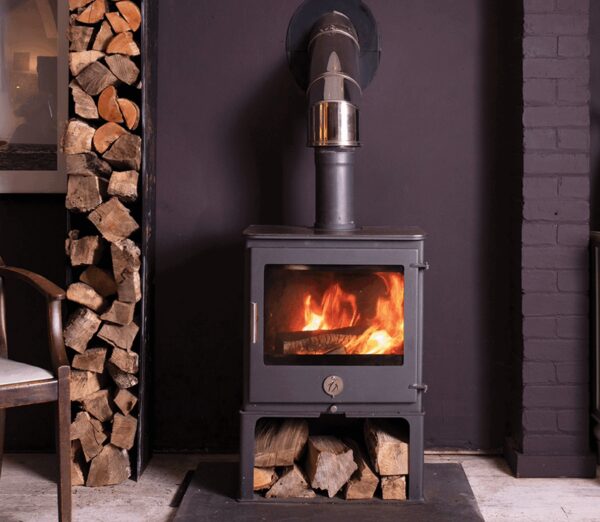
Building regulations set standards for the design and construction of buildings to ensure the safety and health of people in or around those buildings, and also include requirements to ensure that fuel and power is conserved10. They apply where you put up a new building, extend or alter an existing one, or provide services and fittings in a building, a category that expressly includes fuel burning appliances of any type7. The installation or extension of a service or fitting controlled under the regulations is itself defined as building work7.
For biomass specifically, the position is stated plainly: if you wish to install a biomass appliance, building regulations apply12. The same wording appears in Welsh Government guidance13. In Northern Ireland, guidance for householders describes the installation of wood burning and multifuel stoves, or any solid fuel appliance, as work that is controlled under the building regulations, as is the relining or installation of flues and chimneys associated with such heat producing appliances14.
A second principle runs alongside this and often catches people out on older properties. Works must not make other fabric, services and fittings less compliant than they were before, or dangerous15. The worked example given is replacement double-glazing, which must not make compliance worse in relation to means of escape, air supply for combustion appliances and their flues, and ventilation for health7. A household that fits a stove and later replaces its windows can therefore create a compliance problem in the ventilation the stove depends on, even though each job looked separate.
Where a flue is fitted externally, siting rules can also apply. In conservation areas, World Heritage sites, national parks, areas of outstanding natural beauty and the Broads, the flue should not be fitted on the principal or side elevation if it fronts a highway16. Installation of a flue should be carried out by a suitably qualified installer17. Building regulations approval is a separate matter from planning permission, and neither substitutes for the other10.
What a registered installer can self-certify, and what they cannot
Approved installers who join a competent person scheme can self-certify certain types of building work, instead of getting building regulations approval5. The consequence for the householder is direct: there is no need to get a local council to check the work, and no need to get a private approved building inspector to check it either5. Planning Portal guidance on fitting a log burner states that it is recommended that you use a HETAS-registered installer who can certify the work18. A registered installer is approved to carry out the work to comply with building regulations without involving local authority building control, and a certificate is issued on completion19.
The boundary is the installer's own work. HETAS is unambiguous:
"A HETAS Registered Installer can only notify work they have carried out themselves."
That closes off the most common workaround, which is asking a registered installer to notify a stove fitted by an unregistered fitter or by the householder. Where the installer is not registered, they cannot self-certify, and the firm or the household must give notice to the local authority of the intention to carry out the work in advance and pay a notification fee6. The equivalent rule is stated across other technologies: where work is not done by a person registered with the competent person scheme, the relevant building control authority must be notified20.
Self-certification is also limited by scheme scope. An installer registers for the trade and types of work their scheme supports5. Solid fuel fired boilers require an installer registered with the competent person schemes, and the same guidance applies separately to oil fired boilers21, where OFTEC registration is the relevant route. Electrical work associated with an installation is a further distinct matter: a qualified installer, registered or not, should give a signed BS 7671 electrical safety certificate for all types of electrical work22.
The certificate issued on completion, and how it shows up when a home is sold
Under a competent person scheme, the installer should both notify the local authority of the work and issue a certificate of compliance with building regulations, either directly or through their scheme operator23. When work is complete you will receive a certificate showing the work was done by a registered installer24. The certificate arrives within 8 weeks of completion, can be used as evidence of compliance, and will show up in solicitors' searches if you come to sell your home3.
For solid fuel, the specific document is the HETAS Certificate of Compliance. It demonstrates that the installation complies with the relevant building regulations, and the information on it is used to record the installation and notify Local Authority Building Control in England and Wales, taking the place of a Local Authority Building Notice4. Guidance on selling a property lists a Building Regulations Completion Certificate from the installation contractor for notifiable work as something that should be provided when the property is sold26.
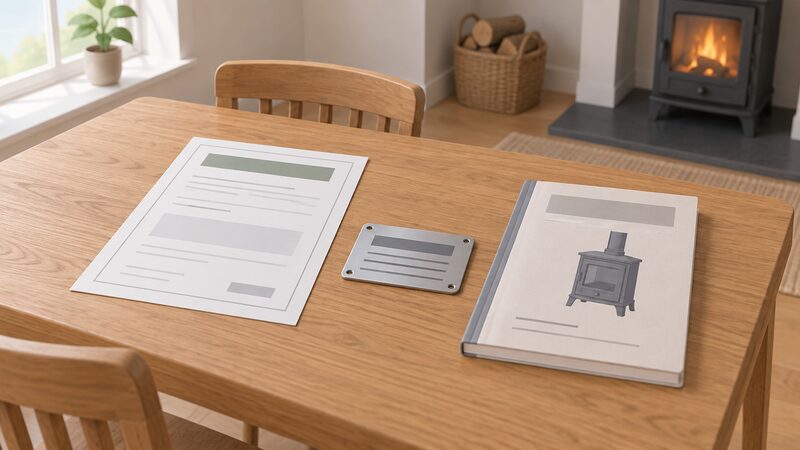
HETAS lists the items that should be in place before a newly installed appliance is used:
An operating manual for the installed appliance should also be received, and many manuals can be found through the HETAS Approved Product search or from the manufacturer4. After servicing by a HETAS Approved Servicing Technician, a servicing and safety record sheet is presented to the homeowner, confirming any remedial work required and what checks and tests were carried out during the service25.
If a Certificate of Compliance is wrong, the route depends on age and registration status.
| Situation | Route |
|---|---|
| Installation less than 6 months old, installer still HETAS Registered | Contact the installer to issue a new certificate, then contact the Consumer Support Team to remove the incorrect record4 |
| Installation older than 6 months, or installer no longer HETAS Registered | Contact the HETAS support team by email or call 01684 2152154 |
Competent person schemes also carry insurance-backed guarantees and complaints procedures if there is a problem with the work3. What those cover in practice is set out on the pages for insurance-backed guarantees and the certificates issued on completion.
The Approved Biomass Maintenance Scheme: servicing and boiler notification
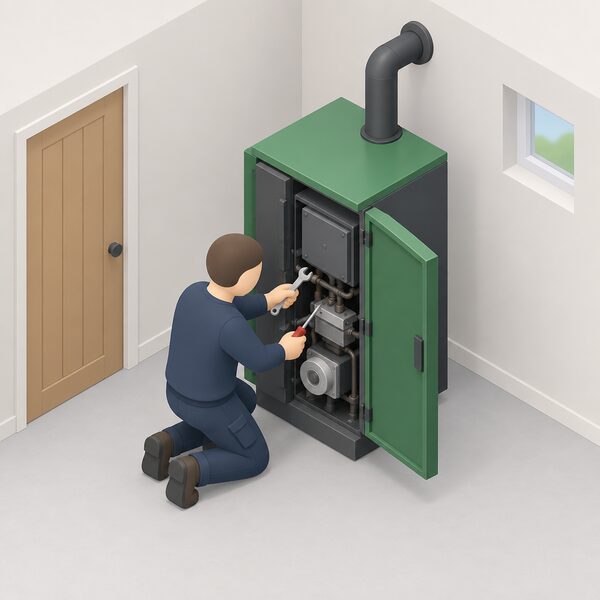
Installation is only half the picture for a biomass boiler. HETAS runs a scheme recognising competent maintenance businesses and individuals that can carry out manufacturers' required appliance maintenance1. Its original purpose was to meet the requirements placed on commercial, non-domestic, Renewable Heat Incentive recipients to prove their appliance is properly maintained1. HETAS states that, in line with the amended regulations, it operates the only scheme registering competent maintenance businesses that can provide evidence of satisfactory planned preventative maintenance27.
Notification under the scheme is closed to outsiders in the same way installation notification is. Only businesses registered on the HETAS Approved Biomass Maintenance Scheme can notify boilers to issue a HETAS document for maintenance completed by them27. The registered business completes a notification of maintenance via the HETAS online portal, which provides a record of all notified activities, and a notification is then issued electronically by HETAS to the client27. HETAS notes that it may be requested to provide electronic notification data to Ofgem27.
On choice of maintainer, HETAS states there is no requirement to appoint a business that has your boiler manufacturer listed in its search criteria, but advises recipients to select carefully, because the boiler manufacturer may stipulate that only their trained personnel can maintain the appliance27. That is a real constraint on independence: a household can be tied to a single manufacturer's network for the life of the appliance, whatever the scheme allows.
How to check an installer is registered, and getting quotes
The general rule across heating work is stated the same way in each nation's guidance: compliance is generally achieved by employing an installer who is registered under an approved scheme21. For a solid fuel fired boiler, the installer should be registered with one of the relevant competent person schemes6. HETAS maintains the register for solid fuel and biomass, and the Certificate of Compliance itself records the installer's registration, which is why a certificate that never arrives is the first warning sign worth acting on.
On pricing, HETAS says it would always recommend obtaining at least 3 quotes to ensure you receive the best price for the service required, and repeats the suggestion of at least 3 installers when seeking re-commissioning work on an existing appliance2. The same figure appears in council guidance on renewable installations, which advises getting at least three quotes from reputable installers29. Comparing three quotes is also the practical way to see differences in scope: flue lining, hearth construction, ventilation provision and the supply of a carbon monoxide alarm are often the reason two prices differ. Further detail sits on the pages covering getting installation quotes and comparing installation quotes.
Checks worth making before signing:
- That the installer is registered for the specific type of work, since scheme registration follows the trade and types of work supported5
- That the quote states who notifies the local authority and issues the certificate23
- That a carbon monoxide alarm, notice plate and manufacturer's instructions are included2
- That any associated electrical work will come with a signed BS 7671 certificate22
- For grant-funded work, whether TrustMark registration is also required30
Where an installer claims registration they do not hold, the route for raising it is covered on the page about reporting an unregistered stove installer, and the meaning of the different marks on appliances and vans is covered under HETAS logos.
Where liability sits if the work is not compliant
The blunt position in Planning Portal guidance is that if you are the owner of the building, it is ultimately you who may be served with an enforcement notice if the work does not comply with the regulations7. The same wording appears in the Welsh guidance31. Council guidance puts it more simply still: ensuring your home improvements comply with building regulations is your responsibility32. Where a builder is employed, the responsibility will usually be theirs, but the guidance advises confirming that at the very beginning7. Non-compliant work may have to be corrected, or a fine paid3.
Government guidance on energy devices puts both parties in the frame for England and Wales: the installation contractor has a responsibility to ensure the work complies with building regulations, and the device owner may also have a responsibility and could be served with an enforcement notice in cases of non-compliance26. The pattern recurs across technologies, with local authorities able to serve an enforcement notice where an installer does not adhere to building regulations33.
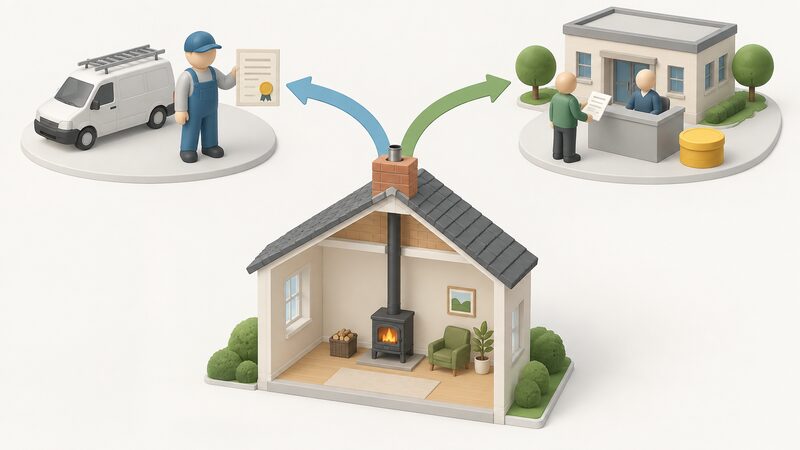
The practical consequence arrives at sale. Because scheme certificates show up in solicitors' searches3, an unnotified stove is discovered by the buyer's solicitor rather than by the household, at the point where it is hardest to fix. Options at that stage are constrained by the rule that a registered installer can only notify work they carried out themselves2. What to do when work turns out to be defective is covered under poor quality installations and complaining about an installer.
HETAS and TrustMark: two schemes doing different jobs
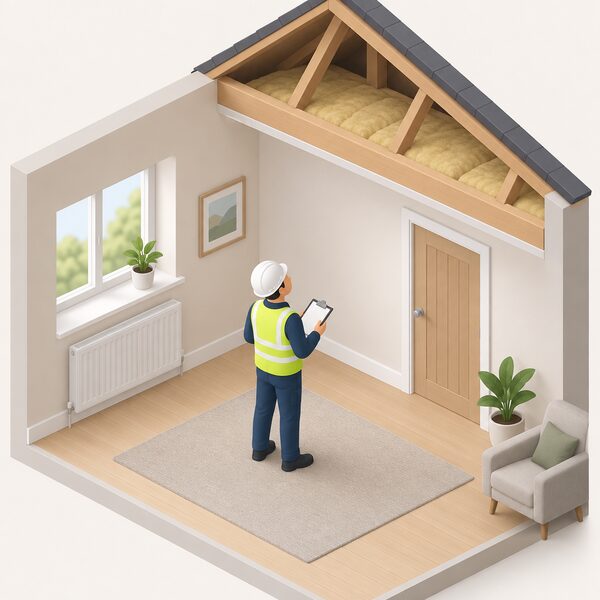
HETAS answers the building regulations question. TrustMark, described as a government endorsed quality scheme, answers the funding and consumer protection question34. The two are not alternatives, and for grant-funded work a household may need both.
| Scheme or programme | Installer requirement |
|---|---|
| Energy Company Obligation | Installers must be TrustMark accredited and will have a registration number, except installers of district heating connections30 |
| ECO4 delivery guidance | Measures should be installed by or under the responsibility of a TrustMark registered installer with a relevant certificate of lodgement for measures covered by PAS, including MCS35 |
| Warm Home Discount (England and Wales) Regulations 2026 | A boiler or central heating system must be installed by, or under the responsibility of, a person registered with TrustMark, with a certificate of lodgement issued by the operator of TrustMark36 |
| Green Homes Wales loans | The installer must be registered with TrustMark and remain registered until the work is complete, and must not be the borrower or a member of their household or immediate family37 |
| Green Homes Grant Voucher Scheme (closed) | Tradespeople had to be registered with TrustMark to be eligible26 |
TrustMark itself is described as a competent person register for finding an installer who will assess your circumstances and property to identify suitable measures38, and it requires a minimum two-year warranty for work, plus a minimum 25-year guarantee for certain measures installed under ECO39. TrustMark can be reached on 0333 555 123440.
The Scottish Government has consulted on a Heat and Energy Efficiency Technical Suitability Assessment, exploring whether it might become a condition of particular government regulations or funding programmes, as MCS or TrustMark currently are42. More on the scheme itself is on the page for TrustMark registered businesses, and on the funding side under installer requirements for grants.
Where the rules differ across the four nations
Competent person scheme notification is an England and Wales mechanism. HETAS states that the notification regulations do not apply in Scotland, Northern Ireland, the Republic of Ireland or the Isle of Man, and that consumers in those places should contact their relevant local authority before commencing work4. Customers using a HETAS Registered Installer in England and Wales receive a Certificate of Compliance9; households elsewhere in the UK need to establish the local route first.
| Nation | Position |
|---|---|
| England | Legal requirement to notify solid fuel installations to Local Authority Building Control, via a scheme such as HETAS or directly to the council2 |
| Wales | Same notification requirement; building regulations apply to installing a biomass appliance, and compliance is generally achieved by using an installer registered under an approved scheme2 |
| Scotland | Competent person notification regulations do not apply; contact the local authority before starting work. Building regulations were revised to amend Section 0 General, Section 2 Fire, Section 3 Environment and Section 4 Safety in the technical handbooks for use from 6 April 20264 |
| Northern Ireland | Competent person notification regulations do not apply; installing a wood burning, multifuel or any solid fuel appliance is controlled work, as is relining or installing the associated flue or chimney4 |
Detector requirements also differ. Under Scotland's tolerable standard, carbon monoxide detectors must be fitted in all rooms used for living accommodation where there is a fixed combustion appliance or a flue, excluding an appliance used solely for cooking44. HETAS lists a carbon monoxide alarm among the items that should be in place before a new appliance is used, wherever it is installed2.
Nation-specific routes are set out on the pages for installers in England, installers in Scotland, installers in Wales and installers in Northern Ireland. The wider picture on choosing and checking a trade sits on the installers and retailers pillar.
What registration does and does not buy a household
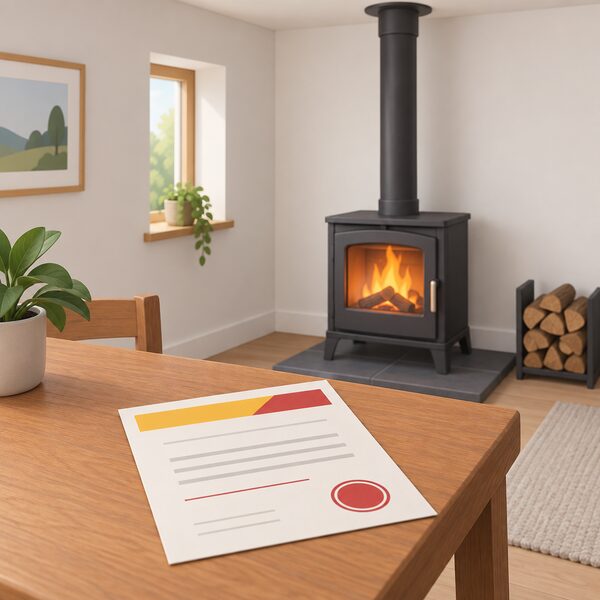
A stove or biomass boiler is one of the more genuinely independent heat sources available to a UK home: fuel can be bought locally or gathered, and the appliance needs no gas connection. Registration does not change that, but it changes what the household is exposed to. A scheme certificate is the evidence of compliance that survives a conveyancing search3, it comes with an insurance-backed guarantee and a complaints procedure3, and it removes the separate building control application and its fee5.
The dependencies that remain are worth stating. Registration is voluntary, so the register is not a complete list of competent fitters5. The certificate covers compliance at installation, not the appliance's performance over time. For a biomass boiler, the manufacturer may stipulate that only their trained personnel can maintain the appliance, which ties servicing to one company regardless of what the maintenance scheme permits27. And notification is closed to retrospective fixes, because a registered installer can only notify their own work2. The paperwork has to be got right at the time, or it is the building owner who carries the enforcement risk7.
Sources44 cited
- HETAS biomass maintenance scheme, HETAS, 2026
- HETAS consumer FAQs, HETAS, 2026-04-01
- Use a competent person scheme, GOV.UK, 2026-09-17
- HETAS Certificates of Compliance, HETAS, 2026-03-31
- Building work: competent person schemes, GOV.UK, 2026-09-17
- Boilers and heating: building regulations, Planning Portal, 2026
- When you need building regulations approval, Planning Portal, 2026
- Future Homes and Buildings Standards consultation response, GOV.UK, 2026-03
- HETAS consumer information, HETAS, 2024-01-29
- Difference between planning permission and building regulations, Planning Portal, 2026-09-17
- Building regulations and planning permission compared, Planning Portal, 2026-09-17
- Biomass fuelled appliances: building regulations, Planning Portal, 2026
- Building regulations: biomass fuelled appliances, Welsh Government, 2026-09-17
- Stove guidance for householders, Building Control Northern Ireland, 2015-11
- Building regulations overview, Planning Portal, 2026
- Boilers and heating: flues and permitted development, Planning Portal, 2026-09-17
- Building regulations: flue, chimney or soil and vent pipe, Welsh Government, 2026-09-17
- Building control and log burner installation, Planning Portal, 2026
- Doors and windows: building regulations, Planning Portal, 2026
- Electric vehicle chargers: building regulations, Planning Portal, 2026
- Building regulations: boilers and heating, Welsh Government, 2026-09-17
- Quick guide to the building regulations, Welsh Government, 2021-12
- Building work: competent person schemes, Welsh Government, 2023-04-05
- Building regulations: doors and windows, Welsh Government, 2026-09-17
- HETAS advice on moving home, HETAS, 2026
- Register energy devices in homes or small businesses, GOV.UK, 2021-03-31
- HETAS biomass maintenance FAQ, HETAS, 2022-12-08
- Domestic RHI essential guide, Ofgem, 2024-07
- Solar panels and finding certified installers, Hammersmith and Fulham Council, 2026-09-17
- Energy Company Obligation: homeowners and tenants, Ofgem, 2026-09-17
- When you need approval: your responsibilities, Planning Portal Wales, 2026
- Building regulations approval for homeowners, Solihull Council, 2026-09-17
- Building regulations guidance for renewables, Bedford Borough Council, 2026-09-17
- Grants and loans to improve home energy efficiency, Bristol City Council, 2026
- ECO4 delivery guidance version 4.0, Ofgem, 2026-03-26
- The Warm Home Discount (England and Wales) Regulations 2026, legislation.gov.uk, 2026-03-27
- Green Homes Wales loan standard terms and conditions, Development Bank of Wales, 2026-09-17
- Energy Company Obligation scheme and home energy efficiency, Leeds City Council, 2026-09-20
- Energy efficiency schemes research briefing, UK Parliament, 2026-05-13
- Written statement on support for householders after ECO scheme closure, Welsh Government, 2026-03-13
- Public Accounts Committee report on energy scheme oversight, UK Parliament, 2026-01-23
- HEETSA scoping consultation and partial BRIA, Scottish Government, 2025-06-06
- Monitoring and improving building regulations, Scottish Government, 2026-04-06
- Tolerable standard guidance on fire and carbon monoxide detection, Scottish Government, 2023-06-20
 Installer QualificationsWhat training and qualifications should a heat pump installer actually have?
 Certificates You Should ReceiveAfter work like solar panels or a new boiler, what paperwork should you actually be handed, and by when?
 Building Regulations EnglandAdding a heat pump, solar panels or an extension usually needs building regulations approval, and it is separate from planning permission.
 Gas Safety RulesAnyone working on gas in your home has to be on the Gas Safe Register, whether they are installing, fixing or servicing an appliance.
 Electrical Safety RegulationElectrical work at home raises real questions about who can do it, what needs signing off, and what paperwork you should keep.
 Installer Schemes and CodesCheck whether your installer is on TrustMark, and whether they belong to HIES or the Renewable Energy Consumer Code.