In this guide
A manufacturer approved installer is a firm the maker of your boiler, heat pump or solar equipment has trained and listed on its own network. What that approval buys is narrower than the phrase suggests. It is not a licence to work, and it is not a substitute for Gas Safe registration, MCS certification or a competent person scheme membership. It is a commercial relationship between a maker and an installer, and its most concrete output is usually a longer warranty on the product.
The warranty is where approval shows up in figures. Daikin states that a 7 year warranty on its air-to-water heat pumps is paid for and applies only if the installer is a Sustainable Home Expert, and that a heat pump installed by a Sustainable Home Installer can claim a warranty extension of up to 3 years completely free1. Hybrid systems installed by a Sustainable Home Expert extend up to 7 years1. Those terms are set by the maker, apply to the maker's own products, and depend on which tier of the network the installer holds.
Everything else that protects a household comes from elsewhere: the building regulations notification route, the consumer code the installer belongs to, and the insurance-backed guarantee behind the workmanship. This page sets out what each layer covers, where they overlap, and what remains outside all of them.
What "manufacturer approved installer" actually means
The phrase describes a training and listing arrangement, not a statutory status. A maker decides which firms it will train on its products, what technical support they receive, and what the firm may call itself in the market. The Benchmark scheme documentation, which sits behind most boiler warranties, describes the framework: installers are supplied with the means, including documentation, training and technical support, to competently carry out and notify installation, commissioning and servicing work, in accordance with the manufacturer's instructions5.
That is the substance of approval. It is product-specific knowledge, backed by a maker's technical line, and it is the reason a maker will extend a warranty to work done by a firm it has trained. It says nothing about whether the firm is competent to work on gas, to certify electrical work, or to claim a government grant.
The legal permissions come from separate registers. For gas appliances, official guidance states that if you employ a registered installer with the relevant competencies to carry out the work on gas appliances, they should be able to self-certify the work without the need for close involvement of building control6. For electrical work in homes and gardens, guidance recommends hiring an installer registered with a competent person scheme, a registered competent person, who can self-certify that the work meets the required standards7. A manufacturer network membership does not confer either.
The practical consequence is that a household can meet three different firms in one job: the maker's approved installer, the Gas Safe registered engineer who signs off the gas side, and the MCS certified contractor who certifies the renewable installation for grant purposes. Often one firm holds all three. Where it does not, the approvals do not transfer between them.
What approval buys you: warranty terms that depend on the installer

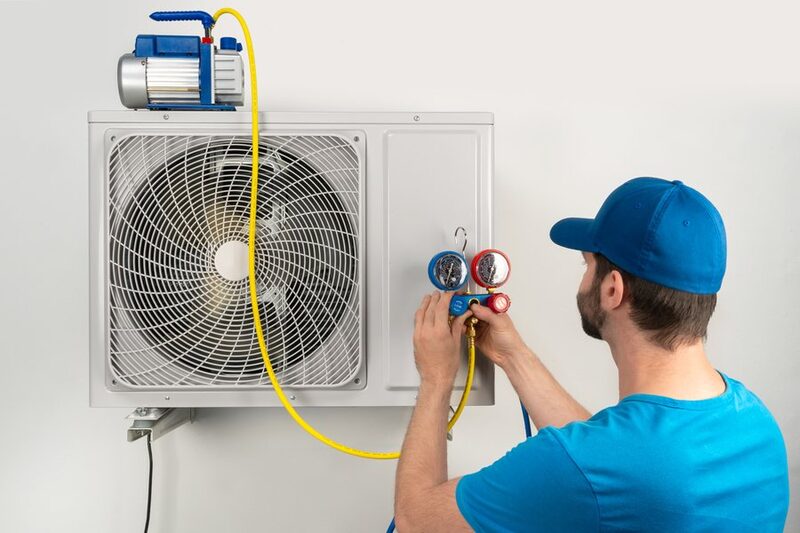
Warranty length is the clearest thing approval changes, and the terms are set by the maker for its own products. Daikin's published position is tiered. A 7 year warranty is available on a paid basis and only if the installer is a Sustainable Home Expert1. An air-to-water heat pump installed by a Sustainable Home Installer can claim a warranty extension of up to 3 years completely free1. Where the installer is a Sustainable Home Expert, the household can purchase an additional 2 years, taking the total to 7 years1. Hybrid systems installed by a Sustainable Home Expert extend up to 7 years1.
Read together, those terms mean the same Daikin product carries different warranty cover depending on which tier of the network fitted it. The maker is pricing risk: a firm it has trained and monitors is a lower warranty risk than one it has not.
"If your heat pump was installed by a Daikin Sustainable Home Installer, you can claim a warranty extension up to 3 years"
The conditions attached to a warranty are not only about the installer. Independent guidance states that if a boiler is still under its manufacturer's warranty, not getting it serviced every year might invalidate its protection policy8. Annual servicing is therefore a live condition on the cover, separate from who installed the appliance. The Benchmark Checklist matters here too: the installer is required to have fully completed the Benchmark Checklist on the inside back pages of the installation instructions supplied with the product, and the householder signs it to confirm they have received a full and clear explanation of its operation5. That signed checklist is the record a maker will ask for when a warranty claim is made.
For a household, the independence question is straightforward. A longer warranty is real value, but it is value tied to one maker's product and one maker's network. It does not make the household any less dependent on that manufacturer for parts, on the installer for servicing, or on the gas or electricity supply the appliance runs on.
Workmanship guarantees and insurance-backed cover: IBGs versus manufacturer warranties
Two different guarantees are often described as if they were one. A manufacturer's warranty covers the product: if a component fails within the term, the maker repairs or replaces it. An insurance-backed guarantee covers the installation: the quality of the work and the labour that went into it.
The MCS position is explicit. An Insurance Backed Guarantee is an insurance policy that backs the original guarantee given by a contractor, and for domestic installations an IBG is required2. It provides a consumer with cover for an installation in the event that their MCS certified contractor ceases to trade during the term of the guarantee2. The workmanship guarantee itself must be insured to ensure that this workmanship guarantee will be honoured if the company ceases to trade2.
That distinction matters most in the failure case. If the installer goes out of business, the manufacturer's warranty on the boiler or heat pump usually survives, because it is the maker's obligation. The workmanship guarantee does not survive on its own: it needs the insurance behind it. A household that has an IBG is covered for the installation; one that has only a maker's warranty is covered for the parts.
The two also have different triggers. A warranty claim usually needs the Benchmark Checklist, the annual service record and proof of installation by an approved firm. An IBG claim needs the guarantee document and evidence that the contractor has ceased trading. Keeping both sets of paperwork is what makes either claim workable.
Gas Safe and MCS: the two registrations behind approval

Manufacturer approval sits on top of two registrations that carry legal and scheme weight. The first is Gas Safe registration for gas work. The second is MCS certification for renewable installations, and MCS itself has a precondition that shapes who can hold it.
MCS states that a requirement of companies wanting to gain MCS certification is that they are members of a CTSI Approved Consumer Code of Practice scheme in the first instance9. So an MCS certified installer is, by definition, also signed up to a consumer code with a complaints route. That is a structural protection, not a marketing claim.
For grant-funded work the requirement is tighter still. To participate in the Boiler Upgrade Scheme, installers working with consumers must be MCS-certified and members of a consumer code approved by the Secretary of State10. A manufacturer network membership does not satisfy that test on its own.
The building regulations route is the third layer, and it applies whether or not a grant is involved. Most work requires using an installer registered with a competent person scheme or seeking approval from a Building Control body11. Where a registered installer is used, they are approved to carry out the work to comply with building regulations without involving local authority building control, and a certificate is issued on completion12. Where the installer is not registered, approval can be sought from the relevant Building Control Body, either at the local authority or a registered building control approver, who check compliance and issue a certificate of compliance if satisfied12. Installers who do not join a scheme can still use local council or private inspectors13.
| Layer | What it covers | Who sets it |
|---|---|---|
| Manufacturer network | Product training, technical support, extended warranty terms | The maker1 |
| Gas Safe registration | Competence to work on gas appliances, self-certification of that work | Official guidance6 |
| MCS certification | Renewable installation standards, grant eligibility, consumer code membership | MCS and the Secretary of State9 |
| Competent person scheme | Building regulations compliance and self-certification | Official guidance11 |
For a household, the layers answer different questions. Manufacturer approval answers "will the warranty be extended". Gas Safe and MCS answer "is this work lawful and certifiable". The competent person scheme answers "will I get a certificate without a separate building control application". A firm that holds all four is doing the same job as four separate trades would, with one point of contact.
Genuine parts and why approved networks insist on them
Approved networks require products to be installed, commissioned, serviced and used in accordance with the manufacturer's instructions provided5. That instruction is the reason networks push genuine parts: a warranty claim on a component that was not fitted to specification is a claim the maker can decline.
The Benchmark Checklist is the enforcement mechanism. The installer must have fully completed the Benchmark Checklist on the inside back pages of the installation instructions supplied with the product, and the householder signs it to confirm they have received a full and clear explanation of its operation5. The checklist records the appliance, the installation details and the commissioning readings. It is the document a maker reads first when something fails.
For households, the practical point is that the paperwork is part of the product's cover, not an administrative extra. A boiler or heat pump installed to specification but without a completed checklist leaves the warranty in a weaker position than one installed with it. The same logic runs through the grant schemes: evidence of compliant installation is what unlocks the money.

How the quote process works: postcode, property visit, no-obligation quote
The quote process for approved network work follows the same shape as any other installation quote, with one procedural difference that depends on the installer's registration. Where a boiler is fitted by an installer who is not registered under a competent person scheme, the installer cannot self-certify, and the firm or the householder must give notice to the local authority of the intention to carry out the boiler work in advance and pay a notification fee4. That is a cost and a delay that a registered installer avoids.
For renewable work, the quote is also the entry point to grant funding. Under the Boiler Upgrade Scheme, the application is installer-led, with the installer applying for the grant on the property owner's behalf14. The grant is applied upfront as a discount to the cost of the installation, and the householder does not receive the grant directly: it is paid to the installer15. Installers must deduct the full Boiler Upgrade Scheme grant value from the quote before any payment is made by the property owner3. Ofgem pays the installer when the installer redeems the voucher, with the owner benefiting through the reduced upfront cost16.
The scheme provides upfront capital grants to support the installation of heat pumps and biomass boilers in homes and non-domestic buildings17, and the government has stated its intention to implement the requirement in regulations for installers to deduct the grant amount from the upfront costs of the eligible plant18.
Where a scheme loan is involved, the quote becomes a formal document. Under the Green Homes Wales loan, the borrower must provide the Development Bank of Wales with a copy of the quotation provided by the installer, in the form required by the scheme, and all information must be true, accurate and complete19. A change of installer or measure before work starts requires the bank to be contacted and the offer re-validated, with no guarantee that approval will be granted, particularly if the change would result in an additional amount of Installation Grant being payable19.
MCS umbrella schemes: how gas installers get MCS sign-off without the paperwork
An umbrella scheme lets one organisation hold the MCS certification and handle the compliance work while another firm carries out the installation. Mitsubishi Electric and Alto Energy launched one in June 2026, letting gas boiler installers deliver Ecodan heat pump installations with Alto Energy handling MCS compliance, commissioning, certification and grant paperwork20.
The model exists because MCS certification is a company-level status with ongoing obligations, including membership of a consumer code9. A heating engineer who has spent a career on gas boilers may not want to build that administrative structure. An umbrella scheme separates the certification from the labour.
For households, the arrangement changes who is accountable for what. The installing firm does the physical work; the umbrella organisation holds the certification that makes the installation eligible for grant funding and issues the compliance paperwork. Where a grant is claimed, the requirement that installers be MCS-certified and members of an approved consumer code10 is met through the umbrella rather than by the firm on the doorstep.
The building regulations position is broadly similar. MCS certified installers generally do not need to submit a Building Regulations Application, but should check with local Building Control21. That is a general statement rather than a blanket exemption, and it is the reason the certification route and the notification route are usually described together.
Daikin KEY EXPERT and KEY SPECIALIST: where installer status changes the warranty length

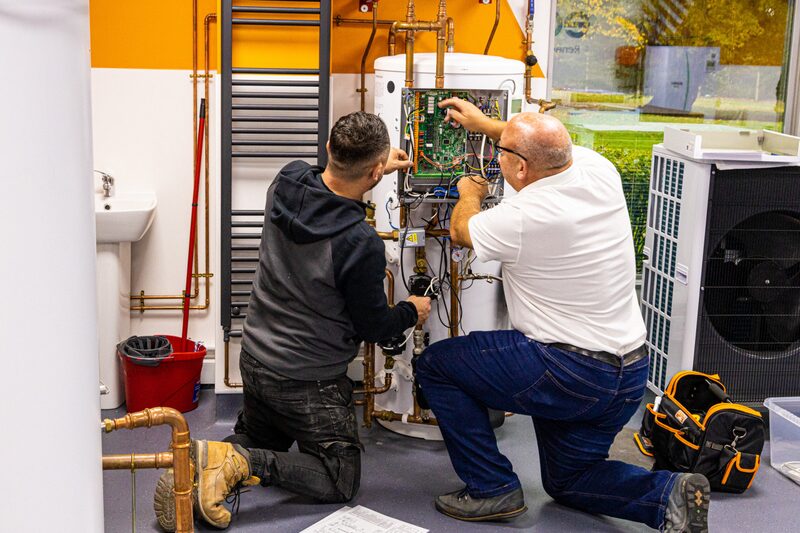
Daikin's network is the clearest worked example in the UK market of installer status changing the warranty a household receives. The tiers are named, and the terms attached to each are published.
| Installer status | Product | Warranty outcome |
|---|---|---|
| Daikin Sustainable Home Installer | Air-to-water heat pump | Up to 3 years extension, completely free1 |
| Daikin Sustainable Home Expert | Air-to-water heat pump | Additional 2 years purchasable, total 7 years1 |
| Daikin Sustainable Home Expert | Hybrid system | Up to 7 years1 |
| Daikin Sustainable Home Expert | 7 year warranty | Paid, and only with a Sustainable Home Expert installer1 |
The pattern is worth reading carefully. The free extension is attached to the lower tier; the paid extension to the higher one. A household comparing two quotes for the same Daikin unit may find the warranty differs by up to three years depending on which tier the installer holds, and that the longer cover carries a cost.
That is a commercial arrangement between maker and installer, and it is the household that experiences it as warranty length. It does not change the product, the installation standard or the grant position. It changes what happens if a component fails in year four.
Nationwide coverage and regional networks: Cornwall, Leeds, Devon and Northern Ireland
Manufacturer networks are national in name and uneven in practice. Coverage depends on how many firms in a given area have taken up the training, and on how far an installer will travel. No regional installer counts are published, so no coverage map can be given.
What can be said is that some infrastructure work is genuinely nationwide and some is not. NIE Networks maintains the meters at the properties of all customers across Northern Ireland no matter who your supplier is22, and all employees of NIE Networks will carry identification, wear identifiable uniforms and drive marked vehicles22. That is a network operator's own workforce, not a manufacturer network, and it illustrates the difference between a nationally mandated service and a commercially recruited one.
For grant-funded work, the installer requirements are national but the administration differs. TrustMark accredited private installers will carry out the installation work under ECO4 Flex23. For heat pumps, official guidance points to an installer who preferably belongs to either the Microgeneration Certification Scheme or the relevant Competent Person Scheme24. For electric vehicle chargepoints, guidance recommends using a reputable company and ensuring the installer has the relevant qualifications25.
A household in Cornwall, Leeds, Devon or Northern Ireland is therefore looking for the same set of registrations as anywhere else, and the practical question is which local firms hold them. The registrations are checkable; the network membership is a maker's list.
Approved installer or independent engineer: which route suits which job
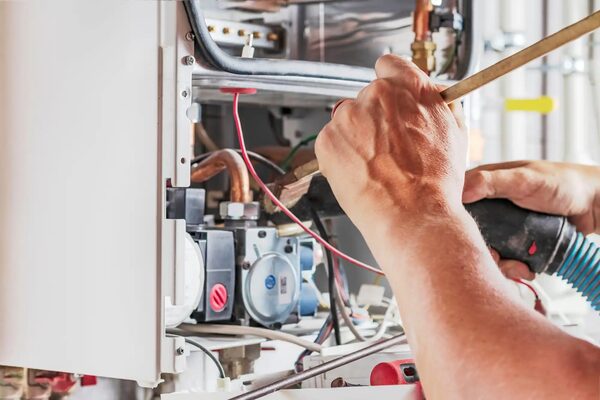
The choice is not between a good route and a bad one. It is between two sets of paperwork, and the job determines which set matters.
Where a maker's extended warranty is the priority, an approved network installer is the only route to it, because the terms are conditional on installer status1. Where the priority is a grant, the requirement is MCS certification and membership of an approved consumer code10, which an approved network installer may or may not hold. Where the priority is a building regulations certificate without a separate application, the requirement is competent person scheme registration11.
| Situation | Registration that carries the weight |
|---|---|
| Extended product warranty | Manufacturer network membership1 |
| Gas appliance work | Gas Safe registration6 |
| Grant-funded renewable installation | MCS certification plus approved consumer code10 |
| Building regulations certificate without a separate application | Competent person scheme11 |
| Work by an unregistered installer | Building Control approval and a notification fee4 |
The independence question runs underneath all of it. A manufacturer approved installer ties the household to one maker's product range, one maker's parts supply and one maker's warranty terms. An independent engineer may fit a wider range of equipment but cannot offer the extended warranty. Neither route removes the household's dependence on the gas network, the electricity grid or the manufacturer's spare parts operation. What both can do is put the installation on a register that can be checked, and leave the household with certificates that outlast the firm that issued them.
Sources25 cited
- Daikin residential warranty terms, Daikin, 2026-09-17
- Insurance backed guarantee products, MCS, 2026-05-13
- Boiler Upgrade Scheme guidance for installers, Ofgem, 2026-07-02
- Boilers and heating: building regulations, Planning Portal, 2026
- HHIC Benchmark scheme documentation, HHIC, 2026-09-17
- Boilers and heating: competent person self-certification, Planning Portal, 2026
- Electrics: building regulations general information, Planning Portal, 2026
- Getting the best boiler service, Which?, 2025-09-17
- Renewable Energy Consumer Code, Chartered Trading Standards Institute, 2026-09-20
- Boiler Upgrade Scheme guidance for property owners (draft v5), Ofgem, 2026-03-25
- Building regulations: electrical work in Wales, Welsh Government, 2026-09-17
- Doors and windows: building regulations, Planning Portal, 2026
- Building regulations: competent person schemes, GOV.UK, 2026-09-17
- Boiler Upgrade Scheme, Find Government Grants, 2026-09-18
- Boiler Upgrade Scheme guidance for property owners v5, Ofgem, 2026-04-28
- Boiler Upgrade Scheme guidance for property owners v5.1, Ofgem, 2026-07
- Boiler Upgrade Scheme quarterly report, issue 17, Ofgem, 2026-08-31
- Amendments to the Boiler Upgrade Scheme: government response, Department for Energy Security and Net Zero, 2025-11
- Green Homes Wales loan standard terms and conditions, Development Bank of Wales, 2026-09-17
- Mitsubishi Electric and Alto Energy launch MCS umbrella scheme, Mitsubishi Electric, 2026-06-17
- Barcud solar panel installation scheme specification, Sell2Wales, 2026-06-15
- Meter replacements, NIE Networks, 2026-09-19
- ECO4 Flex, South Cambridgeshire District Council, 2026-09-17
- Building regulations: heat pumps, Welsh Government, 2026-09-17
- Electric vehicle charging: building regulations, Planning Portal, 2026-09-17
 Energy Independence and MakersWhich brands let you keep control of your heating, solar or car charging, and which tie you to their app and their cloud?
 The Full Brands GuideWhich boiler, heat pump or solar brand can you trust, and who actually owns it?
 Manufacturer WarrantiesHow long does a boiler, heat pump or solar panel warranty actually last, and what do you have to do to keep it valid?
 Buying Direct or Via InstallerCan you buy a heat pump yourself and still get the grant, or does it have to go through an installer?
 The Full Installers GuideHow do you find an installer you can trust, and what should you check before signing anything?
 Checking an InstallerBefore you sign anything, how do you know your installer is genuine?