In this guide
NICEIC is the UK's largest certification body for electrical businesses and has operated for almost 70 years, with over 40,000 businesses currently certified with it1. It assesses, certifies and trains electricians, plumbers, renewable energy installers, and gas and heating engineers1. For a household, the practical meaning is narrower than the brand suggests: NICEIC certifies a business on specific schemes, and a business can only issue NICEIC-branded certificates based on what it is certified to do1.
Registration itself is voluntary. NICEIC states plainly that belonging to a certification body like NICEIC is purely voluntary2. What is not voluntary is compliance with the Building Regulations. Most electrical work in homes and gardens requires either an installer registered with a competent person scheme or approval from a Building Control body3. Scheme membership is the route most electricians take because it lets them self-certify notifiable work as compliant, rather than putting each job through the local authority4.
Certified businesses are assessed annually by an experienced NICEIC assessor to confirm they meet the scheme's quality and technical requirements2. That annual visit, plus the insurance requirement and the complaints route behind it, is the substance of what registration buys a householder. It is a check on a company's systems and a sample of its work, not a guarantee attached to the individual who turns up at the door.
Approved Contractor and Domestic Installer: which covers which work
NICEIC certifies businesses on particular schemes, and the scheme determines the certificates the business may issue1. The distinction a householder meets in marketing, between a contractor certified for the full range of electrical installation work and one certified for domestic work only, matters when the job sits at the edges: a full rewire, a new supply, a consumer unit change, or electrical work forming part of a larger renovation.
The regulations themselves define scope by the work, not by the badge. Notifiable works are explained in Approved Document P Section 0 and include new circuits back to the consumer unit and additions or alterations to existing circuits in kitchens, bathrooms and outdoors8. The authorised competent person schemes covering fixed low or extra-low voltage electrical installations in dwellings as part of other work being carried out by the registered person include APHC, BESCA, Blue Flame Certification, Certsure and NAPIT9.
For anything substantial, NICEIC's own guidance points the same way: rewiring a house is described as a significant project that should only be carried out by a qualified, competent electrician, such as one registered with NICEIC10, and for an outbuilding it advises hiring a registered electrician certified with a recognised body like NICEIC4.
Work on the network side is a separate matter entirely. In Northern Ireland, where a customer appoints their own contractor for a new electricity connection serving one to 11 houses, that contractor needs to be an approved Independent Connection Provider for that work activity11. NICEIC certification does not substitute for that approval.
Registration is voluntary, so why businesses join
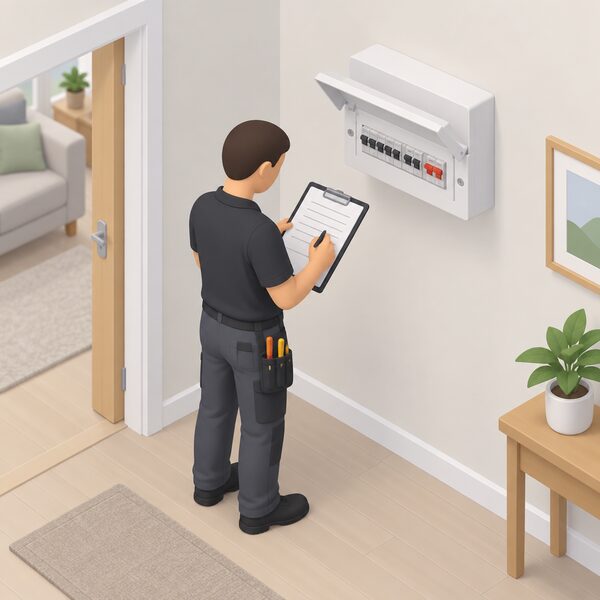
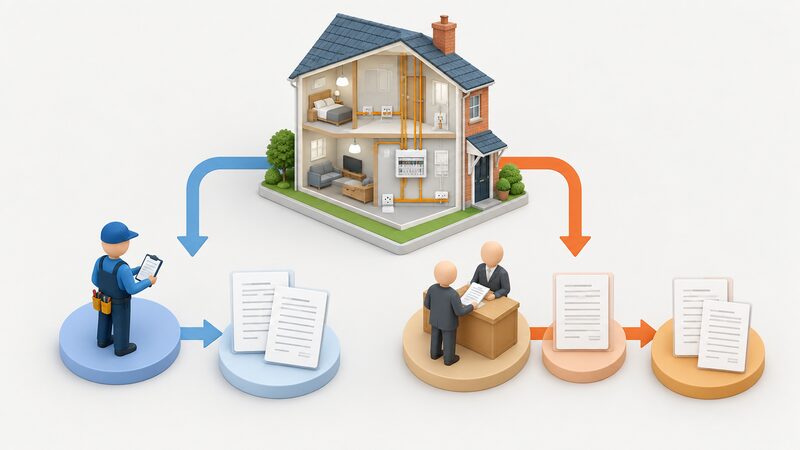
Self-certification is the main commercial driver. An electrician registered with an approved self-certification organisation becomes able to certify their own notifiable work12, and where work is carried out by an electrician qualified to self-certify under the competent person scheme, no separate application is needed; where it is carried out by an individual or firm not qualified to self-certify, a Building Regulations application must be submitted to the local authority13. NICEIC frames the saving in the same terms: many registered electricians are able to self-certify their work to building control, saving time, money and effort14.
The second driver is visibility. Scheme members are listed on the electrical competent person register, described as a single place for householders to find registered electricians in their area9. Directory listings for renewables installers work similarly, with the Energy Saving Trust's finder described as free to join and as making it easy for a firm to promote itself and reach new customers15.
The third is the assurance package a certified firm can advertise. NICEIC-registered electricians must have the right skills, qualifications and experience to get on the register16, their business must carry comprehensive insurance to protect the customer and their property in the event of accidental damage or injury2, and the work is backed by NICEIC's Platinum Promise guarantee2. Electrical Safety First's own checklist for householders lists the same two features of a registered electrician: their work is regularly assessed and they are regulated17, and they must be insured so the customer is protected18.
None of that changes the underlying legal position. Registration is a commercial and regulatory convenience. A qualified installer, regardless of whether they are registered or not, should give a signed BS 7671 electrical safety certificate for all types of electrical work8.
What registration covers: self-certifying work under the Building Regulations
A competent person scheme allows electricians and other professionals to self-certify that notifiable work complies with the relevant regulations and standards in England and Wales10. NICEIC-registered electricians are deemed competent to self-certify their work as compliant with the Building Regulations4.
In practice that produces two documents. A registered electrician issues an Electrical Installation Certificate or Minor Work Certificate confirming the work meets BS 7671, and a Building Regulations Compliance Certificate confirming the work meets the Building Regulations19. Where an electrician is registered with a government-approved scheme, they handle notification, including notifying the local authority before the work is started where the Building Regulations require it18. For a household selling later, a Building Regulations Completion Certificate from the installation contractor for notifiable work should be provided on sale20.
Approved Document P's 2013 edition reduced the range of electrical installation work that is notifiable, and introduced an alternative: installers who are not a registered competent person may use a registered third-party certifier to certify work instead of using a building control body21. The Planning Portal records that third-party certifier route as available in England only22.
How the four nations differ
| Nation | Position on domestic electrical work |
|---|---|
| England | Competent person self-certification, building control approval, or a registered third-party certifier (England only)22 |
| Wales | Use an installer registered with a competent person scheme or seek approval from Building Control; an application should be made if the electrician is not a registered competent person or the work is done by the householder3 |
| Scotland | An approved certifier of construction who has been assessed to have the professional skills and relevant experience can certify compliance23 |
| Northern Ireland | There are no Building Regulations for domestic electrical work, although Electrical Safety First still recommends using a registered electrician19 |
Renewables fall under the same machinery. For a wind turbine not attached to the house, if the electrical work is of the type listed in Row 12 of Schedule 3 of the Building Regulations and the installer is a member of a competent person scheme listed against that row, the installer may be authorised to self-certify the work without involving local authority building control24. Heat pump installation work is certified either by self-certification by a registered competent person or by a building control body25.
Businesses, not individuals: who actually holds the certificate
This is the point householders most often misread. NICEIC certifies businesses, not individuals, unless they are a sole trader1. The responsibility for works carried out lies with the business, not the individual1. An electrician who once worked for a certified firm and has since left does not carry the certification with them, and a subcontractor working under someone else's name is not certified by association.
The consequence is procedural as well as legal. Businesses are certified on certain schemes, and the certificates a business may issue follow from that1. So the useful question for a household is not whether an electrician is "NICEIC" but which business is being contracted, which scheme that business is certified on, and whether the work in question falls inside it.
Historically the organisations operating full self-certification for electrical work were recorded as BRE Certification Limited, British Standards Institute, ELECSA Limited, NICEIC, NICEIC Certification Services Limited and NAPIT13. A narrower scheme, covering limited electrical works associated with a kitchen, bathroom or boiler installation, was run by ELECSA, NAPIT and NICEIC plus CORGI and OFTEC13. Those older lists show how the scope of a registration has always been defined by the scheme, not the brand. The current authorised list for fixed electrical installations in dwellings as part of other work names APHC, BESCA, Blue Flame Certification, Certsure and NAPIT9.
For a household, the independence angle is direct: the paperwork that proves a circuit, a battery or a chargepoint was installed legally sits with a company that may not exist in five years. Keeping the certificates rather than relying on the firm to reissue them is the only durable position.
Annual assessment: what checked businesses go through
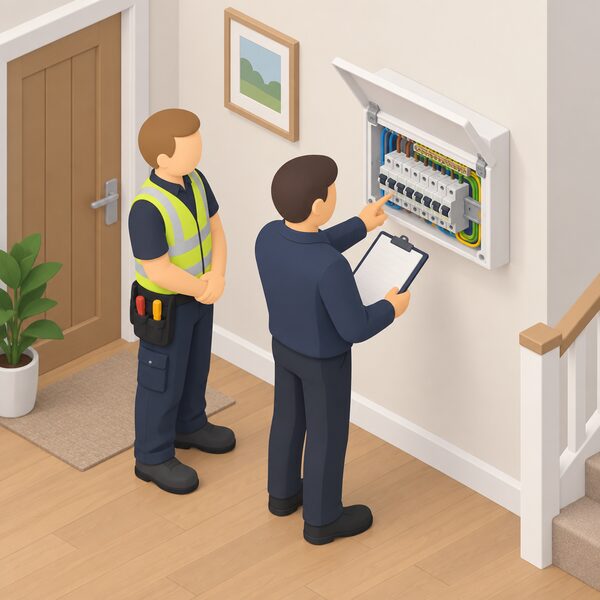
NICEIC-registered electricians are assessed on an annual basis4, with the business assessed each year by an experienced NICEIC assessor to ensure it meets stringent quality and technical requirements2. NICEIC describes the purpose of those assessments as ensuring firms continue to comply with all the right technical standards16, and its complaints team states its role in the same language.
"our job is to make sure the work undertaken by our certified businesses meets the required technical standards"
Annual is more frequent than several comparable regimes. TrustMark requires Registered Businesses to have an inspection no less than every three years by a qualified independent inspector, while all Registered Businesses must have their insurances and similar documents checked each year by their Scheme Provider27. Flexi-Orb states that all certified installers are subject to up to five further assessments, depending on the size of their business, each year28. The frequency figures are not directly comparable because the schemes assess different things and cover different trades, but they indicate the range a household is choosing among when it looks at badges.
What an assessment does not do is inspect every job. It samples. That is why a periodic inspection of the installation itself remains a separate exercise: an inspection of the electrical installation by a registered electrician, known as a periodic inspection, checks for any lack of earthing or bonding and can identify potential dangers29. NICEIC recommends that homeowners have an Electrical Installation Condition Report carried out at least every 10 years7. In houses in multiple occupation, the law is firmer: every fixed electrical installation must be inspected and tested at intervals not exceeding five years by a qualified person30.
NICEIC and the MCS Installer Scheme: renewables a household may be buying
NICEIC offers MCS certification for four key technologies: solar heating, solar photovoltaic systems, heat pumps (air and ground source) and electrical energy storage systems5. It states that it is accredited by UKAS to offer the redeveloped MCS Installer Scheme5 and that it is now approved to offer the latest version of the MCS Installer Scheme31. From 9 March 2026, all new applicants have been automatically assessed under the redeveloped scheme5.
That matters because MCS, not electrical registration, is the gate on most funded renewables work. Under the Domestic Renewable Heat Incentive, eligible renewable technology had to be installed and commissioned by an MCS certified installer who could provide an MCS certificate32, and certificates could only be issued for systems using an MCS certified product32. MCS certified installers must also be registered with a consumer protection scheme such as RECC or HIES33. Further detail sits on MCS certified installers and the Renewable Energy Consumer Code.
Solar PV also runs through the competent person machinery: installers who are members of a relevant competent person scheme can self-certify certain types of building work, including solar PV installation, avoiding separate building regulations approval34. NICEIC's own renewables guidance suggests a household get quotes from at least three different NICEIC approved contractors before agreeing to any work7, and some scheme specifications name the body directly, requiring that the existing installation within the dwelling be assessed by an NICEIC certified electrician35.
Electrical upgrades often ride alongside. For EV charging, faster units may require an NICEIC-certified business to upgrade a home's wiring, which NICEIC says ensures the work is completed safely and meets all necessary regulations36. NICEIC's renewables training routes all require attendees to hold an industry-recognised Level 3 electrotechnical qualification31.
Where NICEIC sits among the certification bodies
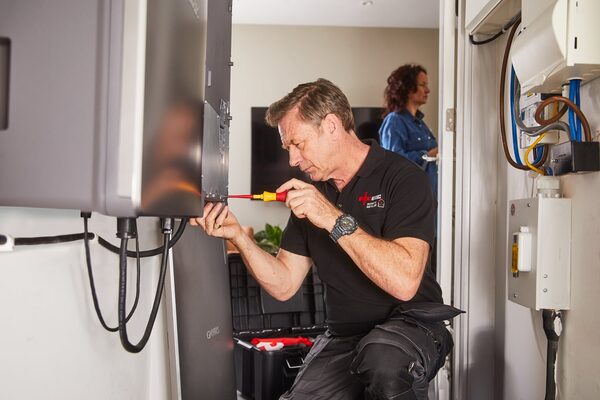
NICEIC describes itself as the UK's largest certification body for electrical businesses1. Competent person schemes named for domestic electrical work include NAPIT, ELECSA and NICEIC39. NAPIT reports over 20,000 registered installers working across electrical, heating, plumbing, ventilation, microgeneration and building work40. TrustMark operates across trades with the inspection and insurance checks described above27.
| Body | Scope and checking |
|---|---|
| NICEIC | Electricians, plumbers, renewable energy installers, gas and heating engineers; over 40,000 certified businesses; annual assessment1 |
| NAPIT | Over 20,000 registered installers across electrical, heating, plumbing, ventilation, microgeneration and building work40 |
| ELECSA | Named as a competent person scheme for domestic electrical work39 |
| TrustMark | Inspection no less than every three years by an independent inspector; insurances checked annually27 |
| Flexi-Orb | Up to five further assessments a year depending on business size28 |
No ranking is intended or possible from these figures: the schemes differ in trade coverage, in what an assessment examines and in the redress they offer. What a household is choosing between is a set of different checking regimes, not different grades of competence. NAPIT registration, TrustMark and the wider picture of competent person schemes are covered separately.
Northern Ireland is the exception again: there are no Building Regulations for domestic electrical work there, though organisations do register and assess electrical contractors in that area19. See using an installer in Northern Ireland.
How to check an electrician is genuinely registered
NICEIC operates a Find a Trusted Tradesperson tool that lets a household find an electrical business nearby or check whether an electrician they have found is registered2, and states that any electrician chosen through that process is NICEIC-registered16. Because certification belongs to the business, the search is on the company.
A cross-check against the government-backed route is available too. Local authority building control guidance directs householders to the Competent Persons Register to check whether an electrician is registered41, and Electrical Safety First points to electricalcompetentperson.co.uk as a place to find a registered electrician42. NICEIC's own advice to householders is to check that the certified contractor is registered with a government-approved competent person scheme like NICEIC43. For work already done in England and Wales, domestic electrical installation work notified by an NICEIC electrical contractor to the Local Building Control Body is searchable through checkmynotification.com43.
- Get the exact registered business name, not just the electrician's name.
- Search the NICEIC tool or the electrical competent person register for that business2.
- Confirm the scheme it is certified on covers the work being quoted, since certificates can only be issued for what the business is certified to do1.
- For renewables, check MCS certification separately, and the consumer code membership that goes with it33.
- After completion, check the notification appears against the property where that route applies43.
If something goes wrong, NICEIC operates a consumer complaints resolution process whose stated function is to make sure the work undertaken by its certified businesses meets the required technical standards26. That is a technical standards remedy, not a general commercial one, and it is bounded by what the business is certified to do. The escalation route beyond it is set out in complaining about an installer, and the guarantee attached to certified work in the NICEIC Platinum Promise.

What registration does and does not do for household energy independence
A household moving towards self-supply accumulates electrical work: a consumer unit with capacity for a chargepoint, a solar array and its isolation arrangements, battery storage, a heat pump circuit. Each of those is notifiable or close to it, and each generates paperwork that has to survive a house sale, an insurance claim and a future grant application. Registration is what makes that paperwork self-issued and immediate rather than dependent on a local authority queue14.
The dependencies that remain are worth naming. The certification is held by a company that can cease trading, and the Platinum Promise and the complaints process are only as durable as NICEIC's relationship with that company2. MCS certification is a separate approval from electrical certification, and grant eligibility has historically turned on the MCS certificate rather than the electrical one32. Where a scheme requires PAS 2030, NICEIC is no longer the certifying body as of 31 March 20266. And in Northern Ireland the self-certification framework that gives registration its legal force does not apply to domestic electrical work at all19.
What registration reliably delivers is an annually assessed business carrying insurance2, a defined technical standard applied to the work26, and a documented compliance route. What it does not deliver is a guarantee about the individual on site, coverage of work outside the certified scheme, or any protection at all against the firm disappearing. The certificates in the householder's own file are the part that lasts.
Sources43 cited
- NICEIC householders and landlords help hub, NICEIC, 2026-09-17
- Everything you need to know about choosing an electrician, NICEIC, 2025-11-21
- Building regulations and electrics, Welsh Government, 2026-09-17
- Wiring a shed: a guide for homeowners, NICEIC, 2026-09-17
- Redeveloped MCS Installer Scheme: key changes and benefits, NICEIC, 2026-03-09
- PAS 2030 scheme, NICEIC, 2026-03-31
- Renewables and electrics for householders, NICEIC, 2026-09-17
- Quick guide to the Building Regulations, Welsh Government, 2021-12
- Competent person scheme: current schemes and how schemes are authorised, GOV.UK, 2013-04-04
- Rewiring your house: an essential guide for homeowners, NICEIC, 2026-09-17
- New electricity supply for 1 to 11 houses, NIE Networks, 2026-09-19
- Electrical safety and building control, Cumberland Council, 2026-09-17
- Amended Part P electrical safety guidance, Wigan Council, 2004-12
- EV charger regulations in England: what has changed, NICEIC, 2026-08-19
- Renewables installer finder, Energy Saving Trust, 2024-01-04
- How to check if an electrician is NICEIC registered, NICEIC, 2026-06-19
- Five questions to ask your electrician, Electrical Safety First, 2026-09-19
- Choosing a registered electrician, Electrical Safety First, 2026-09-19
- Building regulations and registered electricians, Electrical Safety First, 2026-09-17
- Register energy devices in homes or small businesses, GOV.UK, 2021-03-31
- Approved Document P: electrical safety, dwellings, Planning Portal, 2013-01
- Electrics: building regulations general information, Planning Portal, 2026
- Building standards technical handbook: electrical safety, Scottish Government, 2020-12-02
- Wind turbines: building regulations, Planning Portal, 2026
- Approved Document L, Volume 1: Dwellings, GOV.UK, 2026
- Consumer complaints resolution process, NICEIC, 2026-09-17
- Homeowner FAQs, TrustMark, 2026-09-20
- Pre and post installation checklists, Flexi-Orb, 2024-06-24
- Charity campaigns for safer electrics in rented homes, Electrical Safety First, 2026-09-19
- The Management of Houses in Multiple Occupation (England) Regulations 2006, legislation.gov.uk, 2006-02-15
- What the Warm Homes Plan and Future Homes Standard mean for installers, NICEIC, 2026-04-23
- Domestic RHI: eligible heating systems, Ofgem, 2026-09-17
- Find a heat pump installer, GOV.UK, 2022-07-05
- Solar panels guidance, Wirral Council, 2026-09-17
- Barcud solar panel installation scheme specification, Sell2Wales, 2026-06-15
- Everything you need to know about EV charging points, NICEIC, 2024-09-27
- The Electricity and Gas (Energy Company Obligation) Order 2018, legislation.gov.uk, 2018-11-12
- Reforming consumer protection for home upgrade schemes, GOV.UK, 2026-06-17
- Installing solar panels on your home, Brighton and Hove City Council, 2026-09-17
- NAPIT welcomes Climate Change Committee report, NAPIT, 2025-02-26
- Building control application guidance notes, London Borough of Bromley, 2026-09-17
- Don't die for DIY, Electrical Safety First, 2026-09-19
- How to work with your tradesperson, NICEIC, 2026-09-17
 Competent Person SchemesIf a tradesperson says they can sign off their own work, how do you know they are genuinely registered?
 Checking an InstallerBefore you sign anything, how do you know your installer is genuine?
 Installer in Northern IrelandHow do you check an installer in Northern Ireland is properly registered, and who do you complain to if the work goes wrong?
 Using an Installer in EnglandHow do you check an installer is registered to sign off their own work, and what happens if they are not?
 Arrange an Electrical InspectionHow to find and check a registered electrician, what an Electrical Installation Condition Report covers and the intervals usually recommended for owner-occupied homes.
 Electrical Safety RegulationElectrical work at home raises real questions about who can do it, what needs signing off, and what paperwork you should keep.