

In this answer
Short answer
A Building Regulations Compliance Certificate is an official document that certifies that building work complies with the relevant Building Regulations1. It is the householder's own copy of the record, issued after the work is finished, and it is the piece of paper that proves the job was done to the standard the law requires rather than merely to the standard the installer chose.
The certificate is not the same as the electrical or gas safety certificate for the same job. A registered electrician issues an Electrical Installation Certificate or Minor Work Certificate confirming the work meets BS 7671, and separately a Building Regulations Compliance Certificate confirming the work meets the Building Regulations2. One covers the trade standard, the other covers the legal standard, and a household needs both.
The duty to produce it sits with the person carrying out the work, not with the householder. Where a registered competent person installs a heat pump, the certificate or a copy of the information on it must be given to the building control authority, and a copy of the Building Regulations compliance certificate must be given to the occupier3. The deadline is within 30 days of the work being completed3.
What the certificate records, and what it does not
The certificate is a compliance record, not a warranty, a guarantee or a statement of quality. It says the work meets the relevant Building Regulations; it does not say the work will last, that the installer will return, or that the design was the best available. Building work must meet all relevant requirements of the Building Regulations3, and the certificate is the evidence that this particular job did.
Its scope is defined by the regulations in force at the time and by the type of work notified. A Building Regulations Compliance Certificate will then be issued to you once the notification process has run its course5. For electrical work, the certificate sits alongside the BS 7671 certificate rather than replacing it2. For solid fuel and biomass work, a HETAS Certificate of Compliance demonstrates that the installation complies with the relevant Building Regulations and is used to record the installation and notify LABC in England and Wales, taking the place of a Local Authority Building Notice6.
The certificate also has a role in the wider paperwork trail. Where a building control body has decided that work meets all the Building Regulations requirements, it issues a Building Regulations completion certificate if it is a building control authority, or a final certificate if it is a registered building control approver3. Those are the building control body's own documents; the compliance certificate is the one the householder holds.

Who issues it and who receives it
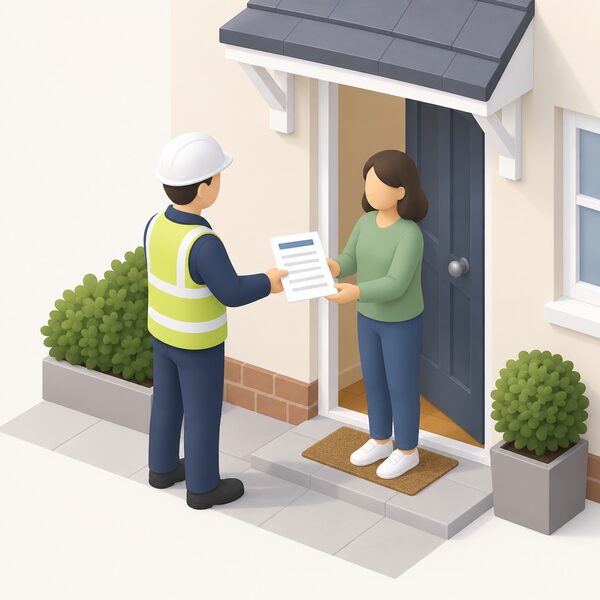
Two routes produce the certificate, and they look different from the householder's side.
Under the competent person route, a registered installer is approved to carry out the work to comply with building regulations without involving local authority building control, and a certificate is issued on completion7. The installer's registration body handles the notification. NAPIT, a government-approved Competent Person Scheme provider, allows its members to self-certify that their work complies with Building Regulations without needing to submit a building notice or use an approved inspector1. The Building Regulations &c. (Amendment) Regulations 2016 updated the list in Schedule 3 of persons authorised to issue certificates of compliance with the requirements of the Building Regulations for their own work8.
Under the building control route, the householder or installer applies to a building control body, which inspects and then issues its own completion document. Once it has decided that the work meets all the Building Regulations requirements, it will issue a Building Regulations completion certificate if it is a building control authority, or a final certificate if it is a registered building control approver3.
The distribution of copies is set out in regulation. Where the relevant authority is the regulator, it must send a copy of each certificate it gives under this regulation in relation to a building to the local authority for the area in which the building is situated9. The same copy requirement applies where the building control authority is a designated local authority under section 91ZD of the Act9.
| Document | Who issues it | Who receives it |
|---|---|---|
| Building Regulations Compliance Certificate | The installer's competent person scheme or registration body | The occupier3 |
| Building Regulations completion certificate | A local authority building control body | The applicant and the local authority3 |
| Final certificate | A registered building control approver | The applicant3 |
| Electrical Installation Certificate or Minor Work Certificate | The registered electrician | The occupier2 |
Which jobs need one: notifiable work and self-certification
Notifiable work must be reported to the local building control body unless completed by someone registered on the competent person scheme who can provide a compliance certificate7. That single sentence explains most of the confusion householders meet: the same job is notifiable in one household and self-certified in the next, depending entirely on who does it.
For electrical work, a Building Regulation Certificate of Compliance (Part P) is required for any notifiable electrical jobs2. The examples given are changes to a consumer unit, a full rewire, the installation of new circuits, any addition or alteration to an existing circuit in a special location, or a new full electrical installation2. Once works are complete the electrician will arrange for the householder to receive a building regulations compliance certificate within 30 days of completion of the work10.
Not everything needs a certificate. There is no requirement for a certificate confirming that the work complies with Building Regulation requirements to be given to the occupier or the building control body for work listed in Schedule 4 as non-notifiable11. The exceptions to notification are work carried out under a self-certification scheme listed in Schedule 3, and work listed in Schedule 4 to the Building Regulations as being not notifiable11.
For heating, work to install a new boiler, or a cooker that also supplies central heating such as an Aga or Rayburn, needs Building Regulations approval because of the safety issues and the need for energy efficiency4. In due course the local authority should supply a Building Regulations Completion Certificate that indicates compliance4. Where the installer is registered under a competent person scheme, the notification runs through that scheme instead, and the householder receives the compliance certificate rather than dealing with the local authority directly.
The 30-day deadline, and the shorter deadlines that also apply
The headline deadline for the compliance certificate is within 30 days of the work being completed3. The same 30-day figure appears in the Welsh guidance: the occupier of the building must be given, within 30 days of the completion of the work, a certificate confirming that the work complies11. The building control body must also be given a notice that the work has been done, or a copy of the certificate, again within 30 days of the completion of the work11.
Shorter deadlines apply to other documents in the same package, which is where householders most often think something has gone missing. The energy performance certificate and notice must be given not later than five days after the building work has been completed for work covered by Regulation 7A12. Regulation 27 requires that, in any other case, not later than five days after the work has been completed, the building control authority is given a notice13. Regulation 27B requires, for dwellings and buildings not within a higher-risk building, that the building control authority be given a notice not later than 5 days after the work has been completed14.
In Scotland the structure differs. On completion, the owner or client must certify that the works have been constructed in accordance with the building warrant and the building regulations15. The role of issuing warrants and accepting completion certificates rests with verifiers, enforcement is by local authorities, and the system is overseen and updated by the Building Standards Division16.
For new buildings in Scotland, the deadlines are being tightened. Developers of new buildings completed on or after 31 October 2026 will be required to give a copy of a valid EPC and property report to the building owner within seven days of submitting a completion certificate to a local authority verifier17. A later statement puts the same requirement at within seven days of submitting a completion certificate to a local authority verifier, for developers of new buildings completed on or after 30 April 202818. The two documents give different commencement dates, and the later figure is the more recent.
| Document | Deadline | Source |
|---|---|---|
| Building Regulations compliance certificate to the occupier | Within 30 days of the work being completed | 3 |
| Notice or copy of certificate to the building control body | Within 30 days of the completion of the work | 11 |
| Energy performance certificate and notice, Regulation 7A work | Not later than five days after the work has been completed | 12 |
| Notice to the building control authority, Regulation 27 | Not later than five days after the work has been completed | 13 |
| Notice to the building control authority, Regulation 27B | Not later than 5 days after the work has been completed | 14 |
What the building control authority gets, and why it matters
The building control authority does not simply receive a courtesy copy. It receives the certificate or a copy of the information on it, and it holds the record that the work was notified and compliant3. That record is what a future buyer's solicitor, a lender or an insurer may ask for years later.
The authority also has powers to accept other evidence of compliance. A building control authority is authorised to accept, as evidence that the requirements of regulation 26A have been satisfied, a certificate by an energy assessor accredited to produce energy performance certificates for that category of building14. It is also authorised to accept, as evidence that the requirements of paragraph (2)(a)(ii) have been satisfied, a certificate by a person registered by Elmhurst Energy Systems Limited or the Air Tightness Testing and Measurement Association in respect of pressure testing for the air tightness of buildings19.
Separately, the energy performance regime imposes its own duties on the person carrying out the work. The person carrying out the building work must give an energy performance certificate for the building to the owner of the building, give the local authority notice, and include the register reference number in the notice, for the erection of a building or certain modifications with fixed heating, hot water, air conditioning or mechanical ventilation services20. The duty is the requirement in accordance with the provisions of regulation 29 of the Building Regulations 201020. An exception applies in the case of an energy performance certificate issued under regulation 9A, for energy performance certificates in respect of excluded buildings12.
The practical consequence for a household is that the compliance certificate is not the only document generated, but it is the one that answers the question a buyer or an insurer will actually ask: was this work signed off under the Building Regulations?
Why to keep it safe: selling your home and future proof
The certificate's second life begins at sale. Without approval you will not have the certificates of compliance you may need when you want to sell your home4. HETAS states that the information on its Certificate of Compliance can be required to validate home insurance and will be required in any home-selling process6. A lawful development certificate may be helpful to answer queries raised by potential buyers or their legal representatives when later selling the property21.
The certificate also protects the householder's position if enforcement is ever considered. If you are the owner of the building, it is ultimately you who may be served with an enforcement notice if the work does not comply with the regulations22. The certificate is the evidence that the work did comply, and it is the householder, not the installer, who needs it to hand.
Where a job was grant-funded, the audit trail is stricter. For major non-compliance, the installer is required to provide evidence of correction within 8 weeks, and if not remediated by this point certification bodies should inform the installer of the implications of not having done so by 12 weeks from the audit23. The same 8-week and 12-week timetable applies to minor non-compliance23. For Category 1 non-compliance, the installer is then required to provide evidence of full correction within 8 weeks, and if not remediated by this point certification bodies should inform the installer of the implications of not having done so by 12 weeks from the audit23.
"The Building Regulations exist so that all householders will have a safe and healthy home in which to live and a home which is energy efficient"
For a household pursuing energy independence, the certificate is the paperwork half of the installation. The panels, the battery or the heat pump reduce reliance on a supplier; the certificate is what makes that work legally recorded, insurable and saleable. Without it, the physical system may still work, but the household carries a defect in its records that surfaces at the worst moment, which is when the property changes hands.

Sources24 cited
- NAPIT glossary of terms, NAPIT, 2026-09-19
- NICEIC help hub for householders and landlords, NICEIC, 2026-09-17
- Approved Document L Volume 1: Dwellings, HM Government, 2026
- Building regulations: boilers and heating, Welsh Government, 2026-09-17
- HHIC certificate of compliance guidance, HHIC, 2026-09-17
- HETAS certificates of compliance, HETAS, 2026-03-31
- Building regulations for doors and windows, Planning Portal, 2026-09-17
- The Building Regulations &c. (Amendment) Regulations 2016, legislation.gov.uk, 2016-03-10
- The Building Regulations 2010, Regulation 18, legislation.gov.uk, 2026-09-17
- Building regulations: electrics, Welsh Government, 2026-09-17
- Building Regulations guidance Part J: heat producing appliances, Welsh Government, 2026-09-17
- The Energy Performance of Buildings (England and Wales) Regulations 2012, Regulation 7A, legislation.gov.uk, 2016-03-10
- The Building Regulations 2010, Part 6, legislation.gov.uk, 2026-09-17
- The Building Regulations 2010, Part 6, England, in force 2026-07-01, legislation.gov.uk, 2026-07-01
- Building Standards Technical Handbook: Domestic (April 2026), Scottish Government, 2026-03
- Building Standards Domestic Technical Handbook, Scottish Government, 2022-12
- Energy Performance of Buildings (Scotland) Regulations 2025 update, Scottish Government, 2025-10
- Energy performance certificate reform updates, Scottish Government, 2026-08-24
- The Building Regulations 2010, Regulation 43, legislation.gov.uk, 2026-09-17
- The Energy Performance of Buildings (England and Wales) Regulations 2012, Regulation 34, legislation.gov.uk, 2012
- Installing solar panels at your home, Brighton & Hove City Council, 2026-09-17
- When you need approval, Planning Portal, 2026
- Solid wall insulation installed under ECO4 and GBIS: statistical audit results, HM Government, 2026-09-17
- Building Control NI FAQs, Building Control Northern Ireland, 2026
 Competent Person SchemesIf a tradesperson says they can sign off their own work, how do you know they are genuinely registered?
 Certificates You Should ReceiveAfter work like solar panels or a new boiler, what paperwork should you actually be handed, and by when?
 EPC Regulations and ReformSelling or renting out a home means you need an Energy Performance Certificate.
 Insulation StandardsHow do you know your insulation was fitted to a proper standard, and who backs the guarantee if the installer disappears?
 Building Regulations EnglandAdding a heat pump, solar panels or an extension usually needs building regulations approval, and it is separate from planning permission.
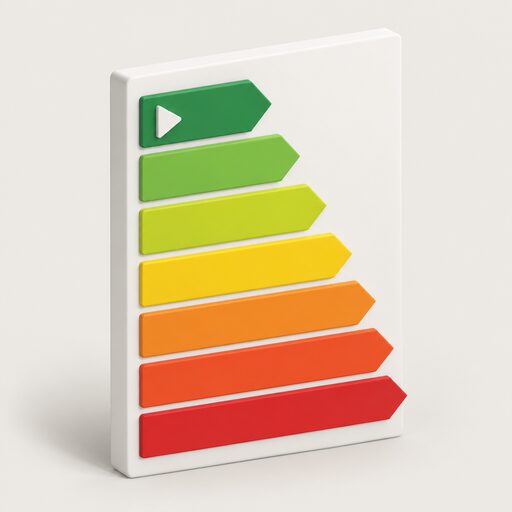 Energy Performance CertificatesAn Energy Performance Certificate rates how energy efficient your home is, from A down to G.