

In this answer
Short answer
Building regulations approval is always required when installing an EV home charger1. There is no exemption for a small wallbox, a DIY fit or a charger added alongside an existing supply. What varies is not whether approval is needed but how it is obtained: either through an installer registered with a competent person scheme, who self-certifies the work, or by notifying local authority building control before work starts2.
The reason is that a home charge point is notifiable work. It involves creating a new circuit, which brings it within the building regulations rather than outside them1. The installation must also comply with BS 7671, the national standard for electrical installations, and all EV charging installations in the UK must continue to meet its requirements3.
Planning permission is a separate question with a different answer. Most home chargers fall within permitted development and need no planning application, but on-street parking, conservation areas, listed buildings, Article 4 Directions and upstands above 1.6 metres are the exceptions that catch households out5. Building regulations and planning permission are judged independently: needing one does not mean the other will be needed7.
Notifiable work: what approval involves and who can sign it off
Approval is not a single document but a process. Because the charger creates a new circuit, the work is deemed notifiable, and the building control body or a registered third-party certifier must be notified before work starts1. That timing matters: notification is not something that can be arranged after the fact as a matter of course.
There are two routes. The first is a registered competent person. It is best to use an installer registered with a competent person scheme, who can self-certify compliance with the building regulations9. Electricians registered on a scheme such as NICEIC's are deemed competent to self-certify their own work, saving householders time and money4. The second route applies where the work is not done by a registered person: the relevant building control authority must then be notified of the work2.
The scope of self-certification is wider than EV charging alone. Installers who are members of a relevant competent person scheme can self-certify certain types of building work, including the installation of solar PV, avoiding the need to seek separate building regulations approval10. The principle is the same for a charge point: the registered installer takes responsibility for compliance rather than the householder applying separately.
For a household, the practical difference is administrative rather than technical. Both routes end with compliant work; one produces a certificate from the installer, the other from building control. What a householder cannot do is treat the installation as exempt. The work is classified as notifiable work in terms of building regulations, so the installation must be approved and compliant11.
The compliance certificate: what it proves and why you keep it
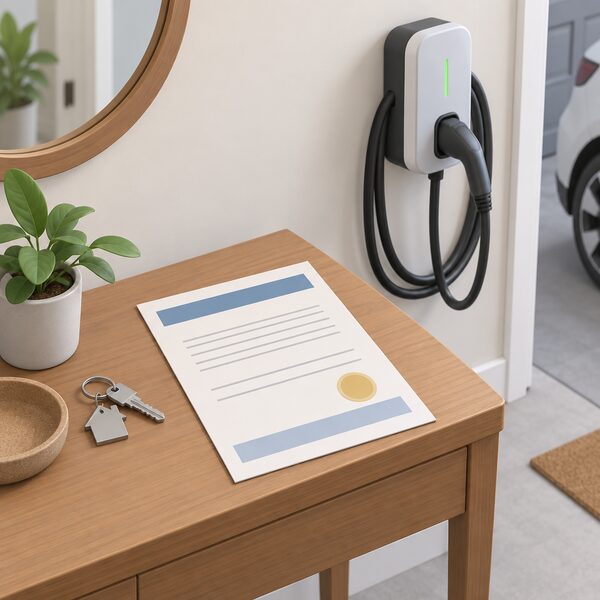
The certificate is the evidence that the work complies with building regulations1. It is not a receipt or a courtesy document. A Certificate of Compliance is described as vital for validating home insurance and is required when selling a home12. That is the practical reason to keep it: a future buyer's solicitor, or an insurer assessing a claim, may ask for it.
Different routes produce differently named documents. Where building control is involved, the local authority issues a Building Regulations completion certificate, or a registered building control approver issues a final certificate13. A Building Regulations Compliance Certificate is an official document certifying that building work complies with the relevant Building Regulations14. On the electrical side, an EIC must be issued for an EV charger installation15.
The certificate also records the notification. A HETAS Certificate of Compliance demonstrates that the installation complies with the relevant Building Regulations and is used to record the installation and notify LABC in England and Wales, taking the place of a Local Authority Building Notice16. The same logic applies to competent person self-certification for electrical work: the certificate confirms the work has been designed, inspected and tested in line with the standard and in compliance with building regulations17.
For energy independence, the certificate is the paper trail that keeps a self-generated fuel source lawful. A household that charges from its own solar or a home battery still relies on a compliant connection to the grid for the charger's supply, and the certificate is what proves that connection was done to standard.
Planning permission: usually not needed, but the exceptions matter
Usually, no planning permission is needed to install an EV charger at a property because it falls within permitted development rights, with exceptions for listed buildings, conservation areas, or cross-pavement solutions4. Where a home has off-street parking, it is likely the installation of a domestic electric vehicle charger will fall under permitted development with no planning application required, provided it meets the criteria5.
The permitted development limits are specific. In a conservation area, or where a dwelling is subject to an Article 4 Direction, planning permission is not required provided the upstand will not exceed 1.6 metres in height8. For dwellings outside those designations, the limit is 1.6 metres for residential and 2.7 metres for non-residential8. A wall-mounted outlet is treated separately: permission is not required provided the outlet and its casing will not exceed 0.2 cubic metres8.
Planning permission is not generally required for installing or replacing electrical circuits18, which is the part of the job most households assume is the regulated one. The charger itself is classified as development, so it is up to the householder to ensure the correct permissions are in place6. Without them, enforcement action may be taken against the householder6.
Where a cable crosses a pavement, a different permission applies. Unless the crossing is owned by the Highways Authority, separate planning permission will be needed, and pavement cable crossings are unlikely to be covered under householder permission for the EV charging point where they fall outside the curtilage of the building on highway pavement19. Permission from the Highways Authority will be required, and separate planning permission for the pavement crossing solution may also be needed2.
Listed buildings, conservation areas and on-street parking: when permission is likely
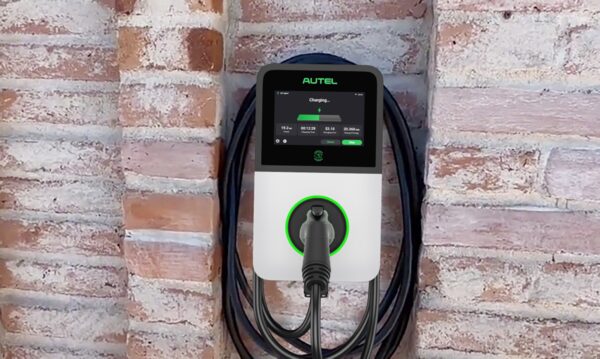
Planning permission is usually required for on-street parking, conservation areas, listed buildings, areas where installation is restricted, and more than one upstand per parking space5. The same list appears in the Planning Portal's own guidance: permission is usually required for on-street parking, conservation areas, listed buildings, areas where installation is restricted through Article 4 Directions, and more than one upstand per parking space6. Where there is no off-street parking, planning permission is required20.
Listed buildings carry a further consent. Electric vehicle charging points will require listed building consent21. That is separate from planning permission and is specific to the listed status of the building. The same principle applies to other protected sites: exceptions to the permitted development rule include listed buildings, conservation areas, and world heritage sites, among other protected buildings and landscapes3.
Designated landscapes follow the same pattern. If a building is in a designated area, such as a conservation area, a national park, an area of outstanding natural beauty or the Broads, planning permission will be required22. For solar, a comparable technology, planning permission may be required in conservation areas and on listed buildings10. The pattern across these designations is consistent: the more protected the setting, the more likely a formal application.
"Electric vehicle charging points will require listed building consent"
For a household in a conservation area, the practical position is that a wall-mounted charger within the size and height limits may still fall within permitted development, but the setting changes the calculation. A charger in a conservation area or listed building may change the permitted development position2. Where a property has had permitted development rights removed, or sits in an area of outstanding natural beauty or a conservation area, the wall outlet exemption is narrower8.
New builds and major renovations: where chargers are required by law
For new homes, the requirement runs the other way: rather than needing permission to add a charger, the building must include one. Building regulations now include requiring all new-build homes to have EV charge points installed1. A household buying a new build therefore inherits a charge point as part of the property rather than applying to add one.
Major renovations of residential buildings carry their own requirements. For buildings with more than 10 car parking spaces, ducting is to be installed in each residential car parking space to support future charge points23. Where an exemption applies, ducting infrastructure is to be installed in each car parking space23. Charge point sockets are to be installed with a minimum 7kW output power rating in as many residential car parking spaces as the post-renovation electrical capacity allows23.
The cost of that infrastructure is capped. The requirement applies to the cost of recharging and ducting infrastructure up to 7% of the total major renovation cost23. That cap is what makes the obligation proportionate to the scale of the works rather than open-ended.
This matters for independence because a new build with a charge point and ducting is already wired for home charging. The household's remaining dependence is on the grid connection and the electricity supplier, not on whether a charger can be fitted at all. For a flat owner or renter, the position is different: the grant for renters and flat owners requires an OZEV-authorised installer and an eligible residential chargepoint24, and there must not by law already be a chargepoint or charging infrastructure, for example because the home is a new build25. Eligibility also requires using or owning a vehicle on OZEV's list of approved vehicles and having the charger installed by an OZEV-approved installer4.
Where the rules bite: enforcement, load checks and multi-occupied buildings
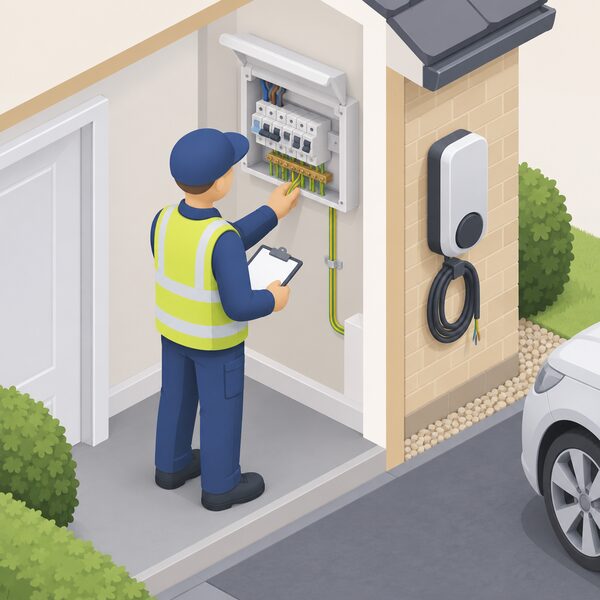
The consequences of skipping approval fall on the householder. Without the correct permissions, enforcement action may be taken against the householder6. Retrospective approval may be required if work has been completed by someone who lived there previously and did not gain the appropriate permissions, or if building regulations approval was not applied for during development7. Retrospective permission may be required for both planning permission and building regulations, but one being needed does not mean the other will be; it should be judged case by case depending on the work completed7.
There is also a network constraint that sits alongside the building regulations. A load check is required when the total demand of the property is more than 60 amps or does not qualify for Connect and Notify; the installer must apply and wait for permission before installing the EV charger26. Installers are expected to assess the adequacy of the supply capacity for the new EV's electricity consumption plus any existing electricity demand, assess the adequacy of the earthing, and notify the electricity Distribution Network Operator once the charge point has been installed27.
In multi-occupied buildings such as blocks of flats or industrial units, it is important to gain the building owner's permission before commencing any work26. Landlord grant rules reinforce this: each parking space must be off-street, private and clearly defined, accessible to the tenant, and owned by the applicant or one they have the legal right to use28.
Sources28 cited
- Building regulations for electric vehicle charging, Planning Portal, 2026
- Electric vehicle chargers, Planning Portal, 2026
- EV charger regulations in England: what's changed, NICEIC, 2026-08-19
- Electric vehicle charger installation and maintenance, NICEIC, 2025-08
- Electric vehicle charging: smart search, Planning Portal, 2026
- Planning permission for electric vehicle charging, Planning Portal, 2026
- Retrospective approval for electric vehicle charging, Planning Portal, 2026
- Permitted development for retrofit and energy efficiency, Cotswold District Council, 2026-09-17
- Building regulations: general information, Planning Portal, 2026
- Solar photovoltaics and planning in conservation areas, South Norfolk and Broadland Council, 2026-09-17
- EV charger safety tips, E.ON Next, 2026-09-17
- Log burner timeline, HETAS, 2026
- Approved Document L Volume 1: consultation version, Welsh Government, 2025-08
- Glossary of terms, NAPIT, 2026-09-19
- Section 722 EV charging: complete guide, Elec-Mate, 2026-07-02
- Certificates of compliance, HETAS, 2026-03-31
- Plug-in solar consumer guide, Electrical Safety First, 2026-08
- Planning permission for electrics, Planning Portal, 2026-09-17
- Approved pavement crossings, Planning Portal, 2026
- Cross-pavement charging solutions, Energy Saving Trust, 2025-07-18
- Improving energy saving and sustainability in conservation areas and listed buildings, Brighton & Hove City Council, 2026-09-17
- Planning permission for boilers and heating, Welsh Government, 2026-09-17
- Electric vehicle charge points for new buildings: policy proposals, Transport Scotland, 2026-09-20
- Electric Vehicle Chargepoint Grant for renters and flat owners, GOV.UK Find a Grant, 2026-09-18
- Electric Vehicle Chargepoint Grant: eligibility, GOV.UK, 2026-09-17
- Electric vehicles: cost, time and what's involved, UK Power Networks, 2026-09-17
- EV connections, SSEN Distribution, 2026-09-20
- Electric Vehicle Chargepoint and infrastructure grants for landlords, GOV.UK Find a Grant, 2026-09-18
 Home Charger InstallationWho can fit a home EV charger, and does it need building regulations approval?
 Electrical RequirementsWill your home need a bigger electricity supply before a charge point can go in?
 Planning Permission for ChargersDo you need planning permission for a home EV charger, and does it change if you live in a listed building, a conservation area or a flat?
 Telling the Network OperatorWho tells the network operator you are having a home EV charger fitted, and when?
 The Full EV Charging GuideCharging an electric car at home usually means a wallbox, but do you need one, and what will it cost to fit and run?
 Charger Cybersecurity and DataWho can control your home charger, and how do you keep it secure?