
In this guide
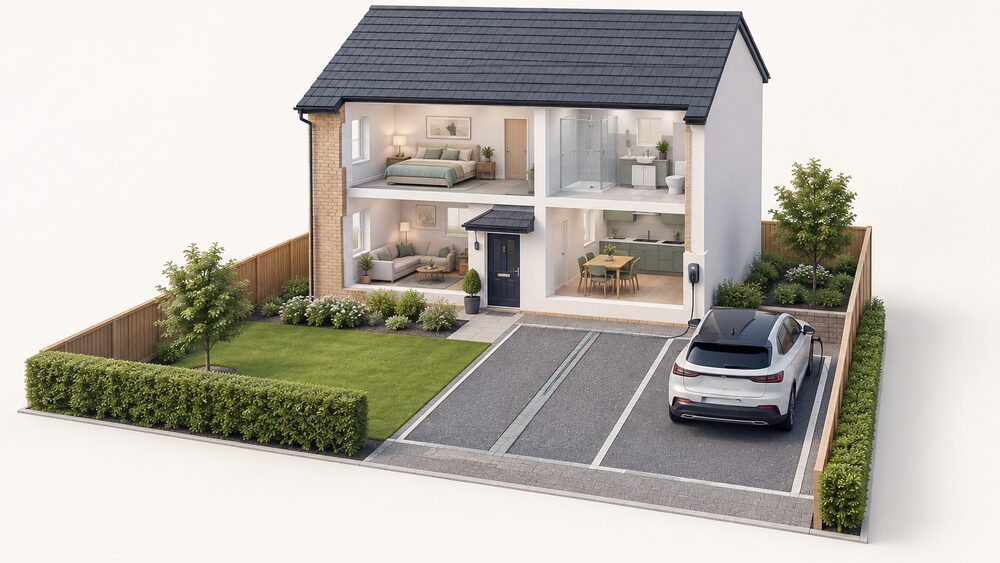
In England, a new home with an associated parking space must have access to an electric vehicle charge point. The duty sits in Part S of Schedule 1 to the Building Regulations 2010, inserted by amendment regulations that apply to buildings and building work in England, and it is explained in Approved Document S, which took effect on 15 June 20221. A new residential building with associated parking must have access to charge points equal to the number of dwellings, or to all associated parking spaces where there are fewer spaces than dwellings1. Each charge point must have a minimum nominal rated output of 7kW2.
Where a residential building has more than 10 associated parking spaces and more spaces than dwellings, cable routes must be installed in the remaining spaces that do not have a charge point, so a socket can be added later without excavation1. Two relief mechanisms matter most in practice: there is no charge point requirement where no associated parking spaces are provided, and the number of charge points required is limited to the maximum that can be installed at an average connection cost of £3,600 or less per connection2.
Nothing here is a UK-wide rule. Part S and Approved Document S apply to England3. Scotland has its own requirements, which government grant rules date from 5 June 20234. Wales consulted in September 2024 on draft amendments to its Building Regulations, and Northern Ireland set out proposals in a 2023 building regulations discussion document5.
Part S requires a charge point for every new home with parking
Requirement S1 is written in terms of access rather than hardware on a wall. A new residential building with associated parking must have access to charge points as provided for in the regulations, equal in number to the dwellings, or matching the number of associated parking spaces where those are fewer than the dwellings1. Guidance written for developers restates the same arithmetic: one charge point for each new dwelling, and where there are fewer parking spaces than dwellings, all of the spaces will need one8.
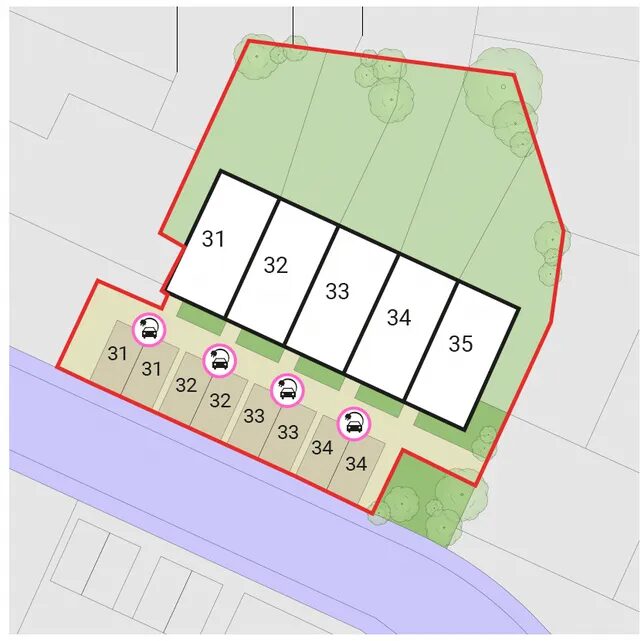
An associated parking space has a defined meaning. It is a space available for use by the occupant of the building or a visitor to it, and within the site boundary of the building3. A space outside the boundary, or one that belongs to another building, does not pull a dwelling into the requirement.
The requirement is part of a wider policy of requiring all new-build homes to have EV charge points installed9, and it sits alongside the rules for new residential and non-residential buildings with off-street parking and for buildings undergoing major renovations10. Part 9B of the Building Regulations 2010 carries the infrastructure provisions, including the minimum standards of an electric vehicle charge point at regulation 44J11.
For a householder, the practical effect is that the charge point should be present on handover, not an optional extra on a specification sheet. What is not guaranteed is anything above the minimum: the regulations set a floor of 7kW and say nothing about tethered or untethered cables, brand, app features or solar diversion. Those remain choices the developer makes, and a buyer who wants a particular behaviour should check what has been fitted against the types of home EV charger on the market.
Approved Document S and the regulations behind it

Approved Document S, titled "Approved Document S: infrastructure for charging electric vehicles", was published in December 2021 and is valid from 15 June 20227. It provides technical guidance regarding the installation and charge point requirements in Part S to the Building Regulations12. The document runs to 47 pages12. The underlying legal text was made by amendment regulations that apply in relation to buildings and building work in England1.
Transitional arrangements softened the change on site. Guidance for developers describes no charge point requirement where a building notice or initial notice was applied for before 15 June 2022, so long as the site had started before 15 June 20238. That window has now closed, so current work is assessed against the full requirement.
Approved Document S does not stand alone. Building regulations approval is always required when installing an EV home charger, and a compliance certificate serves the purpose of proving the work complies with building regulations9. All EV charging installations must continue to comply with BS 7671, the wiring regulations13, and government installation specifications refer to BS EN 61851, BS 7671, the IET Code of Practice for Electric Vehicle Charging Equipment Installations, and the Electricity Safety, Quality and Continuity Regulations14. Part P covers the safety of fixed electrical installation work on domestic premises. Fuller detail sits on EV charger building regulations and EV charge point safety, standards and certification.
Which buildings are covered: new build, renovation and change of use
Approved Document S applies to new residential and non-residential buildings, buildings undergoing a material change of use to dwellings, residential and non-residential buildings undergoing major renovation, and mixed-use buildings that are either new or undergoing major renovation7. A building, for these purposes, means any permanent or temporary building but not any other kind of structure or erection, and a reference to a building includes a reference to part of a building3.
| Type of work | What is required in England |
|---|---|
| New residential building with associated parking | Charge points equal to the number of dwellings, or to all associated spaces where fewer1 |
| Material change of use to dwellings | At least one associated parking space for each resulting dwelling must have access to a charge point1 |
| Residential major renovation, more than 10 associated spaces after works | At least one space per dwelling with a charge point, plus cable routes in all additional associated spaces1 |
| New non-residential building, more than 10 spaces | One space with a charge point, plus cable routes in a minimum of one fifth of the remaining spaces1 |
The change of use trigger is narrower than it looks. Requirement S2 applies where a charge point for each resulting dwelling can be accommodated within the incoming electrical supply without upgrading it, and charge points are only required where work is done to the car park or the electrical infrastructure1. A conversion, as defined by the building regulations, is capable of triggering the EV provisions15.
Building control bodies expect to see the reasoning, not just the outcome. Developer guidance describes submitting a full strategy showing how charging infrastructure will be included on the development, where charge points and future connection locations are provided, and which parking spaces are associated with which buildings8.
The 7kW minimum and what counts as a compliant charge point
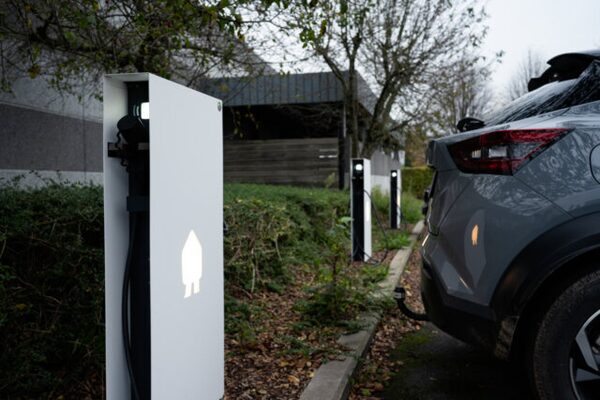
Every charge point provided to meet Part S must have a minimum nominal rated output of 7kW2. That figure recurs across the UK policy documents: Scottish proposals describe all dwellings with a parking space having at least one EV charge point socket with a minimum 7kW output power rating15. Regulation 44J of the Building Regulations 2010 is the provision that sets the minimum standards of an electric vehicle charge point11.
Seven kilowatts is a single-phase domestic rate, and it is the design assumption behind most home installations. What it delivers in hours depends on the vehicle and its onboard charger, covered on EV charging speeds and times and in the comparison of 7kW versus 22kW home charging.
Two points of flexibility are worth knowing. A single charge point with multiple outlets may serve more than one parking space, as long as each space served has its own outlet, the outlets can be used simultaneously, and each meets the minimum requirements3. A meter supplying more than one charge point may also be an acceptable way to meet the requirements in certain circumstances, for example in communal areas3. Worked guidance for developers notes that a third-party-operated charge point service with a smart method of metering may be an acceptable way to meet the requirements, but that the charge points would have to be private, not public17.
That last point matters for independence. A charge point installed under Part S but operated by a third party places a commercial intermediary between the household and its own electricity, which can constrain the choice of EV energy tariff and the ability to charge from on-site generation.
Cable routes and future connection locations
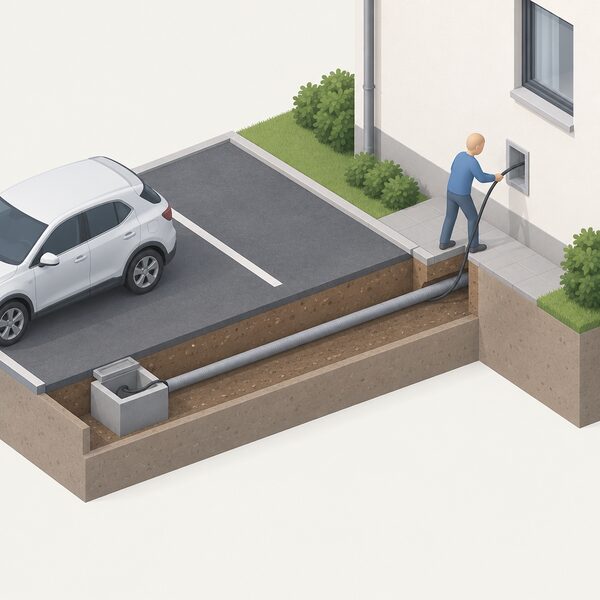
Where a new residential building has more than 10 associated parking spaces and more spaces than dwellings, cable routes for charge points must be installed in any associated parking spaces that do not have access to a charge point1. The same logic applies after a residential major renovation that leaves more than 10 associated spaces: a charge point per dwelling, and cable routes in all additional associated parking spaces2. Approved Document S requires additional cable routes for all associated parking spaces without charge points where there are more than 10 associated spaces for a new residential building3.
Developer guidance sets out the counting in two branches. Where there are more than 10 associated spaces, future connection locations are required for all associated spaces without a charge point. Where there are 10 or fewer, the number required is the number of dwellings less the number of charge points provided8. A worked example for a residential building with more than 10 associated spaces reaches the same result: cable routes to all spaces without a charge point17.
Quality matters as much as presence. All cable routes should be laid as straight as possible and with suitable access points, so that cables can be pulled through in future3. Where a lamppost or similar is proposed as the future connection location, it should either be metered or capable of being metered for future connection3.
For non-residential buildings with more than 10 spaces, cable routes are required in a minimum of one fifth of the total number of remaining parking spaces2, which developer guidance expresses as a minimum of 20% of spaces without a charge point, rounded up to the next whole space8.
The £3,600 connection cost cap
The number of charge points that must be installed is the maximum number that it is possible to install at an average sum of £3,600 or less for each connection1. Connection cost has a narrow definition: the cost of upgrades needed to the electricity system in order to accommodate a charge point, excluding the cost of any building work or the cost of the charge point itself3. Developer guidance frames it as the cost of offsite network reinforcement, and states that where the average cost exceeds £3,600 per charge point, future connection locations are provided in lieu of the charge points that cannot be delivered within the cap8.
Evidence is formal. To show that the connection cost is greater than £3,600, at least two formal quotes should be given to the building control body, at least one of them from a distribution network operator2. Developer guidance describes a network operator quotation noting that the average cost of full installation exceeds £3,600 per charge point, together with a statement from the operator confirming the maximum number of charge points supported within the cap8.
Regulation 44D is the provision covering when the covered parking and connection cost cap exceptions apply8. The cap is a genuine limit rather than a formality: on a constrained network, a development can lawfully deliver fewer working charge points than dwellings, with cable routes standing in. A buyer on such a site inherits a space that is ready for a charge point rather than one that has it, and the cost of closing that gap falls to the household. Typical figures for the work itself are set out on how much a home EV charge point costs, fitted.
Flats, terraces and mixed-use: how the counting works
The unit of measurement in Part S is the building, and that is where flats and terraces diverge. For a block of flats, the residential rule bites at building level: charge points or future connection locations must be installed to at least as many associated parking spaces as there are dwellings in the building8. A block with substantial parking will therefore cross the more than 10 spaces threshold easily and pick up cable route duties across the remainder.
For semi-detached houses or terraced properties with associated parking spaces, guidance states that the building to which the more than 10 threshold applies may be considered at individual dwelling level rather than the whole row3. A terrace of fifteen houses, each with one space, is not automatically treated as a single building with fifteen spaces.
Mixed-use buildings that are new, or undergoing major renovation, are within the scope of Approved Document S7. Where a building has both residential and non-residential parking, the residential and non-residential rules apply to their respective spaces, with the non-residential branch requiring one charge point plus cable routes to a minimum of one fifth of the remaining spaces where there are more than 102.
Planning rules interact with all of this once a household wants to change what was provided. Permitted development rights that apply to many common projects for houses do not apply to flats, maisonettes or other buildings, and permission is usually required for on-street parking, conservation areas, listed buildings, areas where installation is restricted, and more than one upstand per parking space18. Charge points on listed buildings require listed building consent20. The detail sits on planning permission for a home EV charge point and EV charging by home type.
Exemptions: covered parking, accessible spaces and sites with no parking
Where no associated parking spaces are provided with new dwellings, there is no requirement to install a charge point2. Developer guidance puts the same point plainly: EV charging infrastructure does not need to be included if no parking is included with the development site8. Households in such developments depend on charging without off-street parking.
Covered parking is treated differently. For buildings other than residential or mixed-use buildings, where all parking spaces are within a covered car park, the requirement to install a charge point does not apply, but cable routes must still be provided for a minimum of one in five parking spaces2. The same disapplication runs through material change of use and major renovation cases, with cable routes installed instead where needed2. Guidance confirms that a building with only covered parking spaces is exempt from installing charge points but needs cable routes, and that where charge points are installed voluntarily in that situation the guidance in section 6 does not apply to them, though they should still meet other relevant standards including electrical safety3. Where more charge points are required than there are uncovered spaces, developer guidance describes charge points to all uncovered spaces first, then future connection locations in lieu at covered spaces8.
Accessibility has its own floor. Where accessible parking spaces are associated with the building, at least one accessible parking space should have access to either a future connection location or a charge point2. That is a minimum, not a design standard; accessible EV charging and PAS 1899 covers what good practice looks like.
Major renovation carries a separate cost relief. A residential building undergoing major renovation is exempt from installing charge points where the cost exceeds 7% of the total cost of the renovation, with cable routes required unless those also exceed 7%2.
Scotland, Wales and Northern Ireland

Part S applies to England3. The rest of the UK is moving on its own timetables and with its own figures.
| Nation | Position |
|---|---|
| England | Part S in force, Approved Document S effective 15 June 2022, £3,600 connection cost cap7 |
| Scotland | Requirements under the Building (Scotland) Regulations, dated in grant rules from 5 June 20234; proposals set all dwellings with a parking space to have at least one socket of minimum 7kW output, with exemption where the additional grid connection cost exceeds £2,00016 |
| Wales | Consultation of September 2024 on draft amendments to Building Regulations covering new residential and new non-residential buildings and buildings undergoing major renovation or material change of use where car parking is part of the development5 |
| Northern Ireland | Charge point requirement described in the 2023 building regulations discussion document, subject to a cost cap of £3,600 for the average connection cost6 |
The Scottish proposals also set out non-residential ratios: for buildings with more than 10 non-residential parking spaces, one in every two spaces to have ducting installed and one in every 10 spaces to provide a charge point socket with a minimum 7kW output; and for existing non-residential buildings with more than 20 spaces, the same ratios by a compliance deadline of 1 January 202516. For residential buildings undergoing major renovation with more than 10 car parking spaces, ducting is to be installed in each residential car parking space, with the recharging and ducting cost capped at 7% of the total renovation cost16.
The cost caps differ by nation: £3,600 in the England rules and the Northern Ireland discussion document, £2,000 in the Scottish proposal for the additional cost of an electricity grid connection2. These are separate regimes rather than competing figures for the same rule.
Grants rarely apply where the rules already require a charge point
Chargepoint grants and Part S are designed not to overlap. The grant for renters and flat owners cannot be paid where installation was a mandatory requirement, and the exclusion names buildings under construction or being renovated where the Part S requirements apply on or after 15 June 2022 in England21. The landlord grant carries the same exclusion, extending it to devolved countries with similar regulations, for example the Building (Scotland) Regulations from 5 June 2023, and to planning application conditions mandating chargepoint installation4. The landlord grant property must be located in England, Wales, Scotland or Northern Ireland4.
A household buying a new home should therefore expect the charge point to be part of the build cost rather than a grant-funded addition. Where a property falls outside the mandatory scope, the chargepoint grant for renters and flat owners and the grant for residential landlords remain the relevant routes.
What Part S means for a household's energy independence
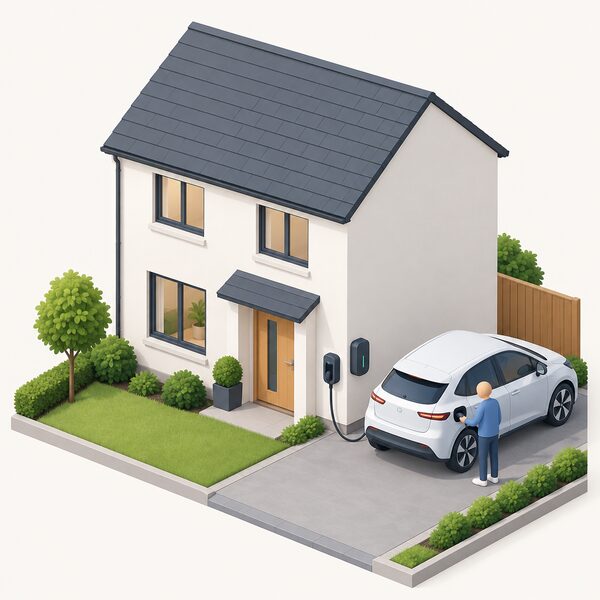
Part S delivers one thing reliably: a 7kW connection point at a new home with parking, present from day one, without the household negotiating an installation or a network connection1. That removes the largest practical barrier to charging at home, and home charging is the precondition for almost everything else a household might do to loosen its dependence on public networks and forecourt pricing.
The dependence that remains is substantial and should be stated plainly. The charge point is a grid connection: it does not generate electricity, and a Part S installation carries no obligation to be solar-aware, to work with a time-of-use tariff, or to function without an internet connection. Where a third-party-operated service meets the requirement, the household's charging is metered by a company it did not choose17. Where the £3,600 cost cap has been applied, what a buyer receives may be a cable route rather than a working socket, with the remaining cost to come2. And where cross-pavement access is needed, a pavement cable crossing may require separate planning permission unless the crossing is owned by the highways authority, and is unlikely to be covered by householder permission for the charge point22.
Part S is best read as a minimum guarantee of readiness, not a finished energy strategy. Pairing the charge point with generation and storage is a separate decision, set out on charging an EV from solar panels, EV charging alongside a home battery and EV charging and household energy independence. The full picture of home charging in the UK sits on the EV charging guide.
Sources22 cited
- The Building Regulations etc. (Amendment) (England) (No. 2) Regulations 2021, legislation.gov.uk, 13 December 2021
- Approved Document S: infrastructure for charging electric vehicles (PDF), GOV.UK, 2021
- Approved Document S: frequently asked questions, GOV.UK, 17 April 2023
- Electric vehicle chargepoint grant for residential landlords, Find Government Grants, 2026
- Electric vehicle charging in residential and non-residential buildings, Welsh Government, 6 September 2024
- Building regulations discussion document and pre-consultation, NI Direct, 11 October 2023
- Approved Document S: infrastructure for charging electric vehicles, Planning Portal, December 2021
- EV charging infrastructure: where to start, Future Homes Hub, 26 April 2023
- EV charging: building regulations, Planning Portal, 2026
- Solar car parks and EV charging call for evidence, GOV.UK, May 2025
- The Building Regulations 2010, legislation.gov.uk, 2010
- Infrastructure for charging electric vehicles: Approved Document S, GOV.UK, 15 December 2021
- EV charger regulations in England: what has changed, NICEIC, 19 August 2026
- Electric vehicle chargepoint and infrastructure specifications, GOV.UK, 10 October 2023
- Scottish building regulations: proposed changes to energy standards, Scottish Government, 23 July 2021
- Electric vehicle charge points for new buildings: policy proposals, Transport Scotland, 2026
- EV charging infrastructure: worked examples, Future Homes Hub, 28 April 2023
- The Planning (General Permitted Development) Order (Northern Ireland) 2015, Schedules, legislation.gov.uk, 2015
- EV charging: planning permission, Planning Portal, 2026
- Energy saving and sustainability in conservation areas and listed buildings, Brighton and Hove City Council, 2026
- Electric vehicle chargepoint grant for renters and flat owners, Find Government Grants, 2026
- EV charging: approved pavement crossings, Planning Portal, 2026
 EV Charger WarrantiesCovers typical warranty lengths on UK home charge points, what parts and labour are included, registration conditions and extended warranty options.
 Home Charger InstallationWho can fit a home EV charger, and does it need building regulations approval?
 Electrical RequirementsWill your home need a bigger electricity supply before a charge point can go in?
 Planning Permission for ChargersDo you need planning permission for a home EV charger, and does it change if you live in a listed building, a conservation area or a flat?
 Charging by Home TypeHow the practical and legal position for home EV charging changes by property type: flats and leasehold consent, terraced homes without frontage, shared car parks and metering, rural properties with long cable runs, and listed or conservation area homes.
 The Full EV Charging GuideCharging an electric car at home usually means a wallbox, but do you need one, and what will it cost to fit and run?