
On this page
Northern Ireland is the hardest place in the UK to charge an electric car away from home, and that makes charging at home matter more there than anywhere else. As of 1 July 2026 there were 60.0 public EV chargers per 100,000 people in Northern Ireland, of which only 19.3 were rapid or above. Across the UK as a whole the figures were 174.9 and 41.7 per 100,0001. The Climate Change Committee put it plainly in March 2025: "Northern Ireland currently has the fewest public EV charge points per capita of any of the UK nations."2
Against that backdrop, official guidance for Northern Ireland is unambiguous about the best route: home charging. NI Direct states that "In Northern Ireland, home-charging is the least expensive way to charge an electric vehicle (EV) because you can use lower home electricity tariffs", and notes that a home charger itself can cost up to £1,0003. This page sets out what that means in practice: which grants actually apply in Northern Ireland, how the grid connection process works through NIE Networks, what standards an installation must meet, and what home charging does and does not do for a household's energy independence.
Public charging in Northern Ireland: the figures
The headline numbers come from the UK Government's official charging infrastructure statistics. At 1 July 2026, Northern Ireland had 60.0 public chargers per 100,000 population and 19.3 rapid-or-above chargers per 100,0001. A year earlier, at 1 July 2025, the region had 35.8 devices per 100,000 and 9.8 devices rated 50kW and above per 100,0008. The gap between those two snapshots shows the network is growing, but from a very low base.
The growth rate is also the slowest in the UK. In the quarter from 1 April to 1 July 2025, Northern Ireland saw the smallest increase of any region at 1.8%, and the number of 50kW-and-above devices actually fell by 1.1% over the same quarter8. Independent statistics compiled the same picture: "Northern Ireland's total of 707 devices is by far the lowest of anywhere in the UK"4.
| Measure | Northern Ireland | UK | Date |
|---|---|---|---|
| Public chargers per 100,000 | 60.0 | 174.9 | 1 July 20261 |
| Rapid or above per 100,000 | 19.3 | 41.7 | 1 July 20261 |
| Devices per 100,000 (July 2025) | 35.8 | not given | 1 July 20258 |
| 50kW+ devices per 100,000 | 9.8 | not given | 1 July 20258 |
For comparison, the North East of England had 150.2 chargers per 100,000 (37.1 rapid or above), the North West 112.1 (40.0), Wales 185.5 (42.8) and the East of England 48.8 rapid or above per 100,000 at the same date1. Northern Ireland sits far below all of them, and below the UK average by a factor of nearly three.
The character of the network matters as much as its size. Across the UK, 57% of public charging stations are rated between 3 and 8kW, which one consumer review notes is "at best slightly faster as an at-home charger and at worst would take nearly a full" day to charge a car9. Northern Ireland's public network leans heavily on exactly this kind of slow unit, so a household that cannot charge at home in Northern Ireland has fewer and slower options than one in any other part of the UK. Our page on public EV charging covers how these networks work in general.
What drives the gap
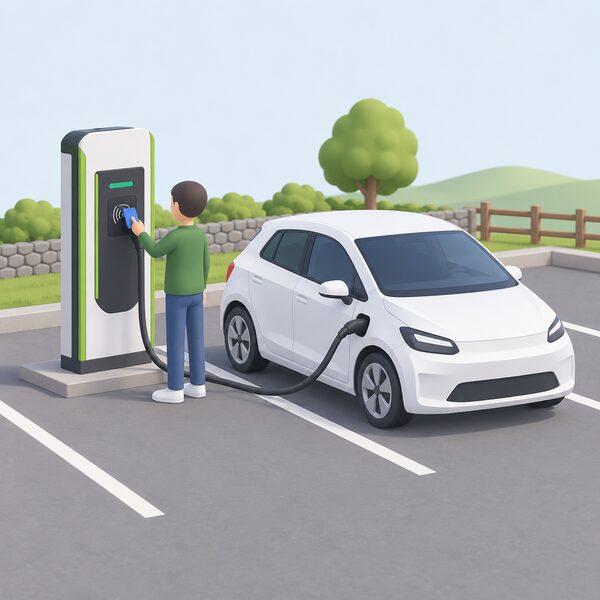
Several things lie behind Northern Ireland's position at the bottom of the UK table, and they reinforce each other.
The first is the age and design of the existing network. Northern Ireland's public chargers sit on the eCar NI network, and as one UK charging guide puts it: "Many chargers are still free but require RFID cards or an app. Modernisation of the network is currently underway."10 A network built on free-to-use, card-operated chargers was generous for its time, but it does not deliver the reliability or payment flexibility drivers now expect, and modernisation takes time. Historically the regional networks took a different funding path: "Regionally based ChargePlace Scotland and ecarni network (Northern Ireland) provide rapid chargers within their network" that were typically free to use11, an approach that kept costs down for early adopters but did not build a commercial market.
The second driver is scale of demand. NIE Networks noted as far back as 2020 that "there are almost 3,500 electric vehicles registered in Northern Ireland"7, a small fleet at the time, and network investment has trailed the growth in EV numbers since. The third is geography and rurality. Across England and Wales, 83.3% of public EV chargers are located in urban areas, compared with 82.4% of the population living there, while 16.7% of chargers serve the 17.5% of the population in rural areas1. Northern Ireland has a large rural population and a thin rural charging estate, so rural households without off-street parking are particularly poorly served.
The Climate Change Committee has flagged the gap as a policy problem, not just a market outcome. Its March 2025 statement on electric technologies called for measures to "support the deployment of public charge points across Northern Ireland, to address the issue that Northern Ireland currently" has the fewest per capita of any UK nation12. Its work on Northern Ireland's fourth carbon budget repeats the same finding2. In other words, the official assessment is that the public network will not close the gap on its own, which pushes the practical burden onto home charging.
Grants that apply in Northern Ireland
This is where Northern Ireland differs most from the rest of the UK, and where households most often go wrong. The position is not that no grants exist; it is that the grants that exist are narrow.
The electric vehicle chargepoint grant for renters and flat owners covers Northern Ireland. The Department for Infrastructure states that "DfT/OZEV have numerous grants available in Northern Ireland towards the installation of EV charge points and infrastruct"ure5. This grant is for people who do not own their home or who live in a flat, not for owners of houses with driveways. Our page on the electric vehicle chargepoint grant sets out the eligibility rules in full.
The electric vehicle chargepoint grant for residential landlords also covers all four nations: the scheme rules state that "The property must be located in England, Wales, Scotland or Northern Ireland."6 So a landlord renting out property in Northern Ireland can apply, and our page on the EV chargepoint grant for residential landlords explains what it funds.
What there is not, in the current scheme structure, is an open grant for owner-occupiers with off-street parking. The old Electric Vehicle Homecharge Scheme that once covered that group has closed, and the current chargepoint grant schemes have been extended, with funding running until 31 March 202713. Anyone in Northern Ireland hoping to use a grant should treat that date as a hard deadline and check the scheme rules on the Department for Infrastructure page before committing to an installation5.
Grant-funded installations must meet a defined set of standards. The Government's chargepoint and infrastructure specifications require that "You must carry out chargepoint installations as per" BS EN 61851, the IET wiring regulations BS 7671, the IET Code of Practice for Electric Vehicle Charging Equipment Installations, and the Electricity Safety, Quality and Continuity Regulations installation requirements14. Those standards apply to the installation itself wherever you are in the UK, and they are the same standards a good installer will work to whether or not a grant is involved.
Charging without a driveway: the cross-pavement route
Many Northern Ireland homes are terraces or sit directly on the street, with no driveway at all. For those households the question is not which wallbox to buy but how to get electricity from the house to the car legally and safely.
Northern Ireland has its own official route for this. NI Direct runs a service for people who "live in Northern Ireland, own an electric vehicle and need a way to charge it at home across a pavement"15.
For households with no off-street parking at all, our page on charging an EV without a driveway covers the options, and the cross-pavement charging grant page explains the funding that can help with the work.
Grid connection and telling NIE Networks
Northern Ireland has a single distribution network operator, NIE Networks, covering the whole region16. That simplifies one part of the process: there is only one organisation to notify, and the rules it works to are set out in Northern Ireland-specific regulations.
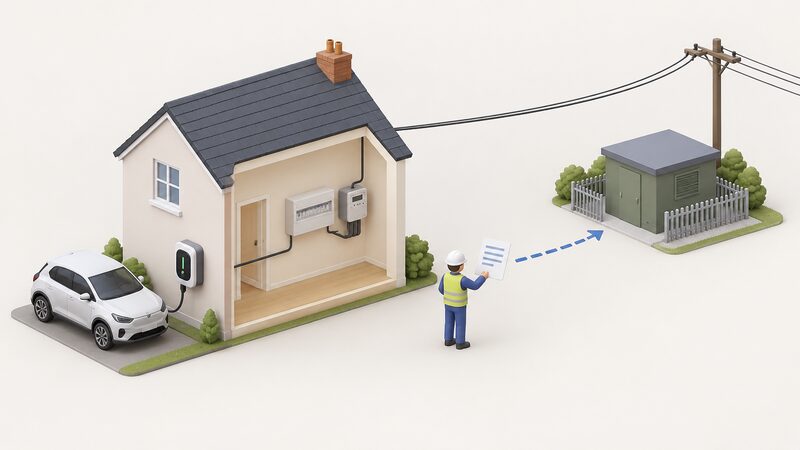
The installer's obligations are clear. Under the IET Code of Practice for EV Charging Equipment Installation, installers must "Assess the adequacy of the supply capacity for the new Electric Vehicle load plus any existing load, before installing the charging equipment; assess the adequacy of the earthing, before installing the charging equipment; notify NIE Networks of the installation"17. The same duties apply across the water, where installers must assess supply capacity and earthing and "notify your electricity Distribution Network Operator (DNO) once the charge point has been installed"18, but in Northern Ireland the named recipient is NIE Networks.
The legal framework is also Northern Ireland-specific. Connection requirements in the region "are governed by the Electricity Safety, Quality and Continuity Regulations (Northern Ireland) 2012 and the Engineering Recommendation G98/NI"19. G98/NI is the Northern Ireland version of the standard that governs small-scale generation and load connections, and it is what determines whether a straightforward notification is enough or whether a fuller connection application is needed.
Why does notification matter? NIE Networks explains its purpose plainly: it needs to know "so it can invest in the electricity network where needed and ensure the network has sufficient capacity. It is also crit"ical for safety and for ensuring a property does not exceed its supply capacity7. When you apply, NIE Networks "check[s] how much electricity your area uses and whether it can handle the new equipment like heat pumps or electric car" chargers, to avoid power cuts and keep the supply safe and steady20. Our page on telling the network operator about a home EV charger walks through the process in detail.
There is also a wider policy shift working in favour of new connections. NIE Networks has changed its connection charging approach in a way that "supports Northern Ireland's energy strategy and the growth of renewable energy"21, which is relevant to any household thinking about a charger now and solar panels or a heat pump later. The network's capacity checks are not a hurdle to fear; they are the mechanism that keeps an older supply from being overloaded when a charger joins a house already running electric heating.
Installation standards and who should do the work
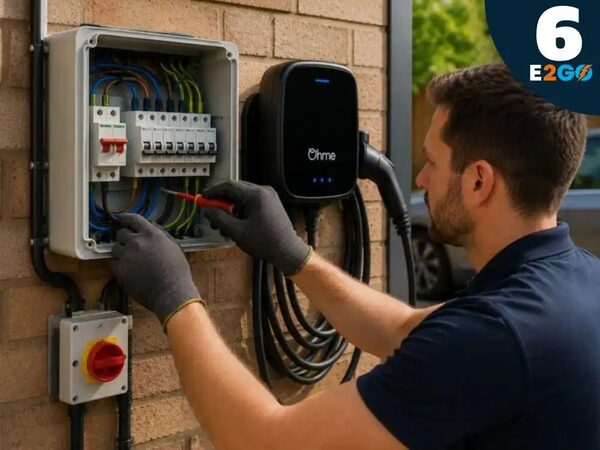
The technical rules for a home charger in Northern Ireland are the same UK-wide standards, applied through Northern Ireland's own regulations.
Every EV charging installation must comply with BS 7671, the Wiring Regulations. As NICEIC puts it, "all EV charging installations must continue to comply with the requirements of BS 7671, the national standard for electrical installations"13, and the same body states that a charger "must be installed in line with the current edition of BS 7671" and that householders should "hire an electrician registered with a recognised certification body, like NICEIC"22. A registered installer handles the supply capacity assessment, the earthing assessment and the NIE Networks notification as part of the job.
Two differences from England and Wales are worth knowing. First, in England and Wales, "Building Regulations in England and Wales require EV charger installations to be notified to your local authority build"ing control because they involve creating a new circuit13; the notification route in Northern Ireland runs through NIE Networks and the 2012 Regulations instead. Second, permitted development rules, which govern whether a wallbox needs planning permission, have their own Northern Ireland order, and the size and height limitations that apply to equipment installed under permitted development rights in England13 have their equivalents in the NI order. Our page on planning permission for a home EV charge point covers the position in each nation, and our page on home EV charge point installation covers the process step by step.
The practical sequence for a Northern Ireland household is therefore:
- Confirm your eligibility for a grant, if any, before booking anything5.
- Choose an installer registered with a recognised certification body22.
- Let the installer assess your supply capacity and earthing17.
- Have the charger installed to BS 7671 and the IET Code of Practice14.
- Ensure NIE Networks is notified of the installation17.
What home charging means for energy independence
Home charging in Northern Ireland delivers a real gain in independence, but it is a partial one, and it is worth being clear about both halves.
The gain is substantial. Charging at home frees a household from the public network, which in Northern Ireland is the weakest in the UK1. It also frees the household from the public network's payment friction: the older eCar NI chargers that require RFID cards or apps10, and the slow 3 to 8kW units that dominate the UK's public estate9. With a home charger and a favourable tariff, the car runs on the household's own supply, at the price the household has negotiated, and the daily dependence on any charging operator disappears. NI Direct's guidance that home charging is the least expensive way to charge in Northern Ireland3 is the official confirmation of what the per-capita numbers imply: in this region, home charging is not just cheaper, it is the only dependable option.
The dependence that remains is the grid itself. A home charger is only as independent as the wire behind it. Northern Ireland uses load shedding, "a form of emergency power cut which is used by energy companies in response to severe shortage of elect"ricity generation23, and NIE Networks also runs planned power cuts for maintenance23. Unlike a gas car, which can be refuelled during an outage, an EV at home simply cannot charge while the supply is down. Households that pair a charger with solar panels and a home battery reduce that dependence further; our pages on charging an EV from solar panels and on EV charging and household energy independence cover that route.
The supplier relationship also differs from Great Britain. Northern Ireland has its own energy market and its own consumer protections. All electricity and gas suppliers in Northern Ireland "have voluntarily committed to the new energy Charters" launched for winter 2026/2724. During the energy crisis, the Energy Price Guarantee ran as a separate Northern Ireland scheme, "intended for customers on domestic tariffs", with ministerial directions that allowed "domestic electricity and gas suppliers in Northern Ireland to make tariff changes on days other than the first day of a quarter"25, a flexibility that existed because the NI market works differently. A household choosing an EV tariff in Northern Ireland is choosing within that separate market, and our page on EV energy tariffs explains how they work.
Help is available, and it is free. The Consumer Council NI and Northern Ireland Energy Advice "give free, independent and impartial energy advice to all dom"estic householders in Northern Ireland26. NI Energy Advice offers "independent and impartial energy advice to domestic householders in Northern Ireland, plus referrals to energy grants and other sources of help"27, including advice on energy efficiency and grants28. For a household weighing a charger, a tariff and possibly solar, that is the official starting point.
The bottom line for energy independence is this: a home charger in Northern Ireland removes dependence on the UK's thinnest public charging network, but it deepens dependence on the local grid and a single supplier relationship in a small, separate market. The households that gain most are those that treat the charger as one part of a wider setup, with the tariff, the network notification and, where possible, generation of their own.
Sources28 sources
- Public electric vehicle charging infrastructure statistics: 1 July 2026, GOV.UK, 2026
- Northern Ireland's Fourth Carbon Budget, Climate Change Committee, 2025
- Electric vehicles, NI Direct, 2026
- EV charging statistics, Uswitch, 2025
- Electric vehicle chargepoint and infrastructure grants, Department for Infrastructure, 2026
- Electric vehicle chargepoint and infrastructure grants for landlords, Find Government Grants, 2026
- Customers installing electric vehicle chargers, NIE Networks, 2020
- Electric vehicle public charging infrastructure statistics: July 2025, GOV.UK, 2025
- Should I buy an electric car?, Which?, 2025
- Electric car charging guide, Carwow, 2025
- EV rapid charge cost comparison, Zapmap, 2018
- Electric technologies will benefit Northern Ireland, Climate Change Committee, 2025
- EV charger regulations in England: what's changed, NICEIC, 2026
- Electric vehicle chargepoint and infrastructure specifications, GOV.UK, 2023
- Apply for electric vehicle cross-pavement charging, NI Direct, 2026
- Who supplies my electricity and gas?, Uswitch, 2026
- EVs and heat pumps FAQs, NIE Networks, 2026
- Single EV connection, Electricity North West, 2026
- Plug-in solar consultation document, GOV.UK, 2026
- What we do with your application, NIE Networks, 2026
- Fairer connection costs: why is this change being made, NIE Networks, 2026
- Electric vehicle charger installation and maintenance, NICEIC, 2025
- Planned and emergency power cuts, NIE Networks, 2026
- Northern Ireland's Consumer Energy Charters launched winter 2026/27, Utility Regulator, 2026
- Energy Price Guarantee for domestic energy consumers in Northern Ireland: ministerial directions, GOV.UK, 2023
- Low carbon heating, NI Direct, 2026
- Biomass, NI Direct, 2026
- Energy efficiency tips, NI Direct, 2026