
In this guide
ChargePlace Scotland is the public charging network that operates the non-motorway charge points in Scotland1. It is the network Scottish drivers meet by name at car parks, leisure centres, retail parks and roadside sites, and it is the one most often searched for by name rather than by location. Scotland now has over 6,900 public charge points, and the number of public EV charge points per capita in Scotland is 7% higher than the UK average2.
The network's growth is the headline. It went from just 55 charge points in 2013 to over 1,700 by 2021, and a Scottish Government target for 6,000 public charge points was met in October 2024, two years ahead of schedule4. Scotland recorded 231.6 total EV chargers per 100,000 population as of 1 July 2026, with 59.1 rapid or above chargers per 100,000 population5.
What that means for a household is a network that reduces one form of dependence, the reliance on a single operator's card or app for local journeys, while leaving others in place: the electricity still comes from a supplier, the charge point is owned by someone else, and access depends on a card, an app or a payment platform that the driver does not control.
What ChargePlace Scotland is: the national public charging network
ChargePlace Scotland is the single operator of non-motorway charge points in Scotland, run as a public charging network rather than as a commercial brand competing with others1. That structure is unusual in Great Britain. The public charging experience in Scotland has been described as significantly different from the rest of Britain, with a greater variety of charge point operators and processes outside Scotland6. A driver crossing the border moves from one named network with one access method to a patchwork of operators, each with its own account, tariff and support route.
The network exists because Scottish ministers chose to build one. Since 2011, the Scottish Government has spent over £45m to establish and roll out ChargePlace Scotland7. That public funding is the reason the network reached places a purely commercial roll-out might have skipped: approximately 70 per cent of publicly available charge points are outside Scotland's cities8. For a household in a rural or island community, that distribution matters more than the headline count, because it is the difference between an electric vehicle being usable for local journeys and not.
Scotland's position relative to the rest of the UK is strong on a per capita basis. The number of public EV charge points per capita in Scotland is 7% higher than the UK average3. Scotland had over 2,500 public EV chargepoints as of June 2021, representing 10% of the UK total at that point9. Wales, by contrast, was described in its own charging strategy as behind England and Scotland in terms of the number of chargers available and electric vehicle ownership10.
The independence question is straightforward. A public network gives a household access to charging without owning a charge point, which lowers the barrier to running an electric vehicle for anyone without off-street parking. It does not give independence from the grid, from an electricity supplier, or from the network operator's systems. The charge point is someone else's asset, maintained on someone else's schedule, and the electricity is bought at whatever tariff the host has set.
From 55 charge points to nearly 3,000: how the network grew
The growth curve is the clearest evidence of what public funding achieved. ChargePlace Scotland had over 1,700 public charge points by 2021, up from just 55 in 20134. By the time of a 2021 consultation, the network was described as having more than 1,800 publicly available charge points throughout Scotland11. Public charge points across Scotland then increased by approximately 34% to over 6,000 in 202412, and a target for 6,000 public charge points was met in October 2024, two years ahead of schedule2.
The wider UK context shows how fast the sector moved. Over the period 2016 to 2020 the number of chargepoints more than tripled, from over 6,000 to more than 20,0007. Since 2011, government, local authorities and the charging infrastructure sector delivered a 3,000% increase in standard public chargepoints13. Scotland's own trajectory tracked that national curve but started from a much smaller base.
The next phase is different in character. The Scottish Government's ambition is to enable the creation of approximately 24,000 additional public charge points by 2030, largely funded and delivered by the private sector2. Two thirds of public EV charging in Scotland is already funded and delivered by the private sector2. By the end of 2024, over half of all public EV charging in Scotland was owned and funded by the private sector2.
That shift changes what a household can expect. A publicly funded network tends to prioritise coverage, including sites that will never pay for themselves. A privately funded network prioritises sites with traffic. The risk is that the places public money reached first, rural and low-traffic locations, see slower renewal and replacement as the commercial share grows. An earlier estimate put the required investment in Scottish public EV charging infrastructure at £280 million overall up to 203011.
Who runs it: SWARCO, EVolt and the local authority hosts
The network is not run by one organisation from top to bottom. A single back-office provider, SWARCO until 2023, was secured through a tender process run by Transport Scotland7. SWARCO Smart Charging took over management of the ChargePlace Scotland chargers in July 2021. The back office is the system behind the card, the app, the tariff records and the out of service list, and it is the part a driver interacts with without seeing it.
Ownership of the hardware is spread across Scotland's councils. Funds were offered to all local authorities in Scotland to install charge points, with a condition of the grant that chargepoints are on the ChargePlace Scotland network7. That condition is what made a single national network possible: councils could install to local need, but the sites had to be accessible through one system rather than thirty-two.
The 32 Scottish local authorities and the Scottish Government are the parties responsible for operation of the energy performance of buildings system in Scotland14, which is a separate regime but illustrates the same pattern of shared responsibility between central and local government. For charging, the practical consequence is that a fault at a site may sit with a council, with the back-office provider, or with a maintenance contractor, and the driver's route in is the network's own reporting process rather than the council.
Charging speeds: from 7kW standard to 150kW ultra rapid
ChargePlace Scotland sites span the full range of speeds, and the mix is what determines whether the network suits a household. Rapid charging covers 50kW up to 149kW, and ultra-rapid covers 150kW and above15. Ultra-rapid chargepoints at 150kW and over are the fastest, taking 10 minutes to one hour to charge up to 80%16. Rapid chargepoints at 50kW to 149kW take 15 minutes to one hour to charge up to 80%16.
Scotland's rapid and ultra-rapid provision is substantial. Scotland has 3,395 rapid and ultra-rapid chargers, and of Scotland's charge points, 1,030-plus are rapid and ultra-rapid charge points6. Across the UK, 12% of chargers were rated ultra-rapid at 150kW and above as of 1 July 20265. Rapid and ultra-rapid chargers are defined in manufacturer and industry material as spanning 50kW to 300kW17.
| Speed band | Power | Time to 80% | Scotland position |
|---|---|---|---|
| Standard | Below rapid | Not stated | Majority of sites historically |
| Rapid | 50kW to 149kW | 15 minutes to one hour16 | 3,395 rapid and ultra-rapid chargers in Scotland6 |
| Ultra-rapid | 150kW and above15 | 10 minutes to one hour16 | 12% of UK chargers were ultra-rapid5 |
Scotland's rapid charging build-out has been among the fastest in the UK. Scotland added 773 charge points at 50kW or above in the 24 months to the end of April 2026, a 58.3% increase, alongside 3,195 charge points or charging devices in total, a 62.9% increase18. The region showing the biggest growth in rapid charging was the East of England, which almost doubled its number of high-powered chargers18. Across the UK, there was a 16% increase in the number of rapid and ultra-rapid EV chargers over the 12 months to August 202615.
For a household, the speed mix decides how the network is used. Standard and fast chargers suit destination charging, where the car sits for an hour or more. Rapid and ultra-rapid chargers suit journey breaks. A network weighted towards the slower end is not a deficiency for local use, but it changes the planning a driver does before a long trip.
What it costs: free chargers, tariffs and the £20 RFID card
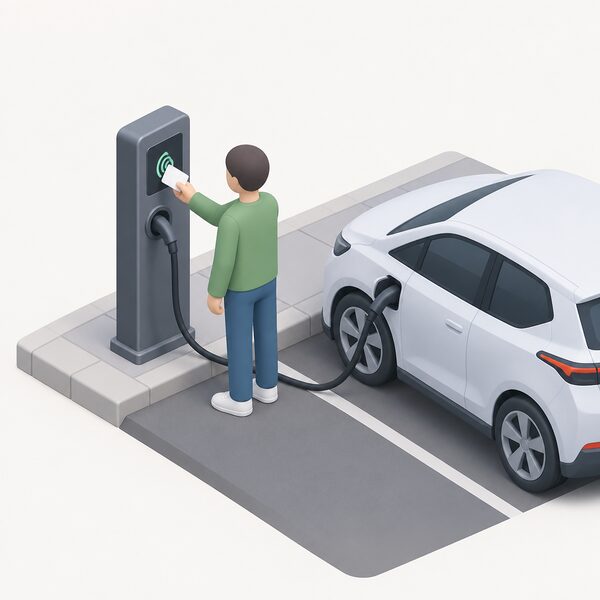
The cost picture is the part of ChargePlace Scotland that has changed most, and the evidence spans several years. The electricity for the majority of charge points is free to use, and most public chargepoints were described as currently free to use in official guidance8. An RFID card to use all charge points cost £20 per year, with no cost beyond this to charge1.
That combination, a small annual card fee and free electricity, was the network's defining feature for its first decade. It was funded by the Scottish Government's £45m-plus investment rather than by driver payments7. Free use at the point of use is not the same as free to provide: the cost sat with the public purse.
"An RFID card (to use all charge points) costs £20 p/year. No cost beyond this to charge."
The direction of travel is towards tariffs set by hosts and operators. With two thirds of public EV charging in Scotland funded and delivered by the private sector, and over half owned and funded privately by the end of 2024, the commercial pressure to charge for electricity has grown2. A household should treat free charging as a feature of many sites rather than a network-wide guarantee, and check the tariff at the specific charge point before relying on it.
There is no published national tariff for ChargePlace Scotland in the evidence here, and no figure for what a paid session costs. Prices are set site by site. For context on what electricity costs a household at home, the Ofgem price cap for Southern Scotland in the Charge Restriction Period 15b was £228.10 at nil consumption on single-rate metering, and £877.81 at 2,700 kWh, with the documents giving more than one figure for the same band19. Those are domestic supply figures, not charging tariffs, and they are given here only to show the scale of a household electricity bill against which a public charging session is judged.
How to access and pay: one card or app for the whole network
Access is the network's main practical advantage. One RFID card works across the charge points, and the card was priced at £20 per year with no cost beyond this to charge1. That single-account model is what distinguishes ChargePlace Scotland from the rest of Great Britain, where the public charging experience involves a greater variety of charge point operators and processes6.
The card is not the only route. ChargePlace Scotland has been the newest charging network partner on the Octopus Electroverse network since August 2024, which allows drivers with an Electroverse account to use ChargePlace Scotland sites through that platform rather than a separate card. Roaming arrangements of this kind are how a driver reduces the number of accounts they hold, though each platform carries its own terms and its own record of which sites are included.
For a household, the access model matters for independence in a specific way. A single card for a national network means one account, one support route and one place to check status. It also means a single point of failure: if the card is lost, the account is locked or the back office is down, access depends on whatever alternative payment route the individual site offers. Sites with contactless payment or an app option give a fallback; sites that accept only the card do not.
The wider Scottish support landscape is separate from charging but relevant to a household weighing running costs. The energy advice service for Scotland can be reached on 0808 196 8660 for problems with energy supply20. Winter Heating Payment support can be redeemed at one of 2,850 PayPoint outlets in Scotland21. These are not charging schemes, and they do not pay for charging, but they are the routes a Scottish household uses when energy costs become unmanageable.
Reliability and support: the out of service list and helpline
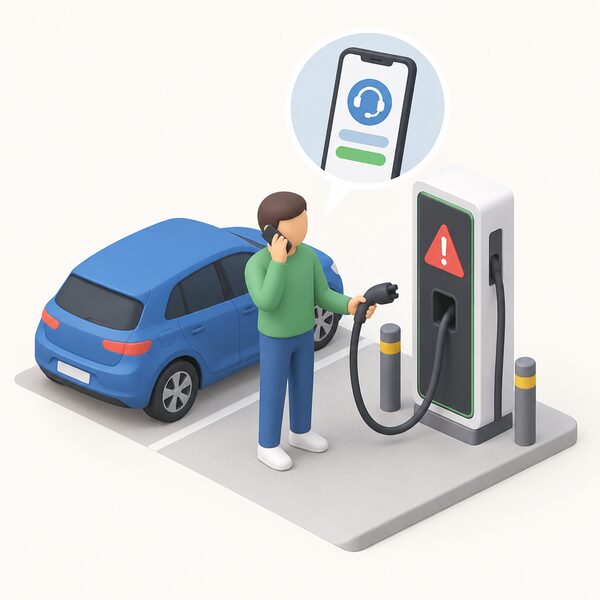
Reliability is the part of any public network a driver cannot control. ChargePlace Scotland publishes an out of service list for its charge points and runs a helpline for faults, and those are the correct first points of contact when a charger does not work. The network's own reporting route exists because ownership is fragmented: a fault may sit with a council, a maintenance contractor or the back office, and the driver needs one place to report it rather than a search for the right body.
The support picture around energy in Scotland is broader than charging. Advice Direct Scotland provides assistance in various areas related to the cost-of-living, including energy, debt, and support with benefits applications22. The Community and Renewable Energy Scheme has a network of development officers across Scotland to provide free, expert and impartial advice and support to community groups, charities and other eligible organisations seeking to explore their renewable energy options23. Neither is a charging helpline, but both are part of how Scottish households and communities get help with energy decisions.
For a household, reliability determines whether a public network can substitute for a home charge point. A driver with off-street parking and a home charger treats public charging as occasional. A driver without it depends on the public network for every journey, and an out of service rapid charger is then not an inconvenience but a change of plan. That is the dependence a public network creates even as it removes the need to own hardware.
ChargePlace Scotland and the wider UK: Electroverse and what comes next
ChargePlace Scotland joined the Octopus Electroverse network in August 2024, which extended access to drivers holding an Electroverse account rather than a ChargePlace Scotland card. Roaming of this kind is the direction the sector is moving in, and it changes the network from a closed Scottish system into one node among several.
The funding model behind the network is shifting at the same time. The Scottish Government's ambition is approximately 24,000 additional public charge points by 2030, largely funded and delivered by the private sector, and two thirds of public EV charging in Scotland is already funded and delivered privately2. The public money that built the network is not the money that will extend it.
For home charging, the Scottish Government has provided over £19m since 2013 for the installation of over 23,000 lower powered charge points at homes and workplaces2. The domestic charge point grant scheme is funded by Transport Scotland, and one of the conditions of the grant is that funding is only available for the installation of an electric charge point at a residential property based in Scotland with dedicated off-street parking at the property24. That condition is the dividing line: a household with off-street parking can reduce its dependence on public charging with grant support, and a household without it cannot.
The comparison with Wales is instructive. Wales was described in its own 2020 charging strategy as behind England and Scotland in terms of the number of chargers available and electric vehicle ownership10. Scotland's early public investment produced a per capita lead that persists: public EV charge points per capita in Scotland are 7% higher than the UK average3.
What comes next for a Scottish household is a network that is larger, faster and less free than the one built between 2013 and 2024. The independence it offers is real but partial: it removes the need to own a charge point, and it does not remove the need for a supplier, a grid connection, an account with an operator, or a working payment platform. For households weighing a home charge point against reliance on the public network, the grant conditions and the tariff direction are the two facts that decide the calculation.
Sources24 cited
- Electric vehicle charging in Scotland, Ofgem, 2021
- Scotland's Climate Change Plan 2026 to 2040, Scottish Government, 2025
- Scotland's Carbon Budgets, Climate Change Committee, 2025
- Making the switch: experiences of people who have already switched to electric vehicles, Energy Saving Trust, 2025
- Public electric vehicle charging infrastructure statistics, 1 July 2026, Department for Transport, 2026
- EV charging statistics, Zapmap, 2026
- Electric vehicle charging market study: final report, Competition and Markets Authority, 2021
- Electric cars, Home Energy Scotland, 2026
- Net zero by 2045: how Scotland is addressing the climate emergency, Energy Saving Trust, 2021
- Electric Vehicle Charging Strategy for Wales consultation, Welsh Government, 2020
- Scottish Building Regulations: proposed changes to energy standards, Scottish Government, 2021
- Progress in reducing emissions in Scotland 2025, Climate Change Committee, 2025
- UK automotive calls for EV chargepoint mandate governed by independent regulator, Society of Motor Manufacturers and Traders, 2022
- Energy Performance of Buildings (Scotland) Regulations 2008, legislation.gov.uk, 2008
- Rapid charging prices, Zapmap, 2026
- Charging electric vehicles, Energy Saving Trust, 2026
- EVs: the facts, Society of Motor Manufacturers and Traders, 2025
- Over nine in 10 rapid EV charge points built outside London in last two years, ChargeUK, 2026
- Energy price cap levels, 1 October to 31 December 2025, Ofgem, 2025
- Complain about your energy supplier or network operator, Ofgem, 2026
- Winter Heating Payment: low income Scotland equality impact assessment, Scottish Government, 2022
- Boosting the Fuel Insecurity Fund, Scottish Government, 2026
- Local and small scale renewables, Scottish Government, 2026
- Domestic charge point grant fund, Scottish Government, 2024