
In this answer
Short answer
Scotland had approximately 52 solar PV systems per 1,000 households as of 2026, according to analysis of MCS installation data by the Energy and Climate Intelligence Unit1. That is a higher rate per household than England's, and it sits alongside a heat pump rate of more than 17 installations per 1,000 households cumulatively1.
The national figure conceals a wide spread. Aberdeenshire records 423 solar panel installations per 10,000 people, the highest in Scotland, while Glasgow City records 452. Across the country, 23 of Scotland's 32 local authorities show above average solar panels per 10,000 people2. New build is doing much of the work: the proportion of new houses in Scotland built with solar PV rose from around 10% in 2015 to around 80% in 20233.
For a household, the number matters because it describes how normal rooftop generation has become in Scotland, and how much of the supporting infrastructure, from installers to grid connections, is already in place. It also marks the limit: a solar array still depends on the grid for the hours it does not generate, and on a supplier for the export and import arrangements that make the economics work.
How Scotland compares with the rest of the UK on per-household uptake
The per-household comparison is the one that matters, because it strips out population size. On that basis Scotland is ahead of England for both solar PV and heat pumps, according to the ECIU analysis of MCS data published in June 20261. MCS's own consumer research found that over 5.7% of households in one English region had a certified renewable installation, placing that region behind Wales and Scotland5.
Scotland's position in the Feed-in Tariff register tells a different and older story. In Scotland solar PV made up only 37.88% of installed capacity in the March 2026 quarterly report6, and 37.89% over the scheme lifetime to 31 March 20257. The word "only" is the report's own: Scotland's installed capacity under the scheme was dominated by onshore wind, which is why the average capacity of installations in Scotland is higher than in other regions8. Solar's share of capacity is therefore not a measure of household uptake, and the two figures should not be read as one.
Survey evidence gives a lower household figure than the installation data. Consumer Scotland's net zero survey found 7% of consumers in Scotland had solar photovoltaic panels, with a further 13% stating they did not have them but would consider installing9. That is a 2023 survey of stated possession, not a register count, and it will undercount households that have panels they did not report or did not know about.
The practical reading is that Scotland's per-household solar rate is high by UK standards and rising, driven substantially by new build rather than retrofit. Scotland's homes and buildings account for around 30% of the country's total energy consumption, or 44 TWh, which is the demand that domestic generation is chipping away at10.
Where uptake is highest: the best performing local authorities
Uptake in Scotland is not concentrated in the cities. The highest rates per head of population are in rural and semi-rural authorities, and the pattern is consistent across two independent datasets.
| Local authority | Installations per 10,000 people | Source |
|---|---|---|
| Aberdeenshire | 423 | 2 |
| Perth and Kinross | 334 | 2 |
| Scottish Borders | 331 | 2 |
| Angus | 290 | 2 |
| East Lothian | 265 | 2 |
| Orkney Islands | 74 | 2 |
| Glasgow City | 45 | 2 |
MCS's low carbon landscape report names Na h-Eileanan Siar, Midlothian and Moray as the best-performing local authorities in terms of uptake for 2026, and lists Neath Port Talbot, Na h-Eileanan Siar and Midlothian as coming out on top for MCS-certified renewable installations as a proportion of households11. The two lists overlap on the islands and Midlothian but not on Moray, which reflects different measures: one counts solar panel installations per head of population, the other counts all certified renewable installations as a proportion of households.
For context, the highest rate in the UK as a whole is South Hams in the South West of England at 409 installations per 10,000 people, and the lowest named authority is High Peak in the East Midlands at 1172. Aberdeenshire's 423 is above the highest English figure, which is a striking result for a Scottish authority.
The rural skew has a straightforward explanation. Off-gas-grid properties have the strongest financial case for generating their own electricity, and around 7% of households in Scotland rely on oil or LPG, with rural and island areas disproportionately affected12. Solar thermal follows a different pattern: Wales has the highest proportion of solar thermal accreditations at 11.4%, against England at 8.4% and Scotland at 6.4%13.
Why Scotland's rate matters for household energy independence
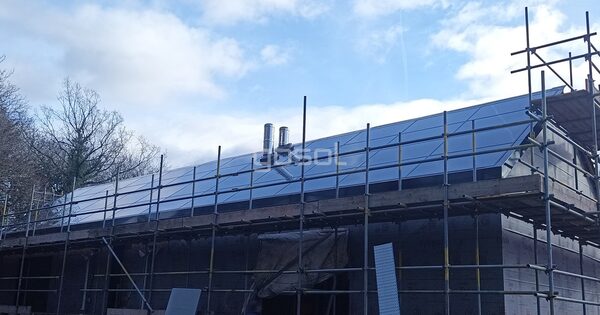
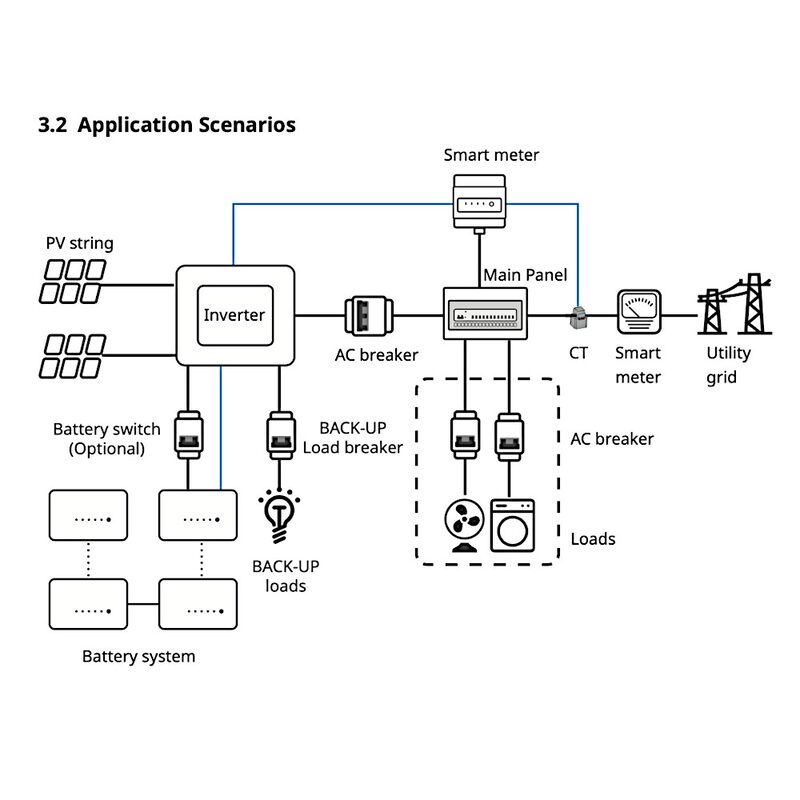
A solar array changes what a household buys and when. It generates during daylight, offsets the import that would otherwise be metered, and exports whatever is not used on site. What it does not do is remove the household from the grid: at night, in winter and in poor weather the property still draws from the network, and the export and import arrangements still run through a licensed supplier. Independence, in the Scottish context, means a smaller bill and a smaller exposure to wholesale prices, not disconnection.
The starting point for many Scottish homes is weak. As of the 2021 consultation, 45% of Scotland's homes had a good level of energy performance, equivalent to EPC Energy Efficiency Rating C14. That leaves a majority below C, and a solar array on a poorly insulated house delivers less benefit because more of the generation is offsetting heat that should never have escaped.
Scotland's target framework is more demanding than the rest of the UK's. The Scottish Government has set a target date for net zero emissions of all greenhouse gases by 204515, five years before the UK target16, and by 2045 all homes in Scotland must have significantly reduced their energy use17. Heating in homes and buildings currently accounts for 30% of Scotland's total energy consumption18.
Solar is one of the cheaper ways to make progress against that target. Home Energy Scotland gives an installation cost range of £1,500 to £10,000, with an average 4 kWp solar array costing around £6,500 to install4. A typical home solar PV system could save up to a tonne of carbon per year, depending on where in Scotland the property is4. Two other independent guidance sources give the same figure of around one tonne of carbon per year for a typical home system, depending on location in the UK19.
"A typical home solar PV system could save up to a tonne of carbon per year, depending on where you live in Scotland."
The dependence that remains is worth stating plainly. A household with panels still relies on the grid for the majority of its winter electricity, on a supplier for metering and payment, and on the manufacturer of the inverter and any battery for monitoring apps and warranty service. Where a battery is fitted, the household's ability to use its own generation after dark depends on that product continuing to work and on the maker continuing to support it.
Grants and advice: Scotland's separate support system
Support for Scottish households is administered separately from the schemes in England, Wales and Northern Ireland, and the difference is not cosmetic. Independent guidance states plainly that different grants are available in Scotland21.
The main route is the Home Energy Scotland Grant and Loan Scheme, which helps cover the costs of installing renewable technologies such as heat pumps and solar heating22. A rural uplift of £1,500 is available for households that qualify23. The published grant amount for solar panel installation is not consistent across documents: one states up to £7,500, another £1,250, and the two figures are not reconciled22. Households should treat the amount as scheme-dependent and confirm the current position with Home Energy Scotland rather than relying on either figure.
Other Scottish support sits alongside it. The Scottish Government's heat in buildings programmes have supported over 20,000 households to save up to £500 on their energy bills24. General help with home energy bills is available through the routes set out by Ofgem25. For households in social housing, energy efficiency obligations run through a separate policy route17.
Advice is free and Scotland-specific. Home Energy Scotland publishes guidance on solar panels covering cost, output and installation4, and runs free online webinars on related topics such as water saving, with free water-saving devices available afterwards subject to eligibility and availability26.
Two closed schemes are worth knowing about because they still generate complaints. The Green Deal and the Home Energy and Lifestyle Management Ltd (HELMS) arrangements are the subject of dedicated Citizens Advice Scotland guidance for consumers with problems arising from them27. Households approached about a Green Deal-style arrangement should check the current status before signing anything.
Planning, building warrants and electrical rules for solar in Scotland
Scotland's planning position for domestic solar is permissive in most cases, but it is not identical to England's, and the rules that appear in English council guidance do not apply north of the border.
The most useful starting point is the building warrant question, because it is the one Scottish households ask most often. Independent guidance states that a building warrant is not always needed for solar panels in Scotland, but that one might be needed for conservation areas or listed buildings27. A second independent source puts it the same way: often a building warrant is not needed for PV solar panels in Scotland, but if the property is in a conservation area or is listed, the position changes, and the household should check with the local council's planning department28.
For non-domestic solar, permitted development rights exist up to 45 kW electricity or 50 kW thermal in Scotland29. The Scottish Government's own impact assessment work on permitted development rights records that planning authorities estimated around £168,000 per year in lost fee income from solar panels, which indicates the scale of installations proceeding without a planning application29.
Electrical work is a separate matter from planning. Any alteration to a domestic electrical installation has to meet the relevant standards, and a full rewire in Scotland requires a building warrant30. Solar installation involves new circuits, an inverter connection and often a consumer unit alteration, so the electrical side is where the compliance burden actually sits.
English council guidance is sometimes mistaken for UK-wide rules. Cornwall Council sets out Class A and Class B permitted development rights for solar panels on domestic premises31, Wirral Council describes roof solar as considered in most cases permitted development under the Town and Country Planning (General Permitted Development) (England) Order 2015, Schedule 2, Part 14, Class J32, and Richmond Council notes that in many cases, even in conservation areas, homes can have solar panels without requiring planning permission under permitted development33. These are statements of English law. Scottish households should work from Scottish guidance and their own planning authority.
Sources33 cited
- Uptake of net zero technologies in Scottish homes, Energy and Climate Intelligence Unit, 2026-06-22
- UK solar panel hotspots, Energy Saving Trust, 2026
- National Energy Efficiency Data Framework: NEED report summary of analysis 2026, GOV.UK, 2026-06-11
- Solar panels, Home Energy Scotland, 2026-09-20
- The South leads for adoption of renewables in England last year, MCS Certified, 2024-03-05
- Feed-in Tariffs quarterly report, issue 63, Ofgem, 2026-03-30
- Feed-in Tariffs quarterly report, issue 60, Ofgem, 2025-06
- Feed-in Tariffs annual report, scheme year 13, Ofgem, 2023-12
- Consumers and the transition to net zero, Consumer Scotland, 2023-10-08
- Heat in buildings strategy: achieving net zero emissions in Scotland's buildings, Scottish Government, 2021-10-07
- Low carbon landscape 2026, MCS Certified, 2026
- Support for households using heating oil and LPG, Scottish Government, 2026-09-17
- Domestic Renewable Heat Incentive annual report, scheme year 11, Ofgem, 2025-07
- Heat in buildings strategy consultation, Scottish Government, 2021-02-05
- Climate change, Scottish Government, 2026-09-17
- Scotland's climate change plan 2026 to 2040, Scottish Government, 2025-11-06
- Energy efficiency in social housing, Scottish Government
- New measures to accelerate greener cheaper heating, Scottish Government, 2021-02-23
- How do solar panels work, Smart Energy GB, 2026-03-16
- Solar panels advice, Energy Saving Trust, 2026-08-27
- Heat pumps: beyond affordability, Which?, 2026-06
- Home Energy Scotland grant and loan, MCS Certified, 2026-06-17
- Heat pump calculator, Which?, 2025-04-30
- Helping households to manage their bills, Scottish Government, 2025-11-03
- Get help with your energy bills, Ofgem, 2026-09-17
- Water really worth saving, Home Energy Scotland, 2026-09-22
- HELMS and Green Deal complaints, Citizens Advice Scotland, 2026-09-17
- Problems with your Green Deal energy efficient home improvements, Citizens Advice Scotland, 2026-09-19
- Permitted development rights impact assessments, Scottish Government, 2026-09-17
- Rewiring your house: an essential guide for homeowners, NICEIC, 2026-09-17
- Solar panels and planning permission, Cornwall Council, 2026-09-17
- Solar panels, Wirral Council, 2026-09-17
- Solar panels and permitted development, Richmond Council, 2026-07-06
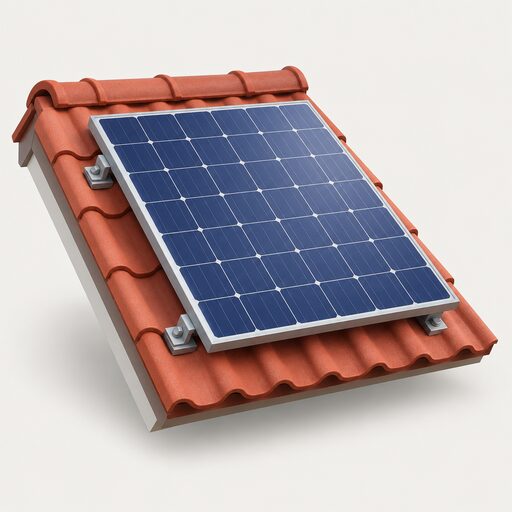 Solar PV Deployment StatisticsHow much solar power does the UK actually have, and how much of it sits on people's roofs?
 Microgeneration UptakeScotland has more solar panels and heat pumps per household than England, while Wales has built larger solar schemes and Northern Ireland lags behind.
 Home Energy Planning ScotlandDo you need planning permission for solar panels or a heat pump in Scotland?
 Housing Stock Data for ScotlandScotland's housing is measured differently from England's, so the numbers you see may not compare directly.
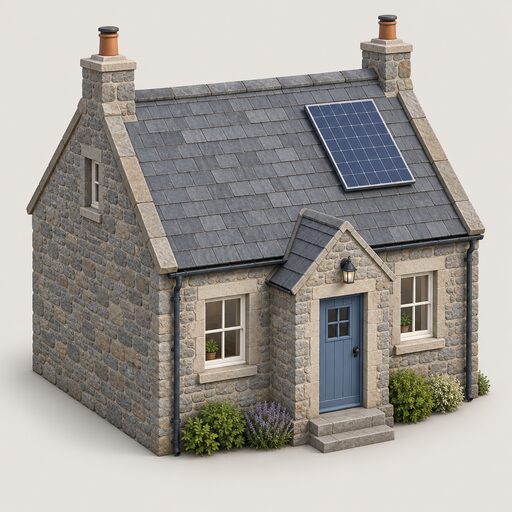 Planning Permission ScotlandMost solar panels on Scottish homes go ahead without planning permission, but flats, conservation areas and listed buildings change that.
 Solar Panel CostsA typical UK home pays somewhere between four and eleven thousand pounds for solar panels fitted, with most landing in the middle.