

In this comparison
Scotland installs more heat pumps per household than England, and the gap is widening rather than closing. The Scottish House Condition Survey found heat pumps used by 2% of Scottish dwellings in 2023, roughly 20 per 1,000 households, against a much lower rate south of the border1. Independent analysis of installer certification data published in June 2026 found Scotland ahead of England on a per-household basis for both solar PV and heat pumps2.
The absolute numbers are small on both sides. Government-supported installations in Scotland ran at 538 in the first quarter of 2025 and 745 in the third quarter of 2025, against 7,257 in England in the second quarter of 20243. Those figures cover grant-backed work only, and the UK statistics exclude some devolved administration schemes in Scotland and Northern Ireland, so the Scottish total understates real activity5.
What follows sets out the installation numbers, the reasons Scotland is ahead, the targets and the gap, the grant and loan support, the constraints on further growth, and how uptake varies across Scotland's 32 local authorities.
Installations compared: the numbers side by side
The two nations are measured on different bases, which is the first thing to understand before comparing them. The Scottish figure of 2% of dwellings is a stock measure: it counts homes that have a heat pump installed, not homes that installed one this year1. The quarterly deployment statistics count government-supported installations, meaning work that drew a grant or a loan from a public scheme3. Neither is a full market count.
| Measure | Scotland | England |
|---|---|---|
| Heat pumps as share of dwellings | 2% (2023)1 | Not given on the same basis |
| Government-supported installations, 2024 Q2 | 8844 | 7,2574 |
| Government-supported installations, 2025 Q1 | 5383 | Not given in the same table |
| Government-supported installations, 2025 Q3 | 7455 | Not given in the same table |
Read per household rather than in total, Scotland's position is stronger than the raw counts suggest, because England has roughly ten times the households. The UK as a whole remains a small market internationally: the number of heat pump units installed in the UK is just 7% of that in France9.
The Scottish Government's own consultation, published in November 2023, put the wider rate at around 5,000 people per year installing heat pumps, alongside around 33,000 buildings connected to heat networks10. That is a broader measure than the grant-backed statistics and includes installations that drew no public support.

Why Scotland is ahead: off-gas homes and electric heating

The structural reason for Scotland's lead is the heating mix. Census 2022 recorded 1,841,697 Scottish households on mains gas only, 73.4% of the total, and 226,515 households, 9.0%, on electric heating only2. The Scottish House Condition Survey, using 2023 data, put electricity as the primary heating fuel for 11% of households, or 270,000 homes1. Scottish Government guidance from December 2021 put the number of households with electric heating at over 280,00011.
Those homes are the natural first market. A household already on electric heating, storage heaters or a solid fuel or oil system has no gas connection to write off, and the switch to a heat pump is a replacement rather than a conversion of the whole system. Scottish Government strategy documents describe the very large majority of these systems as individual air and ground source heat pumps, or connections to heat networks powered by larger heat pumps12.
Scotland also has a better starting point on fabric. The House of Commons Library rates Northern Ireland highest on average energy efficiency, followed by Scotland and England, with the lowest average rating in Wales13. Better insulation makes a heat pump cheaper to run, which is why the Heat Pump Sector Deal Expert Advisory Group recommended that support for deployment be accompanied by support for fabric energy efficiency measures, and that the Scottish Government maintain or increase its current support for energy efficiency14.
New build adds to the lead. In 2024, 62% of low-carbon heated new homes in Scotland used heat pumps, with 22% using less efficient direct electric technologies15. Building standards now require all new buildings for which a building warrant is applied for from 2024 to use zero emissions heating16.
For a household, the independence gain is real but partial. A heat pump replaces a delivered fuel, whether that is gas from the grid, oil from a tanker or LPG from a cylinder, with electricity. It does not remove dependence on the electricity network or on a supplier, and it does not remove dependence on imported equipment, since the units themselves are manufactured outside the UK.
Scotland's targets and the gap still to close
Scotland's ambition is set well above current delivery. The Scottish Government committed to installing one million zero carbon heating systems by the end of the decade17. The Climate Change Committee's advice is that annual heat pump installations in existing homes will need to accelerate rapidly, reaching nearly 35,000 by 2030, and that around a quarter of existing homes should be heated by a heat pump by 2035, either as standalone or communal systems8.
Against that, the Scottish Government reported an 18% increase in heat pump installations between 2023 and 202418. Growth is happening, but from a low base and at a rate well short of the 2030 requirement.
Other targets sit alongside the heat pump numbers. The Heat in Buildings Strategy set a provisional target for renewable heat of at least 22% by 203010. Heat networks are expected to supply 3% of current heat demand by 2027 and 8% by 203020. The Scottish Government also aims to reduce emissions from buildings by 68% by 2030 against a 2020 baseline, and expects over one million households to need a low-carbon heating system by 203021.
The gap matters for households because it determines how much public money continues to flow. The Expert Advisory Group recommended that the Scottish Government set targets for its fuel poverty programmes in line with an ambition to at least double the number of heat pumps each year for the next five years14. It also recommended continued work with the UK Government on energy market reform, including rebalancing gas and electricity prices, which currently give gas an unjustified advantage in carbon terms14. Electricity pricing is reserved to Westminster, so Scotland cannot close that gap alone.
Support: the Home Energy Scotland grant and loan
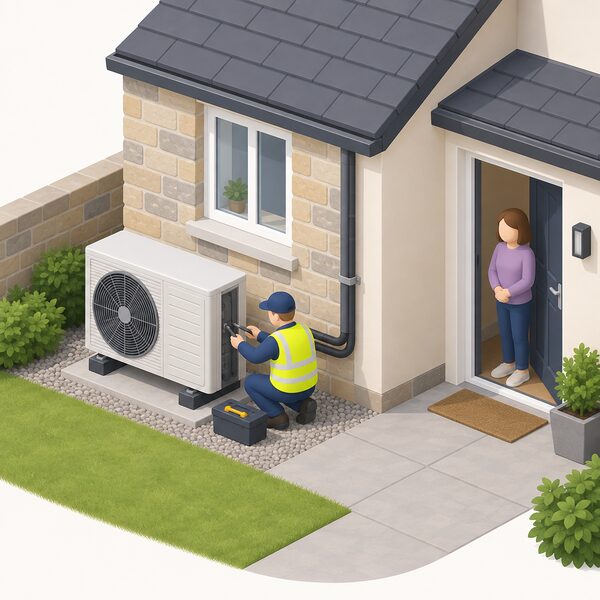
The main route for a Scottish owner-occupier is the Home Energy Scotland Grant and Loan scheme, which offers grants to homeowners to install heat pumps22. The scheme has offered grants up to £15,000 for heat pumps and energy efficiency measures6. The heat pump element has carried a £9,000 grant with a rural uplift7. Grants and loans are available to all domestic owner-occupiers in Scotland to install clean heat and energy efficiency measures21.
For households that cannot fund the work even with a grant, Warmer Homes Scotland takes a different approach: energy efficiency measures and a heat pump are installed with all the work planned and carried out for the household, fully funded by the Scottish Government10.
| Route | What it provides | Who it is for |
|---|---|---|
| Home Energy Scotland Grant and Loan | Grants up to £15,000; £9,000 heat pump grant with rural uplift6 | Domestic owner-occupiers in Scotland21 |
| Warmer Homes Scotland | Measures and a heat pump, fully funded, work carried out for the household10 | Eligible households under the fuel poverty programmes |
There is no leasing or subscription model in the published Scottish schemes. The funded routes are grants, interest-free loans and fully funded installation. The Expert Advisory Group's fifteenth recommendation was that government and industry work together to ensure consumer engagement with and acceptance of heat pumps, with trusted comprehensive information and advice available for householders14.
Fuel poverty is the policy frame. Scotland's legal definition, set out in section 3 of the Fuel Poverty (Targets, Definition and Strategy) (Scotland) Act, treats a household as fuel poor where fuel costs exceed 10% of adjusted net income after housing costs and remaining income is insufficient to maintain an acceptable standard of living, at least 90% of the UK Minimum Income Standard23. The 2040 targets are no more than 5% of households fuel poor, no more than 1% in extreme fuel poverty, and a fuel poverty gap of no more than £250 in 2015 prices24.
Where uptake could stall: installers and ownership models
Two constraints stand out in the published evidence, and neither is about household willingness.
The first is measurement and scheme coverage. The UK deployment statistics cover installations across the UK, but some devolved administration schemes in Scotland and Northern Ireland are currently not included5. That means the Scottish quarterly totals understate activity, and it also means the figures used to judge progress are incomplete. A household reading that Scottish installations fell from 884 in 2024 Q2 to 745 in 2025 Q3 is reading a partial series4.
The second is the supply chain. The Heat Pump Sector Deal Expert Advisory Group was established precisely because deployment depends on installer capacity, training and consumer confidence as much as on grants12. Its recommendations on fabric efficiency and on doubling programme targets point at the same constraint: the rate at which homes can be surveyed, specified and fitted14.
"As heat pumps are much more cost-effective in well-insulated dwellings, the Scottish Government should maintain or increase its current support for energy efficiency"
Ownership is the third. A heat pump is bought and owned by the household, installed by a firm, and run on electricity bought from a supplier. There is no Scottish leasing scheme in the published record, so the household carries the capital cost, the maintenance and the performance risk. The independence it gains is independence from a delivered fuel, not from the grid, the supplier or the manufacturer.
Regional variation across Scotland's 32 local authorities
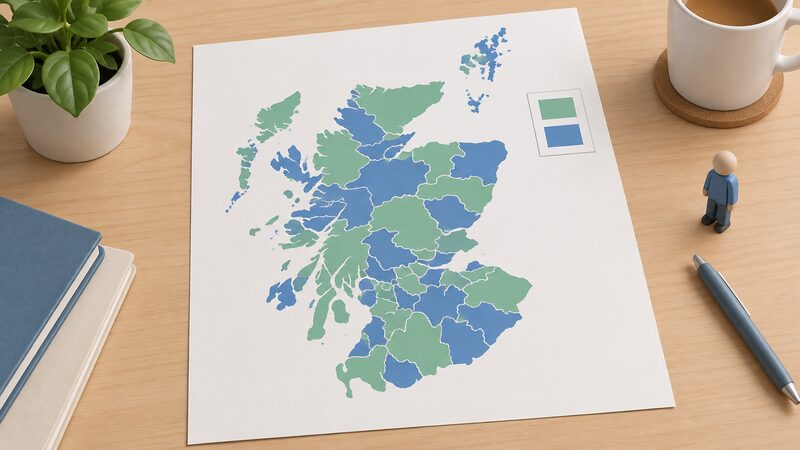
Scotland's local picture is organised around Local Heat and Energy Efficiency Strategies. All 32 local authorities in Scotland have published them25, a position confirmed in December 202519. That is a recent achievement: the Heat in Buildings progress report of October 2024 recorded 27 of the 32 having published, including 24 final strategies and three in draft21.
The published installation breakdown is by region rather than by Scottish council area. For the year ending September 2024, the largest proportion of government-supported heat pump installations took place in Wales at 18%, followed by the South West at 14% and the South East at 12%, with the smallest proportions in London and the North East at 3% each26. No equivalent Scottish council-level ranking appears in the deployment statistics.
For new properties, 11 local authorities in England and Wales had more than 20% of their heating types made up of heat pumps, six of them in the East of England27. That is an England and Wales figure and does not describe Scottish council areas.
What the Scottish strategies do provide is a consistent local planning basis. Each of the 32 authorities has assessed its housing stock and set out a route for heat decarbonisation, which is the layer a household encounters when it applies for consent or seeks local advice. The practical variation a household should expect is in the housing stock itself: tenement flats, pre-1919 sandstone terraces, rural off-gas cottages and island properties each raise different questions about outdoor unit siting, insulation and electrical capacity.
Sources27 cited
- Scottish House Condition Survey 2023: Key Findings, Scottish Government, 2023
- Heat Pump Deployment Quarterly Statistics, United Kingdom, 2025 Q1, Department for Energy Security and Net Zero, 2025
- Heat Pump Deployment Quarterly Statistics, United Kingdom, June 2024, Department for Energy Security and Net Zero, 2024
- Heat Pump Deployment Quarterly Statistics, United Kingdom, 2025 Q3, Department for Energy Security and Net Zero, 2025
- Heat in Buildings Progress Report 2024, Scottish Government, 2024
- FOI 202400442664: Home Energy Scotland Grant and Loan, Scottish Government, 2025
- Heat in Buildings Strategy, Scottish Government, 2021
- Scotland's plan means immediate climate targets are now within reach, Climate Change Committee, 2026
- Fuel Poverty in Scotland: Definition and Criteria, Welsh Government, 2024
- Heat Pump Sector Deal Expert Advisory Group: Final Report, Scottish Government, 2021
- Electric technologies will help Scotland decarbonise, Climate Change Committee, 2025
- Energy in Non-Domestic Buildings and Heat: EINAS 2025, Department for Energy Security and Net Zero, 2025
- Heat Networks Delivery Plan, Scottish Government, 2022
- Heat in Buildings Strategy: Strategic Environmental Assessment, Scottish Government
- Heat Pump Sector Deal Expert Advisory Group: Interim Report, Scottish Government, 2021
- Heat Pump Deployment Quarterly Statistics, United Kingdom, 2024 Q3, Department for Energy Security and Net Zero, 2024
- Scotland's Climate Change Plan 2026 to 2040, Scottish Government, 2026
- Delivering Net Zero for Scotland's Buildings, Scottish Government, 2023
- Heat in Buildings Progress Report 2024: Local Heat and Energy Efficiency Strategies, Scottish Government, 2024
- Building Scotland Amendment Regulations 2022: Section 6 Energy, Scottish Government, 2022
- The Heat in Buildings Programme, Scottish Government
- Heat in Buildings Strategy: Summary Document, Scottish Government, 2021
- Heat Pump Sector Deal Expert Advisory Group: Interim Report, Scottish Government, 2021
- Energy Efficiency of Housing in England and Wales, Office for National Statistics, 2025
- Scottish Government Response to the Green Heat Finance Taskforce, Scottish Government
- High Rise Retrofit and Upgrade Programme Phase 1, City of Edinburgh Council
- Feed-in Tariffs Quarterly Report, Issue 64, Ofgem, 2026
 Heat Pump Install StatisticsHow many heat pumps are actually being fitted in the UK each year, and is that number going up?
 Microgeneration UptakeScotland has more solar panels and heat pumps per household than England, while Wales has built larger solar schemes and Northern Ireland lags behind.
 Home HeatingMost Scottish homes are heated by mains gas, so what happens to the rest?
 Planning Permission in ScotlandDo you need planning permission for a heat pump in Scotland?
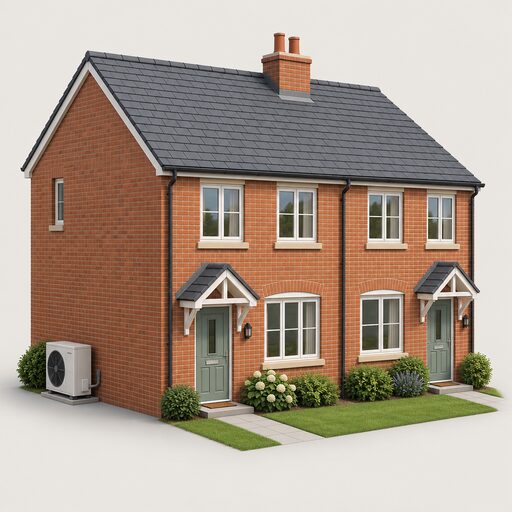 Which Homes Suit a Heat PumpMost UK homes can have a heat pump fitted, so the real question is whether yours makes it easy or expensive.
 How They Perform in UK HomesHow well do heat pumps really work in UK homes, and why do some run far better than others?