
In this comparison
Power NI is one of five electricity companies in Northern Ireland, alongside Budget Energy, SSE Airtricity, Click Energy and Share Energy, and it is regulated by the Utility Regulator for Northern Ireland rather than Ofgem1. That single structural fact explains most of what follows. The Great Britain price cap, which currently protects around 28 million customers in England, Wales and Scotland, does not apply to Power NI bills, because Northern Ireland has a different regulator, no price cap and an entirely different set of suppliers2.
The practical consequence is that Power NI sets its own tariffs. Energy prices were not capped in Northern Ireland, and energy suppliers there have the flexibility to set their tariffs independently to reflect their costs of operating4. Energy costs in Northern Ireland are high currently, with some variation between suppliers, and there are two gas suppliers against the five electricity companies1.
For a household, the difference is not simply a different number on the bill. It is a different market design, a different regulator, a different VAT rate on electricity, and a different heating fuel for most homes. This page sets out how the two systems diverge, what Power NI bills cover that Great Britain bills do not, and what remains within a Northern Ireland household's own control.
Power NI at a glance: what kind of supplier it is
Power NI is a domestic electricity supplier in Northern Ireland, one of five electricity companies operating there1. It is not a Great Britain supplier trading across the Irish Sea, and it does not sit under the Ofgem price cap regime. Its regulatory home is the Utility Regulator for Northern Ireland, the body that took the place of Ofgem in the Northern Ireland settlement described in the Energy Prices (Domestic Supply) (Northern Ireland) Regulations 20222.
The supplier's own published material shows it operating as a competitive retailer within that market. Power NI runs an electric vehicle tariff that is available to households switching to Power NI in Northern Ireland, applied for by filling out an online form, after which Power NI contacts the household to switch it to Power NI and the EV tariff that suits it8. That is a switching proposition aimed at customers of the other four Northern Ireland suppliers, not at customers in Great Britain.
For a household's energy independence, the distinction matters in a specific way. A Power NI customer depends on a single licensed supplier for electricity, on the all-island and cross-channel wholesale market behind that supplier's pricing, and on a regulator that is not Ofgem. There is no cap to fall back on if tariffs move. What the household does control is which of the five electricity companies it buys from, and the Consumer Council's comparison tool exists precisely to make that choice visible9.
A different market: regulation and pricing in Northern Ireland
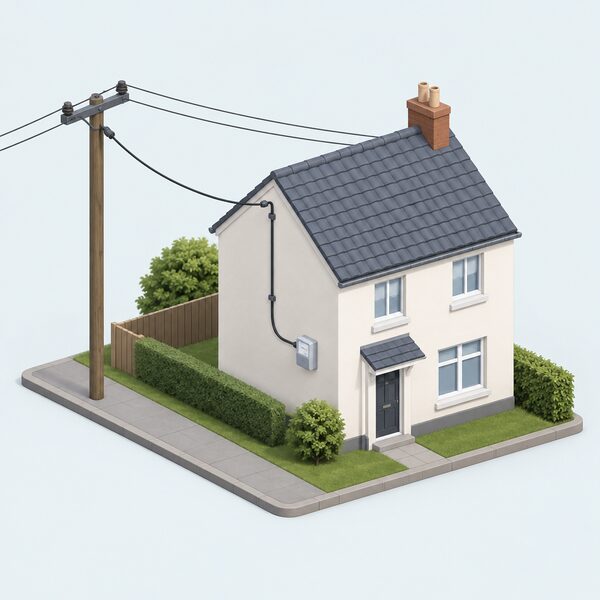
The Northern Ireland electricity market is not a regional variant of the Great Britain one. It is a separate settlement with its own regulator, its own supplier set and its own pricing logic. The Energy Price Guarantee for Northern Ireland was legislated separately, and the reasoning given at the time was explicit: there is a different regulator, the Utility Regulator for Northern Ireland, no price cap and an entirely different set of suppliers from Great Britain2.
That separation runs through the whole architecture. The Energy Prices Act 2022 set out that the Energy Price Guarantee Northern Ireland schemes are to apply to those with domestic electricity supply and domestic gas supply, and the 2022 Regulations define those two terms for the purposes of the scheme2. The definitions matter because they determine who was covered by crisis support, and they were written for Northern Ireland alone.
Pricing follows the same pattern. Because there is no cap, suppliers in Northern Ireland set tariffs independently to reflect their own operating costs4. The result is a market where the headline protection that Great Britain households know, a ceiling on default tariff unit rates and standing charges, simply does not exist. Instead, Northern Ireland households face a market in which energy costs are high currently, with some variation between suppliers, and where shopping around is the main lever1.
The regulator's reach is also narrower than households sometimes assume. The GB and NI energy regulators cover only the on-grid pipes and wires market10. That leaves off-grid fuels, most importantly heating oil, outside the regulatory perimeter altogether, which is the subject of the next section.
What Power NI bills cover that GB bills do not
The clearest difference is not in the bill's structure but in the support that has been attached to it. During the energy crisis, Great Britain delivered a £400 energy bills discount for all households, paid through domestic electricity suppliers7. Northern Ireland received a separate scheme: a £400 discount on energy bills for households in Northern Ireland, legislated under the Energy Prices Act 20227.
The delivery mechanics differed too. In Northern Ireland, customers on standard credit schemes without direct debits set up, and those on prepayment keypad meters, received vouchers, while customers with a direct debit arrangement received the payment directly to their bank account11. In Great Britain, the Energy Bills Support Scheme data was broken down by electricity supplier, meter type and geographically by region, local authority and Westminster parliamentary constituency12.
Later, the government made a one-off £600 payment in Northern Ireland combining both the Energy Bills Support Scheme and Alternative Fuel Payment domestic schemes13. That combined figure reflects the fact that Northern Ireland households were being supported for both electricity and off-grid heating fuel in a single payment, a structure that had no direct Great Britain equivalent.
Heating is the bigger difference: oil, gas and electricity
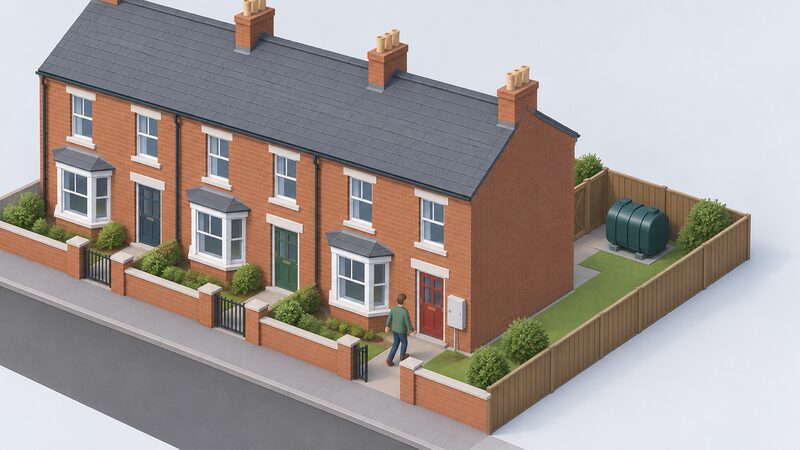
For most Northern Ireland households, the fuel that matters most is not electricity at all. More than two-thirds of Northern Ireland households use oil boilers as their main source of heating6. That is a fundamentally different starting point from Great Britain, where most heating in the UK is supplied by gas15.
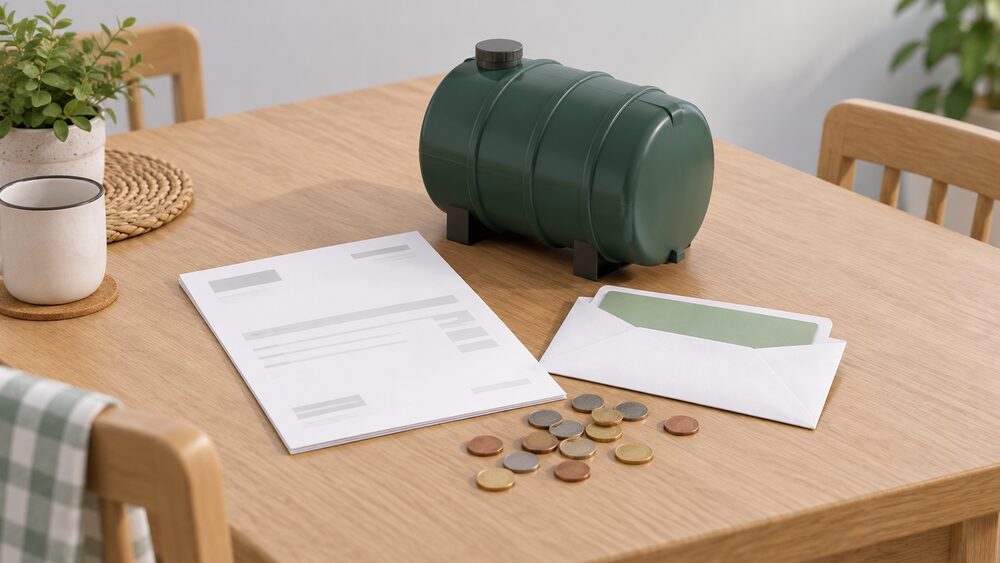
Heating oil sits outside the regulated market entirely. Those who heat their homes with oil are not covered by the energy price cap16, and the GB and NI energy regulators cover only the on-grid pipes and wires market10. An oil-heated household therefore carries wholesale price movements directly, with no cap and no supplier tariff to compare. The Consumer Council publishes a home heating oil price checker with Northern Ireland averages, which is the practical reference point for that exposure.
Electricity plays a secondary but significant role. Electricity is the second most common heating fuel after gas in England and Scotland, at 9 per cent and 15 per cent of homes respectively17. In Northern Ireland the pattern is different again, shaped by the reach of the gas network and the prevalence of oil.
The direction of travel is contested. The Climate Change Committee has argued that faster electrification would cut UK household bills, and its analysis found that since the start of the Iran war households with gas boilers and petrol cars have seen energy bills rise almost four times more than those with heat pumps and EVs18. That is a modelled comparison for the UK as a whole, not a Northern Ireland-specific figure, and it sits alongside the practical reality that most Northern Ireland homes currently heat with oil.
The price cap question: why GB protections do not map onto NI

The Great Britain price cap is a specific legal instrument with a specific territorial extent. Ofgem sets it to protect people from a loyalty penalty19, and it currently protects around 28 million customers in Great Britain3. Its legal basis constrains what it can do: under the Act, Ofgem cannot set different cap levels for different suppliers and must protect default tariff customers20.
That instrument does not extend to Northern Ireland. The cap's territorial extent is Great Britain21, and Northern Ireland has no price cap at all2. Even within Great Britain, the cap's coverage is narrower than many households assume. It does not protect fixed tariffs, business energy contracts, heat networks or heating oil22, and prices are not protected if a household has chosen to be on a fixed-term energy tariff23. Business energy customers are not protected by the energy price cap10.
For Northern Ireland, the practical answer is that there is no equivalent ceiling to compare against. The Northern Ireland regional figures that appear in Ofgem's cap tables are not a Northern Ireland cap; they are the cap levels that apply to a defined Northern region within the Great Britain methodology, published for the period 1 October to 31 December 202524. Reading them as a Northern Ireland price would be a category error.
Bills, tariffs and switching: what households can compare
What a Northern Ireland household can do is compare the five electricity companies and two gas suppliers against each other. The Consumer Council offers an energy price comparison tool to compare electricity and gas tariffs for all suppliers in Northern Ireland9, and its guidance notes that with 5 electricity suppliers in Northern Ireland and 2 gas suppliers, it makes sense to shop around to compare prices and service1.
Switching within Northern Ireland is a normal retail process. Power NI's own electric vehicle tariff page illustrates the mechanics: a household fills out an online form and Power NI contacts it to switch to Power NI and the EV tariff that suits it8. That is a switch between Northern Ireland suppliers, not a switch from a Great Britain supplier, because Great Britain suppliers do not serve the Northern Ireland domestic market.
Consumption benchmarks are also defined differently. Electricity meters are classified as domestic meters based on their tariff type25, which means the Northern Ireland domestic statistics are built on a tariff-based definition rather than a physical one. That is a technical point, but it affects how consumption data should be read when comparing Northern Ireland with Great Britain.
On the wider cost picture, UK industrial electricity prices have been reported at around four times as much as companies in the US, and around 50% more for electricity than German and French competitors26. Those are industrial rather than domestic figures, and they describe the UK as a whole, but they indicate the wholesale and policy cost environment that sits behind domestic tariffs on both sides of the Irish Sea.
Consumer support in NI: the Consumer Council and where to turn

Northern Ireland has a distinct consumer support architecture. The Consumer Council NI and Northern Ireland Energy Advice give free, independent and impartial energy advice to all domestic householders in Northern Ireland6. NI Energy Advice offers independent and impartial energy advice to domestic householders in Northern Ireland, plus referrals to energy grants and other sources of help27.
Suppliers themselves have a role in referral. Energy suppliers refer customers who are struggling to pay bills to organisations like Advice NI, which offers free, independent debt advice9. That is a route a household can ask about directly when a bill becomes unmanageable.
For households in difficulty, the Northern Ireland guidance on struggling to pay energy bills sets out the available help9, and there is a separate route to energy saving grants depending on area28. The Consumer Council also publishes cost of living data, which has shown small signs of improvement in household discretionary income in Northern Ireland at the start of the year, though spending power remains under pressure.
"The Consumer Council NI and Northern Ireland Energy Advice give free, independent and impartial energy advice to all domestic householders in Northern Ireland"
What this means for household energy independence in Northern Ireland
The Northern Ireland household's position is structurally different from a Great Britain household's, and the difference cuts both ways. On the dependence side, a Power NI customer relies on a single licensed supplier for electricity, on a market with no price cap, and on a regulator whose remit covers only the on-grid pipes and wires market10. Most households additionally depend on delivered heating oil, a fuel with no cap, no supplier tariff and no regulatory protection16.
The crisis support that was built for this market recognised that dual exposure. The Northern Ireland schemes were designed around reducing the amount that would otherwise be charged for Northern Ireland domestic electricity supply by licensed electricity suppliers who are parties to the scheme7, and the £600 combined payment reflected both electricity and off-grid heating fuel13. The Energy Price Guarantee for Northern Ireland directions applied to Northern Ireland and allowed suppliers to change tariffs on days other than the first day of a quarter14.
What remains within the household's control is narrower than in Great Britain but real. There are five electricity companies and two gas suppliers to compare1, a free comparison tool covering all of them9, and free independent advice with referrals to grants27. For an oil-heated home, the Consumer Council's heating oil price checker is the reference point for what a delivery should cost.
The honest summary is that Northern Ireland households have less regulatory cushioning and more direct exposure to fuel markets than Great Britain households, and correspondingly more reason to compare suppliers and to treat heating fuel purchasing as a managed cost rather than a fixed one.
Sources28 cited
- Switching electricity or gas supplier, Consumer Council, 2026
- Energy Prices (Domestic Supply) (Northern Ireland) Regulations 2022(NorthernIreland)Regulations2022), Hansard, 2022-11-16
- Energy price cap statistics, House of Commons Library, 2024-07
- Energy Price Guarantee up until 30 June 2023, GOV.UK, 2026-09-17
- VAT on fuel and power, Notice 701/19, GOV.UK, 2026-10-01
- Low carbon heating, Northern Ireland Direct, 2026-09-17
- Energy Prices Act 2022, legislation.gov.uk, 2022-10-18
- Electric vehicle tariff: switching to Power NI, Power NI, 2026-09-20
- Advice if you're struggling to pay your energy bills, Northern Ireland Direct, 2026-09-17
- Alternative homes energy guidance, Ofgem, 2026-09-17
- Northern Ireland households to receive voucher support for energy bills, GOV.UK, 2022-12-30
- Energy Bills Support Scheme payments made by electricity suppliers, GOV.UK, 2022-10-20
- Energy bills support: an update, National Audit Office, 2024-11-14
- Energy Price Guarantee for domestic energy consumers in Northern Ireland: ministerial directions, GOV.UK, 2023-01-04
- Most heating in the UK is supplied by gas, House of Commons Library, 2022-01
- Over £50 million to help families struggling with soaring heating oil costs, GOV.UK, 2026-03-16
- Fuel poverty written evidence, Parliament, 2011-12-30
- Faster electrification would cut UK household bills, say climate advisers, Climate Change Committee, 2026-06-24
- Energy price cap explained, Welsh Government, 2026-03-04
- Energy price cap operating cost and debt allowances decision, Ofgem, 2025-05
- Energy price caps explained, Ofgem, 2020-12
- Energy price cap, Ofgem, 2026-09-17
- Price caps explained, easy read, Ofgem, 2018-12
- Energy price cap levels, 1 October to 31 December 2025, Ofgem, 2025
- Domestic electricity consumption indicator, Office for National Statistics, 2026-09-20
- Electricity prices in Great Britain, House of Lords Library, 2026-06
- Heating technologies to suit your home, Northern Ireland Direct, 2026-09-17
- Energy saving grants in your area, Northern Ireland Direct, 2026-09-17
 Energy Bills in Northern IrelandNorthern Ireland has no price cap.
 Utility Regulator NIWho sets your energy prices in Northern Ireland and who can you complain to?
 Suppliers in Northern IrelandNorthern Ireland runs its own energy market, with its own regulator, its own suppliers and no price cap.
 The Full Energy Suppliers GuideWho the UK's domestic gas and electricity suppliers are, how the market is structured across Great Britain and Northern Ireland, what a supplier is licensed and obliged to do, how the price cap limits bills, what happens when a supplier fails, and who regulates it all.
 Devolved vs Reserved PowersWho decides what you pay for gas and electricity, and who decides how your home is insulated or improved?
 NI Gas Tariffs and NetworksHow gas tariffs in Northern Ireland are set by network area, why the Ten Towns area differs from Greater Belfast, when approved changes take effect, and what the Consumer Council comparison tool covers.