
In this answer
Short answer
Northern Ireland does not use the 105 power cut number. Households there report an outage to NIE Networks on 03457 643 643, a line the company describes as 24/7 support for reporting a loss of electricity supply1. The same number appears across the network's own advice pages and in cross-industry guidance, which sets out the split plainly: 105 in England, Scotland and Wales, and 03457 643 643 in Northern Ireland2.
Compensation follows a separate track again. NIE Networks' published standards state that it will restore electricity within 24 hours of a power cut, and that a planned interruption requires three days' notice. Where that notice is not given, the entitlement is £25 per home, and a claim must be made within one month of the day of the interruption4. Repeated interruptions can attract a further £954.
The practical consequence for a household is that almost every power cut question has a Northern Ireland answer and a Great Britain answer, and they are not interchangeable. The network operator is different, the helpline is different, the compensation standard is different, and the support register is administered differently. This page sets out who to contact, what the standards require, and what remains outside a household's control.
Who to call when the power goes off
The electricity network operators introduced 105 to give households an easy-to-remember number that puts them through to the local people who can help during a power cut6. It is free to call, and it routes the caller to whichever network company covers their area2. Ofgem's consumer guidance describes the same arrangement: call 105 for free and you will be put through to your electricity network operator7. Electricity North West, one of the Great Britain networks, tells customers to continue using 105 if their power goes off2.
That arrangement stops at the Irish Sea. Cross-industry guidance states the position directly: the number to report a power cut is 105 in England, Scotland and Wales and 03457 643 643 in Northern Ireland2. NIE Networks gives the same number as its customer helpline for 24/7 support in reporting a loss of supply1, and again as the number to contact immediately in an emergency8.
There is a second number that matters, and it is not a reporting line. If electricity lines are down or causing significant risk to the public, NIE Networks asks that 999 be called8. A fallen conductor is a danger to life, not a supply fault, and it belongs with the emergency services.
UK Power Networks covers London, the South East and East of England, not Northern Ireland
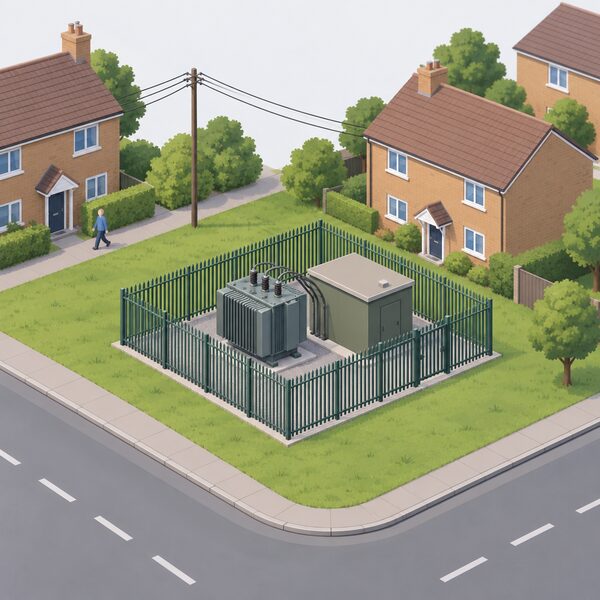
Searches for power cut compensation in Northern Ireland frequently surface UK Power Networks, which is a different company in a different jurisdiction. UK Power Networks covers London, the south-east and eastern England9, described elsewhere as London, the East and the South East of England10 and as London, South East and Eastern England11. The company's own material refers to its substations around London, the South East and East of England12.
The operating companies behind that area are London Power Networks plc, South Eastern Power Networks plc and Eastern Power Networks plc, covering London, South East England and East England respectively4. None of them holds a distribution licence in Northern Ireland.
Northern Ireland is served by NIE Networks, which runs its own helpline, its own customer standards and its own Priority Services arrangements1. A householder in Belfast, Derry or Enniskillen who contacts UK Power Networks will not reach the crews who restore their supply.
The distinction matters beyond the phone number. Compensation standards, restoration targets and support registers are set per network area, so a figure quoted for a UK Power Networks customer does not describe what a Northern Ireland household can claim. The same logic applies in reverse: the £25 and £95 figures below are Northern Ireland entitlements and do not apply in London, the South East or the East of England4.
Reporting a power cut: free 24-hour phone lines
NIE Networks offers several routes. Customers can report having no electricity online13, and the network lists its reporting channels as nienetworks.co.uk, WhatsApp, Facebook or the helpline on 03457 643 64314. It also provides a tool to check whether there is a power cut in the area13.
The helpline is the route that works when the broadband is down with the power. NIE Networks describes 03457 643 643 as 24/7 support for reporting a loss of electricity supply1, and the same number appears in its emergency guidance8. The number is also given in cross-industry guidance as the Northern Ireland contact2.
For households that want advice rather than a fault report, the Northern Ireland Energy Advice service can be reached on freephone 0800 111 445515. The Consumer Council NI and Northern Ireland Energy Advice give free, independent and impartial energy advice to all domestic householders in Northern Ireland16.
NIE Networks also advises listening for information on local radio, checking its website or social media, and using a car radio to tune in for hourly news bulletins when the power is out at home17. That is a practical point rather than a compensation one: a household with no electricity has no television and often no mobile data, and a car radio is one of the few receivers still working.
Priority services and extra help during an outage
The Priority Services Register is a free service for anyone who may need additional support during a power cut18. It ensures extra help during an emergency outage, such as a power cut or supply interruption19. Registration is made by contacting each of your utility suppliers directly, so a household with separate electricity, gas and water suppliers may need to register more than once20.
What the register provides is set out across the network and gas distributor guidance. It includes advance notice of planned power cuts where possible21, accessible communication, early warning of planned outages, extra support during interruptions and a password scheme22. It also allows a nominated contact to be added to deal with bills or to help in a power cut on the householder's behalf23.
In Northern Ireland specifically, NIE Networks runs a Medical Customer Care Register, whose benefit is to receive regular information during a power cut13. That sits alongside the general Priority Services arrangements rather than replacing them.
During a severe weather event, NIE Networks sets out how it prioritises faults. Its first priority is to send crews to fix damage which has resulted in a loss of power to critical national infrastructure, for example hospitals, airports, and water pumping and treatment sites24. Domestic properties follow once that work is under way, which is why a rural household can wait longer than an urban one after a storm.
Response times: what to expect after you contact your network operator
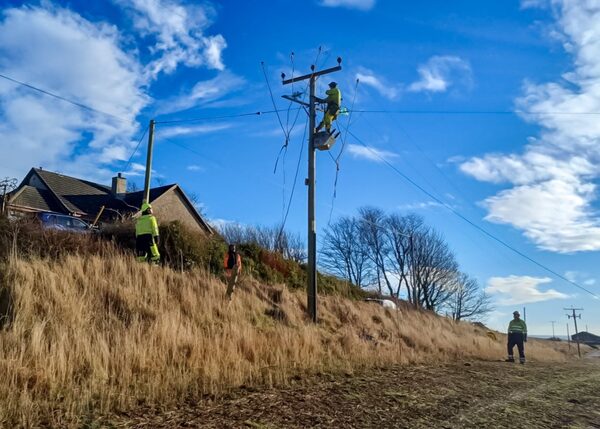
NIE Networks publishes two figures that describe its performance. It aims to reconnect 87% of customers affected by a power cut, due to a fault on its distribution system, within three hours, and all customers within 24 hours5. Its customer standards state that it will restore your electricity within 24 hours of a power cut4.
Those are targets rather than guarantees, and the gap between them and reality widens in severe weather. The fault-priority rules explain part of the reason: crews go first to damage affecting critical national infrastructure such as hospitals, airports and water treatment sites24, so a domestic outage in a storm-affected area may run well past the three-hour mark.
The compensation rules attach to the same standards. If a supply is turned off for planned reasons, three days' notice is required, and without it the entitlement is £25 per home4. A claim must be made within one month of the day of the power interruption4. Where a household suffers repeated power cuts, an extra £95 can be claimed4.
For a household, the practical sequence after an outage is: report it through one of the NIE Networks channels, check the published standards against what happened, and claim within the month if the standard was missed. Ofgem's guidance is that a network operator is the right contact for a power cut or connection issues in your area25, and complaints about a network operator follow the same route.
What this means for a household's energy independence
The Northern Ireland position is a clear illustration of how much of a household's resilience sits outside its own control. The network operator is fixed by geography, the helpline number is fixed by the operator, and the compensation standard is set by the regulator rather than negotiated by the customer. A household can report a fault, register for priority support and claim what the standards allow, and that is the extent of its influence over the grid side.
What a household can control is the period between the power going off and the power coming back. The published targets describe that period as up to 24 hours for all customers after a distribution fault5, and severe weather can extend it. A backup supply, whether a portable power station, a home battery or a generator, addresses that window rather than the compensation question. The two are separate: compensation is a payment after the event, and backup power is what keeps a fridge, a router or a heating pump running during it.
There is also a wider Northern Ireland dimension. A scheme has been announced to cut energy bills in Northern Ireland by £30 a year per household26, and the Northern Ireland Sustainable Energy Programme has funded advice and efficiency work through the Utility Regulator15. Those are cost measures rather than resilience measures, but they sit in the same landscape of support that a household can draw on.
The dependence that remains is straightforward. A Northern Ireland household depends on NIE Networks for restoration, on its suppliers for priority registration, and on the grid for supply. Backup equipment reduces the consequences of an outage; it does not change who owns the wires.
Sources26 cited
- Most popular FAQs, NIE Networks, 2026-09-19
- Power cut reporting contacts, Energy Networks Association, 2026-09-17
- Get winter ready, Energy Networks Association, 2026-09-05
- How to find out if there's a power cut, Which?, 2026-06-04
- Overall standards, NIE Networks, 2026-09-20
- What to do in a power cut, Met Office, 2026-09-20
- Check if you can get payment for a power cut, Ofgem, 2026
- Additional works, NIE Networks, 2026-09-19
- Who supplies my electricity and gas?, Uswitch, 2026-06-29
- For homes, FlexAssure, 2026-09-19
- Who is my gas and electricity supplier?, Confused.com, 2026-07-03
- What is an electrical substation?, UK Power Networks, 2026-09-17
- Preparing for winter, NIE Networks, 2026-09-19
- Power cuts help, NIE Networks, 2026-09-20
- NISEP 2024/2025 list of schemes, Utility Regulator, 2024-04-03
- Low carbon heating, nidirect, 2026-09-17
- What action should I take when power is disrupted?, NIE Networks, 2026-09-19
- Priority Services community toolkit, SSEN, 2026-09-20
- Priority Services Register, Cadent Gas, 2026-09-20
- Heating your home, Carmarthenshire County Council, 2026-04-04
- Priority Services: dementia, SSEN, 2026-09-19
- Priority Services: sight, SSEN, 2026-09-19
- Priority Services Register, Cadent Gas, 2026-09-20
- How do you prioritise faults in a severe weather event?, NIE Networks, 2026-09-19
- Complain about your energy supplier or network operator, Ofgem, 2026
- Energy bills support in Northern Ireland, House of Commons Library, 2026-08-06
 Power Cuts in Northern IrelandNorthern Ireland has a single electricity distribution network, run by NIE Networks, and its own reporting number, registers and compensation arrangements.
 Utility Regulator NIWho sets your energy prices in Northern Ireland and who can you complain to?
 Energy Bills in Northern IrelandNorthern Ireland has no price cap.
 Suppliers in Northern IrelandNorthern Ireland runs its own energy market, with its own regulator, its own suppliers and no price cap.
 Network Operators and 105When the lights go out, who do you actually ring?
 Energy Supply in NICan you get gas where you live in Northern Ireland, and what happens if your power goes off?