
In this guide
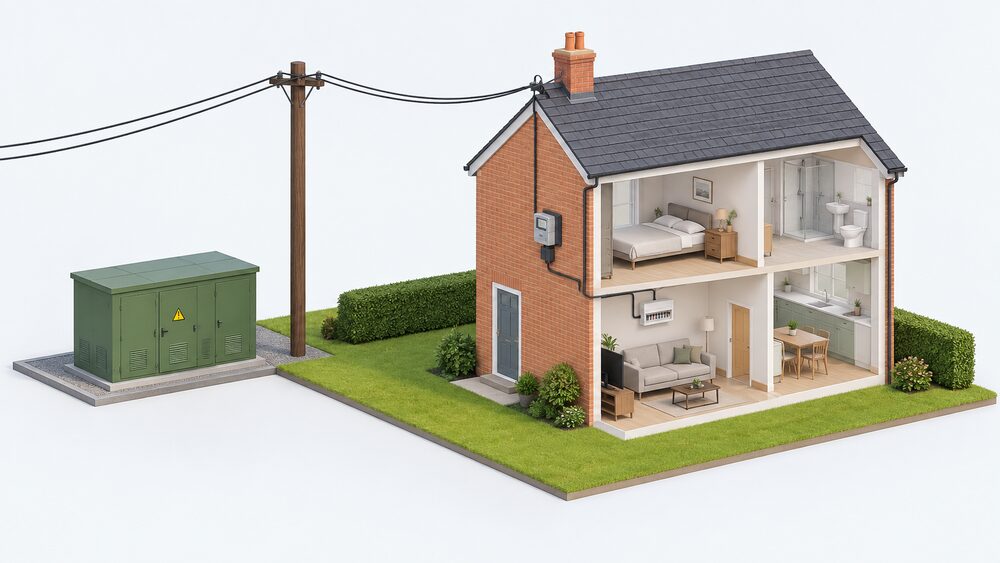
UK Power Networks is the electricity distribution network operator for London, the South East and the East of England, running the wires and substations that carry power from the national transmission network to homes and businesses. It holds three licence areas, numbered 10, 12 and 19, and operates under three licensed companies: London Power Networks plc, South Eastern Power Networks plc and Eastern Power Networks plc1.
It does not sell electricity. The company that appears on your bill is your supplier; the network operator is responsible for maintaining the physical electricity supply to your property1. That split matters for a household trying to work out who to call: a power cut, a new supply or work near overhead lines goes to UK Power Networks, while billing, tariffs and the meter account go to the supplier4.
For a household, the network is the part of the electricity system that cannot be chosen or switched. Independence from a supplier is possible; independence from the wires is not, short of generating and storing everything on site. What a household can control is how well it understands the connection it has, the fuse capacity behind it, and the support available when supply fails.
What UK Power Networks does: the DNO behind the wires, not the bills
A distribution network operator owns and operates the distribution network of towers and cables that bring electricity from the national transmission network to homes and businesses1. It is responsible for maintaining physical electricity supplies to your home or business, and it does not sell electricity to consumers, which is done by the electricity retailers whose name appears on your bill1.
That division is the single most useful thing to understand about the company. UK Power Networks is the right contact if there is a power cut in your area, if you need a new power supply or need to make changes to an existing one, or if you need to carry out maintenance near or on overhead power lines5. Its lines are open 24 hours5. Everything else, from the tariff to the meter reading to the final bill, sits with the supplier.
The network also sits underneath the wider system. The distribution networks connect to the transmission network, and the shift toward distributed generation, electric vehicle charging and heat pumps puts new demands on the low-voltage side of that boundary. For the wider picture of who owns and runs each layer, see electricity distribution networks and the electricity transmission network.
For a household, this is the first layer of dependence: the connection to the street main is a monopoly service, and the only choice available is how the property is set up to use it.
Where it operates: London, the East and the South East
UK Power Networks covers Eastern England, London and South Eastern England, with distributor IDs 10, 12 and 192. The three licensed entities behind those IDs are London Power Networks plc, South Eastern Power Networks plc and Eastern Power Networks plc, covering London, South East England and East England respectively3.
The company describes itself as having thousands of electricity substations around London, the South East and East of England1. Its supplier lookup service covers the same footprint: if you live in London, the South East and East of England, it can tell you who the current electricity supplier is4.
| Licence area | ID | Region | Licensed company |
|---|---|---|---|
| Eastern England | 10 | East of England | Eastern Power Networks plc3 |
| London | 12 | Greater London | London Power Networks plc3 |
| South Eastern England | 19 | South East England | South Eastern Power Networks plc3 |
The boundaries matter because the network operator is fixed by address, not chosen. A household in the UK Power Networks area cannot switch to another distribution company, and the same is true everywhere else: neighbouring areas are served by different operators, such as Electricity North West in North Western England under ID 16, or National Grid Electricity Distribution across the East Midlands, West Midlands, Southern Wales and South Western England under IDs 11, 14, 21 and 222. To check which operator covers a specific address, the Energy Networks Association runs a postcode lookup11.
Power cuts: who to call and how supplies are restored
The contact number for a power cut in Great Britain is 105, and it is free to call6. UK Power Networks publishes 0800 31 63 105 as its emergency number, alongside 105, and both are free to call from a landline or mobile5. The emergency line is open 24 hours a day6.
The scope of that line is wider than outages. UK Power Networks is the right contact for a power cut in your area, for a new power supply or changes to an existing one, and for maintenance near or on overhead power lines5. For an urgent disconnection, the same 24-hour number applies, and the advice is to stay well away from any damaged cables or equipment before calling7.
Once a fault is repaired, the compensation process is largely automatic. UK Power Networks states that once power is restored it will proactively contact all eligible customers, so there is no need for the household to make contact7. That is a meaningful difference from a supplier dispute, where the onus usually sits with the customer.
Where a claim relates to damage, the network operator expects insurers to take the lead. Most insurance companies will contact UK Power Networks directly if they require further information about the power cut12. A household with a damaged appliance or spoiled food is therefore usually dealing with its insurer, not the network.
Compensation: when a power cut qualifies and how claims are paid
The main compensation trigger is duration. A power cut lasting longer than 12 continuous hours may entitle the household to a payment7. Where fewer than 5,000 homes were affected, the initial payment is £100 if the power is off for more than 12 hours, with a further £45 for every 12 hours after that11.
Businesses have a separate figure. For planned and unplanned power cuts, a business can get £12010. The scheme is administered through the network operator, and the categories are set out in Ofgem's guidance on power cut payments10.
Not every outage qualifies. Ofgem lists exclusions including blackouts caused by a national power shortage, damage to electrical equipment or appliances, and a low supply after a power cut9. Those exclusions explain why a household cannot treat the compensation scheme as insurance: it covers the duration of an outage, not the consequences of one.
| Situation | Payment | Source |
|---|---|---|
| Power off more than 12 hours, fewer than 5,000 homes affected | £100 initial | 11 |
| Each further 12 hours | £45 | 11 |
| Businesses, planned and unplanned cuts | £120 | 10 |
| National power shortage, equipment damage, low supply after a cut | Not paid | 9 |
On damage inside the home, the position is explicit. UK Power Networks states it is not liable for any damage to electrical appliances such as TVs, computers and similar equipment as a result of a power cut12. On food, it states it is not liable for any loss of fridge freezer contents as a result of a power cut13. Both pages direct households toward their insurer, and both note that most insurance companies will contact the network operator directly if further information is needed12.
For a household, this is a limit worth knowing before an outage happens. The compensation scheme pays for time without power; it does not replace contents insurance, and it does not cover the cost of a failed freezer or a damaged appliance.
Connections and upgrades: applying, the 15kVA default and fuse upgrades

A domestic supply upgrade is the route to more capacity at an existing property. UK Power Networks can upgrade a fuse to 80 or 100 amps, with a visit requested to assess the work8. New homes are built with an 80A or 100A fuse, while older properties tend to have less14.
The 80A figure is treated as adequate for most modern loads. The Electricity Networks Association states that an 80A fuse connection is sufficient for any typical household looking to install a combination of low carbon technologies14. That covers the combination that matters most for household independence: an electric vehicle charger, a heat pump and solar generation on the same supply.
For generation, the application route depends on size. A G99 application is required for larger installations exceeding 3.68kWp, while smaller systems follow the simpler notification route15. On the charging side, the power bands used in public charging statistics run from 8kW to less than 50kW for the standard plus category, which gives a sense of where domestic and commercial charging sit relative to one another16.
The trench is one part of a new connection a householder can take on. UK Power Networks can take care of the digging, or the customer can arrange it, and where the customer digs, the company provides the necessary black ducting to place inside the trench17. The trench needs to be dug on your land18.
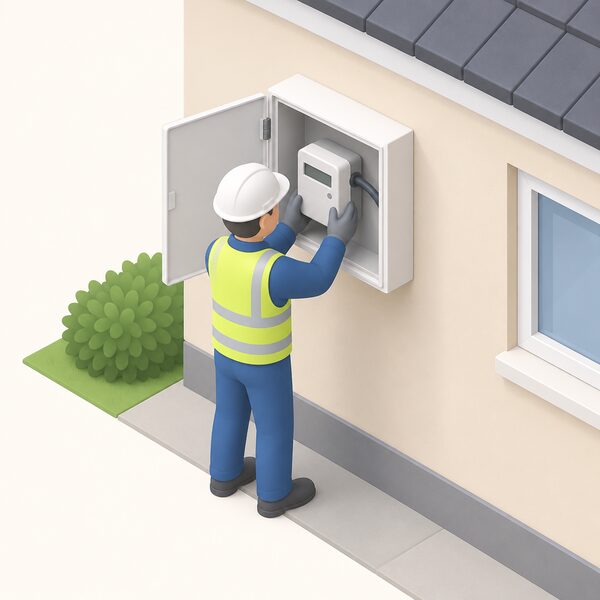
The meter is not the network operator's job. UK Power Networks states that the customer's electricity supplier is responsible for installing the electricity meter into the meter box18. A new connection therefore involves two organisations: the network operator brings the supply to the property boundary and the meter box, and the supplier fits and registers the meter.
Equipment on your land: substations, access rights and payment schemes
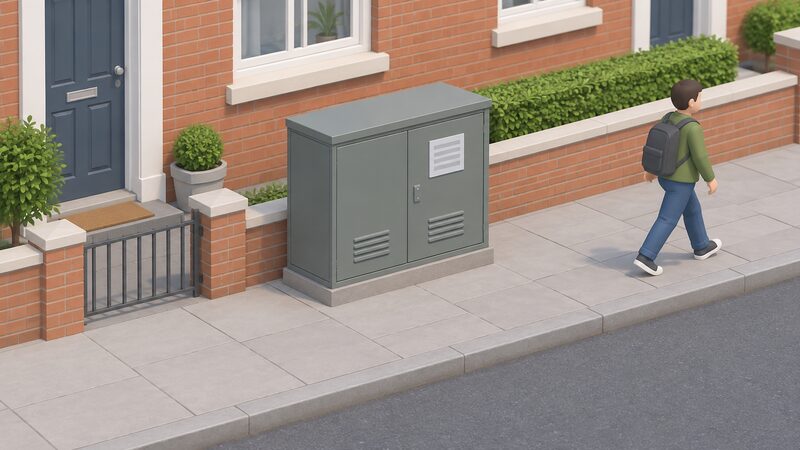
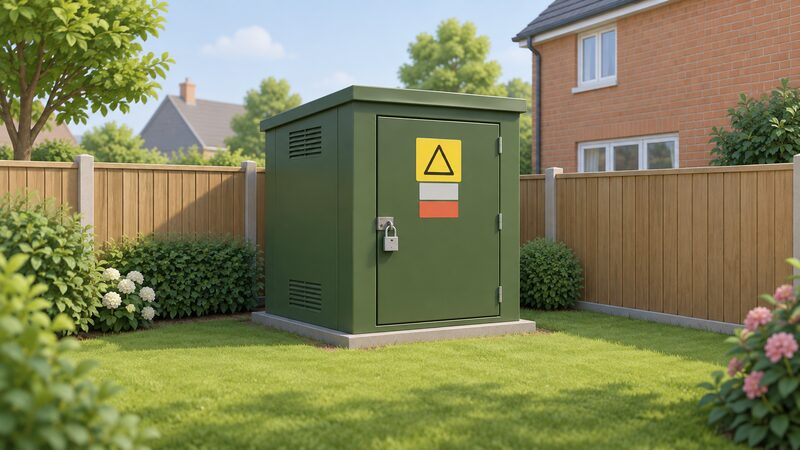
To supply electricity to all homes and businesses within its area, it is sometimes necessary for UK Power Networks to place equipment, both overhead and underground, on private land22. Where an electricity substation is located on your property or within your building, the company will generally hold a lease or freehold interest in the land with associated access and cable rights22.
Access is the condition that matters most. To ensure power supplies are restored quickly if a fault occurs, access to a substation must be maintained and kept unrestricted at all times22. That is a continuing obligation on the landowner, and it survives changes of ownership.
For a household, this cuts both ways. A substation on the property can be an inconvenience, but it also means the local supply is close by, and the network has a direct interest in maintaining it. The rights are usually recorded in the title, so a buyer should expect to see them in the legal pack rather than discover them after completion.
Safety near power lines: the 10-metre rule and emergencies
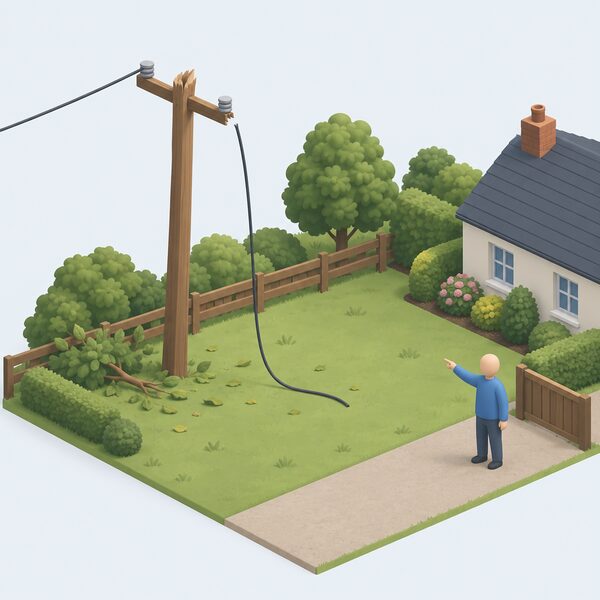
The core safety rule is simple and absolute. UK Power Networks states that electricity power lines are always to be treated as live19. Its emergency guidance is to treat electricity cables as live, stay at least 10 metres away and call immediately6.
That 10-metre distance applies to more than touching a cable. It covers the zone around a fallen or damaged line, and it applies to equipment carried near overhead lines, including ladders, scaffolding and long tools. The emergency line for reporting is open 24 hours a day6.
Trees are a separate but related risk. UK Power Networks runs a tree cutting service for vegetation near power lines, and aims to process a request and contact the householder within 10 working days19. Cutting trees near lines is not a householder task.
Flooding brings its own rules. The advice is to switch off the electricity at the mains if it is safe to do so, and not to touch any electrical equipment, switches or sockets when standing in water, or if the equipment is wet, damp or has been flooded and the electricity is on23.
Support services: the Priority Services Register and free energy advice
The Priority Services Register is a free service provided by water and power suppliers for households that need extra help during an interruption9. UK Power Networks runs its own register for people living in vulnerable circumstances, giving free extra help if a power cut happens10.
Registration runs through each supplier. To sign up, a household needs to contact all its utility suppliers directly24. For the network side, applications go to www.ukpowernetworks.co.uk/priority, by phone on 0800 169 9970, or by email at psr@ukpowernetworks.co.uk10. The network's priority services line is free to call from a mobile or landline and is open 24 hours25.
Beyond the register, UK Power Networks offers free expert energy advice and tailored practical support for customers struggling with the cost of energy, the energy transition, disability, non-ownership of property or difficulty paying bills25. It has partnered with organisations including Scope and AgilityEco to expand the range of tailored support services available26. In the past year, users of the Priority Services Register gave UK Power Networks' service a 94% customer satisfaction rating26.
The register is the clearest example of what a network operator can offer a household that the supplier relationship does not. It does not change the physical dependence on the wires, but it changes what happens during an outage, and it is free at the point of use.
Sources26 cited
- What is an electrical substation?, UK Power Networks, 2026-09-17
- Find my network operator, Energy Networks Association, 2026-09-17
- Who is my gas and electricity supplier?, Confused.com, 2026-07-03
- Why is your telephone number on my bill?, UK Power Networks, 2026-09-17
- Help and contact, UK Power Networks, 2026-09-17
- How do I get my power turned off urgently?, UK Power Networks, 2026-09-17
- Compensation: power cut lasting more than 12 hours, UK Power Networks, 2026-09-17
- Adding more power: what's involved, UK Power Networks, 2026-09-17
- Plan for a power cut, Ofgem, 2026
- Check if you can get payment for a power cut, Ofgem, 2026
- Power cuts: how to find out if there's a power cut, Which?, 2026-06-04
- Compensation: a power cut damaged something in my home, UK Power Networks, 2026-09-17
- Compensation: a power cut ruined food in my fridge freezer, UK Power Networks, 2026-09-17
- Connecting electric vehicles and heat pumps to the networks, Energy Networks Association, 2025-09-22
- Building regulations: renewables guidance, Bedford Borough Council, 2026-09-17
- Public electric vehicle charging infrastructure statistics, GOV.UK, 2026-08-27
- New electricity connection: what's involved, UK Power Networks, 2026-09-17
- Permanently disconnect: what's involved, UK Power Networks, 2026-09-17
- Cut trees and bushes, UK Power Networks, 2026-09-17
- Replace meter box, UK Power Networks, 2026-09-17
- Electricity equipment on your land, UK Power Networks, 2026-09-17
- Safety advice and resources, UK Power Networks, 2026-09-17
- Additional services, UK Power Networks, 2026-09-17
- Residents risk missing out on free emergency support, UK Power Networks, 2026-09-17
- What to do in a power cut, Met Office, 2026-09-20
- Heating your home, Carmarthenshire County Council, 2026-09-17