

In this guide
Power cut compensation in Great Britain is set by the Guaranteed Standards of Performance, a regulated scheme that specifies what an electricity distribution network operator must pay a customer if it fails to meet specified standards of performance1. For an unplanned cut in normal weather, Ofgem states a household can get £100 (and a business £195) where fewer than 5,000 properties are affected for more than 12 hours, or where more than 5,000 properties are affected for more than 24 hours, plus an extra £45 for every additional 12-hour period without electricity2. The maximum is £400 where the cut affects 5,000 or more properties2. These rules cover England, Scotland and Wales2; Northern Ireland runs a separate set of standards.
The money comes from the network operator that owns the wires, not from the energy supplier3. Most payments for unplanned cuts should arrive automatically within 10 working days, typically as a cheque sent to the property that lost supply3. The payment for repeated cuts is the exception: Ofgem states a claim must be made with the local network operator, which decides whether the payment is due5.
Compensation is an acknowledgement of inconvenience, not an indemnity. It does not cover damaged appliances, spoiled food, or blackouts caused by a national power shortage2. Ofgem research found that participants had low awareness of Guaranteed Standards of Performance, while there was widespread agreement that compensation is an important element of responding to service failings, and that service failings related to loss of supply were typically seen as the most severe6.
What the Guaranteed Standards of Performance are, and who pays
The Guaranteed Standards of Performance payments specify what an electricity distribution network operator must pay a customer or relevant authority if they fail to meet specified standards of performance1. A parallel set applies to energy suppliers: Ofgem describes supplier standards as setting minimum service standards with consumers automatically compensated if they are breached, and government has described suppliers as having to pay £40 automatic compensation where minimum standards are not met11. Ofgem reviews and updates the amount paid for a power cut each year based on inflation2.
For supply interruptions, the responsible party is the distribution network operator. Citizens Advice states the gas or electricity network operator is responsible for fixing power cuts and paying compensation, not the energy supplier3. Ofgem describes a network operator as responsible for the pipes and wires that move energy and directs anyone with a power cut or connection issue in their area to that operator12. The free 105 number connects a caller to the right operator13, and the page on who fixes a power cut sets out how the operators divide the country.
This matters for a household thinking about its own resilience. The Guaranteed Standards do not restore supply any faster: they put a price on the operator failing a deadline. The dependence remains on a monopoly network, its repair crews and the weather. Compensation arrives after the event, usually by cheque, and cannot be spent during the cut itself. The practical alternatives, covered in backup power for UK homes, are the household's own store or generation of electricity.
Amounts are inflation-linked and change. Older reporting illustrates the direction of travel: during Storm Gerrit in December 2023 SSEN stated that customers impacted for over 48 hours would be entitled to compensation, with £80 for power interruptions over 48 hours1. Ofgem's current published figures, set out below, are higher.
How much you can claim: £100 plus £45 for each extra 12 hours
Ofgem's headline figures for unplanned electricity cuts in normal weather are £100 for homes or £195 for businesses where fewer than 5,000 properties are affected for more than 12 hours, or where more than 5,000 properties are affected for more than 24 hours, with an extra £45 for every additional 12-hour period without electricity and a maximum of £400 where the cut affects 5,000 or more properties2. Ofgem gives two worked examples: a cut that crosses the 12 hour threshold and runs for 36 hours attracts 2 additional £45 payments, adding up to £90; a cut that crosses the 24 hour threshold and runs for 72 hours attracts 4 additional £45 payments, adding up to £1802. For planned and unplanned power cuts, businesses can get £120 in the circumstances Ofgem describes2.
Independent guidance restates the same structure: Citizens Advice says that where fewer than 5,000 homes were affected the payment is £100 if power is off for 12 hours, then £45 for every 12 hours after that, and where more than 5,000 homes were affected, £100 if power is off for longer than 24 hours, then £45 for every 12 hours after, up to a maximum of £4003. Which? sets out the same £100 initial payment and a further £45 for every 12 hours9.
| Situation | Home payment | Each further period | Cap |
|---|---|---|---|
| Fewer than 5,000 properties, off more than 12 hours | £1002 | £45 per 12 hours2 | £400 where 5,000 or more affected2 |
| More than 5,000 properties, off more than 24 hours | £1002 | £45 per 12 hours2 | £4002 |
| Category 1 storm, off 24 hours | £908 | £45 per 6 hours8 | £2,2358 |
| Category 2 storm, off 48 hours | £905 | £45 per 6 hours5 | £2,2358 |
| Businesses, planned and unplanned cuts | £195, or £120 in Ofgem's planned and unplanned category2 | £45 per 12 hours2 | £4002 |
Lower and different figures circulate on commercial sites and some operator pages. SSEN publishes £95 for cuts of more than three hours on four separate occasions in the same financial year14, while Ofgem and Citizens Advice give £100 for the equivalent repeat cuts payment2. One consumer guide states £40 for every additional 12 hours without supply in normal weather rather than £4515, and another gives £75 where power was out for longer than 12 hours and fewer than 5,000 homes were affected16. Ofgem's published amounts are the regulator's own and are revised annually with inflation2.

Restoration deadlines: 12 hours normally, 24 or 48 in severe storms
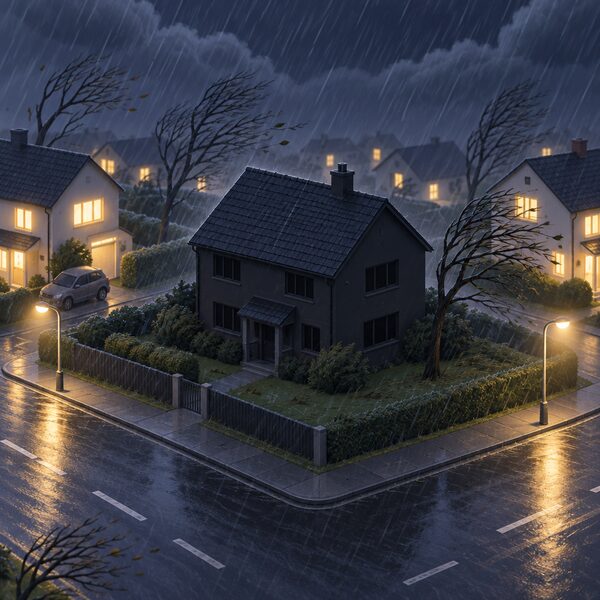
The deadline a network operator must meet is the pivot on which everything else turns. Ofgem gives three: 12 hours for interruptions outside of severe weather, 24 hours in severe storm category 1 weather, and 48 hours in severe storm category 2 weather2. SSEN states the same normal-weather obligation:
"if your electricity supply fails because of a problem in our network during normal weather conditions, we must restore it within 12 hours"
Electricity North West states that for power cuts caused by severe weather, compensation is available if the outage lasts longer than 24 hours17. UK Power Networks is explicit at the other end of the scale: a payment would not normally be offered for a power cut lasting less than 12 hours18.
In practice, restoration after severe weather or flooding is reported to take 8 to 12 hours or longer19, and a major storm can leave rural circuits down far longer than that. The deadline extension in a storm is not a discretionary gesture by the operator: the category is assessed against fault counts, and the household has no say in it. From an independence point of view, the 48 hour category 2 deadline is the honest measure of how long a home in an exposed area may need to sustain itself. That is the figure to hold in mind when reading essential loads and backup circuits or how to prepare your home for a winter power cut.
Claim deadlines differ by cause. For unplanned cuts a claim must be made within three months, with no time limit for anyone on the Priority Services Register3. For storm cuts the three months runs from the power coming back on, again with no time limit for Priority Services Register customers8. Registration is covered on the Priority Services Register.
Storm categories 1 and 2: how they change the thresholds
Storm categories are based on the impact the storm has on the electricity network, such as damage to the network4. Ofgem states it bases the categories on how the storm has affected the electricity network and how many faults it has caused in a high-voltage area in one day5. A category 1 storm is where unusually bad weather conditions, including lightning, cause at least 8 to 13 times more faults than normal; a category 2 storm is where very severe weather causes at least 13 times more faults than normal2.
Operator and independent descriptions add detail. National Grid states that during lightning events, a category 1 storm arises where the number of high-voltage faults in a 24 hour period is at least 8 times the normal amount, a threshold set by Ofgem, and that during non-lightning events the trigger is between 8 and 13 times the normal amount of high-voltage faults within 24 hours15. Uswitch describes a category 1 storm as causing 8 to 12 times the number of daily average faults in a 24-hour period and a category 2 storm as causing more than 12 times that number19. Ofgem's 2023 press release defined category 2 as a storm causing more than twelve times the daily average number of faults in a 24-hour period, as defined in the Electricity (Standards of Performance) Regulations 2015, and announced the removal of Category 3, which it said will increase the number of compensation payments for inconvenience20. The documents therefore disagree over whether the category 2 boundary is "more than twelve times" or "at least 13 times"; both figures are published, the later Ofgem consumer guidance giving 132.
Inside a storm category, the payment steps change shape as well as size. Ofgem states that for storm category 2 a household can get £90 for the first 48 hours and an extra £45 for every 6 hours after5. Citizens Advice gives £90 where power was off for 24 hours in a category 1 storm, then £45 for every 6 extra hours without power, up to a maximum of £2,2358. The cap is far higher than the £400 normal-weather maximum precisely because storm outages run longer. Energy Networks Association publishes a category 2 figure of £85 after 48 hours4; that page and its companion figures are not consistent on whether the trigger is 24 or 48 hours, so the Ofgem thresholds are the reliable ones.
An extra £100 for repeated cuts in a year

Repeated short interruptions attract their own payment. Ofgem states a household could get an extra £100 if power has gone off more than 4 times between 1 April and 31 March the following year, and that each power cut must have lasted at least 3 hours2. This one is not automatic: Ofgem states a claim must be made with the local network operator who will decide if the payment is due5.
Operator pages describe eligibility in the same terms. UK Power Networks lists four or more power cuts each lasting three hours or more, all within the same financial year between 1 April and 31 March21. Electricity North West defines a multiple or repeat power cut as electricity going off more than once in the past 12 months and publishes guidance on compensation for affected customers22. SSEN publishes £95 for power cuts lasting more than 3 hours on 4 separate occasions in the same financial year14, a lower figure than Ofgem's £1002.
Two exclusions catch people out. Citizens Advice states the payment is not available if the household has already qualified for compensation from any power cuts in the same 12 months, and that planned cuts notified in advance do not count8. The claim window is three months after the end of March8.
For a home on a rural spur with frequent three to four hour interruptions, this payment is the clearest signal that the network connection is weak. It is also the point at which the arithmetic of a battery or a standby generator begins to look different, since £100 a year does not buy continuity.
What is not covered: shortages, appliance damage and food
Ofgem lists three exclusions from power cut payments: blackouts caused by a national power shortage, damage to electrical equipment or appliances, and a low supply after a power cut2. Citizens Advice states there is no compensation where the cut was caused by an emergency, giving a blackout because of a national power shortage as the example, and separately that the electricity network operator does not have to give compensation for damage to electronic devices after a power cut, though it may offer a goodwill payment8. That position is expanded on the page about compensation if a power cut damaged my devices.
Rota disconnection is firmly outside the scheme. Electricity North West states that under Ofgem rules compensation is not available for an emergency power cut of this nature23. SSEN states that a very limited number of sites are protected from emergency power cuts, typically critical national infrastructure such as air traffic control centres and major hospital facilities with accident and emergency departments, and that domestic properties are not eligible17. UK Power Networks notes of power sharing that "It does not protect vulnerable customers from the power cut"24. Energy Networks Association adds that exemptions are not automatic25. The mechanics are set out under rota power cuts.
Food loss is excluded across the board:
"Power cuts occur for many different reasons and usually without warning, so we're not liable for any loss of fridge freezer contents as a result of a power cut"
Electricity North West states that it cannot be held responsible for any loss of fridge or freezer contents due to these interruptions, that it is unable to reimburse customers for food lost during a power cut, and that home insurance might cover such losses, with an insurance letter available on request27. Uswitch states plainly that no specific claim can be made for refrigerated or frozen food that spoils19. On timings, Energy Networks Association states food should keep for up to 4 hours in the fridge29, and Electricity North West gives about 24 hours for a half-full freezer28. See how long food lasts in a fridge or freezer and claiming on insurance after a power cut.
How payment works: automatic payment, cheques and the £40 penalty

For unplanned cuts not caused by bad weather, Citizens Advice states the household should get an automatic payment from the electricity network operator within 10 working days8. Ofgem states the payment could be made through a cheque, cash or bank transfer5, and Energy Networks Association states that payments are typically made automatically, with a cheque sent to the property which has been without power4.
An energy bill credit is not available for electricity. Energy Networks Association states it is not possible for payments to be credited to an energy bill because network operators do not have access to billing information held by suppliers4. Gas is different: for a loss of gas supply, compensation is paid through energy suppliers and appears as a credit on the next bill, with no need to apply, and usually takes four to five weeks to process, sometimes up to three months depending on the supplier's billing cycle30. Gas network payments are also made automatically within 10 working days, directly or through the supplier, with another £40 if they are not3.
The late-payment penalty is the mechanism that gives the deadline teeth. Ofgem states that if the payment has been missed, the operator may owe an extra £405. Citizens Advice states that where a claim is made after the operator has failed to pay within 10 working days, an extra £40 compensation should also follow8. The same £40 appears across supplier standards, for example where a supplier fails to reconnect within 24 hours it must pay £40 within 10 working days plus a further £40 for the delay.
After a storm the timetable is looser. Citizens Advice advises contacting the operator to make a claim if nothing has been paid within four weeks of the power coming back on3. Where a claim is made and accepted, payment should follow within 10 working days8.
Northern Ireland has its own figures. NIE Networks states that where it misses a cheque payment deadline, the customer receives £2529.
Claiming, chasing and escalating to the Energy Ombudsman
Some operators publish a claim route directly. UK Power Networks states that a customer who has had a power cut lasting longer than 12 continuous hours may be entitled to a payment and asks anyone who has been without power for 12 continuous hours to complete its payment claim form31. It also publishes separate guidance on eligibility for compensation for multiple power cuts21.
Deadlines differ by type of cut:
- Unplanned cut: claim within 3 months; no time limit for Priority Services Register customers3
- Storm cut: claim within 3 months of power coming back on; no time limit on the Priority Services Register8
- Planned cut: claim within 1 month of the start of the power cut8
- Repeat cuts: 3 months to claim after the end of March8
If the operator refuses or does not respond, the complaint escalates. Ofgem states a complaint can go to the Energy Ombudsman where a problem reported has not been fixed within 8 weeks, where the parties cannot agree on a fix, where a deadlock letter is received, or where the decision received is unsatisfactory12. Ofgem describes the process: the Ombudsman will ask for information and evidence, review the evidence from the complainant and the energy company, inform the complainant of their decision within 6 weeks, and give the energy company a set of actions to resolve the problem12. The Energy Ombudsman states a dispute must be escalated within 12 months of receiving a deadlock letter32. Government announced in June 2026 that customers will be able to escalate complaints to the Ombudsman within a shorter time frame, a maximum of 10 weeks, cutting overall waiting times by a month33.
Planned outages and the notice required
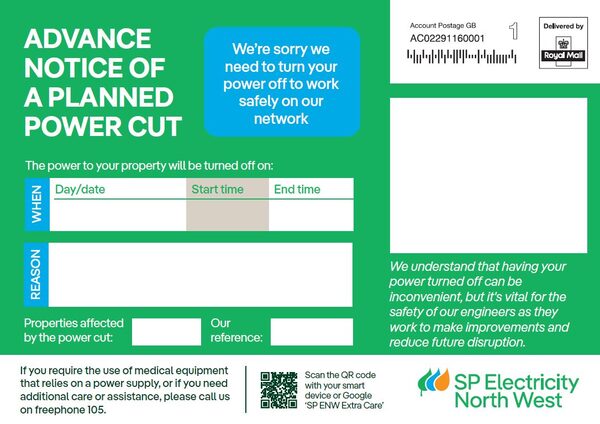
Planned work is treated as a separate standard. Citizens Advice states the electricity network operator must give 2 days' notice if it plans to cut off supply to do work, and that £40 compensation is due if either two days' notice is not given or the customer is cut off on a different day from the one notified3. Which? describes the same obligation and the same £409. Uswitch cites Citizens Advice for the two-day minimum19.
Northern Ireland requires more notice. NIE Networks states it will give a minimum of three days notice before turning off electricity for planned work10, and for customers on its Customer Care Register it states it will contact them at least three days beforehand and inform them of the expected duration of the interruption34. That register is described on priority services in Northern Ireland. NIE Networks also states that the cost of compensation under the severe weather scheme is paid for by electricity customers35, and that compensation will not be paid following the Storm Éowyn severe weather event36. The Northern Ireland position is set out on power cut compensation in Northern Ireland.
Being on the Priority Services Register changes the experience of planned work in Great Britain too: SSEN states registered customers get advance notice of planned power cuts where possible, giving time to charge hearing aids, visual alarms and vibrating devices37.
What the scheme means for household energy independence
The Guaranteed Standards are a floor on service, not a substitute for it. They pay £100 to a home after a qualifying cut and £45 for each further 12-hour block in normal weather, to a maximum of £400 where 5,000 or more properties are affected2. They pay nothing at all for a cut under 12 hours in normal weather18, nothing for spoiled food26, nothing for damaged appliances2, and nothing during a national shortage or a rota disconnection2. The largest sums, up to £2,235, arise only in the storms where a household is most exposed and longest without supply8.
Every payment described here is a payment from a monopoly network operator, made after the event, usually by cheque to the property4. The household remains dependent on that operator's repair programme, on the weather categorisation that sets the deadline, and, for repeat cuts, on making a claim the operator then decides5. Ofgem's own research recorded low awareness of the standards and widely varying views on the appropriate level of compensation6. Understanding the thresholds is useful mainly because they state, in hours, how long a network is permitted to leave a home without electricity: 12, 24 or 48. What a household does with those hours is the subject of the rest of this section, from portable power stations to keeping heating running in a power cut.
Sources37 cited
- Adjustments to Guaranteed Standards of Performance 2026, Ofgem, 2026-03-13
- Check if you can get a payment for a power cut, Ofgem, 2026
- Get compensation if you have a power cut, Citizens Advice, 2026-09-17
- Power cut compensation, Energy Networks Association, 2026-09-17
- Plan for a power cut, Ofgem, 2026
- Energy consumer experiences of customer service standards, Ofgem, 2026-06-23
- Check if you can get a payment for a power cut, Ofgem, 2026
- Get compensation if you have a power cut (Wales), Citizens Advice, 2026-09-17
- How to find out if there's a power cut, Which?, 2026-06-04
- Planned power cuts, NIE Networks, 2026-09-20
- Ofgem transformed to strengthen protections for energy consumers, GOV.UK, 2026-04-22
- Complain about your energy supplier or network operator, Ofgem, 2026
- Get winter ready, Energy Networks Association, 2026-09-05
- Repeat power cuts, SSEN, 2026-09-19
- Standards of performance, National Grid, 2026-09-17
- SSEN performance standards, SSEN, 2026-09-17
- Electricity Supply Emergency Code, SSEN, 2026-09-19
- Compensation for a power cut lasting less than 12 hours, UK Power Networks, 2026-09-17
- How to get power cut compensation, Uswitch, 2025-06-23
- Ofgem announces rise in storm compensation cap, Ofgem, 2023-09-01
- Compensation for multiple or repeat power cuts, UK Power Networks, 2026-09-17
- Multiple or repeat power cuts, Electricity North West, 2026-09-19
- Emergency power cuts, Electricity North West, 2026-09-19
- Emergency power cuts, UK Power Networks, 2026-09-17
- Care and assisted living providers, Energy Networks Association, 2026-09-17
- A power cut ruined food in my fridge freezer, UK Power Networks, 2026-09-17
- Advice and support FAQs, Electricity North West, 2026-09-20
- Be summer ready, Electricity North West, 2026-09-19
- Customer standards, NIE Networks, 2026-09-19
- Gas supply updates, SGN, 2026
- Compensation for a power cut lasting more than 12 hours, UK Power Networks, 2026-09-17
- Energy Ombudsman FAQs, Energy Ombudsman, 2026-09-19
- Greater protections to restore families' trust in home upgrades, GOV.UK, 2026-06-17
- Customer Care Register, NIE Networks, 2026-09-19
- Is compensation paid in other parts of the UK?, NIE Networks, 2026-09-19
- Can I claim for food after a power cut?, NIE Networks, 2026-09-19
- Priority Services for customers with hearing loss, SSEN, 2026-09-19
 Power Cuts in WalesWho do you call when the power goes out in Wales, and how long should it take to come back on?
 Flexibility Payments for HomesCan you really get paid for using less electricity at peak times, and how much would a household actually earn?
 The Full Backup Power GuideHow long do UK power cuts usually last, and what can keep your fridge, heating or phone going until the power comes back?
 Network Operators and 105When the lights go out, who do you actually ring?
 Fixed-Rate Energy TariffsWhat a fixed energy tariff fixes and what it does not, the contract lengths sold in the UK, exit fees and the 49-day window, how fixed rates compare with the price cap, and what happens when the term ends.
 Reading an Energy BillA line-by-line walk through a domestic gas and electricity bill: unit rate, standing charge, kWh consumption, meter readings, tariff name and balance, plus the 12-month back billing limit and the guaranteed standards payments that apply when a supplier or network operator gets it wrong.