
In this guide
A generator gives a household something the grid cannot promise: electricity when the network is down. It also introduces three hazards that a mains supply does not have at the point of use, all of them at the same time. The first is carbon monoxide, a gas that Northern Ireland guidance describes as "a highly poisonous gas which you can't see, taste or smell, but it can kill quickly without warning"1. The second is fire, from hot exhaust surfaces, spilled fuel and refuelling while the unit is running. The third is electric shock, because a portable generator is a source of supply that has to be earthed and protected in a way the wiring regulations recognise.
The scale of the carbon monoxide risk is reported differently by different bodies, and the figures count different things. Northern Ireland guidance describes deaths caused by gas systems that have not been properly installed or maintained1. HSE counts gas-related carbon monoxide deaths on a narrower basis2. A government consultation reports carbon monoxide deaths across England and Wales from all sources3. These are not competing estimates of one number; they are different measures, built on different definitions and different geographies, and none of them is a count of generator deaths alone.
What follows is the safety position as the official and independent sources set it out: where a generator can and cannot be run, what the wiring regulations require, how fuel should be handled, and how the safety profile of a fuel generator differs from that of a battery-based alternative.
Why generator safety matters: the numbers behind the risk
Building regulations for electrics exist for a stated reason: to "help reduce the number of deaths, injuries and fires caused by faulty installations"7. A generator connected to a home's wiring becomes part of that installation, and the same logic applies to it. The risk is not hypothetical. Electrical Safety First reports that every year, half of accidental domestic fires in the UK are caused by electricity, and that the figure is not changing6. It attributes those fires to misuse of appliances, poor regulation of electrical safety checks, particularly in the private rented sector, and faulty appliances6.
Carbon monoxide sits alongside fire as a household hazard with a documented death toll. The three national figures cited above differ because they measure different populations and different causes: gas systems that have not been properly installed or maintained1, gas-related deaths specifically2, and all carbon monoxide deaths in England and Wales3. A generator running on petrol produces the same gas as a faulty boiler, and the exposure route is the same: exhaust entering a building and accumulating.
There is a wider context that makes backup power more relevant, not less. The Climate Change Committee reports a 12% reduction in nuclear generation in 2025, due to operational challenges at several reactors, particularly at Hartlepool8. That is a supply-side fact, not a safety one, but it explains why more households are looking at standby equipment. The safety rules do not relax because the reason for buying a generator is reasonable.
Carbon monoxide: the invisible killer around any fuel-burning generator
Carbon monoxide is described by OFTEC as "the silent killer" because it is colourless, odourless, tasteless and yet extremely poisonous10. Northern Ireland guidance is blunter: it can kill quickly without warning1. The gas has no smell or taste11, so a household cannot detect it by any human sense. That single property is why siting rules are absolute rather than advisory.
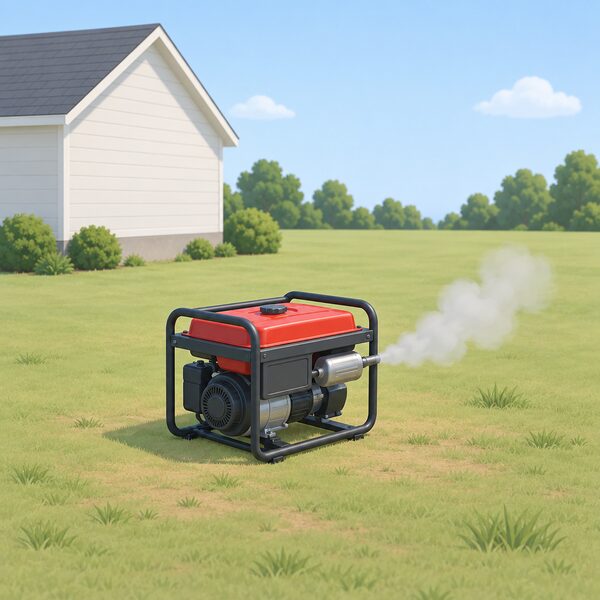
A petrol or diesel generator produces carbon monoxide continuously while it runs. The exhaust has to go somewhere, and the only safe destination is open air, away from any opening into a building. The failure mode is well documented: exhaust enters through a window, door, vent, or through gaps around a connecting door, and accumulates in a room that feels ventilated. OFTEC's guidance on carbon monoxide safety covers the same ground for off-gas-grid heating, and the mechanism is identical for a generator12.
Symptoms are easy to misread. HSE states that anyone experiencing symptoms who believes they may have been exposed to carbon monoxide should seek urgent medical advice from either their GP or an A&E department13. Northern Ireland guidance goes further for suspected high exposure: attendance at a local emergency department is advised immediately if exposure to carbon monoxide is suspected11. OFTEC repeats the GP or A&E route for anyone with symptoms12. In Northern Ireland, a carbon monoxide alarm response can also involve ringing a heating engineer or the Northern Ireland Fire and Rescue Service9.
The practical implication for a household is that a generator is not a device you can bring inside when it rains, or run in a porch to keep it dry. The exhaust is the hazard, and it is produced for as long as the unit runs.
"Carbon monoxide is a highly poisonous gas which you can't see, taste or smell, but it can kill quickly without warning."
Where and how to run a generator safely outdoors
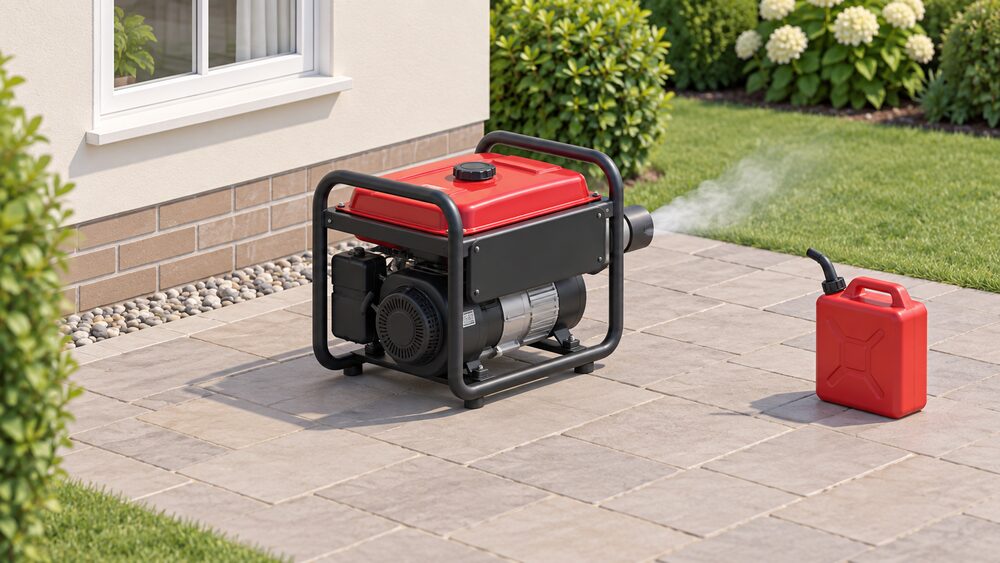
The rule is simple to state and easy to get wrong: a fuel-burning generator runs outdoors, in open air, with its exhaust pointing away from the building and from any neighbouring property. It does not run in a garage, shed, conservatory, porch, basement or attached outbuilding, and an open door does not change that. The gas accumulates faster than an open door clears it, and it can migrate into the house through the structure.
Distance matters as much as location. Exhaust needs to disperse before it reaches an opening, so the unit should be positioned well away from windows, doors, air bricks and vents, and never below a window that might be opened. Wind direction should be considered: exhaust that drifts toward the house defeats the purpose of running the unit outside. A generator running in a garden close to a kitchen window is not meaningfully safer than one in a garage.
The same logic applies to a generator used at a caravan, boat or holiday home, where carbon monoxide incidents and fatalities are documented9. There is no domestic setting in which exhaust can be treated as harmless.
For the electrical side, the siting question is separate from the connection question. Building regulations for electrics apply in England and Wales, and electrical installation work in a home or garden must comply with them7. In Wales, the electrician carrying out the work must be registered by an organisation authorised by the Secretary of State and able to certify the work as safe without notifying Building Control14. Non-notifiable electrical work still has to be designed and installed, and inspected, tested and certificated, in accordance with BS 767115. A generator supply is not exempt because it is temporary.
CO detectors: what to buy and where to fit them
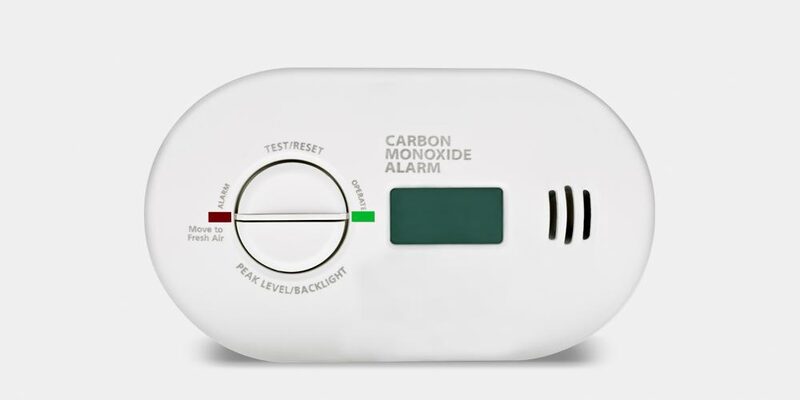
A carbon monoxide alarm is a warning device, not a substitute for correct siting. HSE's test before purchase is specific: "always ensure it complies with British Standard EN 50291 and carries a British or European approval mark, such as a Kitemark"2. HSE repeats the same requirement in its general gas safety answers16. OFTEC states the standard as British standard BS EN 5029112. A detector that does not meet EN 50291 is not a detector in the sense the guidance means.
Placement follows the same logic as for a boiler. In rented properties in the UK and Jersey, CO detectors must be fitted in any room used as living accommodation containing an appliance10. Landlords in Ireland and Guernsey also have a responsibility to ensure CO detectors are in place10. Those duties are written for combustion appliances, but the principle transfers: a detector belongs in the room where combustion products could accumulate, and in the rooms where people sleep.
For a household running a generator outdoors, the detector's job is to catch the failure case, exhaust reaching the interior. That means coverage of the rooms nearest the generator's position and any room with a connecting door or shared wall. A detector in a hallway does not cover a bedroom with a closed door.
Earthing and BS 7671: what the wiring regulations expect
All electrical work should follow the safety standards in BS 7671, the wiring regulations7. The standards that should be met are set out in British Standard 767117, and the current edition is BS 7671:2018+A4:2026, published on 15 April 2026, which supersedes BS 7671:2018+A2:2022+A3:20244. BS 7671 is described by its publisher as the UK's national standard for the design, erection and verification of electrical installations4, and as the most widely accepted way to demonstrate compliance with UK electrical safety legislation, namely the Electricity at Work Regulations 19894.
For Northern Ireland, the legislation defines "electrical safety standards" as the standards for electrical installations in the eighteenth edition of the Wiring Regulations, published by the Institution of Engineering and Technology and the British Standards Institution as BS 7671: 201818. That is a statutory definition, not guidance, and it fixes the baseline for the work.
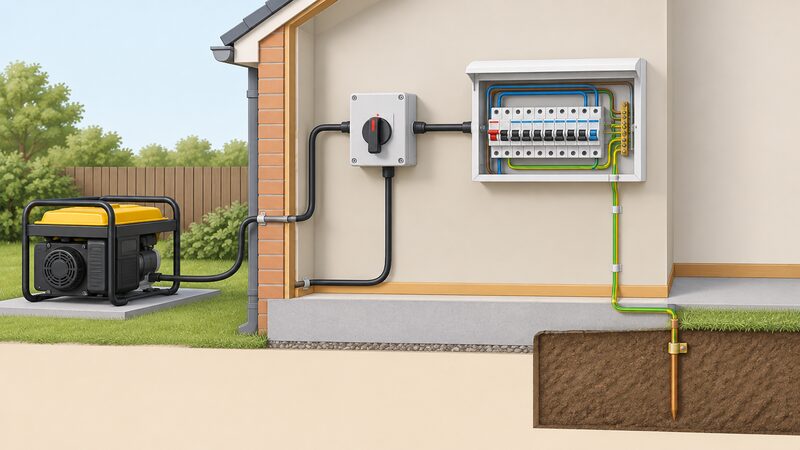
The earthing question is where generator installations differ most from ordinary mains work. A portable generator is a separate source of supply, and the protective measures that make a mains installation safe, such as the supplier's earth and the automatic disconnection of supply, do not automatically exist on a generator-fed circuit. The wiring regulations set out how a generator supply should be designed, earthed and protected, and the detail depends on whether the generator is connected as a standalone supply or as an alternative to the mains. This is not a decision for a householder with a cable and a plug.
Building regulations approval applies to notifiable work, and in England a private registered building control approver can be used where the work does not include a higher-risk building19. In Wales, the route runs through an electrician registered by an organisation authorised by the Secretary of State14. Gas work is separately regulated: you must be on the Gas Safe Register to carry out gas work legally20, and the Gas Safe Register operates a freephone helpline on 0800 408 55002.
Fuel handling, LPG regulators and explosion risk
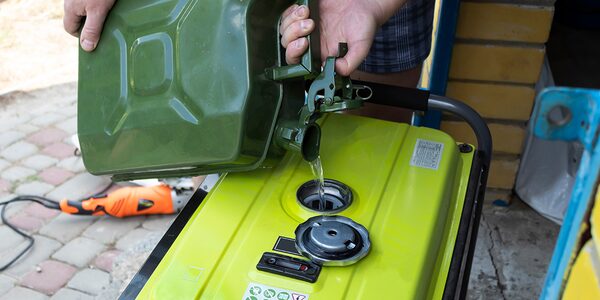
Fuel is the second hazard after exhaust, and it has two distinct failure modes: fire during refuelling, and storage that puts a tank too close to a building. Refuelling a running generator is the classic error. Petrol vapour is heavier than air and can travel to a hot exhaust or a spark, and the exhaust of a generator that has just been running stays hot for some minutes. The safe sequence is shutdown, cooling, moving the unit away from any ignition source, refuelling, clearing any spillage, and restarting only with the cap tight.
Storage is regulated. Requirement J6 of the building regulations guidance for Wales states that liquid fuel storage systems and the pipes connecting them to combustion appliances "shall be so constructed and separated from buildings and the boundary of the premises as to reduce to a reasonable level the risk of the fuel igniting in the event of fire in adjacent buildings or premises"5. That requirement applies to fixed oil storage tanks with capacities greater than 90 litres and fixed LPG storage installations with capacities greater than 150 litres located outside the building5. A household storing a jerrycan for a portable generator is below those thresholds, but the separation principle still describes why fuel should not be kept against a wall or inside a shed.
LPG brings its own rules. Anyone working on CNG refuelling facilities does not need Gas Safe registration, but should be trained and competent to carry out the work16. For refrigeration, air conditioning and heat pump equipment, the F-Gas Handler certification rests on Regulation 2015/2067 as retained in UK law21, and enforcement of the GB F gas Regulation is the responsibility of the Environment Agency in England22. Those are adjacent trades rather than generator work, but they show the pattern: fuels and refrigerants are regulated by competence, not by good intentions.
Fire risk in the home: what the statistics show
Electrical Safety First reports that every year, half of accidental domestic fires in the UK are caused by electricity, and that this figure is not changing6. It identifies the causes as misuse of appliances, poor regulation of electrical safety checks, particularly in the private rented sector, and faulty appliances6. It also reports over five fires a day in England caused by white goods such as tumble dryers, washing machines and dishwashers6. The organisation campaigns for mandatory five-yearly electrical checks in rented homes6.
A generator adds to that fire load in three ways. The unit itself has hot surfaces and a fuel system. The connection to the house, if done badly, creates a fault path. And the loads it supplies may be run in ways they were not designed for, such as extension leads coiled under a rug or daisy-chained across a room. The building regulations' stated purpose, reducing deaths, injuries and fires caused by faulty installations7, is the frame for all three.
Heat is a related risk in a changing climate. The Climate Change Committee projects that hotter heatwaves could see 92% of existing homes overheat by mid-century, creating dangerous conditions for vulnerable people8. That is a projection about homes generally, not about generator rooms, but it bears on where equipment and fuel are stored: a shed or garage that becomes very hot in summer is a worse place for a fuel container than a shaded, ventilated outdoor store.
Recalls and product safety: stop using a recalled item
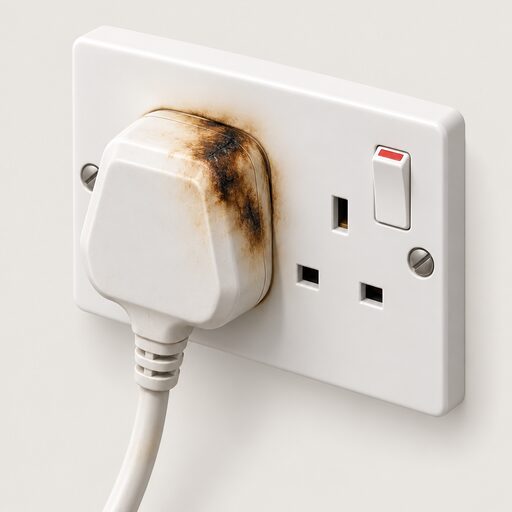
Recalls are a live category for backup power equipment, and the response is not negotiable. Electrical Safety First states that anyone who discovers they have an electrical item that has been recalled should stop using it until it has been checked by the manufacturer23. For the HL R-Team e-bike batteries and chargers recall, its recommended action is to stop using the product immediately and contact the retailer for further advice23. The same body has published recalls for a USB charger and for a standby saver that caught fire during use, among others.
The pattern across recalls is that the fault is often a fire risk in a product that is plugged in continuously or charged unattended. That is exactly how backup equipment tends to be used. A charger left on overnight, a battery pack stored in a hallway, a standby device left in a socket: all are normal behaviours that turn a manufacturing defect into a household fire.
Checking is straightforward. Recalls are published by product name and model, so the search should use the exact model rather than a general term. Where a product has been recalled, the manufacturer's check is the route back to safe use, and the retailer is the route to a remedy.
Fuel generators vs solar generators: how the safety profile differs
The safety case for a battery-based alternative rests on what it does not produce. A solar generator or portable power station has no exhaust, no fuel, no hot exhaust surface and no refuelling step, so the carbon monoxide and fuel-fire hazards described above do not apply to it. That is a genuine difference in kind, not a matter of degree, and it is the main reason a household might choose one for indoor use.
The trade-off is that battery systems carry their own risks, and the regulatory position is unsettled. The government's plug-in solar consultation states that "at present, solar plug-in microgenerators cannot be legally sold, supplied, or used in the UK due to constraints arising from existing product safety legislation"22. The same consultation notes that plug-in solar products will be covered by the General Product Safety Regulations (GPSR) 2005 in Great Britain22. So the category is not unregulated; it is currently unlawful to sell or use in the form the consultation describes, with a framework proposed for it.
For a household weighing the two, the honest summary is that a fuel generator trades a carbon monoxide and fire risk for a higher energy density and unlimited runtime, while a battery system trades those combustion risks for a finite stored energy and a dependence on charging. Neither is risk-free, and neither removes the need for correct installation where the equipment connects to a home's wiring.

Sources23 cited
- Domestic gas installation and health and safety, nidirect, 2025-10-28
- Gas safety in the home: frequently asked questions for owner occupiers, Health and Safety Executive, 2026
- The UK's new product safety framework, GOV.UK, 2026-03-31
- Requirements for Electrical Installations, IET Wiring Regulations, BSI, 2026-04-15
- Building regulations guidance Part J: heat producing appliances, Welsh Government, 2026-09-17
- 10 ways to avoid electrical fires in your home, Electrical Safety First, 2026-09-19
- Building regulations: general information, Planning Portal, 2026
- Progress in reducing emissions: 2026 report to Parliament, Climate Change Committee, 2026-06-24
- Gas safety and carbon monoxide, nidirect, 2025-11-24
- Carbon monoxide safety, OFTEC, 2026-09-17
- Carbon monoxide poisoning, nidirect, 2026-09-17
- Guide to carbon monoxide safety, OFTEC, 2026-09-20
- Carbon monoxide, Health and Safety Executive, 2026
- Building regulations: electrics, Welsh Government, 2026-09-17
- Building regulations: minor works, Planning Portal, 2026
- Gas safety: frequently asked questions, Health and Safety Executive, 2026
- Electrical safety standards in the private and social rented sectors: guidance, GOV.UK, 2025-11-01
- Electrical safety standards legislation, Northern Ireland, legislation.gov.uk, 2024-11-27
- Building regulations approval: how to apply, GOV.UK, 2026-09-17
- Registration to carry out gas work, GOV.UK, 2026-09-17
- Extended CE marking recognition for ecodesign regulations, GOV.UK, 2025-12-09
- Plug-in solar consultation document, GOV.UK, 2026-06-16
- HL R-Team e-bike batteries and chargers recall, Electrical Safety First, 2026-09-17
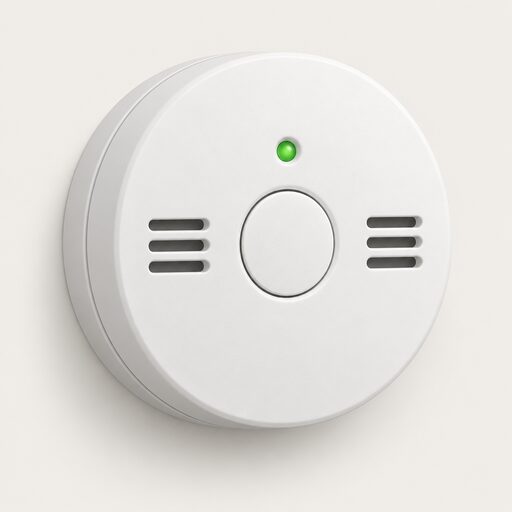 Carbon Monoxide SafetyHow carbon monoxide arises from gas, oil, LPG and solid fuel appliances, where alarms must be sited and what the requirements are in each UK nation.
 Air Conditioning SafetyA safety guide to home cooling appliances: plug and circuit loading, flammable refrigerants in portable units, condensate and water damage, venting, window sealing and product recalls, with the markings to look for.
 Home Battery Fire SafetyHow likely is a home battery to catch fire, and what keeps it safe if it does?
 Smell Gas or Suspect COThe emergency steps for a suspected gas escape or carbon monoxide alarm, including ventilation, ignition sources and turning the supply off at the emergency control valve.
 Generator Transfer SwitchesA generator can only be wired into your home's circuits through a proper changeover switch, never by plugging it into a socket.
 Electrical Safety for GenerationWho signs off the wiring when you fit solar panels or a small wind turbine, and how do you know it is safe?