
In this comparison
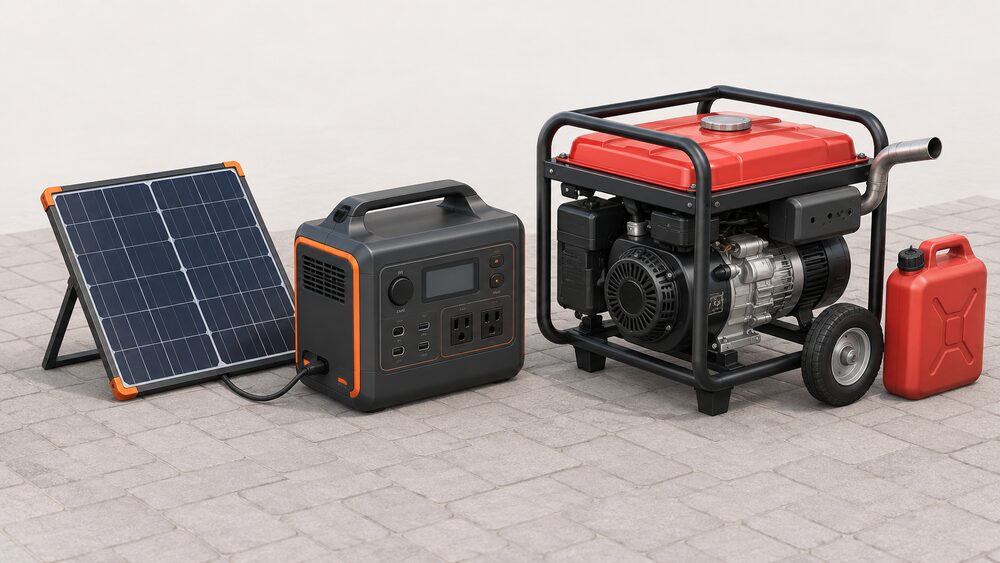
A solar generator is a battery and an inverter in one box, charged from solar panels or a mains socket, with no engine and no fuel. A fuel generator is an engine driving an alternator, burning petrol, diesel or LPG, and it runs for as long as fuel is supplied. The two are compared for the same job, keeping a home's essentials alive when the grid fails, but they solve it in opposite ways: one stores energy it has already collected, the other converts fuel on demand.
The practical differences are stark. A solar generator produces no exhaust and no point-of-use emissions, so it can sit inside a building1. A fuel generator must never be run indoors or in an enclosed space, because of carbon monoxide2. A solar generator's output is capped by its battery and inverter, and its recharge depends on daylight, which official guidance notes is the only time solar electricity can be generated3. A fuel generator will run at any hour, in any weather, until the fuel runs out.
For a household weighing energy independence, the choice turns on what each one leaves you dependent on. A solar generator leaves you dependent on the weather, on panel area, and on the manufacturer for the battery and any app that monitors it. A fuel generator leaves you dependent on a fuel supply chain, on safe storage, and on an engine that wears. Neither removes dependence entirely, and the sections below set out where each one's limits fall.
What each one actually is: battery and panels versus engine and fuel
A solar generator is not a generator in the engineering sense. It is a battery bank, an inverter and a charge controller packaged together, filled from photovoltaic panels or from a wall socket. Solar PV panels convert the sun's energy into electricity, and the greater the intensity and duration of the sunlight, the more electricity is produced3. The panels themselves are passive; the intelligence sits in the unit that stores and converts what they collect.
A fuel generator is the older idea: an engine turns an alternator, and the electricity appears as long as fuel is fed in. It has no storage of its own, so it produces nothing when it is off, and it produces exactly as much as its rating allows when it is on. That makes it predictable in a way a battery is not, and it makes it useless the moment the fuel runs out.
The two approaches also sit differently in a home's electrical arrangements. Adding a battery to a property is treated as a distinct process from connecting an EV charger or a heat pump, and network operators direct householders to a separate application route for it8. A household running a solar generator as a standalone appliance, plugging loads into it directly, avoids that route entirely. A fuel generator connected to a home's wiring raises questions about transfer switches and notification that a plug-in battery does not.
Where the two converge is in what a household actually wants from them: a defined set of essential loads kept alive for a defined period. The essential loads and backup circuits page covers how to decide that list, and the choice between the two technologies follows from it.
Running costs: free sunlight against bought fuel
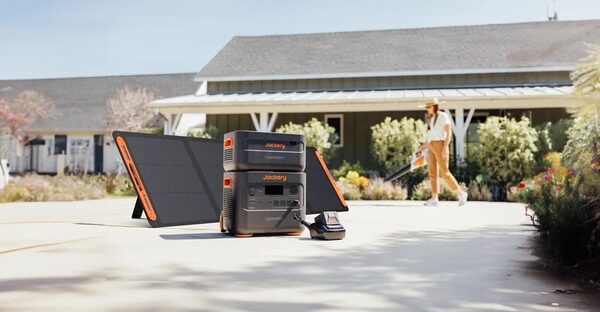
The running cost case for solar is straightforward and well documented. Sunlight is free, so once the initial installation is paid for, electricity costs are lower9. Once a solar installation is paid for, the electricity it generates is completely free to use, though a household still pays for any additional electricity drawn from the grid and for maintenance10. The same point is made more bluntly elsewhere: once the installation is paid for, the electricity generated is free11.
A fuel generator inverts that. Every hour of running consumes fuel that has to be bought, stored and replaced, and the cost recurs for the life of the machine. The published evidence here does not give a per-hour fuel figure, and prices for both technologies are quoted by installers and retailers rather than published centrally, so no comparison of up-front purchase price can be made from the figures available.
What the evidence does show is that self-consumption beats export. Rates for selling electricity to the grid are much lower than tariffs for using electricity from the grid, so using solar electricity yourself is much more cost-effective12. A solar generator used to run appliances directly is capturing that same advantage in miniature. A fuel generator has no equivalent: the electricity it makes is worth whatever the fuel cost to make it.
Power output: what a solar generator can and cannot run
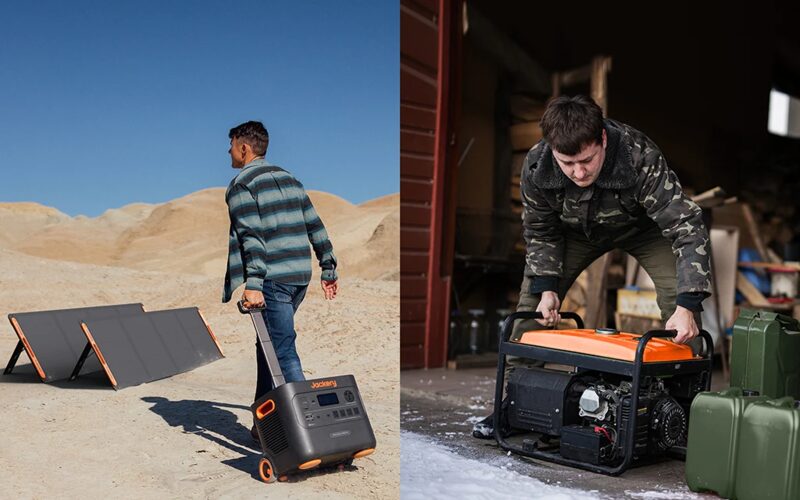
Output is where the two diverge most sharply, and where marketing language needs reading carefully. A solar generator's ceiling is set by its inverter and battery. One maker's 1000 v2 unit is listed at 1070Wh capacity with 1500W continuous output4. A larger unit in the same range is described as able to power 99% of appliances7, a maker's claim rather than a measured figure.
The runtime figures are more useful than the headline wattages. The same maker states that its 1000 Pro can power a fridge drawing 530W for up to 1.5 hours7. That is a single appliance on a single unit, and it shows how quickly capacity is consumed by a compressor. A household expecting a small battery unit to run a fridge, a freezer and a boiler pump through an evening will find the arithmetic unforgiving.
A fuel generator has no such ceiling in the same sense. Its output is limited by its rating, and it will hold that output indefinitely while fuel lasts. That makes it suited to loads a battery unit cannot sustain, and it makes the fuel supply the binding constraint rather than the electronics.
There is a separate regulatory layer for anything connected to a property's supply rather than plugged into directly. Installations above 3.68kW per phase but 50kW or less fall under one network operator's micro-generation connection process, and on a three-phase supply each phase must be 17kW or less14. Small scale renewable generation is classed as greater than 3.68kW and up to 17kW single phase, and greater than 11.04kW and up to 2MW three phase15. A second operator gives the three-phase band as greater than 11.04kW and up to 5MW16.
A fuel generator runs any hour, a solar generator depends on charge
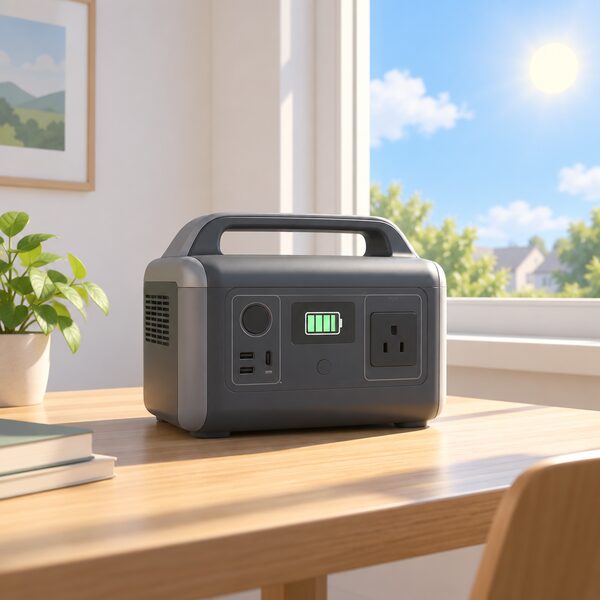
This is the central trade-off, and it is a matter of physics rather than preference. Electricity from solar can only be generated during daylight3. A solar generator therefore has a daily cycle: it fills when the sun is up and drains when loads are applied, and its ability to run overnight depends entirely on what it stored during the day.
Cloud cover reduces but does not stop generation. Solar cells do not need direct sunlight to work and can still generate some electricity on a cloudy day17. One council states that even on a cloudy day, good generation can be achieved18, and a network operator makes the same point, that the cells can still generate some electricity on a cloudy day10. The amount produced depends on the time of day and the weather, and does not require direct sunlight19. UK winter compounds this: short days and low sun angles cut the daily yield even when the sky is clear.
A fuel generator has no such dependency. It runs at 3am in December as readily as at noon in June, and its only limit is the fuel on hand. For a household whose outage risk is concentrated in winter storms, that is a real advantage, and it is the reason the two technologies are often discussed as complements rather than substitutes. The adding a generator to an off-grid solar system page covers that combination directly.
"although a solar system does not require direct sunlight, the amount of electricity it produces will depend on the time "
Noise, fumes and where each can be used
The safety and nuisance rules are not symmetrical, and they are the clearest dividing line between the two. Independent safety guidance is unambiguous: never run a petrol, diesel or gas generator inside or near a tent, awning, caravan, motorhome or cabin, and keep it away from open doors and windows2. A garage is an enclosed space and falls under the same rule. Carbon monoxide from a generator is the hazard, and it is not detectable by smell.
Solar equipment carries no equivalent risk. There is no burning of fossil fuels, so there are no polluting gases released into the atmosphere18, and solar equipment does not normally give rise to noise nuisance, though care in installing it avoids loose cables that could cause wind noise and keeps inverters located internally20. Solar heating and similar systems produce no emissions at the point of use21. A solar generator can therefore be used inside a building, which a fuel generator cannot.
The wider environmental arithmetic is also documented. Getting about 3,500 kWh of electricity from solar panels instead of from a gas-fired power station will avoid about 1.4 tonnes of carbon dioxide emissions22. At grid level, the effect is that the grid needs to generate less electricity from fossil-fuelled generators, because enough renewable energy is generated to cover more homes for longer throughout the day23.
Sizing: the 3,000 to 5,000W rule for basic off-grid appliances
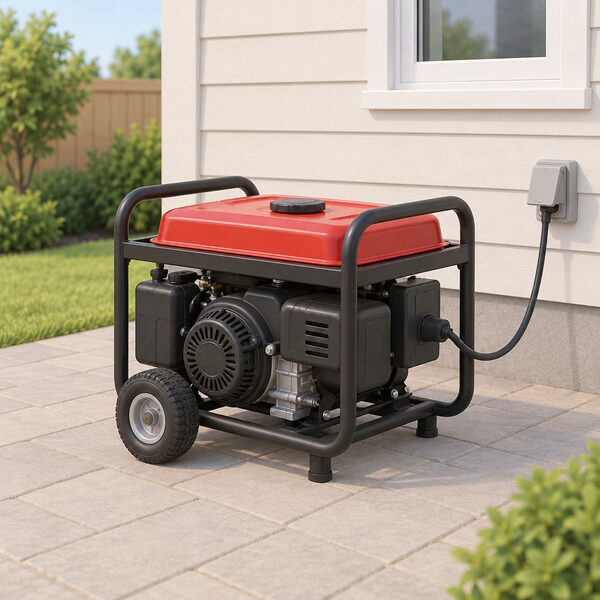
Sizing guidance for off-grid living is thin, and the one published rule of thumb comes from a maker rather than a regulator. Generally, a 3,000 to 5,000 watt generator is sufficient to run basic off-grid appliances4. That figure is a starting point for a whole-property off-grid supply, not for a single battery unit run as backup, and it should be read as the maker's own guidance.
The distinction matters because the two technologies are sized differently. A fuel generator is sized to the peak simultaneous load it must carry, plus headroom for motor starting. A solar generator is sized to the energy it must deliver over a period, which is a function of battery capacity, plus the panel wattage needed to refill it. A unit with 1500W continuous output and 1070Wh of storage4 can meet a modest peak but holds only a small amount of energy, so runtime rather than peak power becomes the constraint.
For anything wired into a property rather than plugged into directly, network operator thresholds apply. Installations above 3.68kW per phase but 50kW or less go through one operator's micro-generation connection process, with each phase at 17kW or less on a three-phase supply14. Small scale renewable generation is classed as greater than 3.68kW and up to 17kW single phase, and greater than 11.04kW and up to 2MW three phase15, while a second operator gives the three-phase band as greater than 11.04kW and up to 5MW16. The disagreement between the two operators on the upper three-phase figure is unresolved in the documents available.
The portable power station sizing page works through the load-by-load method for battery units, and the generator size for home backup page covers the equivalent calculation for engine-driven sets.
Lifespan: 10+ years for batteries, 25 or more for panels, versus engine wear
Solar panels are the long-lived part of a home solar setup. They are described as pretty much maintenance-free and should last for at least 25 years1, with an average lifespan before significant degradation of about 25 years2, and are often expected to remain operational for 25 years or more3, up to 30 years when properly maintained4. Performance warranties run to 20 or 25 years, though inverters are not expected to last as long5. The storage side is shorter: while panels can serve for over 25 years, the lifespan of the core energy storage component, solar batteries, is shorter6. The maker's own portable units, the Solar Generator 1000 v2, 1500 Ultra and 2000 v2, are each stated as having a 10+ Years Lifespan7. Larger generating assets, such as a wind farm, hydro station or solar site, have a life span of 20 to 40 years, after which they may need refurbishment or replacement8. For a household, the practical point is that the panel array is a decades-long asset while the battery is the part most likely to need replacing first, and a fuel generator's engine wear sits outside that pattern entirely.
The two technologies age in different places. A solar generator's wear item is its battery; a fuel generator's is its engine. Panels, where they are part of the picture, outlast both.
On panels, the evidence is consistent. Solar panels are pretty much maintenance-free and should last for at least 25 years24. They are long-term systems, often expected to remain operational for 25 years or more6. The average lifespan before significant degradation is about 25 years5. Three independent sources converge on the same figure, which makes it the most solid number on this page.
On batteries, the published claim is narrower. One maker lists 10+ years of lifespan for its 1000 v2 unit4. That is a maker's figure for one product, and it depends on cycle depth and chemistry. The portable power station batteries page covers how LFP and NMC chemistries differ in cycle life.
A fuel generator's life is measured in engine hours and maintenance intervals, and the material available here gives no service life figure for one. What can be said is that its cost profile is the reverse of a solar generator's: low up-front complexity, recurring fuel and servicing costs, and a finite mechanical life. On lifetime cost of generation, new solar panels and hydropower generators came in 11% lower than the cheapest new fossil fuel generator on a global average in 2021, and onshore wind 39% lower25. Those are global averages for generation plant, not for domestic backup equipment, and they are given here as the nearest published comparison.
Which suits which household: backup, off-grid or everyday use
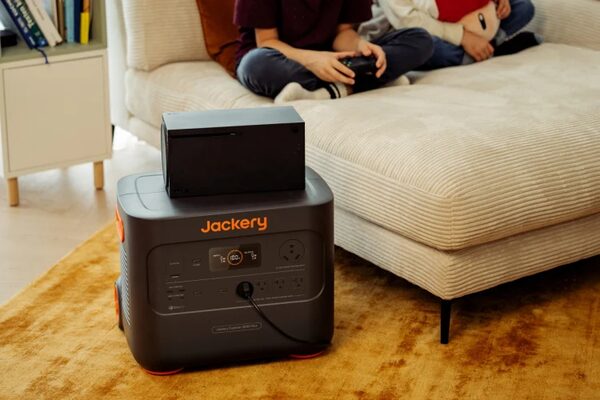
The fit depends on what the household is protecting against and for how long. Official analysis notes that at household level, further innovation in home battery technology, vehicle-to-everything and solar can provide households with additional backup options during power outages26. That frames batteries and solar as backup options alongside, not instead of, other measures.
A solar generator suits a household with a defined list of small essential loads, a place to put panels, and an outage pattern that is short and mostly daytime. It runs indoors, needs no fuel storage, and its running cost after purchase is nil. Its limits are the weather, the battery capacity, and the manufacturer for replacement parts and any monitoring app.
A fuel generator suits a household that needs output at any hour regardless of weather, or that needs to carry loads a battery unit cannot sustain. Its limits are fuel storage and rotation, the carbon monoxide rule that keeps it outdoors, noise, and engine maintenance. The storing fuel at home and generator safety pages cover those conditions.
For a household that wants neither the weather dependency nor the fuel dependency, the two are often combined: a battery and panels for everyday self-consumption, with an engine-driven set as the winter or long-outage fallback. The backup power costs compared page sets the four main options side by side, and the backup power and energy independence page examines what each leaves a household dependent on.
Sources26 cited
- Solar electricity photovoltaics, Planning Portal, 2026-09-17
- Holiday carbon monoxide safety tips, Northern Gas Networks, 2026-07-24
- Solar equipment on residential buildings TAN, Hart District Council, 2025-01
- Solar Generator 1000 v2, Jackery, 2026-09-19
- Solar panel installation, Which?, 2026-08-12
- How long do solar panels last, Uswitch, 2026-07-13
- Small generators, Jackery, 2026-09-19
- Generation connections FAQs, NIE Networks, 2026-09-19
- How do solar panels work, Smart Energy GB, 2026-03-16
- Solar power, Electricity North West, 2026-09-19
- Solar panels, London Borough of Hammersmith and Fulham, 2026-09-17
- Solar panel grants and incentives, The CPA, 2026-05-21
- Solar photovoltaic, CAT, 2026-03-10
- What is the difference between micro, small scale and large scale renewable generation, NIE Networks, 2026-09-19
- Government response to the consultation on permitted development rights, GOV.UK, 2024-03-11
- Installations above 3.68kW per phase but 50kW or less, SSEN, 2026-09-17
- Solar panel electricity systems, House of Commons Library, 2026-09-17
- Solar panels, Oxfordshire County Council, 2026-09-17
- Batteries in the home, Solar Energy UK, 2026-09-17
- The link between energy bills and fossil fuels, End Fuel Poverty Coalition, 2025-09-09
- A homeowner's experience of solar panels and battery storage, MCS, 2024-04-10
- Clifton local listed building consent order guidance, Bristol City Council, 2025-02
- Passivhaus: what you need to know, Energy Saving Trust, 2026-02-16
- Information regarding free solar PV systems, REEC, 2026-09-17
- EVs and heat pumps, NIE Networks, 2026-09-19
- Balancing the grid, Uswitch, 2026-02-09
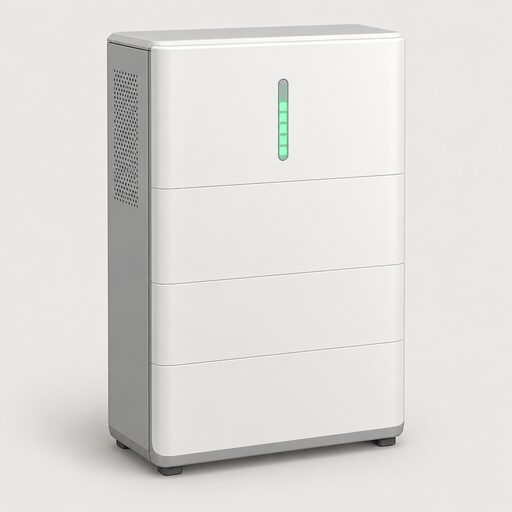 AC-Coupled vs DC-CoupledCan you add a battery to your existing solar panels without swapping the inverter, and does one kind waste more of your solar power than the other?
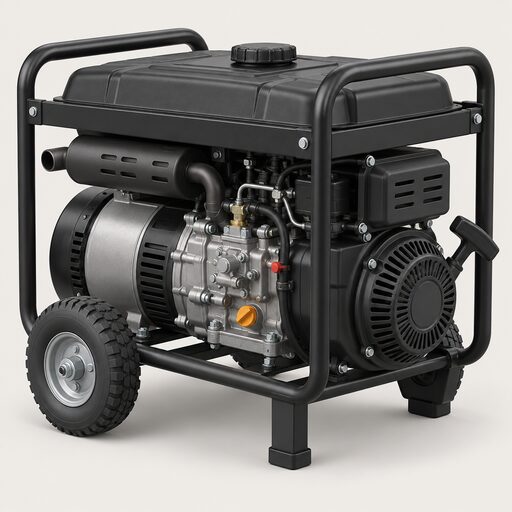 Portable Generators for HomesWhat can a portable generator actually run in a power cut, and for how long?
 Sizing a Self-Sufficient HomeHow many solar panels and how much battery storage does a home need to stop relying on the grid?
 Generator Fuel and Running CostsPetrol, diesel, LPG or HVO: which is cheapest to run a whole-house generator, and how much does it really cost each day?
 Whole-Home Energy DesignHeating and hot water use more energy than anything else at home, so that choice shapes everything.
 Solar and Energy IndependenceHow far domestic solar cuts dependence on suppliers and the grid, what self-consumption really looks like across the year, what a battery, diverter or EV adds, and the grid-outage limit of ordinary inverters.