
In this comparison
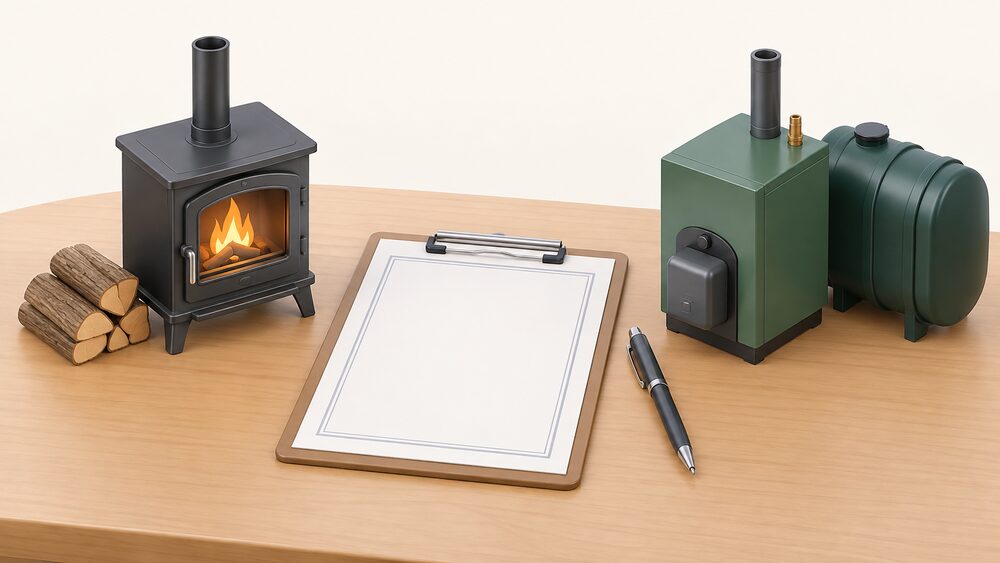
HETAS and OFTEC are two different competent person schemes, not two competing brands of the same thing. HETAS approves biomass and solid fuel heating appliances, fuels and services, and describes itself as the only specialist organisation doing so1. OFTEC runs the registration scheme for heating technicians working with oil, and its register covers the UK and the Republic of Ireland2. Government guidance on carbon monoxide names HETAS for solid fuel appliances and OFTEC for oil appliances, which is the cleanest statement of the split3.
For a household, the practical difference is what the registration lets an installer do. A registered installer can self-certify the work rather than the household applying separately to building control. OFTEC states that work which is self-certified benefits from its free workmanship warranty, which lasts six years from the date of installation and can pay up to £10,000 for rectification work if the original installer is no longer trading2. HETAS issues a Certificate of Compliance to customers using a HETAS Registered Installer in England and Wales5.
Neither scheme is a fuel, a tariff or a source of heat. Both are routes to having work signed off correctly, and both leave the household dependent on the fuel supply chain, the electricity network and the appliance maker. What follows sets out what each scheme covers, what the warranties actually pay for, what registration involves, and where the limits sit.
What each scheme offers in the UK
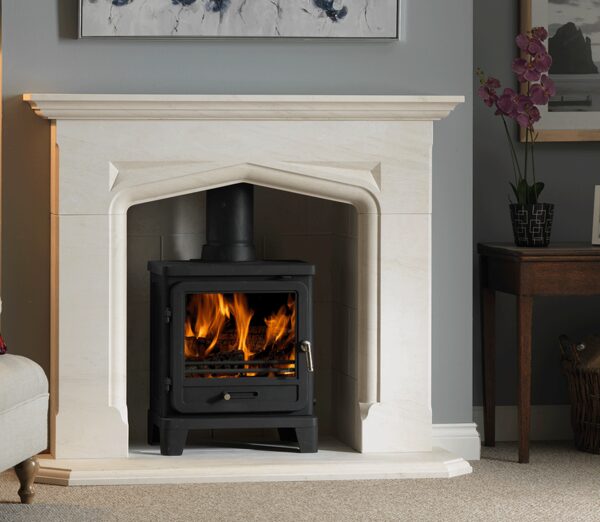
HETAS operates the Cleaner Choice Approval Scheme for UK biomass and solid fuel products, launched as an independent initiative for that market9. The scheme is focused on particulate emissions, but it also gives the consumer and installer assurance that a listed appliance meets all the relevant regulations in the UK, including safety and performance requirements, correct operation, and correct installation for HETAS registrants9. HETAS administers Defra exemption as well, and has put its experience in the solid fuel sector behind the approval work9.
OFTEC's registration scheme for heating technicians was the first to be formally recognised as a competent person scheme, and it covers the UK and the Republic of Ireland2. OFTEC offers registration for several different heating technologies rather than oil alone10. In Northern Ireland, OFTEC maintains a register of trained and assessed technicians qualified to work safely with oil-fired appliances, which is the reference point for domestic oil installation and boiler servicing there11.
The two schemes are voluntary for installers. HETAS describes itself as a voluntary Competent Persons Scheme that installers sign up to if they wish, which means the scheme is not automatically aware of work done by businesses outside it1. That matters to a household checking a claim: registration is a status an installer holds, not a licence the state issues to everyone in the trade.
What the specifications require
The two schemes are built on different technical foundations, which is why the paperwork a household receives differs.
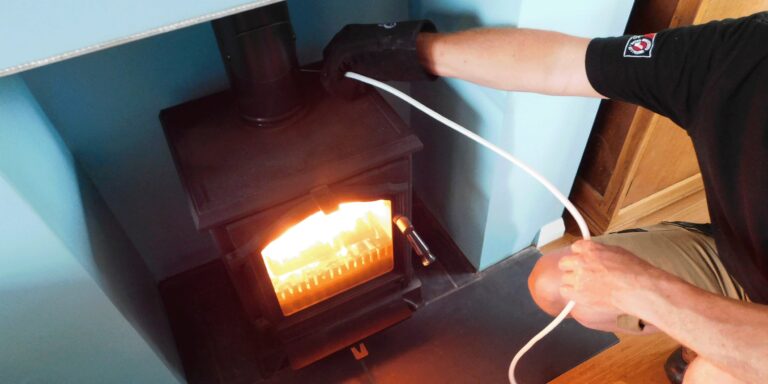
HETAS Cleaner Choice sets a particulate threshold rather than a general efficiency target. Products listed under the scheme achieve a 50% improvement on particulates against currently recognised requirements within UK Smoke Control Areas6. The scheme goes further than any other industry scheme and exceeds Ecodesign and Defra Exemption requirements13. An appliance must also meet all the relevant clauses of UKCA or CE marking, including verification that a suitable factory production control system is in place13.
The product search behind the scheme publishes performance data on output and efficiencies, environmental data on particulate emissions against Clean Air Act requirements and the percentage improvement on those limits, safety data on clearances to combustibles, flue draught and external air supply options, and technical data covering particulate matter, organic gaseous compounds, carbon monoxide, nitrogen oxides, the energy label rating and installation and operating instructions14. Buyers can filter by brand, product name, fuel type, efficiency, air control and additional certification status such as Defra exemption and MCS13.
OFTEC's technical requirements sit alongside the TrustMark registration framework, which lists required scopes including heating and hot water controls, heating system insulation and hot water systems15. For oil-fired heating in existing dwellings, the minimum efficiency figure used in the Welsh Government's Part L consultation is 60% for fixed independent space heating, as given in OFTEC standard OFS A102:2004 and converted using Table E4 of the Standard Assessment Procedure16.
| HETAS | OFTEC | |
|---|---|---|
| Fuel and appliance focus | Biomass and solid fuel1 | Oil, plus other heating technologies10 |
| Territorial extent | UK biomass and solid fuel products9 | UK and the Republic of Ireland2 |
| Headline technical threshold | 50% improvement on particulates against Smoke Control Area requirements6 | Minimum efficiency figures set in standards and building regulations16 |
| Certificate route | HETAS Certificate of Compliance in England and Wales5 | Self-certification through the OFTEC notification system4 |
| Scheme status | Voluntary competent person scheme1 | Competent person scheme, first formally recognised2 |
What the warranties cover
The OFTEC workmanship warranty is the more detailed of the two published protections. It covers the cost of rectifying any contravention of building regulations directly attributable to the installation, and it lasts six years from the date of installation, provided OFTEC receives the job notification on time4. It applies to any domestic work that is self-certified in participating regions through the OFTEC notification system, and it covers renewable heating technology installations as well as oil work4. The scheme was introduced by Government4.
The claim route matters as much as the cover. In the event that work does not meet building regulations and the installer is no longer trading, the work will be rectified, with householders able to claim up to £10,000 for that rectification4. The warranty is fully transferable between owners of a property and passes automatically to the new owner for the duration of the warranty period, which is a point worth knowing at the point of sale4.
HETAS's published assurance is framed around the appliance and the installation rather than a rectification fund. Cleaner Choice certification provides assurance that a product meets all the relevant safety and performance requirements, independently verified using the most robust test methodology to produce at least 50% less particulate emissions than current requirements in UK Smoke Control Areas17. The listing also confirms that manufacturer instructions give clear guidance on correct operation and installation14.
"The warranty lasts for six years from the date of installation, providing OFTEC receives the job notification on time"

What it costs
Neither scheme publishes a consumer price for registration, and installation prices are installer-quoted. What the schemes do publish is the value of the protection and the process a household should follow.
The OFTEC workmanship warranty carries a cap of £10,000 for rectification work if the original installer is no longer trading4. That is the figure to weigh against the cost of the work itself, and it is the only monetary protection either scheme states in these terms.
On choosing an installer, HETAS recommends obtaining at least 3 quotes to ensure the best price for the service required1. That is a consumer guidance point rather than a scheme rule, but it is the only published guidance on price comparison from either body.
For context on what heating work costs in the wider market, a modelled heat pump quote used in Nesta's work on performance guarantees breaks down as £2,000 for the unit, £2,000 for installation and £600 for electrical work, a total of £4,90018. That is a heat pump example rather than a stove or oil boiler figure, and it is included only to show the shape of a quote, not as a benchmark for solid fuel or oil work.
What registration involves for a business
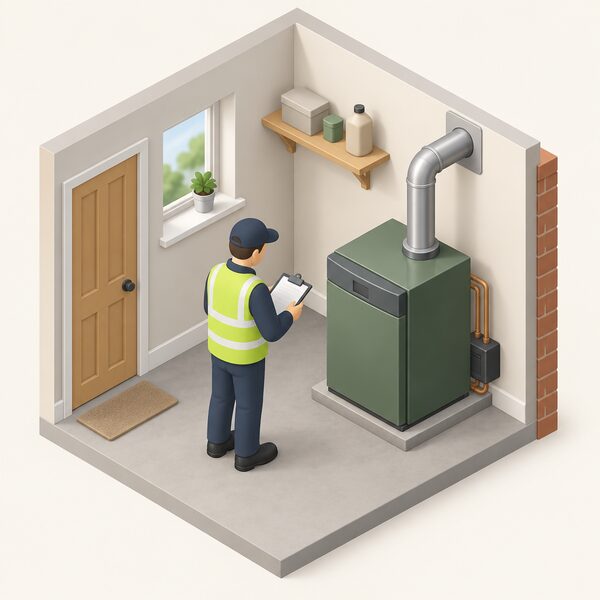
OFTEC does not employ heating technicians directly; a technician must work for a heating business that is OFTEC registered10. All businesses wishing to register have to submit to an initial audit of business practices and an inspection of the type of work to be registered for, plus periodic inspections throughout registration10. OFTEC has a team of self-employed regional inspectors who carry out inspections at customers' properties on its behalf10.
HETAS is a third party independent and impartial certification body that relies on first-hand review of test data from notified laboratories14. It is a not-for-profit company limited by guarantee without share capital, and a UKAS accredited certification body, much of whose work is ensuring compliance with standards, audited annually8. HETAS Limited is registered under the Companies Act with the registration number 0211782817.
The distinction a household can act on is that OFTEC registration attaches to a business and is inspected on a cycle, while HETAS approval attaches to products and to the certification process behind them. Both bodies publish contact routes for consumers: HETAS on 01684 215215, with lines open Monday to Thursday 8:30am to 5pm and Friday 8:30am to 4:30pm, and a complaints line on 01684 278170, option 21.
Where the two schemes overlap and where they do not
The overlap is real and worth stating plainly. OFTEC's own consumer guidance tells households that for mains gas systems they should use a GasSafe registered technician, and for heating oil or solid fuel they should contact an OFTEC registered technician19. HETAS, meanwhile, describes itself as the only competent person scheme specialising in solid fuel and biomass appliances20. A household with a solid fuel appliance therefore sees two bodies both presented as the route to a qualified technician.
The resolution is in the specialism. HETAS is the only specialist organisation approving biomass and solid fuel heating appliances, fuels and services1, and it works as a contractor for Defra on the Ready to Burn scheme and for DESNZ on the Biomass Suppliers List20. OFTEC's register is the one named in Northern Ireland guidance for oil-fired appliance work11. Where a household has both an oil boiler and a stove, the two schemes apply to different appliances in the same house.
There is also a policy layer. OFTEC has campaigned on renewable liquid fuels for off-grid homes, delivering 16,000 submissions to the government consultation on alternative clean heating and urging the government to publish its findings and response much sooner18. HETAS has taken positions on emissions limits, supporting the proposed new smoke limit and recommending a hybrid compliance model combining periodic retesting with factory production controls21. Both bodies are therefore shaping the rules their registrants will work under, not only administering them.
What it means for energy independence
Registration changes who signs off the work. It does not change where the heat comes from. A household with a stove still depends on a fuel supply chain, whether that is logs, smokeless fuel or manufactured solid fuel, and a household with an oil boiler still depends on a delivered fuel and a tank that must be filled. The scheme removes a building control application and adds a warranty route; it does not remove the delivery.
What the schemes do support is the quality of what is installed. HETAS states that it exists to make the journey to cleaner air practical and proportionate, helping households who choose to burn reduce emissions at source22. Its own measures of success include more households moving away from open fires, increased use of Ready to Burn fuels, registrants reporting fewer user-caused issues during routine sweeping, and steady growth in sweeping and servicing bookings22. Those are indicators of how well solid fuel is being used, not of how independent the household is.
The dependence that remains is specific. OFTEC notes that leaving a boiler idle for months at a time can lead to components seizing up, and that an annual service is an important investment19. HETAS encourages sweeping at least twice a year when burning wood and at least once a year when burning smokeless fuels, with the second sweep after the peak of the main heating season7. Both are recurring dependencies on a registered trade, and both are conditions of keeping the appliance safe and the warranty intact.
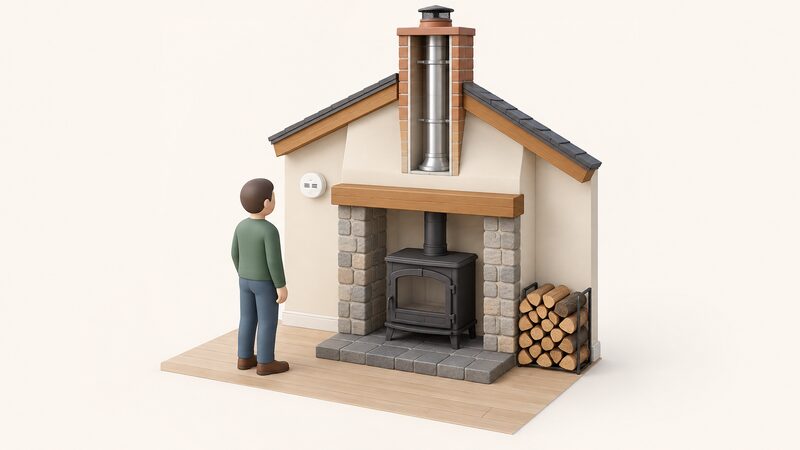
There is a safety dimension that no scheme removes. A carbon monoxide alarm will not prevent a chimney fire, but it will protect against CO poisoning by warning of unsafe levels, and that warning should prompt a professional inspection23. Most chimney fires trace back to what is being burned, or how long it has been since the chimney was last swept23. In the event of a suspected chimney fire, the guidance is to get everyone out of the house and call 999 immediately23.
Sources23 cited
- Consumer FAQs, HETAS, 2026-04-01
- Why choose an OFTEC registered competent person, OFTEC, 2026-09-17
- Carbon monoxide: general information, GOV.UK, 2022-05-24
- Workmanship warranty, OFTEC, 2026-09-20
- Consumer hub, HETAS, 2024-01-29
- Ecodesign explained, HETAS, 2026
- Keeping you safe: rogue traders, logo misuse and imitation businesses, HETAS, 2026
- The changing face of solid fuel, HETAS, 2022-07-12
- What is the Cleaner Choice scheme?, HETAS, 2026
- Domestic oil installation and boiler servicing, nidirect, 2024-08-27
- Five summer heating tips to help households save money on energy bills, OFTEC, 2026-05-26
- Frequently asked questions, OFTEC, 2026-09-17
- Chimney fire causes, HETAS, 2026
- An increasing choice for Cleaner Choice, HETAS, 2023-10-17
- TrustMark registration, OFTEC, 2026-09-17
- 16,000 submissions: a huge milestone for alternative clean heating, OFTEC, 2026-02-10
- The Cleaner Choice Approval Scheme, HETAS, 2023-10-10
- Would performance guarantees increase consumer confidence in heat pumps?, Nesta, 2026-06-02
- Environmental Improvement Plan 2025, HETAS, 2025-12-02
- Tighter wood burner emissions limits explained, HETAS, 2026-04-24
- Scientists' review casts doubt on impact of wood burning stoves, HETAS, 2024-06-06
- Scoping consultation: HEETSA, Scottish Government, 2025-06-06
- When should I get my chimney swept?, HETAS, 2026
 The Full Brands GuideWhich boiler, heat pump or solar brand can you trust, and who actually owns it?
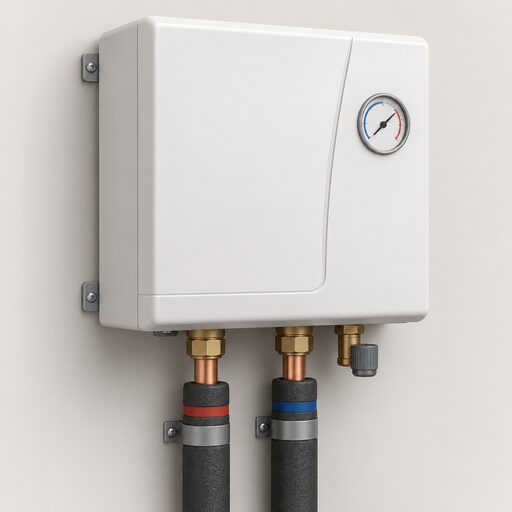 Heat Network RegulationYour home is heated by a shared network instead of your own boiler.
 Getting Installation QuotesHow householders obtain quotes for boilers, heat pumps and solar PV, how many quotes are usually recommended, what a survey should involve, and the difference between an estimate, a quotation and a fixed price.
 Running Costs by FuelHow the cost of heat compares across mains gas, heating oil, LPG, electricity, solid fuel and heat pumps once efficiency and the price cap are applied.
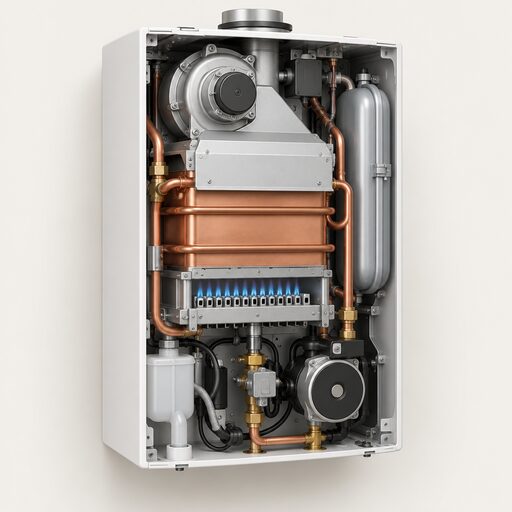 Servicing and MaintenanceWhat an annual gas or oil boiler service covers, the intervals manufacturers specify, the link between servicing records and warranty validity, and what servicing means for a household's energy independence.
 Comparing Installation QuotesWhat should a solar or heat pump quote actually include before you pay a deposit?