
In this answer
Short answer
OFTEC registration is the oil heating equivalent of Gas Safe registration. OFTEC runs a competent person scheme for technicians who install and maintain oil, solid or liquid fuel heating systems1, and it maintains a register of trained and assessed technicians qualified to work safely with oil-fired appliances2. For a household off the gas grid, the register is the practical way to check that the person working on a boiler, a tank or a supply pipe has been trained, assessed and inspected.
The scheme is not small. OFTEC reported over 9,000 technicians registered on its UKAS accredited competent person scheme3, and its registration scheme for heating technicians was the first to be formally recognised as a competent person scheme4. Registration is not a one-off: technicians must first undertake an approved training course and assessment4, and they are regularly inspected to ensure the work meets the required standards and, most importantly, is completed safely5.
What that buys a household is a route around building control. In England and Wales, OFTEC registered technicians can self-certify that their work complies with building regulations6, and self-certified work carries a workmanship warranty against building regulation non-compliance, with remedial work carried out by someone else if the installer is no longer trading7. The warranty lasts six years from the date of installation7.
What OFTEC registration means and who needs it
OFTEC is the registration body for the oil heating trade in the UK and the Republic of Ireland. Its register lists trained and assessed technicians who are qualified to work safely with oil-fired appliances2, and the scheme covers technicians who install and maintain oil, solid or liquid fuel heating systems1. Registration is held at two levels: the individual technician and the business they work for.
That second level matters. OFTEC does not employ heating technicians directly; a technician needs to work for a heating business that is OFTEC registered10. So a household checking a trader is really checking two things: that the individual holds a current registration, and that the business does too. The register search accepts a business trading name or an OFTEC registration number for exactly that purpose9.
Who needs it is set by building regulations rather than by OFTEC. Official guidance for England and Wales states that an oil fired boiler installer should be registered with one of the relevant competent person schemes11, and the equivalent Welsh guidance repeats that an installer should be registered with the competent person schemes12. Independent guidance from the Centre for Sustainable Energy names OFTEC for oil-fired systems13. In Northern Ireland, OFTEC maintains a register of trained and assessed technicians qualified to work safely with oil-fired appliances2.
The scheme exists because competent person schemes are a way for tradespeople to prove their ability to carry out certain work to required standards, instead of the householder applying for building regulations approval14. That is the trade: the technician takes on the compliance paperwork, and the household avoids a separate building control application. For a home that is off the gas grid, that is the difference between a documented installation and one with no paper trail.
A competent person scheme: what OFTEC actually does
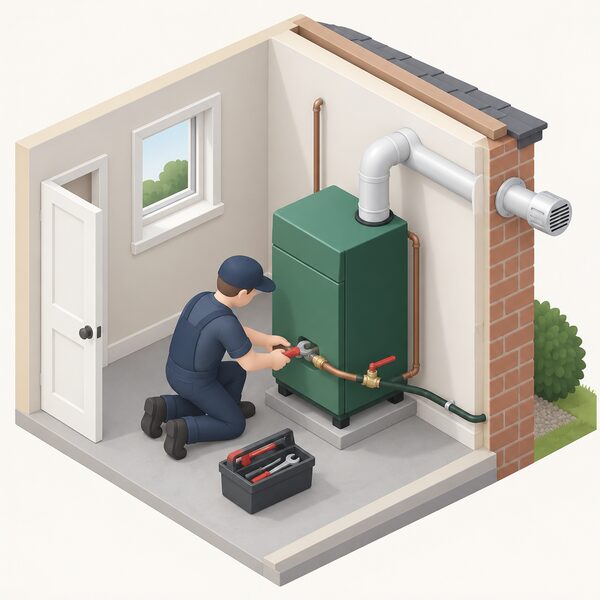
A competent person scheme is a government-recognised route by which tradespeople self-certify that their work meets building regulations, rather than each job being individually approved by a building control body14. OFTEC's scheme was the first to be formally recognised in this way4, and it operates across the UK and the Republic of Ireland4.
In practice the scheme does four things. It sets an entry standard, requiring all technicians to first undertake an approved training course and assessment4. It maintains the register itself, so a household can verify who is registered and for what9. It runs an inspection regime, with technicians regularly inspected to ensure the work meets the required standards and, most importantly, is completed safely5. And it backs self-certified work with a workmanship warranty7.
The self-certification right is territorial. In England and Wales, OFTEC registered technicians can self-certify that their work complies with building regulations6. In England, Wales, the Channel Isles and Isle of Man, they are authorised to self-certify that their installation work complies with the regulations without needing to submit a building control notice4, and in the same territories they can self-certify their installation work, avoiding the need for it to be checked by a building control officer7.
Where self-certification is not available, the fallback is the building control route. If an installer is not registered with a competent person scheme such as OFTEC, the household needs to obtain a Building Control Notice and arrange for an inspection, which can be costly and time consuming6. That is the practical cost of using an unregistered installer, separate from any question about the quality of the work.
"Competent person schemes are a way for tradespeople to prove their ability to carry out certain work to required standards, instead of you applying for building regulations approval"
Over 9,000 registered technicians: training, audits and inspections
OFTEC reported over 9,000 technicians registered on its UKAS accredited competent person scheme3. That figure dates from February 2020 and is the most recent registration total available here; it should be read as the scale of the scheme rather than a current headcount. The UKAS accreditation is the part that carries weight, because it means the scheme's own processes are independently assessed.
Entry to the register is by training and assessment. All technicians must first undertake an approved training course and assessment4, and before becoming OFTEC registered, heating technicians must undergo training and are regularly inspected to make sure the work is safe15. The inspection regime is ongoing rather than a one-off check at registration: technicians are regularly inspected to ensure the work meets the required standards and, most importantly, is completed safely5.
For the electrical side of the register, the inspection is more specific. Technicians on the OFTEC electrical (Part P) registration scheme are subject to an annual on-site visit by an appointed technical expert, to assess competence and sample work16. That scheme operates under Building Safety Regulator and Welsh Government authorisation as an annual registration scheme16.
How much of the oil heating market this covers is harder to pin down. A 2019 installer skills survey found that 60% of installers in its sample were OFTEC registered, but that across the whole market only 10% of installers are OFTEC registered17. The two figures describe different populations, a survey sample of heating installers and the wider installer market, and they are not directly comparable. What they do show is that registration is concentrated among the installers who actually work on oil systems.
For a household, the practical point is that registration is a live status, not a qualification held once. A technician who has let registration lapse, or a business whose registration has expired, will not appear on the register search9. Checking before work starts is the only reliable way to know the warranty and self-certification route will apply.
The six-year workmanship warranty on registered work
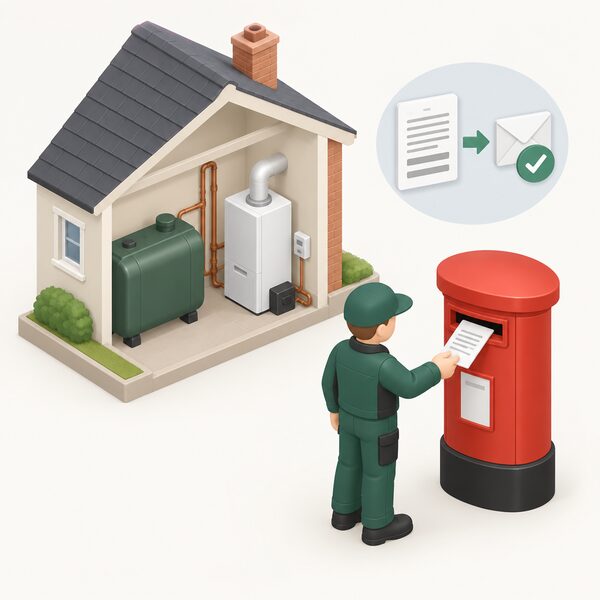
Self-certified OFTEC work carries a workmanship warranty against building regulation non-compliance, with remedial work carried out by someone else if the installer is no longer trading7. The warranty lasts for six years from the date of installation, providing OFTEC receives the job notification on time18. The same six-year term from the date of installation is stated in OFTEC's scheme rules7.
That term is long by the standards of the wider market. Independent guidance on solar installers states that the installer's workmanship should have a guarantee for 2 years19, and the Renewable Energy Consumer Code requires an insurance backed workmanship warranty valid for at least 2 years20. TrustMark registered businesses are expected to provide a minimum two-year guarantee21. OFTEC's six years is three times those minimums, and it is a scheme-backed warranty rather than a promise from a single trader.
The condition attached to it is the notification. The warranty runs for six years from the date of installation, providing OFTEC receives the job notification on time18. A household that has work done and never sees a notification has no way of knowing whether the warranty is live, so the notification is worth asking about at the point of commissioning.
Where the installer is not registered, the position is different in two ways. The household needs a Building Control Notice and an inspection in England and Wales, which can be costly and time consuming6. And households using a non-registered installer are unlikely to receive a warranty on the work carried out7. The six-year cover is a feature of the scheme, not of the trade.
Oil, solid fuel, electrical and renewables: what the register covers
The register is broader than its oil heating reputation suggests. Technicians can register for oil storage tanks and oil supply pipework, oil-fired appliances, solid-fuel appliances with and without an internal boiler, electrical work, air source heat pumps, ground and water source heat pumps, solar thermal panels, biomass systems, unvented hot water storage systems, and energy efficiency measures under the PAS 2030 scheme9.
That spread reflects how off-grid homes are actually heated and improved. A single property may have an oil boiler, a solid fuel stove, an unvented cylinder and a heat pump, and the register lets a household check competence across all of them rather than assuming one registration covers everything. The work type options in the search include installation work, and commissioning, servicing, design, inspections or repair work9.
The electrical strand is separate and has its own authorisation. OFTEC's electrical (Part P) registration scheme operates under Building Safety Regulator and Welsh Government authorisation as an annual registration scheme16, and OFTEC offers registration for technicians who hold Part P electrical qualifications and for those who install energy efficiency measures under PAS20304. TrustMark registration sits alongside this, with its own rules of registration22.
Some adjacent trades sit outside OFTEC entirely. Official guidance names OFTEC for oil appliances and HETAS for solid fuel appliances23, and independent guidance points to a HETAS registered engineer for bio and solid fuel24. For mains gas, the register to check is GasSafe, and for oil boilers it is OFTEC25. A household with more than one fuel will often need more than one registration to be checked.
Finding and checking an OFTEC registered engineer
The register search is the starting point. It covers the UK, Channel Isles and Isle of Man by postcode, and the Republic of Ireland by county9. A household can search for a technician, and can also check whether a business holds a valid OFTEC registration using the business trading name or the OFTEC registration number9. The search can be narrowed by work type, including installation work and commissioning, servicing, design, inspections or repair work, and by premises type, domestic or small commercial premises, or large buildings and commercial premises9.
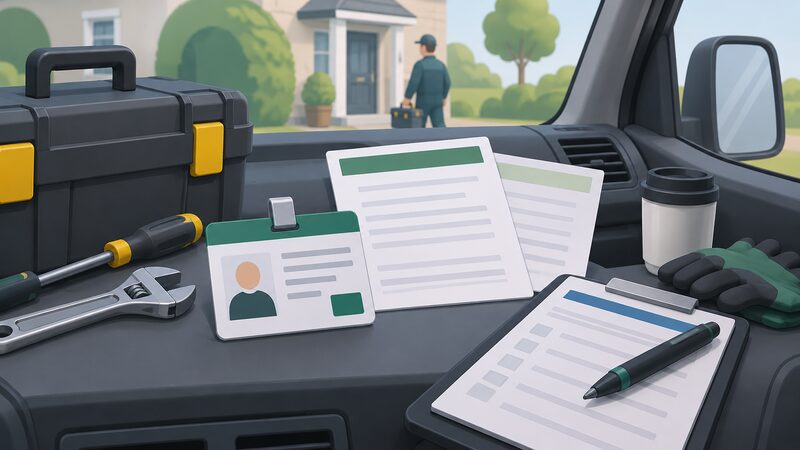
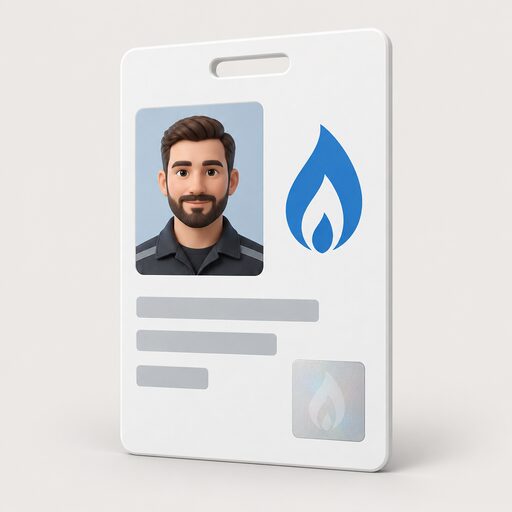
OFTEC provides an official photo ID card for each technician3, so a registration can be checked at the door as well as online. That matters where a household has booked a service through a third party and wants to confirm who has arrived.
For servicing, the interval is annual. Northern Ireland government guidance is to arrange for the boiler and tank to be serviced at least once a year by an OFTEC technician, including any underground pipe work8. Consumer guidance from the Consumer Council points to using an OFTEC registered engineer26, and insurance guidance recommends checking that the company or engineer is on the Gas Safe register or OFTEC registered for an oil-fired boiler27. OFTEC's own summer guidance advises booking an annual boiler service28.
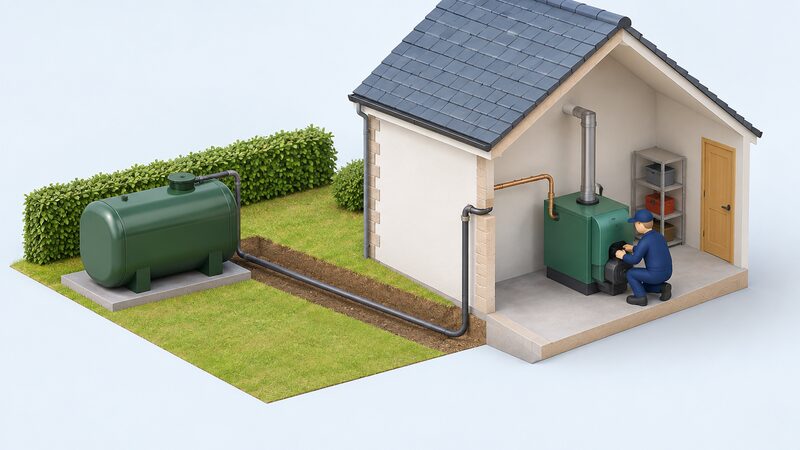
Tank work has its own registration. An OFTEC-registered tank installer will advise on the best place to locate a heating oil tank to ensure it meets safety standards and building regulations29. For heating oil or solid fuel, the guidance is to contact an OFTEC registered technician; for mains gas systems, a GasSafe registered technician28. Where a household is dealing with a suspected carbon monoxide problem, official guidance names OFTEC for oil appliances and HETAS for solid fuel23.
Where the register stops
Registration is a competence check, not a guarantee of the company's future. The workmanship warranty is designed for the case where the installer is no longer trading7, which is a recognition that businesses close. A household relying on a warranty should keep the job notification, because the six-year term depends on OFTEC receiving it on time18.
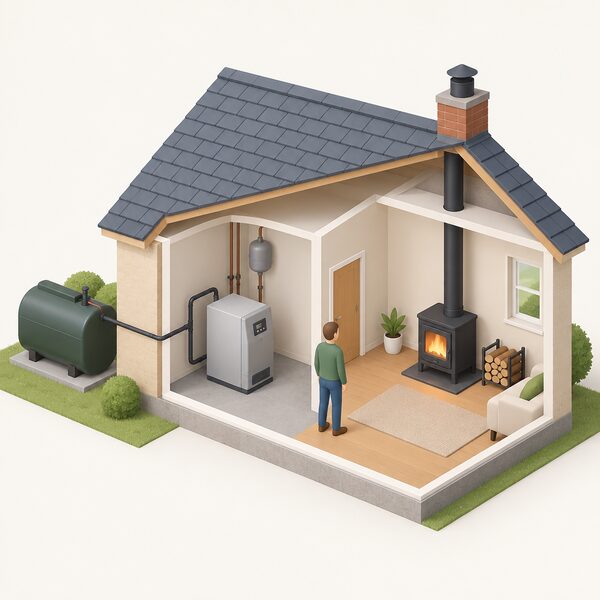
The register also does not cover everything a heating system contains. Solid fuel appliances sit with HETAS23, and mains gas with GasSafe25. Where a property has both an oil boiler and a wood stove, two registrations are in play. And the registration total of over 9,000 technicians dates from February 20203; the scheme's current headcount is not stated in the material available here.
What registration does for energy independence is narrow but real. It does not reduce a household's dependence on delivered heating oil, on a supplier, or on the grid for the boiler's electrical supply. What it does is keep the installation documented, self-certified and covered, so that the equipment a household owns is legally installed and repairable. For an off-grid home, where there is no gas network to fall back on, that documentation is part of the asset.
Sources29 cited
- How to spot an energy scam, Energy Saving Trust, 2026-06-19
- Domestic oil installation and boiler servicing, nidirect, 2024-08-27
- Domestic oil storage, Issue 8, OFTEC, 2020-02
- Why choose an OFTEC registered competent person, OFTEC, 2026-09-17
- Five reasons households should not attempt DIY repairs this summer, OFTEC, 2026-08-17
- Your home guide to liquid fuel heating, OFTEC, 2026-09-20
- Workmanship warranty, OFTEC, 2026-09-20
- Check your oil tank, nidirect, 2026-09-17
- Find an OFTEC registered technician, OFTEC, 2026-09-17
- Frequently asked questions, OFTEC, 2026-09-17
- Building regulations: boilers and heating, Planning Portal, 2026
- Building regulations: boilers and heating, Welsh Government, 2026-09-17
- Upgrading and replacing your boiler, Centre for Sustainable Energy, 2026-06
- Use a competent person scheme, GOV.UK, 2026-09-17
- UKIFDA and OFTEC launch Be Winter Wise campaign, UKIFDA, 2023-09-26
- Electrical Part P registration, OFTEC, 2026-09-17
- Installer Skills Survey summary, HPA, 2019-10
- Workmanship warranty, OFTEC, 2026-09-20
- How to choose a good solar installer, Low Carbon Hub, 2025-10-20
- Consumer leaflet, RECC, 2026-09-17
- Consumer protection, TrustMark, 2026-09-20
- TrustMark registration, OFTEC, 2026-09-17
- Carbon monoxide: general information, GOV.UK, 2022-05-24
- Six reasons to service your boiler now, CIPHE, 2021-09-07
- Thermostats and heating controls, Energy Saving Trust, 2026-02-10
- Home heating oil, Consumer Council, 2026
- Boiler servicing, Confused.com, 2025-07-23
- Five summer heating tips to help households save money on energy bills, OFTEC, 2026-05-26
- Tank care and security, UKIFDA, 2026-02-18
 Installer QualificationsWhat training and qualifications should a heat pump installer actually have?
 Gas Safety RulesAnyone working on gas in your home has to be on the Gas Safe Register, whether they are installing, fixing or servicing an appliance.
 Registering a WarrantyGetting a new boiler covered for longer usually means registering it quickly, often within a month of installation, or the long guarantee drops to a year.
 Appliance Standards and MarkingWhich marks should a boiler, heat pump or cylinder have before you buy, and what do they actually prove?
 Heat Network RegulationYour home is heated by a shared network instead of your own boiler.
 Oil Boilers and Heating OilHow oil-fired boilers work, the kerosene they burn, and the tanks, burners and servicing they need.