

In this guide
Gas Safe Register is the official registration body for gas engineers in the UK, and the only list of engineers qualified to work legally on gas appliances1. It is not a trade association, a training provider or a voluntary badge: by law, all gas engineers must be on the register and hold current qualifications to install, repair or maintain domestic gas appliances2. Anyone employed to work on gas appliances in domestic premises must be a Gas Safe registered engineer and competent in that area of gas work3.
For a household, the practical consequence is a single check. Every gas engineer carries a Gas Safe Register ID card, and it shows the type of work they are qualified to do4. The card is the point of verification, and the register's own freephone helpline, 0800 408 5500, exists to confirm it5. The register held 76,630 registered businesses and 150,729 individual gas engineers in 2023/246.
The register matters to household energy independence in a narrow but absolute way. It does not change where a home's heat comes from, and it does not reduce reliance on the gas grid or a supplier. What it does is place a legal gate on who may touch a gas appliance, which is the one part of a home heating system a householder cannot lawfully work on themselves. DIY gas work is illegal and dangerous7. Everything downstream of that gate, from a boiler service to a replacement appliance, runs through a registered business.
What the Gas Safe Register is and why it exists
Gas Safe Register describes itself as the official hallmark for gas safety4. That phrase carries the substance of the role: it is the body that holds the list of who may lawfully carry out gas work, and the body a householder is directed to when they need to confirm that a person at their door is entitled to be there.
The register's functions fall into three areas. It helps householders find a registered gas engineer, it takes reports of illegal gas work, meaning work undertaken by a person not registered with Gas Safe, and it handles customer complaints about unsatisfactory gas work8. It also coordinates Gas Safety Week, an annual awareness campaign9.
The legal architecture behind it sits with the Health and Safety Executive rather than with the register itself. Any gas installation business, whether an employer or self-employed, must be a member of a class of persons approved by HSE, and for the time being that means registration with Gas Safe Register10. The register is therefore the practical form of a statutory requirement, not a scheme a business can choose to join or leave while continuing to trade lawfully.
One technical point is worth stating because it affects how the register is described. Gas Safe Register is not technically a competent person scheme, but in practice its installers have the same responsibilities for complying with building regulations11. That distinction matters where building work notification is concerned, and it is covered further in the material on competent person schemes.
For a household, the register's value is that it converts a difficult judgement, whether a person is competent to work on a gas appliance, into a check that takes a minute. The register does not assess the quality of a business's workmanship in advance, and it does not set prices. It confirms registration and competence for a defined scope of gas work.
The law: who can legally work on gas appliances
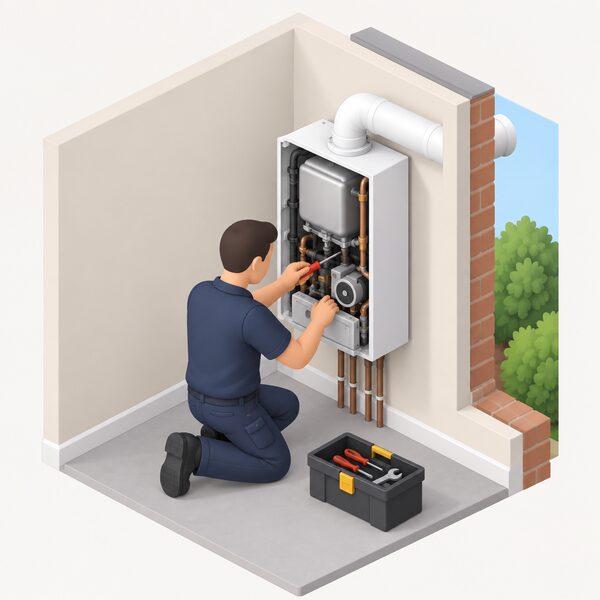
The legal position is stated in the same terms across official guidance. You must be on the Gas Safe Register to carry out gas work legally2. Anyone employed to work on gas appliances in domestic premises must be a Gas Safe registered engineer and competent in that area of gas work3. By law anyone carrying out work on gas appliances or fittings as part of their business must be competent and registered with the Gas Safe Register5.
The requirement is not limited to installation. Gas appliances should be properly installed and maintained at regular intervals by an engineer who is on the Gas Safe Register12. HSE strongly advises that all gas appliances, flues and pipework should be installed, regularly maintained and serviced at least annually by a Gas Safe registered engineer3. The same annual servicing expectation appears in guidance for owner occupiers4 and in consumer guidance, which notes that a gas boiler, gas cooker and gas fire should be safety checked once a year and serviced regularly according to the manufacturer's instructions by a Gas Safe registered engineer13.
Two separate obligations are often confused. Registration governs who may do the work. Servicing governs how often the appliance should receive attention. A registered engineer is the only lawful route to either.
Where building work is involved, the Gas Safety (Installation and Use) Regulations also apply, and a Gas Safe registered installer with the relevant competencies must be employed14. The wider legal framework, including the duties that fall on landlords, is set out in gas safety regulation.
From CORGI to Gas Safe: how the register replaced the old scheme
Gas Safe Register replaced CORGI in Great Britain and the Isle of Man on 1 April 200915. Since 2009 the register has been held by Gas Safe16. CORGI was the previous registration body, and the change was a transfer of the register rather than a change in the underlying legal duty: the requirement for gas work to be carried out by a registered, competent person predates and outlives both schemes.
The practical effect for a householder is that CORGI registration is not a current credential. An engineer or business describing itself as CORGI registered is referring to a scheme that ceased to hold the register in 2009. Consumer guidance still occasionally pairs the two names, describing an accredited Gas Safe (previously CORGI) engineer, which reflects the continuity of the role rather than any continuing CORGI status17.
Northern Ireland is covered by the same register. Gas Safe Register is the official registration for all gas engineers in Northern Ireland2. The devolution of building regulation and housing policy does not create a separate gas registration body, so the check a householder makes is the same across the UK.
The register's own identity has been stable since 2009, which is useful when assessing older paperwork. A service record or installation certificate naming CORGI as the registration body dates the work to before April 2009. A record naming Gas Safe Register dates it to after. Neither tells you anything about the quality of the work, only about the regime in force when it was done.
What the register covers: gas types, businesses and engineers
Registration is held by a business, and the business registers the individual engineers who work under it. To register, a business provides its company name and trading name if different, its address and phone number, and the National Insurance numbers for any engineers it wants to register2. It must also prove it has the necessary qualifications and experience to carry out gas work2.
The scope of an individual's registration is not general. The gas engineer's competencies are clearly marked on the back of the engineer's Gas Safe Register ID card4. That is why the check has two parts: the card confirms the person is registered, and the back of the card confirms they are qualified for the specific work in hand. An engineer competent on a domestic boiler is not automatically competent on every appliance or every gas type.
The register covers work on gas appliances and fittings carried out as part of a business, across the gas types a domestic property might use. Guidance for LPG appliances, for example, applies the same registration requirement and the same annual safety check expectation for appliances a landlord owns and provides3. The register's search allows a check by postcode, business name or licence number18.
| What is checked | Where it appears | What it confirms |
|---|---|---|
| Photograph | Front of ID card | The person at the door is the cardholder2 |
| Licence number | Front of ID card | The individual's registration2 |
| Business registration number | Front of ID card | The business's registration5 |
| Start and expiry dates | Front of ID card | The card is current2 |
| Security hologram | Front of ID card | The card is genuine2 |
| Competencies | Back of ID card | The engineer is qualified for the work asked of them4 |
The Gas Safe ID card: what to look for and the licence number
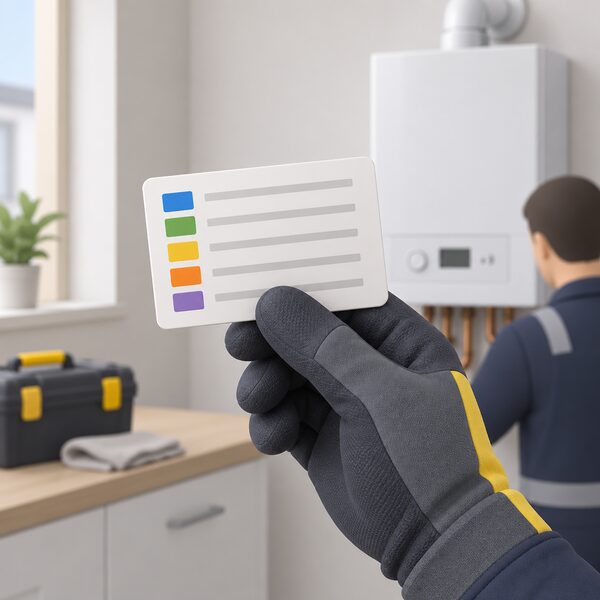
The ID card is the register's verification instrument, and it is designed to be read in front of the householder. On the front of the card, check the engineer's photograph, the start and expiry dates, the licence number, the security hologram, and that the engineer is from the business you contacted2. On the back of the card, check the engineer's qualification to do the gas work you asked them to do, and that the engineer's qualifications are current2.
The card carries a photo of the engineer, their business registration number and personal licence number, the company name, the start and expiry date of the card and a security hologram5. Registered people are issued with the card and must carry it to prove they are on the Gas Safe Register2. Installers should always carry their Gas Safe Register ID card and clients should always verify an engineer's credentials19. The card may be shown as a hard copy or on a phone, and either can be checked with Gas Safe20.
The seven digit licence number is the engineer's personal identifier. It sits alongside the business registration number, and the two are distinct: one identifies the individual, the other the business they work through. The register's online search accepts a licence number, so the number on the card can be used to confirm the registration directly rather than relying on the card alone18. Anyone can verify a Gas Safe ID online19.
"Always check your engineer is registered by asking to see their ID card which has a photo of the engineer, their business registration number and personal licence number, company name, the start and expiry date of the card and a security hologram"
What the register does about unsafe or illegal gas work
The register's remit extends past verification. It handles reports of illegal gas work, meaning work undertaken by a person not registered with Gas Safe, and customer complaints about unsatisfactory gas work8. Anyone working with gas should have Gas Safe registration, and the register is the body that receives reports when they do not21.
There is a separate route for workmanship concerns. Where work has been done by a registered gas installer within the past 12 months, the Gas Safe Register can be asked to inspect it22. That is a distinct process from reporting illegal work: one concerns a registered installer's standard of work, the other concerns work carried out by someone with no registration at all.
Landlord compliance runs through a different channel. Where a tenant has not received the required gas safety record, the report goes to HSE using form LGSR13. Landlords must ensure an annual gas safety check is carried out within 12 months of the installation of a gas appliance and every 12 months thereafter, by a Gas Safe registered engineer3. For LPG appliances a landlord owns and provides, a Gas Safe registered engineer must carry out a safety check at least once every 12 months3.
New registrants face additional scrutiny. A business on probation for three months must tell the Gas Safe Register about all of its gas work and keep records of it2. That gives the register visibility of a new business's work at the point where experience is thinnest.
Contacting the Gas Safe Register: helpline, email and renewal

The register runs several contact routes, and they are not interchangeable. The freephone helpline for checking an engineer or finding one locally is 0800 408 55005. Consumers can also check a business is registered by texting Gas and the business registration number to 850803. The website is www.gassaferegister.co.uk23.
Registration and technical matters use 0800 408 5577, with option 2 for renewals, and the technical enquiries line runs Monday to Friday, 9am to 5pm2. Renewal by phone is described as a 24-hour service2. Customer services can be reached at register@gassaferegister.co.uk2, and a separate enquiries address, enquiries@gassaferegister.co.uk, appears in consumer guidance24. The postal address is 200 Cedarwood, Crockford Lane, Basingstoke, RG24 8WD3.
Registration must be renewed every year2. Renewal can be done online, by post using an application form, or by phone, paid by credit or debit card2. Qualifications more than five years old must be renewed before registering2. New registrants are on probation for three months2.
| Purpose | Route |
|---|---|
| Check an engineer or find one locally | 0800 408 55005 |
| Text check | Text Gas and the business registration number to 850803 |
| Renewals | 0800 408 5577, option 22 |
| Technical enquiries | 0800 408 5577, Monday to Friday 9am to 5pm2 |
| Customer services email | register@gassaferegister.co.uk2 |
| Post | 200 Cedarwood, Crockford Lane, Basingstoke, RG24 8WD3 |
Finding an engineer and checking one: the sequence
The register's own guidance sets out the order of operations. Use your postcode to find Gas Safe-registered engineers in your area, or telephone an advisor on the freephone number2. The search also accepts a business name or licence number18.
- Search the register by postcode, business name or licence number18.
- Ask to see the engineer's Gas Safe ID card when they arrive19.
- Check the front of the card: photograph, start and expiry dates, licence number, security hologram, and that the engineer is from the business you contacted2.
- Check the back of the card: the engineer's qualification for the work you asked them to do, and that those qualifications are current2.
- If anything is unclear, verify online or call 0800 408 55005.
The check is worth making even where a business has been used before, because registration is renewed annually and competencies are specific. A card that has expired, or a back that does not list the work in hand, is a reason to stop rather than to proceed on trust.
For households weighing a boiler replacement or service, the registration check sits alongside the commercial questions. Consumer guidance on avoiding problems with boiler cover and servicing, and on what to ask about a boiler service, covers the wider ground25. The register's role is narrower and firmer: it establishes whether the person may lawfully do the work at all.

What registration does and does not do for a household
Registration is a legal gate, not a quality guarantee. It confirms that a business and an individual engineer are on the statutory list and that the individual is competent for a defined scope of gas work2. It does not rank businesses, set prices, or warrant the standard of an installation. The register's own complaint route exists precisely because registered work can still be unsatisfactory8.
The dependence it creates is worth naming plainly. A household with a gas appliance cannot lawfully maintain or repair it without a registered engineer, so the gas supply chain runs through a registration body, a registered business and an individual whose card must be current. That is a dependence on a trade and a scheme rather than on a fuel or a supplier, and it sits alongside the fuel dependence itself. Where a home moves away from gas, the registration requirement moves with the appliance rather than the household: electrical work has its own competent person arrangements, covered in electrical safety regulation, and solid fuel and oil have their own registration bodies.
The register's scale indicates how much of the trade it covers. With 76,630 registered businesses and 150,729 individual gas engineers in 2023/24, the list is broad enough that finding a registered engineer locally is rarely the constraint6. The constraint is the check itself, which is why the register, HSE and consumer bodies all direct householders to the same action: ask for the card, read both sides, and verify if anything does not match2.
Sources26 cited
- Gas Safe Register, nidirect, 2025
- Registration to carry out gas work, GOV.UK, 2026
- Gas safety in the home: frequently asked questions, Health and Safety Executive, 2026
- Gas appliances: advice for owner occupiers, Health and Safety Executive, 2026
- Gas safety in the home, Health and Safety Executive, 2011
- Projecting the Future Domestic Heat Pump Workforce, Heat Pump Association, 2026
- Top gas safety tips, HHIC, 2025
- Frequently asked questions, CO-Gas Safety, 2015
- 6 mistakes to avoid when looking for boiler cover or boiler servicing, Which?, 2022
- Building Regulations guidance Part J: heat producing appliances, Welsh Government, 2010
- Building work competent person schemes, Welsh Government, 2023
- Domestic gas installation and health and safety, nidirect, 2025
- Using a Gas Safe engineer, Liquid Gas UK, 2026
- Quick guide to the Building Regulations: questions and answers, Welsh Government, 2021
- Carbon monoxide, Energy UK, 2009
- Boiler retirement: using trigger points to support homeowners, Which?, 2026
- Gas leaks safety, Uswitch, 2026
- Take no chances with gas safety, Northern Gas Networks, 2026
- Gas Safety Week 2023, CIPHE, 2023
- Know or suspect you have a gas emergency, IGEM, 2026
- Cold calling: top 5 tips to avoid rogue traders and installers, Energy Saving Trust, 2026
- Why it's vital to use a qualified gas engineer, HHIC, 2025
- Gas Safety Week 2024, Cadent Gas, 2024
- Everything you need to know about choosing an electrician, NICEIC, 2025
- Why you need a boiler service and what to ask about, Which?, 2025
- Boiler prices: how much does a new boiler cost, Which?, 2025