

In this comparison
Yes. A hybrid heat pump and gas boiler system can keep a home as warm as a gas boiler alone, because the gas boiler is still there. A hybrid combines two technologies in a single heating system: a heat pump and a gas boiler1. The heat pump covers the base load in milder weather, and the boiler takes over, or runs in parallel, when the building's heat load is at its maximum2. Nothing about the arrangement removes the boiler's ability to deliver the high flow temperatures a cold snap demands.
What changes is how the work is shared. In a high-quality hybrid installation up to 80% of the annual heating can be provided by the heat pump, with the boiler used only during peak demand3. The most common configuration is an air source electric heat pump alongside a gas condensing boiler3. The heat pump is most efficient when outdoor temperatures are above two degrees centigrade, while the gas boiler is better suited to the coldest periods3.
The comfort question and the independence question pull in different directions. A hybrid keeps the warmth and the existing radiators, and it cuts carbon against gas-only heating, but it keeps the household on the gas grid and on a gas supplier. It is a partial step, not a severing of the gas connection.
How a hybrid heat pump and gas boiler system works
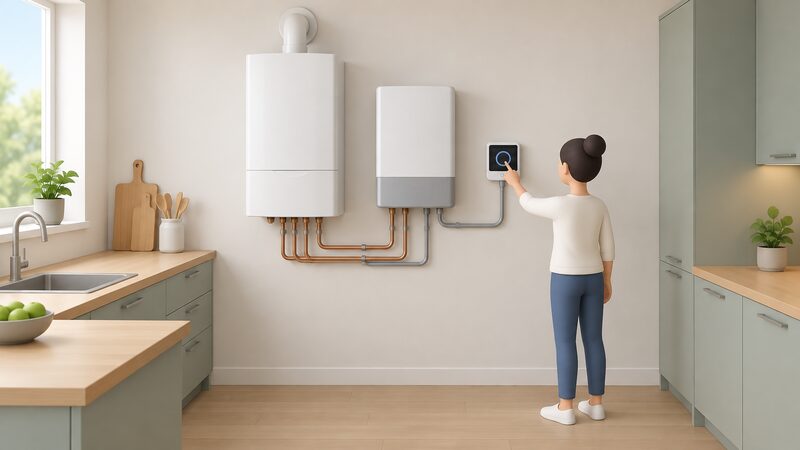
A hybrid heat pump system consists of an outdoor fan unit, an indoor heat exchanger and a gas boiler6. The system intelligently monitors external temperature and calculates the most efficient and cost-effective method to heat the home and provide hot water, using a heat pump whenever possible7. The heat pump takes over the basic supply of heat, and the gas heating switches on at peak times when the heating power of the heat pump is insufficient8.
Control is what makes it a hybrid rather than two appliances in one house. A heat pump supplying space heating and a gas boiler providing domestic hot water is not considered a hybrid heat pump system if they are not controlled by a single master controller9. The single controller is the defining feature, and it is also what allows the system to react to fuel prices, so the boiler only turns on when it is cheaper to run than the heat pump1.
There are two common configurations. In one, the existing heat generator is replaced with a hybrid heat pump and intelligent control, with hot water supplied by the boiler and the boiler supporting during cold periods3. In the other, hot water and heating are separated so the boiler only supplies hot water while the heat pump heats the home1. Heat pump and hybrid controls can be fitted to different heat sources and boiler types, including regular or combination boilers3.
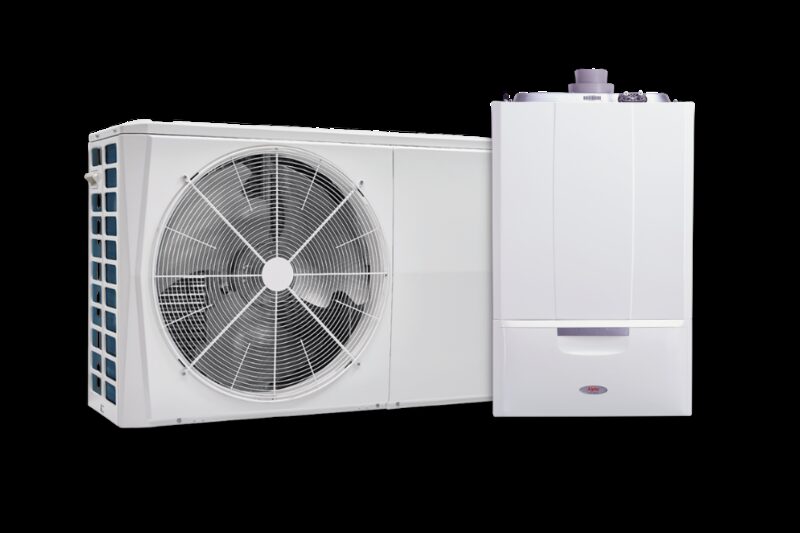
Heat output compared: the boiler's higher flow versus a heat pump's lower grades
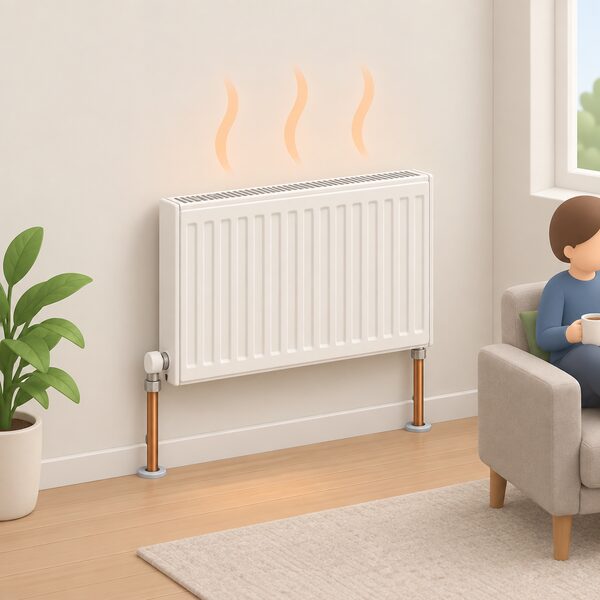
The comfort comparison turns on flow temperature. Heat pumps typically operate at a lower temperature than gas boilers, in line with Building Regulations10. Standard or low temperature heat pumps are at their most efficient when running at lower grades11.
That gap is why the boiler matters. The heat pump can hold a house at temperature in mild weather by running the radiators cooler for longer. When the outdoor temperature falls and the fabric loses heat faster, the flow temperature needed to hold the setpoint rises beyond what the heat pump component delivers, and the boiler supplies the difference. The lower the flow temperature, the better the efficiency of the heat pump12, so the system has a financial reason to keep the heat pump in charge for as much of the year as it can.
Emitters change the picture. With underfloor heating the flow temperature could be lower compared with radiators, and this should result in the heat pump running much more efficiently13. A home with a large emitter surface therefore leans more heavily on the heat pump, while a home with small radiators leans more heavily on the boiler. Neither arrangement changes the maximum temperature the boiler can produce.
Efficiency: from under one unit of heat per unit of gas to a CoP around 2.6
The two units are measured differently, and the difference is stark. Gas boilers produce less than one unit of heat for each unit of gas used14. A condensing boiler is required to meet a minimum efficiency of 86% for gas and 85% for oil under the Welsh building regulations15. Heat pumps can usually deliver three units of heat for every unit of electricity used16, and are usually the most efficient technology for heating homes, using 3 to 4 times less energy to provide the same heat as a boiler6.
In a hybrid, the blended figure sits between the two. Where the heat pump meets 80% of space heating demand and a gas boiler covers the remainder, an average Coefficient of Performance of around 2.6 can be assumed3. That is a system-level figure, not a heat pump rating, and it reflects the boiler's share dragging the average down.
| Measure | Gas boiler | Heat pump | Hybrid at 80% heat pump share |
|---|---|---|---|
| Heat delivered per unit of fuel | Less than one unit per unit of gas14 | Three units per unit of electricity16 | Average CoP around 2.63 |
| Minimum efficiency standard | 86% gas, 85% oil15 | Not applicable | Not applicable |
| Energy used against a boiler | Baseline | 3 to 4 times less6 | Reducing energy demand by 60% against current gas boilers17 |
The 60% energy demand reduction figure applies to hybrid appliances that combine a gas boiler with a heat pump, and the same source notes they could cut peak electrical demand by 10 GW compared with air source heat pumps17. That is the system-level case for hybrids: less energy used than a boiler, less electrical strain than a full heat pump conversion.
Where the gas boiler carries the load
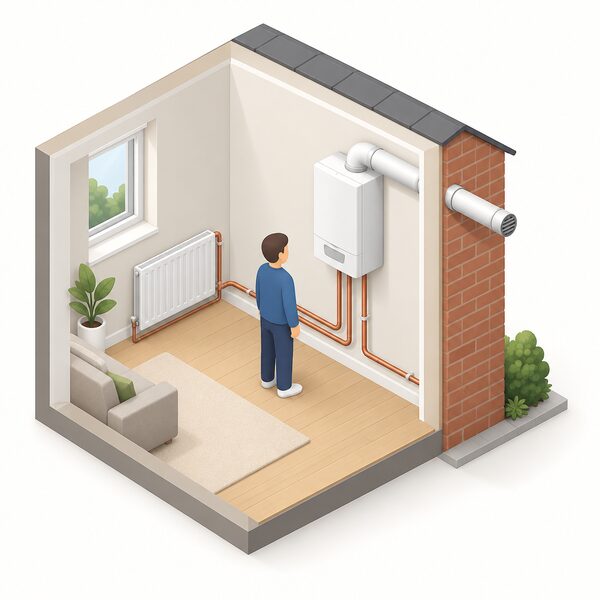
The boiler earns its place in three situations: high heat demand, high hot water demand, and a radiator circuit that cannot be rebuilt. The boiler can provide additional support when demand is higher, such as during colder weather or when extra hot water is needed18. Your gas boiler supports during colder weather or when you need extra heat or hot water19. Hybrids are more common in homes which need more heat to reach a comfortable temperature20.
Hot water is the clearest case. A hybrid can be configured so the boiler only supplies hot water while the heat pump heats the home1, which suits a household with several bathrooms drawing simultaneously. The heat pump should provide the majority of the home's heating demand, switching to the gas boiler when outdoor temperatures are very low or electricity prices are high6.
Manufacturers recommend an ideal share of the overall heat demand met by the heat pump versus the boiler of between 70:30 and 85:154. Research demonstrates how hybrids can meet up to 80% of annual heat demand via the heat pump, with the boiler used only during peak demand21. Hybrids using a smaller heat pump can still meet 80% of a household's annual energy demand without making changes to the existing hydronic heating system3.
"Hybrids using a smaller heat pump can still meet 80% of a household's annual energy demand, without making changes to the existing hydronic heating system"
That is the practical comfort guarantee: the emitter circuit stays as it is, and the boiler covers whatever the heat pump cannot.
Running costs and installation costs compared
Running costs depend on the spark gap between gas and electricity, and the evidence points in more than one direction. At current energy prices, running costs for heat pumps are around the same as for a new gas boiler10. For a typical-sized home, a heat pump currently costs about the same to run as a gas boiler6. One consumer body reports that a household could save as much as 50% and more on running costs with a heat pump compared to a gas boiler, though that requires high quality installation, high efficiency and a heat pump tariff14. Official guidance states that running costs for heat pumps are typically lower than traditional gas boilers, but qualifies that if a system is not designed or operated well the advantage can disappear22. One source states that it is typically more expensive to run a heat pump than a gas boiler due to the relative price difference between electricity and gas23.
For hybrids specifically, the cost to run a hybrid heating system could be about 10% more compared to a standalone heat pump at the current spark gap and typical energy consumption4. Against a gas boiler alone, the hybrid's running cost depends on how much of the year the heat pump carries, which is why the 70:30 to 85:15 control strategy matters more than any single tariff.
Installation costs are higher than for a gas boiler. Heat pump installation costs are higher than gas boilers, in part due to the need for additional retrofitting23. A new gas boiler installation costs between £2,500 and £4,50024, and takes about one day24. Hybrid prices are installer-quoted and vary with the heat pump size, the controls and whether the existing boiler is retained or replaced; no published UK figure is available here.
Why hybrids are being considered as gas boilers are phased out
The policy backdrop is a proposed end to new gas boiler installations. The government has proposed banning new gas boiler installs in all domestic properties from 2035 onwards, and the timeline remains subject to revision. Existing boilers are not being forcibly removed. Gas remains the dominant heating fuel in the meantime: three quarters of people (75%) said they used a gas boiler as their main method of heating the home in winter 20255, and 23 million homes use gas boilers for central heating and hot water6.
Hybrids are argued as a transition technology. Hybrid heat pumps offer better choice and adapt the home for both low-electricity and low-carbon gas technologies, including 100% hydrogen, making it easier to introduce future strategy and policy3. Most hybrid heat pumps combust fossil fuels in the conventional boiler, but as the energy transition gains momentum their fuels may be replaced with low carbon alternatives such as biofuels or hydrogen25. By using gas when it is most needed, hybrid heat pumps take pressure off the electricity network during peak periods26, and spreading the load across both gas and electricity reduces the risk of blackouts and keeps costs manageable26.
The counter-argument is on the record too. Hybrids are not a fully low-carbon technology, could prolong the gas grid and result in higher future utility bills, mean consumers pay twice to decarbonise, and require some outdoor space6. Whether a gas boiler is considered to be powered by fossil fuels depends on the fuel mix in the gas grid at the time when the boiler is installed27. The European Commission's guidance distinguishes stand-alone boilers from hybrid heating systems with a considerable share of renewable energy27.
For a household's energy independence, the position is mixed. A hybrid reduces the volume of gas bought and the amount of electricity a full conversion would draw at peak, but it keeps a gas connection, a gas supplier and a combustion appliance in the home. It is a smaller step away from the grid than a full heat pump, not a step off it.
Servicing, safety and carbon monoxide
A hybrid carries two servicing obligations. Manufacturers recommend annual servicing of hybrid units, which require both gas and electrical skill3. In general, heat pumps need about as much maintenance as a gas boiler10, so the heat pump side does not add a heavy burden, but the gas side remains a combustion appliance with a flue and a carbon monoxide risk that a heat pump alone does not have.
Gas work is regulated. A gas boiler installer should be Gas Safe Registered from 1 April 200915. The replacement of a gas boiler will probably have to be a condensing boiler unless there is sufficient reason why one cannot be installed15. Those rules apply to the boiler half of a hybrid exactly as they apply to a boiler on its own.
Two routine checks carry over. If the system pressure is below 1 bar, the manufacturer's guide should be followed to repressurise the boiler, and the usual target is between 1 and 1.5 bar28. Combi boilers should have the hot water temperature set to at least 50 degrees Celsius, or the water might not feel hot enough28. Neither check is a substitute for the annual service.
What a household should expect in practice
Expect the radiators to feel cooler for longer in mild weather and hotter in a cold snap. The heat pump side runs at lower flow temperatures over longer periods10, while the boiler delivers the higher temperatures when the heat load peaks. Expect the boiler to fire for hot water if the system is configured that way1, and to sit idle for much of the shoulder season.
Expect the system to be compatible with what is already there. Hybrid heat pump systems are usually compatible with existing radiators and pipework29, and a smaller heat pump can still meet 80% of annual energy demand without changes to the hydronic system3. Expect an outdoor unit to need space, since that is one of the listed drawbacks6.
Expect carbon savings against gas-only heating, not against a full heat pump. Hybrid heat pump systems can cut carbon emissions by up to 60% today, rising to about 80% by 20304. By 2040, the hybrid heating system would have saved 25 tonnes of CO2, more than double the 13 tonnes compared to a later heat pump purchase, because an additional 11 tonnes of CO2 per household is emitted from a five-year delay before switching to a heat pump4.
Expect the gas connection to stay. That is the honest summary of what a hybrid does for independence: it lowers gas consumption and defers the electrical upgrade a full heat pump might need, but the household remains a gas customer, and the warmth guarantee rests on the boiler still being there.
Sources29 cited
- Hybrid heat pumps, Energy Saving Trust, 2026-07-16
- Your home guide to heat pumps, OFTEC, 2026-09-17
- Domestic hybrid heat pumps, Heat Pump Association, 2026-09-17
- The Future of the Gas Network: Recommendations for Hybrid Heating, Cadent, 2025-04
- Public attitudes tracker: heat and energy use in the home, winter 2025, Department for Energy Security and Net Zero, 2025
- Domestic heating technology options: hybrid heat pumps, Nesta, 2025-02-03
- Hybrid boilers, HIES, 2022-05-10
- Gas heating or heat pump, WOLF, 2026-09-17
- MCS certificates: why data matters, MCS Certified, 2025-03-11
- Heat pump fact check, Energy Saving Trust, 2026-07-01
- Home heating, Energy UK, 2025-04-04
- Insulation and heat pumps: the perfect pairing, MIMA, 2026-09-20
- Underfloor heating, Energy Saving Trust, 2025-10-02
- An introduction to heat pumps, Which?, 2025-09-22
- Building regulations: boilers and heating, Welsh Government, 2026-09-17
- Heat pumps, nidirect, 2025-02-24
- Buildings energy, CREDS, 2026
- Hybrid heat pumps, SGN, 2026
- Hybrid heating, Cadent, 2026-09-20
- Electrification of heat: heat pump user guides, Energy Systems Catapult, 2024-02-22
- Boiler Upgrade Scheme consultation part 1, IGEM, 2025-06
- What impact can heat pumps have in domestic heating today, Department for Energy Security and Net Zero, 2023-11-21
- Heat pumps for domestic heating, Parliamentary Office of Science and Technology, 2026-09-19
- Heat pumps vs boilers, The CPA, 2025-02-18
- Research on electricity network constraints 2024, Scottish Government, 2021-10-07
- Beat the peak, Energy Systems Catapult, 2024-10-14
- EC guidance on phasing out financing for stand-alone fossil boilers, Solar Heat Europe, 2025-01-14
- Getting your broken boiler repaired or replaced, Citizens Advice, 2024-08-16
- How much does a hybrid heat pump cost, Alpha Innovation, 2026-07-10
 Using a Heat Pump for CoolingCan a heat pump cool your home in summer as well as heat it in winter?
 Hybrid Heat PumpsHow hybrid systems pair a heat pump with a gas, oil or LPG boiler, what decides which appliance runs, what they cost, how much gas they displace, and why the Boiler Upgrade Scheme will not fund them.
 Energy IndependenceA heat pump runs your heating on electricity instead of gas or oil, so how much does that really cut what you pay and how exposed you are when fuel prices jump?
 Heat Pump Running CostsWhat does a heat pump cost to run each year, and is it cheaper than a gas boiler?
 Heat Pumps vs BoilersWill a heat pump actually cost less to run than my boiler, and does it heat the house as well?
 Radiators and EmittersWill your radiators still heat the house properly with a heat pump?