In this guide
A heat pump tariff is an electricity tariff shaped around the way a heat pump uses power: one or more cheaper periods during the day or night, and sometimes a deliberately expensive peak period as well1. The point of it is simple. On a standard flat-rate tariff, most heat pumps cost the same or even more to run than an efficient gas boiler2. Change the shape of the price and the arithmetic changes with it.
The scale of the difference depends heavily on who is measuring and what they assume. E.ON Next states that its dedicated heat pump tariff, Next Pumped, saves around £67 a year3. The Energy Saving Trust puts the figure for a heat pump appropriate tariff at up to £330 a year on heating bills2, and separately reports that heat pump users on smart tariffs save around £330 a year on average compared with those who are not4. Ofgem's 2025 assessment is more conservative, at more than £250 a year for households shifting to a smart tariff and using the heat pump flexibly5. Nesta's modelling of flexible operation on a pass-through time-of-use tariff, against a single-rate tariff with a standard heat pump profile, found average savings of £640 to £750 a year6. These are not the same claim measured four ways: they assume different tariffs, different degrees of load shifting and different comparison baselines.
Very few households are yet taking any of it. Ofgem recorded that the number of heat pump users on specialised tariffs is low, at less than 5 per cent5.
Why a heat pump benefits from its own electricity tariff
A heat pump runs on electricity, which is what makes the tariff decisive9. Unlike a boiler, whose fuel price is the same at 3am and 5pm, a heat pump's fuel is priced by the half hour on any time-of-use product, and its thermal store (the fabric of the house and the hot water cylinder) lets some of that demand be moved.
The obstacle is the price relationship between the two fuels. Parliamentary analysis states plainly that reducing the price of electricity relative to gas would make heat pumps more competitive, and that additional savings are possible with flexible electricity tariffs10. The Energy Saving Trust notes that on standard electricity tariffs, where electricity is nearly four times more expensive than gas, heat pumps can cost slightly more to run than new gas or oil boilers11. Local authority guidance makes the same warning in sharper terms: installing a heat pump in a home that is not well insulated may increase energy bills instead, because electricity is more expensive than gas12.
So the tariff is doing work that the technology alone cannot. Where the home has a battery as well as a heat pump, guidance points towards a heat pump tariff that includes a peak rate, so the battery can power the heat pump during the expensive period1. Where there is no battery, the house itself is the store, and the heat pump is run harder when power is cheap and eased off when it is not.
Smart Energy GB reports that heat pumps can keep homes comfortable on smart tariffs by heating steadily at times when electricity is cheaper, without noticeable change for most households13. That steady, low-temperature operation is the opposite of a boiler's short bursts, and it is why heat pump tariffs are built with long cheap windows rather than the two or three hours an EV needs.
Nesta's research into household attitudes found that among homeowners eligible for free heat pumps, lower home energy bills were the benefit most likely to persuade them, cited by 16 per cent, with only one in ten citing environmental reasons14. Running cost, in other words, is the deciding argument, and running cost is set by the tariff.
Next Pumped: E.ON Next's dedicated heat pump tariff
Next Pumped is E.ON Next's tariff for homes heated by a heat pump. The supplier states that it saves around £67 a year, comes with 100 per cent renewable electricity, and has no exit fees3. Existing E.ON Next customers are also offered up to £200 off an air source heat pump3.
Two of those points deserve care. The £67 figure is a supplier estimate against a standard variable comparison, not an independently verified outcome, and E.ON Next's own published material is not consistent about it: one page states around £67 a year, another around £78 a year, and a third puts it at up to £43 a year3. The honest reading is that the supplier's own claimed saving sits somewhere in the low tens of pounds a year for a typical user, well below the £250 to £330 figures independent and official bodies attach to smart tariff use generally4. The likely reason is behavioural: those larger figures assume the heat pump is actively flexed into the cheap windows, not simply left on a timer.
The absence of an exit fee is a genuine and checkable difference: Next Pumped carries no exit fees3, while consumer guidance notes that fixed tariffs often charge around £100 per fuel for leaving early15. A tariff without one can be left for a better product at any point, which matters in a market where heat pump tariffs are still being designed and withdrawn. More on how those charges work sits in exit fees and tariff contract terms.
Pricing periods: super off-peak from 10pm to 6am
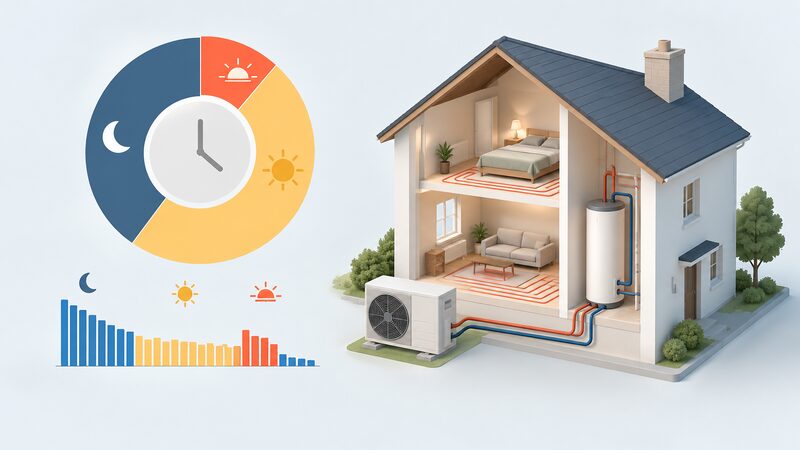
Next Pumped is a three-band tariff rather than a simple day and night product. As of 10 September 2026, E.ON Next set the periods as follows3.
| Band | Hours | Role |
|---|---|---|
| Super off-peak | 22:00 to 06:00 | Cheapest electricity, eight hours3 |
| Off-peak | 19:00 to 22:00 and 06:00 to 16:00 | Middle rate, thirteen hours across two blocks3 |
| Peak | 16:00 to 19:00 | Most expensive, three hours3 |
That structure is typical of the category rather than unique to it. Which? reports that depending on the supplier, heat pump tariffs give between five and ten hours of cheaper electricity a day, and that some come with a pricier peak rate between 4pm and 7pm, where rates as much as 50 per cent above standard tariff levels have been observed7. E.ON Next's peak window matches that 4pm to 7pm shape exactly.
The practical consequence is that only three hours of the twenty-four carry the penalty, and twenty-one hours are at or below the middle rate. For a heat pump running a continuous low-temperature heating curve, that is a far easier fit than an EV tariff, which concentrates its discount into a narrow overnight slot. The tactics are the same as for any time-of-use product and are covered in shifting electricity use to cheap-rate periods and in the general guide to time-of-use tariffs.
Two design questions follow. First, hot water: an eight-hour super off-peak block is long enough to reheat a cylinder overnight at the lowest rate. Second, the pre-peak charge: raising the house temperature slightly before 4pm lets the heat pump coast through the expensive window, which is precisely the behaviour the larger savings estimates assume.
Whether the cheap rate covers the whole house or only the heat pump
On a time-of-use tariff of this kind, the price applies to everything the electricity meter records in that window, not to the heat pump alone. That is what distinguishes a heat pump tariff from an EV charging bolt-on, where a discounted rate is applied to charger consumption specifically. Which? describes the two pricing models used in this market: a set, cheaper rate per kWh regardless of where the household lives, or a discount compared with the region's standard tariff7. The first is geographically flat; the second varies by region, because the regional standard rate it discounts does.
Because the cheap window covers the whole supply, a household on Next Pumped also gains on dishwashers, laundry and any battery charging that falls inside it. Equally, the 4pm to 7pm peak applies to cooking and lighting, not just heating, which is where an evening-heavy household can lose ground. The import tariffs designed for solar and battery homes page covers how storage interacts with that penalty band.
Eligibility, and the smart meter that makes it possible
Heat pump tariffs are mostly only available for homes that have a heat pump1. Suppliers generally ask for evidence of the installation before opening the tariff, and the tariff is not a route to cheap electricity for a home heated another way.
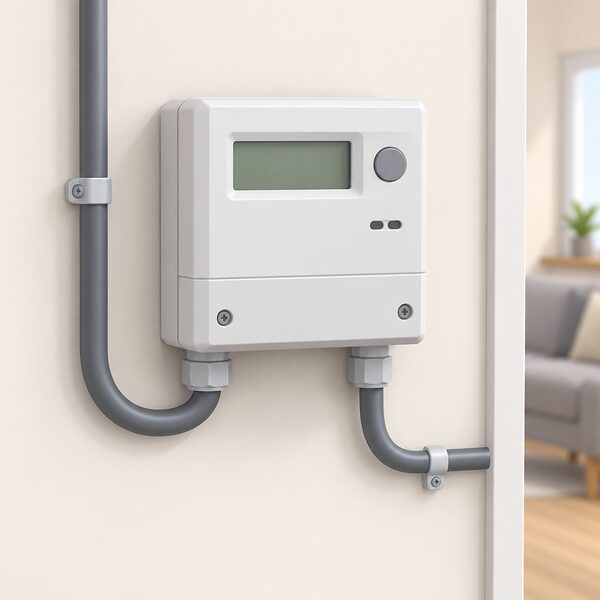
The hard requirement is metering. Time-of-use pricing needs half-hourly measurement, and Ofgem states that a smart meter lets a household access more flexible tariffs, including dual-rate tariffs16. The Data Communications Company puts the negative case: declining a smart meter means excluding yourself from cheaper tariffs which are only available if you have a smart meter17. Independent guidance goes a step further on specification, advising households to ensure the smart meter is SMETS2 compliant so that switching between suppliers does not affect functionality and supply18. First-generation SMETS1 meters have historically lost smart function on a switch unless enrolled into the national network; Ofgem's 2025 consultation on smart meter standards confirms the rules cover both SMETS1 and SMETS2 meters, including unenrolled SMETS1 meters19.
MCS notes the operational purpose of the meter from the installer's side: it allows heating to run at times when electricity is cheaper through time-of-use tariffs and the demand flexibility service20. Whether a particular meter and property can support these products is covered in which tariffs your meter and home allow and, for the specific question, do I need a smart meter for an EV or heat pump tariff.
Aira Intelligence: letting the heat pump follow the tariff
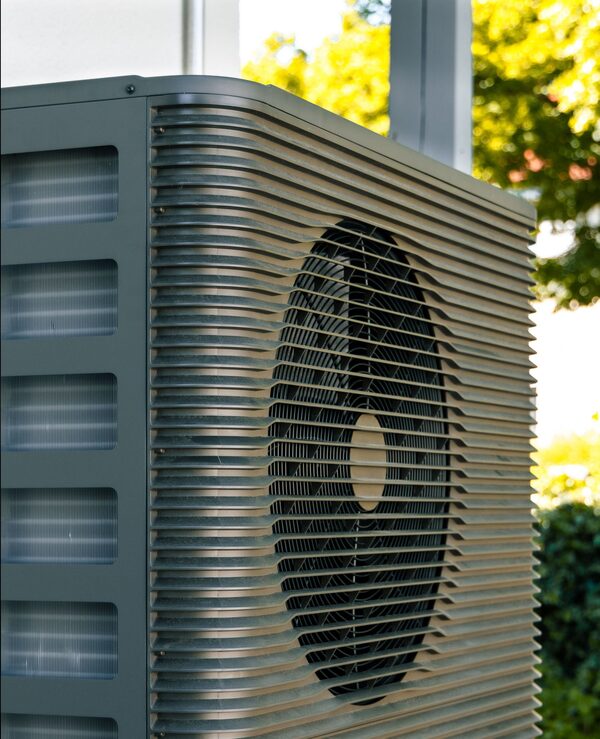
Optimisation software is what turns a favourable tariff shape into an actual saving. Aira states that with Aira Intelligence, its heat pump can optimise against any energy tariff, and that on a smart tariff such as a day and night or dynamic tariff, the system automatically adjusts when the heat pump runs, using more electricity when prices are lower and easing off when they are higher21. The company also states: "No lock-ins. No restrictions. Switch tariffs whenever you like, and your system adapts automatically."21
Those are the manufacturer's claims for its own product, and they describe a capability rather than a verified saving. They matter here because the larger independent savings figures rest on exactly this behaviour. Nesta's modelling of £640 to £750 a year assumed the heat pump was operated flexibly on a time-of-use tariff rather than run to a fixed schedule6. E.ON Next's own £67 figure, by contrast, reflects a more passive pattern. The gap between the two is largely the gap between a heat pump that follows prices and one that does not.
The dependency this introduces should be stated. Automated optimisation typically relies on the manufacturer's cloud service and a working internet connection to receive price signals. A household gains control of its running costs and cedes some control of its heating schedule to a piece of software it does not own.
Standard tariff against time-of-use: what changes
The evidence on this is consistent in direction and cautious in detail.
| Source and date | Finding |
|---|---|
| Energy Saving Trust, August 2026 | Most heat pumps on a standard flat-rate tariff cost the same or even more to run than an efficient gas boiler2 |
| Energy Saving Trust, July 2026 | Switching to a heat pump time-of-use tariff should reduce the cost of running the heat pump, making a saving more likely22 |
| Which?, February 2026 | With a suitable time-of-use tariff, air source heat pumps should cost no more to run than a gas boiler and, in the right home, can be considerably cheaper23 |
| OFTEC, 2026 | Heat pumps may be no cheaper to run than a conventional liquid fuel-fired or gas appliance24 |
| UK government, May 2026 | Where heating patterns are not well aligned to the tariff, time-of-use tariffs can increase fuel bills25 |
The last of those is the one most often left out. A time-of-use tariff is a bet that consumption can be moved. A household that heats hardest between 4pm and 7pm, in a poorly insulated property with no thermal buffer, is paying a premium for the privilege. The Energy Saving Trust's own research programme on this was explicit that it set out to reveal which tariff types provide the best heat pump savings and which might actually increase energy bills26.
For context on absolute running costs, the Centre for Sustainable Energy puts annual space heating for a heat pump in an average flat or small home at £800 to £1,050 on a single-rate tariff, as of June 202627. A separate 2025 comparison of a typical UK household with both an EV and a heat pump attributed £850 a year to the heat pump on a heat pump focused tariff such as Octopus Cosy, within a total annual electricity cost of £1,40018.
Combining a heat pump tariff with solar, a battery or an EV

Where a household has more than one low-carbon technology, the tariff choice gets harder rather than easier. The Energy Saving Trust examined over a million heat pump, tariff and technology combinations in its flexibility research26. Its practical guidance for a home with a heat pump, solar panels and a battery is to look for a good Smart Export Guarantee tariff for exported electricity and then either a dynamic tariff or a heat pump tariff for import, ideally from the same company1. Export rates are covered in Smart Export Guarantee rates.
Electric vehicles complicate matters. There is currently a lack of combination tariffs designed specifically for both EVs and heat pumps18. Where a household has both, the Energy Saving Trust advises that a heat pump tariff is worth looking at instead of an EV tariff, because an EV tariff's cheap window is too short to supply much of the heat pump's demand1. The trade-off is described further in electric vehicle energy tariffs.
The combined prize is sizeable in the official estimates. The Climate Change Committee stated in June 2026 that a typical household could save around £1,200 a year today by combining an EV, a heat pump, solar panels and a time-of-use tariff28. MCS reported in August 2026 that a typical home could save up to £550 a year by installing a heat pump, solar PV and a battery together29. Nesta's earlier figure for flexible heat pump use with a smart tariff alone was up to £600 a year compared with a standard electricity tariff30.
VAT and the wider bill picture
Installation costs sit outside the tariff but change the overall case. A zero rate of VAT applies to the installation of energy-saving materials including heat pumps and biomass boilers between 1 April 2022 and 31 March 20278. Government campaign material states simply that heat pump installations benefit from being exempt from VAT31, and consumer guidance confirms the 0 per cent rate covers heat pumps and biomass boilers32. Water source heat pumps qualify for the temporary zero rate until 31 March 2027 and revert to the reduced rate thereafter, according to HMRC guidance33.
VAT on the electricity itself is a separate question and a live policy argument. Nesta modelled removing VAT from electricity as worth £83 a year to a typical heat pump household, and a wider tax-free electricity proposal as worth £387 a year to the same household34. Neither is current policy. The Heat Pump Association proposed an Interim Domestic Heat Pump Tariff Discount in November 2023 as a short-term route to reducing the price of electricity relative to gas35, which it estimated would cut the cost of electricity faced by heat pump consumers by 12 per cent in 2024 and by 24 per cent in 2026 under central price forecast assumptions36. For comparison, Germany's heat pump electricity tariff offers a discount equivalent to 60 per cent of network fees for the electricity consumed by a heat pump37. CIBSE consultation material gives indicative tariff ranges of 6.9 to 11.5p per kWh for air source heat pumps and 12.5 to 17.3p per kWh for ground source38.
What a heat pump tariff does, and does not, do for independence
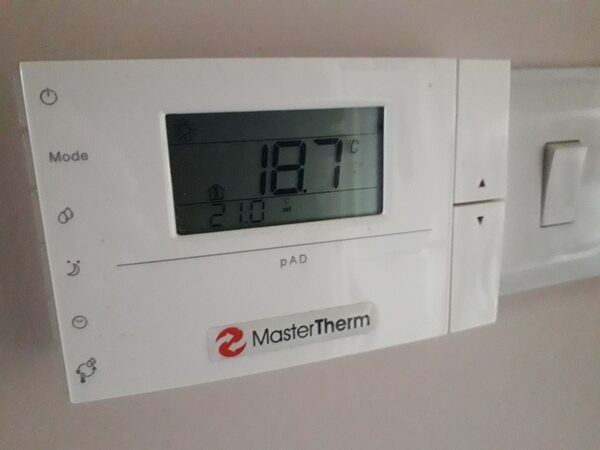
A heat pump tariff moves a household off gas and onto electricity, and then makes that electricity cheaper at particular hours. Both parts are real gains. The household no longer buys a fuel whose price is set on international gas markets, and it gains a lever over its own bill that a boiler owner does not have.
The dependence that remains should not be understated.
- The supplier. A heat pump tariff is a contract with one company, available mostly only to homes with a heat pump1. Leaving it means finding another supplier offering the same shape, in a market where fewer than 5 per cent of heat pump owners are on such products5.
- The grid. Every unit still arrives over the network. A cheap window is cheap because the system is lightly loaded, not because the household has become self-sufficient.
- The price relationship. The case rests on electricity being expensive relative to gas, a ratio set by policy and levies rather than by the household10.
- Software and connectivity. Automated optimisation of the kind Aira describes depends on the manufacturer's service and a live connection21.
- Fabric. The tariff cannot rescue a home that cannot hold heat through a peak window. Where insulation is poor, a heat pump may raise bills rather than lower them12.
Solar generation and storage are what genuinely reduce reliance on imported units, and the tariff is what determines the value of the units still imported. The relationship between the two is set out in tariffs and household energy independence, and the full range of products in the energy tariffs guide.
Sources38 cited
- Tariffs for renewable technology, Energy Saving Trust, 12 August 2026
- Renewable technologies: what really cuts energy bills, Energy Saving Trust, 12 August 2026
- E.ON Next tariff information, E.ON Next, 17 September 2026
- Response on electricity VAT removal, Energy Saving Trust, 22 July 2026
- Smart Meter Guaranteed Standards of Performance Draft Impact Assessment, Ofgem, August 2025
- Domestic heat pump flexibility modelling, Nesta, 19 November 2024
- Time-of-use tariffs explained, Which?, 23 April 2026
- Boiler Upgrade Scheme guidance for participants, Ofgem, 25 September 2023
- Heat pumps, Welsh Government, 17 November 2025
- Domestic heat pumps research briefing, Parliamentary Office of Science and Technology, 19 September 2026
- Air source heat pumps, Energy Saving Trust, 16 July 2026
- Air and ground source heat pumps guidance, Croydon Council, 2026
- How smart meters work with heat pumps, Smart Energy GB, 24 April 2026
- How the British population views heat pumps: homeowners eligible for free heat pumps, Nesta, 2 July 2026
- How to switch energy supplier, Which?, 15 May 2026
- Getting a smart meter, Ofgem, 2026
- Do you have to have a smart meter by law?, Smart DCC, 2026
- Best tariffs for EV and heat pump, Uswitch, 2 July 2025
- Smart Meter Guaranteed Standards Statutory Consultation, Ofgem, 8 August 2025
- Smart meters: installer resources, MCS, 24 July 2026
- Aira Intelligence and clean energy tariffs, Aira, 17 September 2026
- In-depth guide to heat pumps, Energy Saving Trust, 16 July 2026
- Why I'm not getting a heat pump, Which?, 12 February 2026
- Off-gas-grid heating options, OFTEC, 2026
- Call for evidence report: heat pump transition, UK Government, May 2026
- Flexible futures: integrating smart tariffs with low-carbon home technologies, Energy Saving Trust, 10 July 2026
- Electric heating advice, Centre for Sustainable Energy, June 2026
- Faster electrification would cut UK household bills, Climate Change Committee, 24 June 2026
- Record number of UK households combining renewables, MCS, 20 August 2026
- What will my energy costs look like with a heat pump?, Nesta, 21 January 2025
- Heat pumps, UK Government clean energy campaign, 10 September 2026
- What is the Boiler Upgrade Scheme?, Which?, 22 October 2025
- VAT on energy-saving materials and grant-funded heating supplies, HMRC, 17 September 2026
- Tax-free electricity, Nesta, 5 November 2025
- European heat pump market report and UK price disparity, Heat Pump Association, November 2023
- Interim Domestic Heat Pump Tariff background paper, Heat Pump Association, January 2024
- Plugging heat in: smart policy for electrifying household heating in Europe, Ember, 17 December 2025
- Renewable Heat Incentive: proposals for a domestic scheme, CIBSE, 2026
 Heat Pump Running CostsWhat does a heat pump cost to run each year, and is it cheaper than a gas boiler?
 Controls and Time-of-Use TariffsCheaper electricity at night only saves money if your heating actually uses it then.
 Energy IndependenceA heat pump runs your heating on electricity instead of gas or oil, so how much does that really cut what you pay and how exposed you are when fuel prices jump?
 Smart Thermostats ExplainedWhat does a smart thermostat actually do, and is it worth it?
 Controls and Smart OperationWhy does a heat pump need different controls from a boiler, and what does weather compensation actually do?
 The Full Heat Pumps GuideWill a heat pump keep my house warm in winter, and what does one cost to buy and run?