

In this comparison
The short answer is that a heat pump can cost about the same to run as a gas boiler, and less on the right tariff. Official guidance states that heat pumps currently have similar running costs to gas boilers1. Independent guidance for a typical-sized home reaches the same conclusion, noting that the unit price of electricity is almost four times that of gas2.
The reason the two can land in the same place is efficiency. Heat pumps are around three to four times more efficient than gas boilers, so they need far less energy to deliver the same heat3. A gas boiler produces less than one unit of heat for each unit of gas used4. That efficiency advantage is what offsets the price gap between the fuels.
Where the comparison moves in the heat pump's favour is the tariff. Independent research shows that switching to a heat pump time-of-use tariff reduces running costs significantly, and that a heat pump can then cost less to run than a gas boiler5. Independent guidance goes further, putting the potential saving at as much as 50% and more where there is a high quality installation, high efficiency and a heat pump tariff4.
Why the two systems use energy differently
The running cost comparison only makes sense once the efficiency difference is on the table. A gas boiler burns fuel on site and converts most of it to heat, but never more than the energy content of the gas. Independent guidance describes gas boilers as producing less than one unit of heat for each unit of gas used4. The minimum efficiency required for a new boiler is 86% for gas and 85% for oil9.
A heat pump moves heat rather than creating it, so the delivered heat can exceed the electricity consumed. The Climate Change Committee puts heat pumps at around three to four times more efficient than gas boilers3. Bristol City Council's warm homes plan states they are typically over three times more efficient than the most efficient gas boilers or electric heaters10. Scottish Government strategy documents put it in terms of energy input: the higher efficiency of a heat pump means the amount of energy needed can be less than a third the amount needed by a gas boiler to produce an equivalent amount of heat11.
That is the whole basis of the cost case. Independent analysis notes that heat pumps use about 3.5 times less energy than boilers, which is why the electricity to gas price ratio needs to fall below 3.6 for them to become cheaper to run12. The government's own press material describes heat pumps as three times more efficient than gas boilers13.
In practice the efficiency achieved depends on the installation, not the brochure. Independent guidance warns that air source heat pumps can be more expensive to run if there are no other measures and the flow temperature is high14. The same source notes that running costs for heat pumps are typically lower than traditional gas boilers, but that a poorly set up system changes the picture15.
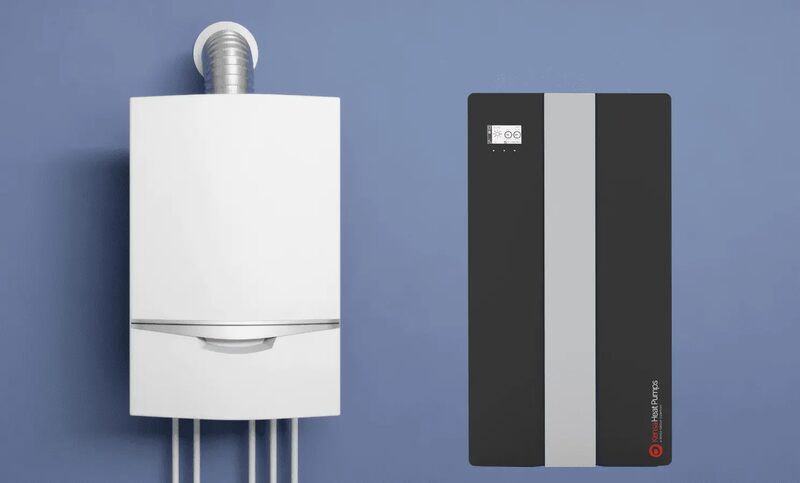
When a heat pump is cheaper: the conditions that decide it

Three conditions decide whether the heat pump comes out ahead: how efficiently it runs across the season, what tariff the electricity is bought on, and how the system is set up in the house.
The efficiency threshold is the clearest. Independent analysis puts the running costs for a heat pump with a seasonal coefficient of performance of 2.9 or more below those of a typical gas boiler, and a SCoP of 3.1 or more beats even the most efficient gas boiler at 92% efficiency16. SCoP is the seasonal figure, so it reflects the whole heating year rather than a mild day.
The tariff is the second lever. On standard electricity tariffs, where electricity is nearly four times more expensive than gas, heat pumps can cost slightly more to run than new gas or oil boilers5. On a heat pump time-of-use tariff, the same source finds a heat pump can cost less to run than a gas boiler5. Independent analysis puts the breakeven electricity to gas price ratio at 3.4 to 1: above that ratio, heat pumps become more expensive to run than gas boilers under existing market arrangements with no other changes6.
The third condition is the fabric and the emitters. Independent guidance notes that air source heat pumps can be more expensive to run if there are no other measures and the flow temperature is high14. A well-insulated home with larger radiators or underfloor heating can run at a lower flow temperature, which raises the efficiency and lowers the running cost.
Demand responds to running costs. In a UK-wide experiment, cutting running costs so that a heat pump cost £40 a month less to run than a gas boiler increased the number choosing a heat pump by seven percentage points17. The same trial found a lower running cost scenario at £60 a month for a heat pump against £100 for a gas boiler, and a baseline scenario at £80 against £75, a £5 monthly difference the other way17.
Upfront cost: the gap between the two systems
Running costs are only half the household arithmetic. The capital gap is wider and better documented.
Official figures put an average heat pump at around £11,600, four times more expensive than a gas boiler7. Parliamentary research confirms that heat pump installation costs are higher than gas boilers, in part due to the need for additional retrofitting1. Independent guidance gives £10,500 upfront on average against around £2,000 for a gas boiler19.
For the boiler side, independent guidance gives a new gas boiler installation at between £2,500 and £4,500, with a total cost range of £1,600 to £6,000 depending on specification and any associated work20. Installation takes about one day20.
| Heat pump | Gas boiler | |
|---|---|---|
| Average upfront cost | around £11,6007 | around £2,00019 |
| Installation cost range | installer-quoted | £2,500 to £4,50020 |
| Typical installation time | not stated in the figures | one day20 |
| Lifespan | not stated in the figures | 10 to 15 years20 |
| Maintenance over 15 years | £7508 | £1,2008 |
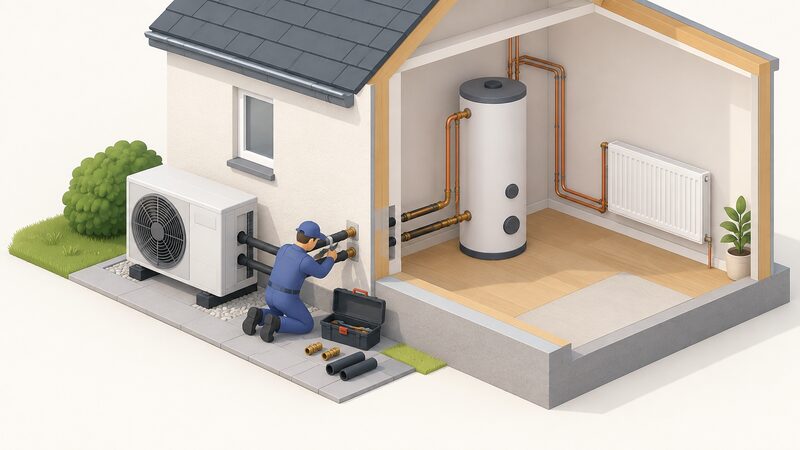
The retrofitting element is what drives much of the difference. A heat pump generally needs a cylinder for hot water, larger emitters to run at lower flow temperatures, and sometimes an electricity supply check. None of that appears on a boiler replacement, which is usually a like-for-like swap into existing pipework and radiators.
Whole-life cost: which system works out cheaper over 15 years
Whole-life cost combines the upfront price, the running cost and the maintenance across the life of the equipment. The published figures point in different directions depending on the assumptions, and the differences are large enough to state plainly.
Independent analysis gives total maintenance costs over 15 years of £750 for a heat pump and £1,200 for a gas boiler8. Running costs, including maintenance, make up approximately 55 to 65% of the total lifetime cost of a heat pump under current policy and market conditions, with upfront and installation cost making up approximately 15 to 20% and 20% respectively21.
On the running side, independent analysis found that a heat pump installed in 2025 would save an average household £380 per year over the course of its lifetime compared to a gas boiler, once levy rebalancing is accounted for12. The same analysis gives baseline projections for 2030 in which heat pumps cost £1,680 a year and boilers £1,110 before subsidies12.
Earlier modelling produced a range of outcomes. One study found that after running cost reductions plus a £5,000 upfront reduction, a heat pump would become between £60 and £110 cheaper than a gas boiler over its lifetime22. Another found heat pumps £120 to £160 per year cheaper over their lifetime under combined policy scenarios with a decoupled electricity market23. The same work gives a smaller home at £670 more for a heat pump, a large detached home at £90 cheaper with a £5,000 grant, and £240 more expensive with a high efficiency system23.
The spread reflects the assumptions rather than a contradiction in the physics. Where the modelling assumes levy rebalancing, a low flow temperature and a competitive upfront price, the heat pump wins over the life of the system. Where it assumes current tariffs and a full-price installation, the boiler is cheaper.
"A household could save more than 50% on running costs with a heat pump compared to a gas boiler."
Efficiency: the seasonal figure that decides the running cost
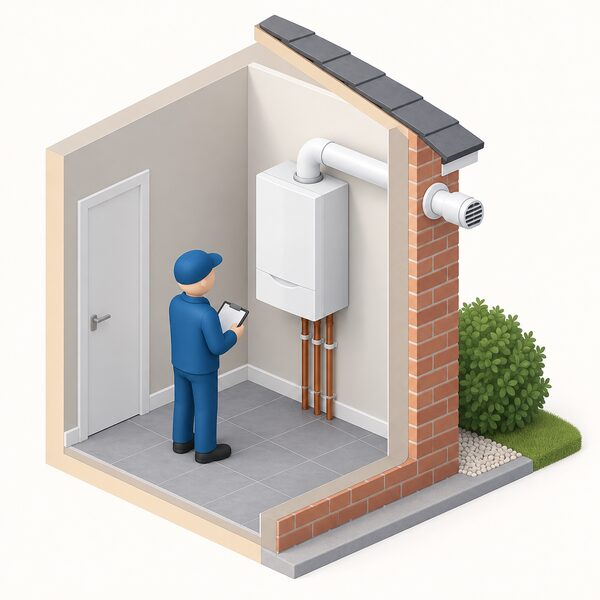
The efficiency figures that matter for running costs are the seasonal ones. A gas boiler's efficiency is capped by combustion: the minimum required is 86% for gas and 85% for oil9, and independent guidance describes boilers as producing less than one unit of heat per unit of gas4. A well set up condensing boiler can reach the low 90s as a percentage, but it cannot exceed 100%.
A heat pump's seasonal efficiency is expressed as a coefficient, not a percentage. The threshold figures are the practical guide: a SCoP of 2.9 or more gives lower running costs than a typical gas boiler, and 3.1 or more beats a 92% efficient boiler16. Those are the numbers to compare against a quoted seasonal performance figure, not the peak COP on a datasheet.
The gap between a good and a poor installation is what produces the range of outcomes in the modelling. Independent guidance attributes higher running costs to the absence of other measures and a high flow temperature14. The same source notes that running costs for heat pumps are typically lower than traditional gas boilers when the system is set up properly15.
For a household, the practical implication is that the running cost is decided at design and commissioning stage, not at the point of purchase. Flow temperature, emitter sizing and controls settings determine whether the installed system lands near the 2.9 threshold or well above it.
Gas boilers: the baseline and the rules around them
Gas boilers remain the default. Official statistics for winter 2025 found that three quarters of people, 75%, said they used a gas boiler as their main method of heating the home24. Independent guidance puts the number of homes using gas boilers for central heating and hot water at 23 million2.
They are also usually the cheapest fuel to run where there is a mains connection. Independent guidance states that with a mains gas connection, a modern condensing gas boiler is usually the cheapest to run compared to oil, electricity, LPG and house coal25. That is the benchmark any heat pump has to beat.
The rules around replacement are tightening. The government has set out an intention to begin phasing out installation of new natural gas boilers from 2035, running in line with replacement cycle timelines so that almost all heating systems in 2050 are low-carbon, though no legally binding regulatory decision had been made at the time of that statement26. Replacement of a gas boiler will probably have to be a condensing boiler unless there is sufficient reason why one cannot be installed, and installation should be by a Gas Safe Registered installer, a requirement in place from 1 April 20099.
For households, the practical points are the ones that affect cost and rights. Combi boilers should have the hot water temperature set to at least 50 degrees Celsius, and system pressure should sit between 1 and 1.5 bar, with repressurising needed below 1 bar27. A boiler bought within the last 6 years can be raised with the seller or installer, and it is usually easier to prove a fault if the boiler was installed in the last 6 months27. The standards expected are satisfactory quality, installation with reasonable skill and care, and fitness for the intended purpose27.
Where a heat pump falls short
The limits are as real as the benefits, and they are the reason the running cost comparison does not resolve to a single answer.
On standard tariffs, the fuel price gap works against the heat pump. Independent guidance states that on standard electricity tariffs, where electricity is nearly four times more expensive than gas, heat pumps can cost slightly more to run than new gas or oil boilers5. Parliamentary research states plainly that electricity prices mean heat pumps can be more expensive to run28. The Welsh Government's draft heat strategy acknowledges that with heat pumps currently costing more than gas boilers, and current energy tariffs limiting the financial case29.
The breakeven ratio is the number to hold onto. Independent analysis puts it at 3.4 to 1: where the ratio is greater than that, the use of heat pumps becomes more expensive than the use of gas boilers, with the consequence that real incomes and spending power across households fall under existing market arrangements with no other changes or interventions6.
Poor installation is the second limit. Independent guidance is explicit that air source heat pumps can be more expensive to run if there are no other measures and the flow temperature is high14. A system sized or commissioned badly will not reach the SCoP needed to beat a boiler, whatever the tariff.
The third limit is the capital requirement. At around £11,600 against a boiler at around £2,000, the upfront gap is roughly £9,600 before any grant7. Whole-life modelling that assumes current tariffs and full-price installation produces outcomes where the heat pump is more expensive over its life, including £670 more for a smaller home23.
What this means for household energy independence
The running cost question and the independence question are not the same, and it is worth separating them.
A gas boiler ties the household to the gas grid and to a fuel whose price is set by international markets. Independent guidance describes gas boilers as connecting to the gas grid to provide fuel when needed25. The household has no storage, no alternative supply and no control over the unit price.
A heat pump runs on electricity, which can be bought on a time-of-use tariff and increasingly paired with on-site generation. Independent research shows that switching to a heat pump time-of-use tariff reduces running costs significantly5. That is a form of control a gas boiler cannot offer: the household can shift when it buys its energy, and can generate some of it.
The dependence that remains is real. A heat pump still draws from the grid, still relies on a supplier, and its performance depends on a manufacturer's controls and, in some cases, an app. The carbon case is separate from the cost case: official guidance puts a heat pump at up to 70% less CO2 over 15 years than a gas boiler, with zero emissions at the point of use30.
For a household weighing the two, the honest position is that the running cost comparison is close, tariff-dependent and installation-dependent, while the independence difference is structural. The heat pump moves the household from a fuel it cannot store to one it can increasingly generate and time-shift. The gas boiler remains cheaper to buy and, on current tariffs, usually cheaper to run.
Sources30 cited
- Heat pumps and domestic heating, UK Parliament POST, 2026
- Heat pumps vs boilers, Which?, 2025
- The Seventh Carbon Budget, Climate Change Committee, 2025
- An introduction to heat pumps, Which?, 2025
- Air source heat pumps, Energy Saving Trust, 2026
- The benefits of heat pumps and the role of electricity and gas prices, UKERC, 2023
- Heat pumps and domestic heating: report, Public Accounts Committee, 2024
- How to make heat pumps more affordable: assumptions and methods, Nesta, 2024
- Building regulations: boilers and heating, Welsh Government, 2026
- Bristol warm homes plan, Bristol City Council, 2025
- Heat in Buildings Strategy, Scottish Government, 2021
- Fixing the levy system could save billions on heat pump subsidies, Nesta, 2025
- Demand for heat pumps rises following increase in applications to the Boiler Upgrade Scheme, GOV.UK, 2024
- Heat Pump Myths Busted, AECB, 2025
- What impact can heat pumps have in domestic heating today, GOV.UK, 2023
- A heat pump might be a lot cheaper than you think, Which?, 2024
- Cheap loans and lower running costs triples demand for heat pumps, Nesta, 2022
- Assessing the government plans to obligate boiler manufacturers to support heat pumps, Nesta, 2022
- Bring down heat pump costs to make green energy pay, Nesta, 2022
- Heat pumps vs boilers: cost comparison, The CPA, 2025
- EINAS 2025: heat and buildings, Department for Energy Security and Net Zero, 2025
- Reduce the cost of heat pumps, Nesta, 2022
- How the costs of heat pumps compare to gas boilers since the energy crisis, Nesta, 2022
- Public attitudes tracker: heat and energy use in the home, winter 2025, Department for Energy Security and Net Zero, 2025
- Boilers, Energy Saving Trust, 2026
- Heat and Buildings Strategy, GOV.UK, 2021
- Getting your broken boiler repaired or replaced, Citizens Advice, 2024
- Heat pumps and domestic heating: summary, Public Accounts Committee, 2024
- Draft heat strategy for Wales, Welsh Government, 2023
- Heat pump, GOV.UK, 2026
 Heat Pump Running CostsWhat does a heat pump cost to run each year, and is it cheaper than a gas boiler?
 Heat Pumps vs BoilersWill a heat pump actually cost less to run than my boiler, and does it heat the house as well?
 Heating Schedules and SetbackIs it cheaper to leave the heating on low all day, or set it to come on only when you need it?
 Heat Pump Electricity TariffsA heat pump tariff gives you cheaper electricity for part of the day, so running your heating costs less than on a standard rate.
 Energy IndependenceA heat pump runs your heating on electricity instead of gas or oil, so how much does that really cut what you pay and how exposed you are when fuel prices jump?
 Replacing a Gas or Oil BoilerSwapping a gas, oil or LPG boiler for a heat pump changes how your home is heated and how much it costs.