
In this guide
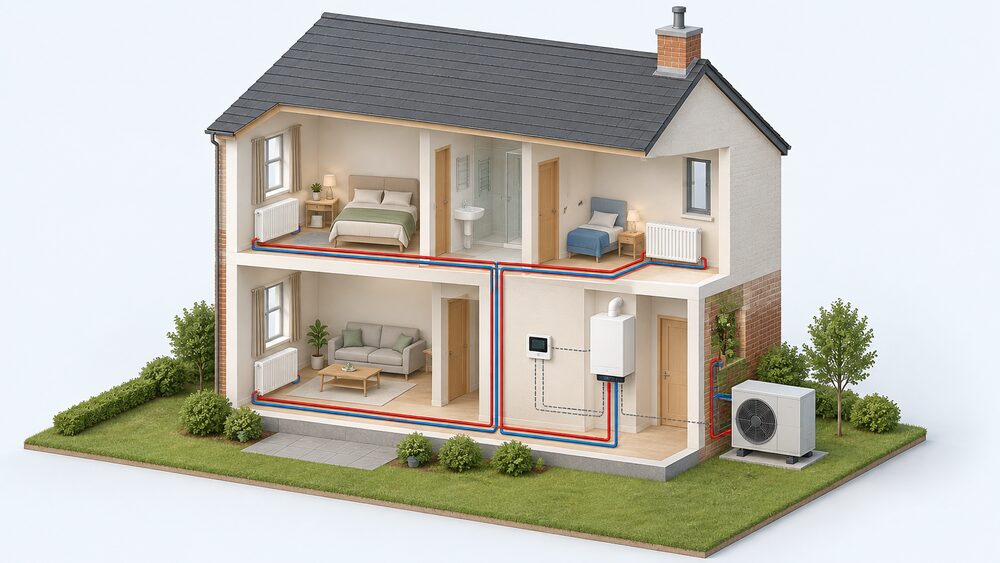
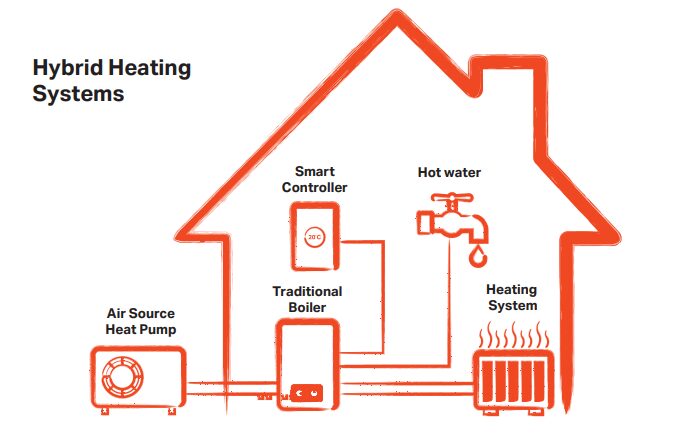
A hybrid heat pump is one heating system built from two appliances: an electric heat pump and a boiler, usually gas, sometimes oil or LPG, with a single control deciding which one runs at any moment1. The most common UK arrangement is an air source electric heat pump working alongside a new or existing gas condensing boiler3. The heat pump does the everyday heating, and the boiler covers the coldest weather, most hot water in combi-based designs, and any hours when gas is the cheaper fuel4.
The numbers that matter to a household are these. Manufacturers recommend the heat pump carries between 70 and 85 per cent of annual heat demand, with the boiler covering the balance5. Industry analysis works on the base assumption that a hybrid operates in heat pump mode up to 80 per cent of the time, and that a hybrid using a smaller heat pump can reduce gas consumption by around 80 per cent while meeting 80 per cent of the household's annual energy demand without changes to the existing wet heating system3. Average hybrid installation cost is put at £8,000 to £9,000, described as two thirds the cost of a typical stand-alone heat pump install at £13,0005. Installation disruption typically lasts around 2 to 5 days6.
The trade-off is stated as plainly by the same sources. A hybrid is not a fully low-carbon technology, it could prolong the gas grid and result in higher future utility bills, and it can mean consumers pay twice to decarbonise6. It also attracts no Boiler Upgrade Scheme grant: scheme rules say a grant cannot be had for a hybrid heat pump system, for example a combination of gas boiler and air source heat pump7. For a household chasing energy independence, a hybrid removes most of the gas burn but keeps the gas connection, the gas standing charge, the supplier relationship and the boiler.
A heat pump and a boiler on one heating circuit
The definition is consistent across gas network, consumer and trade bodies: a hybrid combines two technologies in a single heating system, a heat pump and a gas boiler1, or more broadly a standard heat pump with another heat source, usually a gas, oil or LPG boiler2. Trade guidance defines it as an electric-driven air source heat pump with a new or existing gas condensing boiler, alongside a single control that operates the full system3. Off-grid guidance describes the same principle with a liquid fuel or gas-fired appliance combined with a heat pump on the same system8. Official guidance for Northern Ireland describes hybrid heat pumps as able to work with another heating system in a building, such as a gas boiler9.
Physically, a hybrid consists of an outdoor fan unit, an indoor heat exchanger and a gas boiler6. There are two kinds2:
- Bivalent systems, where a heat pump works alongside another heat source as separate appliances.
- Packaged systems, where the heat pump and boiler are a single unit.
Packaged hybrids are sold as a complete package, with components either integrated into a single product or supplied together, and are used as a replacement system10. A regular hybrid, made up of a regular boiler, hot water cylinder and electric heat pump, gives the design the most room to optimise how the two appliances share the load3.
For the deeper background on the electric half of the system, see air source heat pumps and air-to-water heat pumps.
How the changeover works: temperature, tariff and carbon triggers
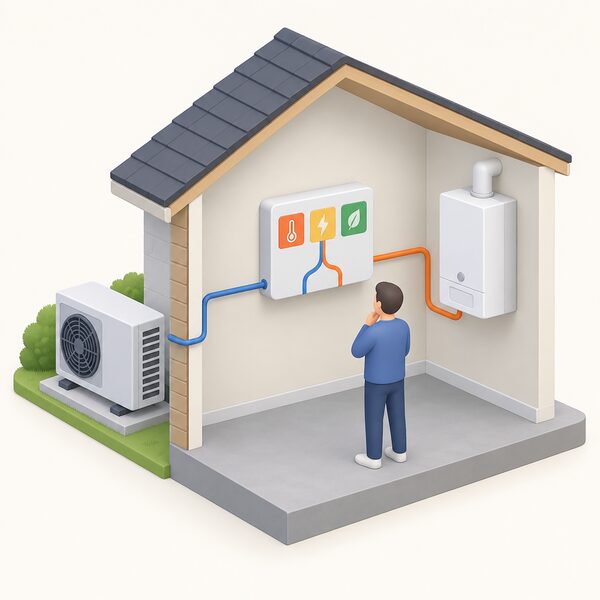
The control is the part that makes a hybrid a system rather than two appliances in a house. Certification body guidance lists the sequential operation triggers used to decide which appliance runs: fuel tariff; external temperature, meaning predicted load; the instantaneous carbon content of the grid; and a combination of predicted efficiency based on external ambient temperature with either the fuel cost or the carbon content11. Consumer guidance describes the same inputs in practice: electricity costs, fossil fuel supply costs, time of day, and whether solar panels are generating or exporting electricity2.
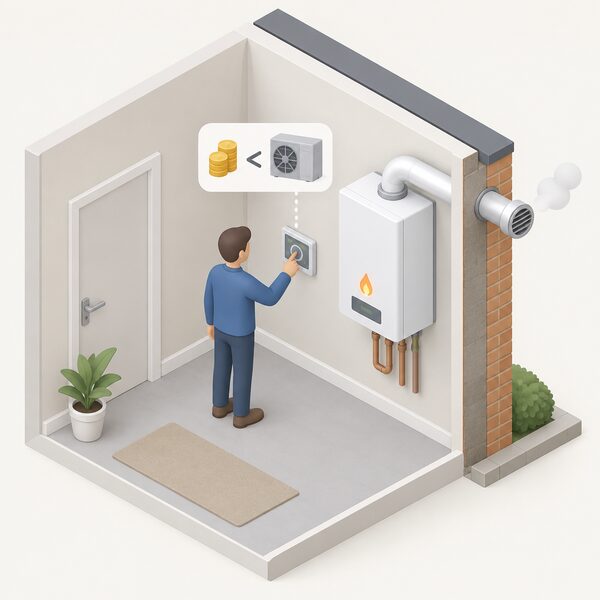
The simplest version is weather-based. An automatic weather compensation programme manages the switch, typically when the temperature falls below 7C12. In operational terms the heat pump alone can be used in milder weather and the boiler can take over, or even run in parallel to the heat pump, in winter when the building's heat load is at its maximum8. Where the control is cost-led, the boiler only turns on when it is cheaper to run than the heat pump, which should lower overall operating costs compared with running either appliance on its own2. A further configuration runs the boiler as a top-up when the heat pump cannot supply the required heat in cold weather, or for hot water, depending on tariff costs2.
Carbon-led switching depends on grid signals rather than the thermostat. Modelling of smart heat pump flexibility found an annual average carbon emissions volume shift of 1.4MWh on a pass-through tariff and 0.7MWh on a tri-rate tariff13. Tariff interactions are not simple: one analysis examined over a million heat pump, tariff and technology combinations14. The practical consequence is that a hybrid's running cost and carbon outcome are set as much by the control logic and the tariff as by the hardware. More on control strategy sits in heat pump controls and smart operation.
Cost: around £8,000 to £9,000 for a hybrid install
The clearest published hybrid figure comes from gas network analysis: average costs are £8,000 to £9,000, which is two thirds the cost of a typical stand-alone heat pump install at £13,0005. That saving comes from the smaller heat pump, the retention of the existing boiler and, in many cases, the ability to leave the existing radiators and pipework alone3.
Full heat pump costs, for comparison, vary widely across published sources, which is worth understanding because the hybrid premium or discount is measured against them.
| Source and date | Full heat pump installed cost |
|---|---|
| Consumer statistics, 2026 | £6,800 to £17,700, average £13,00015 |
| Consumer guidance, August 2026 | around £11,700 on average16 |
| Consumer statistics, November 2024 | approximately £13,000 typical17 |
| Parliamentary committee, May 2024 | £8,000 to £15,000 depending on work needed; average around £11,60018 |
Those documents disagree, and the spread reflects different samples and dates rather than a single true figure. What drives an individual hybrid quote higher is the same set of variables: the scale of the work the home needs, whether a new boiler is fitted at the same time, whether a cylinder is installed, and the electrical and siting work for the outdoor unit. None of these has a published unit price here, so quotes are installer-specific. A comparison of the two routes is set out in is a hybrid heating system cheaper than a full heat pump, and full costs in how much does a heat pump cost in the UK.
Running costs and how much gas a hybrid displaces
The headline operational claim is gas displacement rather than bill reduction. Hybrids using a smaller heat pump can reduce gas consumption by around 80 per cent, and the base assumption is that they can operate in heat pump mode up to 80 per cent of the time3. In a high-quality hybrid installation up to 80 per cent of the annual heating can be provided by the heat pump3.
What that means for money depends heavily on the electricity tariff and on how the control is set. Heat pumps are reported to cost around £800 to £1,050 a year to run, among the cheapest electric heating options19. Switching to a heat pump appropriate tariff is reported to save up to £330 a year on heating bills16, and government campaign material puts smart tariff savings at around £100 per year20. Wider reform figures are modelled rather than observed: with full rebalancing of levies, running a heat pump is modelled at around £420 a year cheaper than a boiler for a typical household using gas21. These figures describe full heat pump systems, not hybrids, so a hybrid household captures a share of them in proportion to the hours the heat pump actually runs, while still paying for the gas it burns.
The most important cost mechanism specific to hybrids is the switching rule itself: where the system reacts to fuel prices, the boiler only turns on when it is cheaper to run than the heat pump2. Consumer guidance says the installer should provide the running costs for the designed system together with the assumptions made about heat pump efficiency, boiler efficiency and fuel prices2. Those assumptions are where a hybrid quote can be interrogated. See also heat pump running costs and heat pump vs gas boiler running costs.
Where a hybrid suits the home
Installers suggest a hybrid for two main reasons: high heat demand, or where a standalone heat pump would not lower energy bills2. Put another way, it is an option where a standard heat pump installation is not suitable but a lower carbon heating system is still wanted2. Hybrids are more common in homes which need more heat to reach a comfortable temperature22.
Several property constraints point the same way. Heat pumps are described as unsuitable for a number of domestic properties, including flats and smaller homes that do not always have the space required23. Terraced streets, tenements and other medium-density homes are identified as places where air source heat pumps are harder to install24. Space for a hot water cylinder is a recurring blocker, and where there is no cylinder space, hybrids are named as one of the options alongside a heat battery or an instantaneous water heater25.
Poor insulation is more nuanced than the common assumption. Heat pumps still work well in homes that have less insulation26, so a hybrid is not automatically the answer for an older house. What a hybrid does is protect the coldest hours with a high-output appliance while leaving the existing hydronic system untouched3.
Off-grid homes are a distinct case. Trade guidance describes off-grid homes as the most difficult to treat, with many owners already supporting their system with secondary heating such as wood burners, and presents hybrids as a practical and affordable solution for both existing on-grid and off-grid homes3. Off-grid guidance confirms that a liquid fuel appliance can be combined with a heat pump on the same system8. Related reading: which homes suit a heat pump.
Retrofit and packaged hybrids, and what happens to a combi
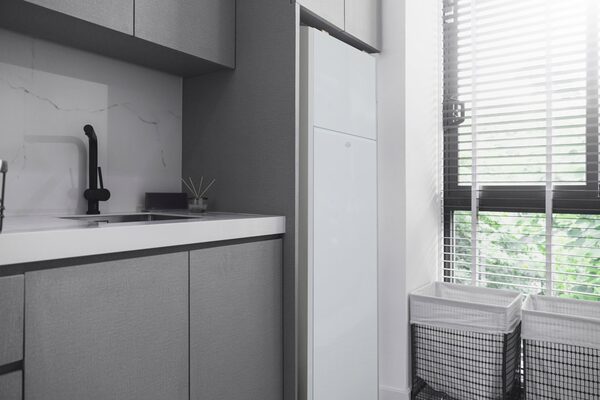
In a retrofit, the heat pump is added to a new or existing gas condensing boiler under one control3. In the hybrid combination arrangement, the existing heat generator is replaced with a hybrid heat pump and intelligent control, with hot water supplied by the boiler and the boiler supporting during cold periods3. Oil and LPG boilers can also be used3.
The hot water question decides much of the design. A heat pump does not provide hot water instantly the way a combi does, so a hot water cylinder is needed27, and most heat pump manufacturers require a cylinder because it lets the heat pump heat water over a longer period and run more efficiently28. Low-temperature, low-carbon solutions generally require a cylinder, while many homes with gas combination boilers do not have one28. In a hybrid, if hot water comes from a combi boiler or instantaneous water heater, no cylinder is needed alongside the heat pump2. That is the single biggest practical difference between a hybrid retrofit and a full conversion in a combi house. See hot water cylinders for heat pumps and heat batteries used with heat pumps.
Emitters usually stay. Heat pumps can work with radiators or underfloor heating29, and the stated hybrid advantage is meeting around 80 per cent of annual demand without changes to the existing hydronic heating system3. Whether that holds in a particular house depends on the heat loss work, covered in radiators and emitters for a heat pump.
Installation: two to five days, and who does the work
Disruption from installation typically lasts around 2 to 5 days6. One gas network hybrid programme reports the system being fully installed within 1 to 2 days, with a smart heating thermostat supplied4; that is a scheme-specific figure for a defined product and not a general expectation.
The work is a two-trade job. Manufacturers recommend annual servicing of hybrid units, which require both gas and electrical skill3, and the same combination of competences applies at installation. The outdoor unit needs a position, a foundation and an electrical supply; the indoor heat exchanger needs to be tied into the existing circuit alongside the boiler; and the single control has to be commissioned so the switching logic behaves as designed. The general installation sequence, including the survey and handover stages, is set out in heat pump installation, with siting rules in where a heat pump outdoor unit can go.
Grants: why hybrids miss out on the Boiler Upgrade Scheme

The Boiler Upgrade Scheme provides a grant to help cover the costs of installing low carbon heating technologies such as heat pumps30. Eligible technologies include air-to-water heat pumps31 and air-to-air heat pumps32. Hybrids are excluded outright.
"You cannot get a grant for a hybrid heat pump system (for example a combination of gas boiler and air source heat pump)."
Independent consumer guidance reaches the same conclusion: a household choosing a hybrid will not be able to apply for BUS funding, and cannot usually apply to the scheme at all for that measure33. Other BUS exclusions include most new build properties, social housing, and a property that has already been given government funding or support for a heat pump or biomass boiler, and there is no grant to replace an existing low carbon heating system34. The grant per heat pump was increased from £5,000 to £7,50035.
Hybrids are not excluded everywhere. Under the Warm Homes schemes, retrofit and packaged hybrids where the heat pump and gas boiler components are in separate units are eligible measures for homes currently heated by mains gas only, and where a new gas boiler is fitted only the heat pump component can receive funding36. Scottish grant and loan terms list a hybrid heat pump with a combined funding maximum of £15,00038. Precedent also exists: under the Green Homes Grant Voucher Scheme, hybrid installations qualified provided the heat pump element could provide the vast majority of the property's space heating demand3.
| Route | Hybrid treatment |
|---|---|
| Boiler Upgrade Scheme (England and Wales) | No grant for hybrid systems7 |
| Warm Homes schemes | Retrofit and packaged hybrids eligible for mains gas homes; only the heat pump component funded where a new boiler is fitted36 |
| Home Energy Scotland grant and loan | Hybrid heat pump listed at £15,000 combined maximum38 |
| Green Homes Grant Voucher Scheme (closed) | Qualified where the heat pump covered the vast majority of space heating demand3 |
Full detail on the schemes in each nation is in heat pump grants and funding across the UK.
Servicing, maintenance and two fuel accounts
Manufacturers recommend annual servicing of hybrid units, requiring both gas and electrical skill3. General consumer guidance is to have a boiler or heat pump serviced every year to make sure it is running properly39. On the heat pump side, an annual service helps it remain clean and ensures it runs efficiently and sounds as quiet as possible40, and typical tasks include cleaning coils, cleaning fan blades, inspecting filters, checking refrigerant level and pressure, and checking that all electrical connections are safe25.
The structural cost of a hybrid is that the household keeps two energy accounts. The gas connection remains, with its standing charge, alongside the electricity supply that now carries most of the heating load. A full conversion can end that: government analysis has put savings at around £234 per year for a typical gas household that opts for smart electricity tariffs and removes the gas meter40. A hybrid household cannot take that step while the boiler is part of the system. This is the central independence trade-off, and it is covered further in heat pumps and household energy independence. More on upkeep sits in heat pump servicing and maintenance.
A transitional technology, and the case against
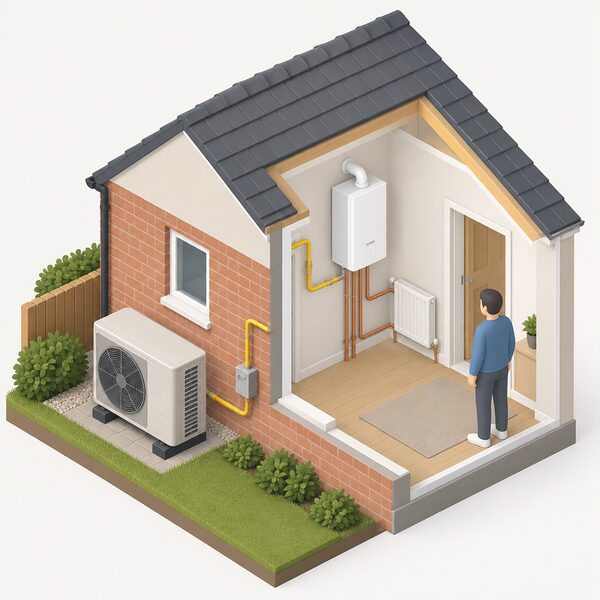
The carbon claims for hybrids are substantial but not total. Trade analysis puts the approach at up to 55 per cent carbon savings as an average across different building types3. Gas network analysis puts the reduction at up to 60 per cent today, rising to around 80 per cent by 2030, and up to 94 per cent if the remaining methane demand is substituted with biomethane or hydrogen5. Research on hybrid appliances suggests they could be a low disruption, low cost pathway to net zero, reducing peak electrical demand by 10 GW compared with air source heat pumps and reducing energy demand by 60 per cent compared with current gas boilers41. For context, official guidance in Wales describes heat pumps as potentially cutting heating carbon footprint by up to 70 per cent42, and Scottish building standards note that heat pumps can limit emissions of carbon dioxide and reduce the use of fossil fuels43.
Delay has its own cost: gas network analysis attributes an additional roughly 11 tonnes of CO2 per household to a five-year delay before switching, from continued gas heating5.
Against that, the objections are explicit. A hybrid is not a fully low-carbon technology, could prolong the gas grid and result in higher future utility bills, and may mean consumers pay twice to decarbonise; it also requires some outdoor space6. The counter-argument from the gas side is flexibility: hybrids are said to adapt the home for both low-electricity and low-carbon gas technologies, including 100 per cent hydrogen, making it easier to introduce future strategy and policy3, and hybrids can be upgraded to an all-electric heat pump, an electric-hydrogen hybrid, an electric-biofuel hybrid, or a heat pump with instantaneous electric backup3. Those upgrade paths depend on decisions not yet made about the gas network, so they should be read as options rather than commitments. Policy direction is tracked in UK heat pump policy, targets and the rules coming.
For the household, the honest summary is this: a hybrid cuts gas burn by around 80 per cent while leaving the gas connection, the boiler and the supplier in place3. It buys warmth security in cold weather and avoids the emitter and cylinder work a full conversion often needs, at roughly two thirds the installed cost of a stand-alone heat pump5, but it carries no Boiler Upgrade Scheme grant7 and it does not deliver energy independence from gas.
Sources43 cited
- Hybrid heat pumps, SGN, 2026
- Hybrid heat pumps advice, Energy Saving Trust, 16 July 2026
- Hybrid heat pumps paper, HHIC, 17 September 2026
- Hybrid heating programme, Cadent Gas, 20 September 2026
- The Future of the Gas Network: recommendations for hybrid heating, Cadent Gas, April 2025
- Hybrid heat pumps: domestic heating technology options, Nesta, 3 February 2025
- Boiler Upgrade Scheme: what you can get, GOV.UK, 17 September 2026
- Your home guide to heat pumps, OFTEC, 17 September 2026
- Heat pumps, nidirect, 24 February 2025
- Domestic hybrid heat pumps, GOV.UK, November 2016
- Domestic Heat Pump Guide, MCS, 2 April 2024
- How to install a heat pump at home, Quiet Mark, 16 October 2020
- Domestic heat pump flexibility modelling, Nesta, 19 November 2024
- Flexible futures: integrating smart tariffs with low-carbon home technologies, Energy Saving Trust, 10 July 2026
- Consumer choice research, Savanta for Cadent Gas, 2026
- Renewable technologies: what really cuts energy bills, Energy Saving Trust, 12 August 2026
- Annual sustainability report: home insulation and heating, Which?, 7 November 2024
- Decarbonising home heating report, Public Accounts Committee, 26 May 2024
- Electric heating advice, Centre for Sustainable Energy, June 2026
- Heat pump campaign, Clean Energy campaign, 10 September 2026
- Cheaper electricity, fairer bills, Nesta, 4 December 2024
- Electrification of Heat: heat pump user guides, Energy Systems Catapult, 22 February 2024
- Government must accelerate sustainable heating, CIPHE, 18 September 2025
- A networked approach to low carbon heat, Nesta, 20 September 2026
- Is now a good time to get a heat pump?, Energy Saving Trust, 12 December 2025
- Heat pumps are suitable for all property types, Energy Saving Trust, 5 April 2024
- Air and ground source heat pumps: retrofit guidance, Croydon Council, 17 September 2026
- Heating and heat pump factsheets, CIBSE, 17 September 2026
- Heating your home, Energy Saving Trust, 19 May 2026
- Boiler Upgrade Scheme guidance for property owners, Ofgem, 3 February 2025
- Boiler Upgrade Scheme: installers, Ofgem, 17 September 2026
- Boiler Upgrade Scheme guidance for installers v5.1, Ofgem, 2 July 2026
- Deciding if a heat pump is right for you, Citizens Advice, 8 December 2025
- Boiler Upgrade Scheme: check if you're eligible, GOV.UK, 17 September 2026
- Assessment of recent announcements and developments on net zero, Climate Change Committee, 12 October 2023
- Warm Homes: Social Housing Fund wave 3 guidance addendum, GOV.UK, June 2026
- Warm Homes: Local Grant policy guidance, GOV.UK, July 2026
- Home Energy Scotland Grant and Loan terms and conditions, Home Energy Scotland, 5 June 2024
- Take control of your heating at home, Energy Saving Trust, 11 September 2026
- Heat pumps explained: experts answer your questions, GOV.UK, 28 March 2024
- Buildings and energy research, CREDS, 2026
- Your essential guide to heat pumps, Welsh Government, 20 February 2025
- Building standards technical handbook 2022: heating, Scottish Government, 1 June 2022
 Replacing a Gas or Oil BoilerSwapping a gas, oil or LPG boiler for a heat pump changes how your home is heated and how much it costs.
 Energy IndependenceA heat pump runs your heating on electricity instead of gas or oil, so how much does that really cut what you pay and how exposed you are when fuel prices jump?
 Heat Pump Running CostsWhat does a heat pump cost to run each year, and is it cheaper than a gas boiler?
 Running Costs by FuelHow the cost of heat compares across mains gas, heating oil, LPG, electricity, solid fuel and heat pumps once efficiency and the price cap are applied.
 Combi BoilersWhat a combination boiler is, how it produces heating and instantaneous hot water from one unit, and the flow rate and mains pressure it depends on.
 Air Source Heat PumpsHow an air source heat pump takes heat from outdoor air, the difference between air-to-air and air-to-water systems, typical efficiency, the £7,500 Boiler Upgrade Scheme grant, noise and planning limits, and what ownership means for a household's energy independence.