In this guide
A heat pump service is an annual visit by a competent engineer who cleans the coils and fan blades, inspects the filters, checks the refrigerant level and pressure, and confirms that the electrical connections are safe1. Independent guidance recommends an annual service for heat pumps, and the same guidance notes that an annual service is often a condition of the heat pump warranty2.
The interval is the same as for a gas boiler. Energy Saving Trust states that heat pumps need about as much maintenance as a gas boiler, and that they are about as much work to maintain as a gas boiler3. What differs is the content of the visit: a heat pump has refrigerant, coils, filters and a compressor that a gas boiler does not, and the checks reflect that.
Reported servicing costs sit around £150 for a typical visit, with one independent guide putting the range at around £150 to £300 depending on the type of heat pump1. Prices are installer-quoted and vary by system type, access and region. The sections below set out what the service covers, when to book it, what keeps a warranty valid, who is allowed to do the work, and how ground source and hybrid systems differ.
What a heat pump service covers
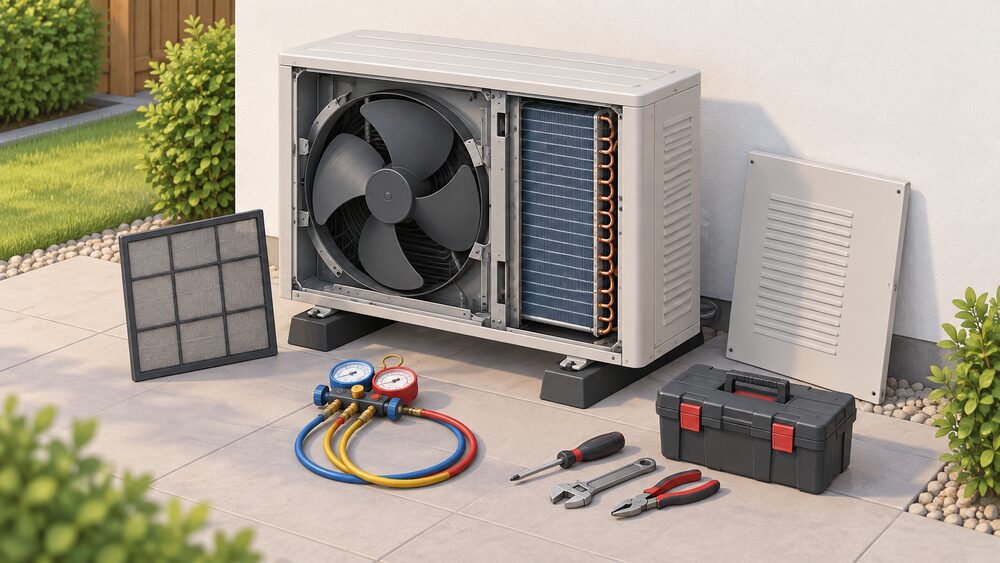
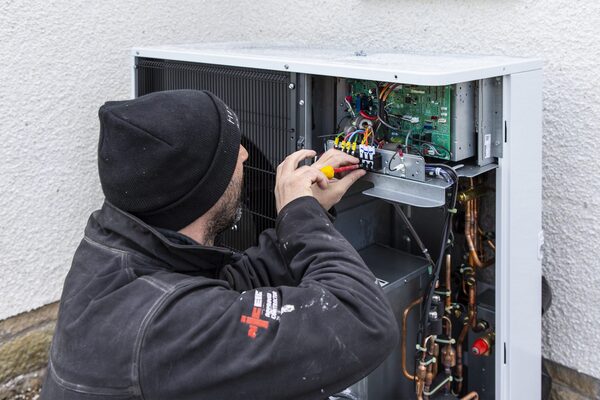
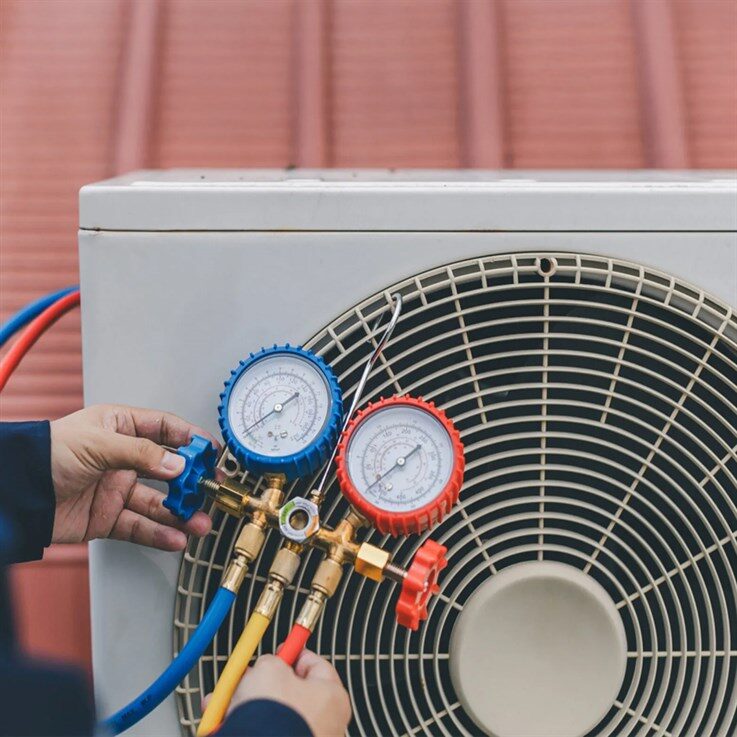
An air source heat pump service typically involves an electrical safety check, checking the thermostat operation, a general visual inspection of the unit, refilling refrigerant if needed, checking for leaks and pressures, cleaning filters and coils, checking all large components such as the compressor, fan and pump, lubricating moving parts, and replacing small parts such as seals and gaskets as per the manufacturer's guidelines1. Energy Saving Trust summarises the same set of tasks as cleaning coils, cleaning fan blades, inspecting filters, checking refrigerant level and pressure, and checking that all electrical connections are safe2.
The refrigerant check is the part that most clearly separates a heat pump service from a boiler service. Refrigerant circuits operate under pressure, and a slow loss of charge reduces performance before it produces an obvious fault. Checking the level and pressure, and looking for leaks, is how that is caught. Refilling refrigerant is listed among the standard tasks where it is needed1.
The cleaning tasks matter for efficiency rather than safety. Coils and fan blades that are fouled with leaves, dust or pollen move less heat, and the outdoor unit works harder for the same output. Filters that are clogged restrict airflow. Both are straightforward to inspect and clean, which is why they appear in every published list of service tasks1.

What the service is not is a repair visit. Where a fault is found, independent guidance advises fixing issues quickly to reduce the risk of the heat pump breaking down in winter9. A common fault is a heating blocked message, which might mean the heat pump is running at temperatures that are too high9. That points to a control or flow temperature setting rather than a failed component, and it is the kind of finding a service is designed to surface before the cold arrives.
How often a heat pump needs servicing, and when to book
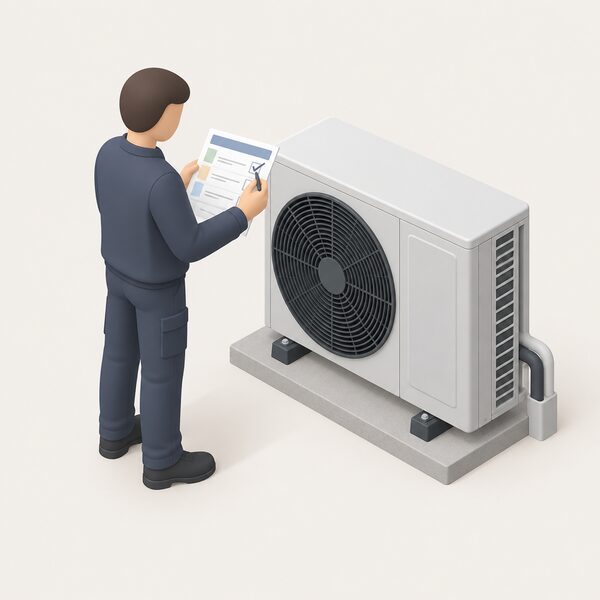
The recommended interval is annual, and the sources agree on it without qualification. Energy Saving Trust advises getting an engineer to service the heat pump according to the manufacturer's advice, usually once a year1. The same organisation states that heat pumps should get a service once a year, and recommends getting a boiler or heat pump serviced every year to make sure it is running properly3. Independent guidance adds the timing: just like a gas boiler, heat pumps should be serviced once a year, preferably before winter5.
That preference for pre-winter booking has a practical basis. A heat pump that fails in January leaves a household without its main heat source at the point of highest demand, and independent guidance notes that a well-designed heat pump system should provide a consistent temperature around the home throughout the year, even during the coldest days5. A service in late summer or early autumn leaves time to order parts or book a return visit before the heating season starts.
Booking early also hedges against diary pressure. Independent guidance notes that, due to the increasing demand for heat pumps, the wait time for a heat pump can be several months11. That figure is given for heat pump work generally rather than servicing specifically, but the same engineer pool serves both, and the shortage of qualified installers noted below affects servicing capacity in the same way.
What a service costs
Reported costs cluster around £150 for a typical visit. Independent guidance states that costs for heat pump servicing vary depending on the type of heat pump, but that a household can typically expect to pay around £1501. A separate independent guide puts the figure at around £150 to £300 per service, again depending on the type of heat pump4.
The spread reflects the work involved rather than regional pricing alone. A monobloc air source unit with an accessible outdoor unit and a straightforward indoor arrangement takes less time than a split system, where the refrigerant circuit is factory-sealed and the engineer's checks are different, or a ground source unit with a larger indoor plant arrangement. Ground source systems also carry a ground array whose commissioning information, including the fluids used and their commissioned concentrations, is provided to the dwelling owner, and that record is part of what a service visit may need to consult12.
Prices are installer-quoted. There is no published national tariff for heat pump servicing, and the figures above are reported ranges from independent guidance rather than fixed prices. Where a household is comparing quotes, the useful comparison is the scope of the visit: whether refrigerant checks, electrical safety checks and filter and coil cleaning are all included, and whether the visit is tied to the warranty terms of the specific unit.
For context on what the equipment itself costs, and how servicing sits within the wider cost of ownership, see how much a heat pump costs in the UK and heat pump running costs.
Why annual servicing keeps a warranty valid
An annual service is often a condition of the heat pump warranty, and independent guidance states this directly2. The maker terms are more specific. Ideal Heating's heat pump warranty states that at the end of each 12-month period after commissioning, the heat pump must be serviced by a suitably competent heat pump engineer in accordance with the process in the manufacturer's instructions, and that should this condition not be met the heat pump warranty will lapse13.
That is a clear statement of consequence, and it is worth reading alongside what the same warranty covers. Ideal Heating states that it will, at its option, repair or replace a heat pump free of charge where it suffers a mechanical or electrical breakdown as a result of defective workmanship or materials13. The warranty does not apply where the registered product is removed from its place of installation without prior consent, to defects caused by inadequate servicing, deliberate action, accident, misuse or third-party interference, to defects caused by the design, installation and maintenance of the central heating system, to de-scaling or hard water scale damage, to damage caused by freezing, to aesthetic degradation not affecting functionality, or to defects from incorrect installation13.
Two further conditions are worth noting. Fitting replacement parts or replacing a heat pump does not extend the period of the warranty13. And heat pumps generally come with warranties lasting two to three years, which can often be extended for a fee4. The interaction between the two is the point: a short warranty that lapses for want of a service is worth less than the paper it is written on, and an extended warranty bought on a unit with a lapsed service record may not deliver what was paid for.
"At the end of each 12-month period after commissioning, the heat pump must be serviced by a suitably competent heat pump engineer"
For the wider picture on how servicing interacts with cover, see does servicing a heat pump affect the warranty.
Who can service a heat pump
Heat pump work is regulated work. Independent guidance states that the installation of heat pumps and associated heating systems is work covered by building regulations and should only be undertaken by competent technicians that have undertaken appropriate training and assessment14. Approved Document L, which sets the standards for dwellings, requires that the person carrying out the work is suitably competent, and that the installer installs and commissions the system to the standards set out in the approved document15.
For a household choosing an engineer, official guidance advises contacting an installer who can provide the necessary advice, preferably one who belongs to either the Microgeneration Certification Scheme or the relevant Competent Person Scheme16. The same advice appears in the Welsh building regulations guidance, which states that installation of either a ground source or air source heat pump will have to comply with the Building Regulations16.
The refrigerant side carries its own competence requirement. Refrigerant handling is a certified activity, and the checks on level, pressure and leaks that form part of a service fall within it. That is the main reason a heat pump service is not a householder task, and it is why the service tasks listed by independent guidance include refrigerant work alongside the cleaning and inspection items1.
Finding an engineer is not always straightforward. Independent guidance notes that there is a shortage of qualified heat pump installers in the UK, so it may be more difficult finding someone to service the system5. The position is improving in some areas: in one independent case study, a householder in a rural off-gas village reported that five or six engineers in the village now offer heat pump servicing, whereas no one was able to service them six or seven years ago18.
Maintenance you can do yourself between services
The tasks that do not touch the refrigerant circuit or the electrical connections are within reach of a householder. Keeping the outdoor unit clear of leaves, debris and obstruction, and checking that filters are clean, addresses the two items that most often degrade performance between visits. Both appear in the published lists of service tasks as cleaning and inspection items1.
Beyond that, the useful household habit is observation rather than intervention. A heat pump that is running longer than usual, or that reports a heating blocked message, is telling the household something. Independent guidance notes that this message might mean the heat pump is running at temperatures that are too high, and advises fixing issues quickly to reduce the risk of a breakdown in winter9. Noting the message and reporting it at the next service, or sooner, is the appropriate response.
There is one operational point worth understanding because it can look like a fault when it is not. Official guidance notes that where a heat pump provides space heating, the heat pump will not provide any space heating until water heating demand is satisfied19. A cylinder reheat cycle that pauses the heating for a period is normal behaviour, not a defect.
For the controls side of running a system well between services, see heat pump controls, weather compensation and smart operation, and for diagnosing problems, heat pump faults and troubleshooting.
Ground source systems: the buried loop needs no routine maintenance
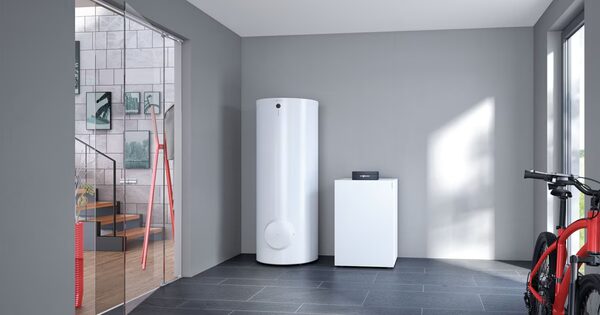
A ground source heat pump, also called a ground-to-water heat pump, transfers heat from the ground outside to heat the home20. Underground temperatures are constant year-round, typically around 10 to 13°C21. The ground array itself is a sealed, buried circuit, and it is not a serviceable item in the way the above-ground plant is.
The regulatory position reflects that. A closed loop ground source system is defined as one that is fully sealed, does not take water from the environment, and does not discharge water or fluids to the environment22. Where a system meets all the exemption conditions, no registration with the Environment Agency is needed6. That is a statement about the loop's environmental isolation, and it is also why the loop has no routine maintenance requirement: there is nothing to top up, filter or clean in normal operation.
What does need attention is the plant inside the house. A ground source heat pump requires space for a compressor and controls, and an internal unit is also needed, often smaller than a standard boiler21. The home will also require space for a hot water cylinder if it does not already have one21. Servicing therefore concentrates on the indoor unit, the cylinder and the heating circuit, with the ground array left alone.
Commissioning records matter here. Commissioning information provided to the dwelling owner should include details of the fluids used and their commissioned concentrations12. Ground arrays, including header pipes and manifolds, should be flushed as one system to remove all debris and purged to remove all air, and a pressure test in accordance with BS EN 805, section 11.3.3.4 should be conducted12. Those are installation-stage requirements, but the records they generate are what a later service visit or a fault investigation will refer to.
For the loop itself, see ground loops and boreholes for ground source heat pumps, and for the systems, ground source heat pumps explained.
Servicing hybrid systems: both appliances need attention
A hybrid heat pump system pairs a heat pump with another heat source. Energy Saving Trust describes bivalent systems as a heat pump working alongside another heat source, and notes there are two kinds of hybrid system: bivalent systems and packaged systems23. Official guidance from Northern Ireland states that hybrid heat pumps can work with another heating system in a building, such as a gas boiler24.
The servicing consequence is that both appliances need attention. Manufacturers recommend annual servicing of hybrid units, which require both gas and electrical skill25. That is a different competence profile from a standalone heat pump service, and it means the engineer attending must be qualified on the gas side as well as the heat pump side. Heat pump and hybrid controls can be fitted to different heat sources and boiler types such as regular or combination boilers, so the boiler in a hybrid arrangement is not necessarily a new one25.
How the two appliances share the load varies. The heat pump alone can be used in milder weather and the boiler can take over, or even run in parallel to the heat pump, in the winter when the building's heat load is at its maximum14. Some hybrid heat pumps are designed so that the heat pump provides heating2. Installers suggest hybrid systems for two main reasons: high heat demand, or a situation where a standalone heat pump would not lower energy bills23.
For a household, the practical point is that a hybrid system carries two service obligations rather than one, and the annual visit needs to cover both. For the wider comparison, see hybrid heat pumps: heat pump and boiler together.
Service cover plans: what ongoing cover funds
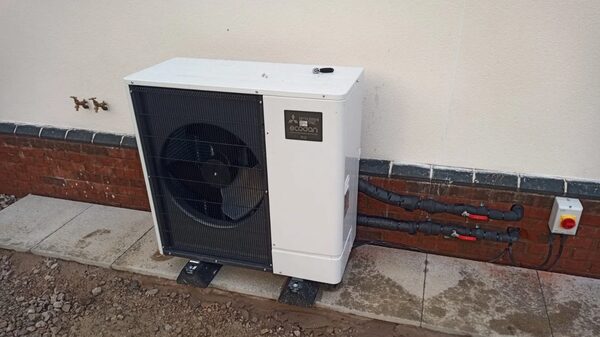
Service cover plans exist for heat pumps as they do for boilers. One published plan covers the air-source heat pump and installation pipework26. That scope statement is the useful part: cover is defined by what is included, and the pipework between the unit and the rest of the system is part of it.
The distinction between a service plan and a warranty matters. A warranty is the maker's obligation on the product, conditional on the service record. A service plan is a contract for the work itself. Ideal Heating's terms illustrate the warranty side: repair or replacement free of charge applies where the heat pump suffers a mechanical or electrical breakdown as a result of defective workmanship or materials, and fitting replacement parts or replacing a heat pump does not extend the warranty period13.
For a household weighing cover, the questions that decide value are the same ones that decide a one-off service: what the visit includes, whether refrigerant and electrical checks are in scope, whether the plan satisfies the maker's annual service condition, and what happens if a fault is found that the plan does not cover. The last of these is where the warranty and the plan meet, and where the exclusions listed in the maker's terms become relevant13.
The grant funds installation, not servicing
The Boiler Upgrade Scheme provides upfront capital grants to support the installation of heat pumps and biomass boilers in residential and non-residential properties8. It does not fund ongoing servicing. A ground source heat pump attracts £7,500, including water source heat pumps and those on shared ground loops, and the voucher is valid for six months7.
Take-up figures give a sense of scale. Cumulative ground source heat pump voucher applications received in England and Wales from May 2022 to July 2026 were 2,388, with 2,024 vouchers issued and 1,567 redemptions paid28. The median reported installation cost for a ground source heat pump in 2026 Q2 was £27,232 including the grant value, at a median capacity of 10.5 kW, with a lower quartile of £18,136 and an upper quartile of £42,11028.
For the full picture on grants across the four nations, see heat pump grants and funding across the UK.
What servicing means for a household's energy independence
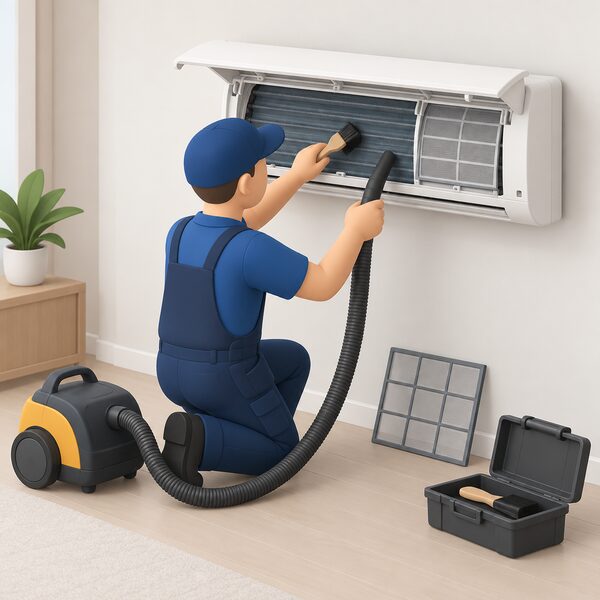
A heat pump moves a household's heating off gas and onto electricity, which changes where the dependence sits rather than removing it. The system still draws on the grid, and it still depends on a manufacturer for parts and on a qualified engineer for refrigerant work. Servicing is the point at which that dependence becomes visible: the annual visit is what keeps the warranty alive, and the warranty is what stands between a household and the full cost of a compressor or control failure13.
What servicing protects is the performance the household paid for. Coils and filters that are cleaned, refrigerant that is checked, and electrical connections that are verified all keep the unit running at the efficiency it was specified for1. A ground source system adds a further degree of independence, because the ground array is a sealed buried circuit with no routine maintenance requirement and no registration needed where it meets all the exemption conditions6. The heat itself comes from the ground rather than from a delivered fuel.
The residual dependencies are real and worth stating plainly. There is a shortage of qualified heat pump installers in the UK, which affects servicing capacity as well as installation5. Refrigerant handling is a certified activity, so the household cannot take the whole task in-house1. And the warranty terms are set by the maker, with the annual service condition and the exclusions that accompany it13. Servicing does not remove those dependencies; it is how a household keeps them from turning into a breakdown in January.
Sources28 cited
- Heat pump questions answered, Energy Saving Trust, 2026-05-27
- Is now a good time to get a heat pump, Energy Saving Trust, 2025-12-12
- Moving house energy checklist, Energy Saving Trust, 2026-05-01
- Living with a heat pump, Home Energy Scotland, 2024-02
- Heat pump fact check, Energy Saving Trust, 2026-07-01
- Closed loop ground source heating and cooling systems: exemption conditions, HM Government, 2023-10-02
- Apply for the Boiler Upgrade Scheme: what you can get, HM Government, 2026-09-17
- Boiler Upgrade Scheme guidance for installers v5.1, Ofgem, 2026-07-02
- How to ensure a heat pump runs efficiently, Energy Saving Trust, 2026-05-19
- Take control of your heating at home, Energy Saving Trust, 2026-09-11
- Heat pump installation: a step by step guide, Energy Saving Trust, 2026-07-15
- Approved Document L, Volume 1: consultation version, Welsh Government, 2026-09-17
- Extended warranty terms and conditions, Ideal Heating, 2026
- Your home guide to heat pumps, OFTEC, 2026-09-17
- Approved Document L, Volume 1: Dwellings, HM Government, 2026
- Building regulations: heat pumps, Welsh Government, 2026-09-17
- Heat pumps: building regulations, Planning Portal, 2026-09-17
- Air source heat pump for a rural off-gas home, Energy Saving Trust, 2026-01-05
- Heat pump methodology, HM Government, 2026-01
- Ground source heat pumps, Energy Saving Trust, 2026-07-16
- Heat pump myths, Energy Saving Trust, 2025-09-02
- Closed loop ground source heating and cooling systems: when you need a permit, HM Government, 2023-10-02
- Hybrid heat pumps, Energy Saving Trust, 2026-07-16
- Heat pumps, nidirect, 2025-02-24
- Hybrid heat pumps, HHIC, 2026-09-17
- HomeServe boiler cover, Uswitch, 2026-09-17
- Boiler Upgrade Scheme guidance for installers V5, Ofgem, 2026-04-28
- Boiler Upgrade Scheme statistics, July 2026, HM Government, 2026-08-27
 Faults and TroubleshootingWhat to check when a heat pump stops working, how to read fault logs and error codes, why short cycling happens, what servicing and warranty cover, and which refrigerant and F-gas rules apply.
 The Full Heat Pumps GuideWill a heat pump keep my house warm in winter, and what does one cost to buy and run?
 Sizing and Heat LossHow do installers work out what size heat pump your home needs, and why can a unit that is too big cost more to run than one that is slightly small?
 Heat Pump Running CostsWhat does a heat pump cost to run each year, and is it cheaper than a gas boiler?
 Heat Pump Electricity TariffsA heat pump tariff gives you cheaper electricity for part of the day, so running your heating costs less than on a standard rate.
 Controls and Smart OperationWhy does a heat pump need different controls from a boiler, and what does weather compensation actually do?