In this guide
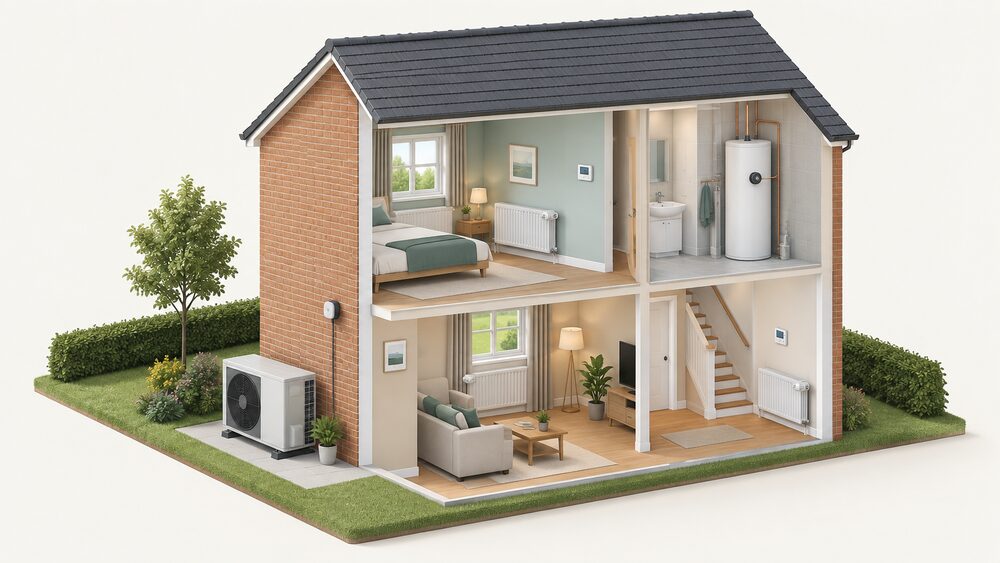
Heat pump controls decide when the compressor runs, what temperature water leaves the unit and how the system responds to the weather. They are not a boiler programmer with a different badge. A heat pump is managed through a thermostat and controller, which may be built in or separate, and the controller adjusts heating schedules, flow temperatures and hot water settings while the thermostat signals when heating is needed1. Efficiency depends on system design, operating temperatures, building fabric performance, emitter sizing, controls strategy and commissioning quality, so the control layer is one of the levers that decides whether a well-specified unit performs as designed2.
The central control idea is weather compensation: altering the temperature of the water flowing to the heating circuit in relation to the measured outdoor temperature3. Mild weather means a lower flow temperature, cold weather a higher one. Because a heat pump's efficiency rises as flow temperature falls, running the circuit as cool as the weather allows is the main efficiency mechanism a household controls. Independent guidance describes heat pumps as best suited to buildings with good insulation levels, with insulation added internally or externally where levels are poor4.
Costs frame the stakes. Running cost makes up approximately 55 to 65% of the total cost of a heat pump over its lifetime, against roughly 15 to 20% upfront and 20% for installation, under current policy and market conditions5. Installation itself is quoted between £8,000 and £15,000 depending on the work needed to the home6. Controls sit inside that running-cost share, which is why the settings, the curve and the tariff matter more over fifteen years than the badge on the outdoor unit.
What heat pump controls actually do
A control system has three jobs: decide when the heat pump runs, decide how hot the water it makes should be, and decide whether that water goes to the radiators, the underfloor circuit or the cylinder. Heating controls help control when the heating system operates and the temperature in each room9. On a heat pump, the controller adjusts the heating schedules, flow temperatures and hot water settings, while the thermostat signals when heating is needed1. The two roles are often split between a wall unit and an outdoor sensor, or combined in one box.
The heat pump itself is a versatile system capable of providing heating, cooling and hot water for homes, commercial buildings and industrial applications2. It moves heat from the air or ground and raises its temperature via a refrigeration cycle before transferring it to the central heating system10. Controls do not change that physics; they change the temperatures and timings at which it happens. Independent guidance notes that heat pumps can also provide both space and water heating, which significantly lowers fuel bills, and that the heat gathered is usually applied to space heating and hot water11.
The installer's role in the control layer is explicit. Installer responsibilities include helping with heating controls and performance and helping set up the system to run on a preferred schedule12. That handover is where the curve, the schedule and the hot water priority are set, and it is the point at which a household can ask what the flow temperature is doing and why.
| Control element | What it does | Where it sits |
|---|---|---|
| Controller | Adjusts heating schedules, flow temperatures and hot water settings1 | Built in or separate wall unit |
| Room thermostat | Signals when heating is needed1 | Living area or hallway |
| Outdoor sensor | Feeds measured outdoor temperature to the weather compensation curve3 | External wall |
| Thermostatic radiator valves | Control temperature in each room9 | On radiators |
| Cylinder thermostat | Controls stored hot water temperature9 | On the hot water cylinder |
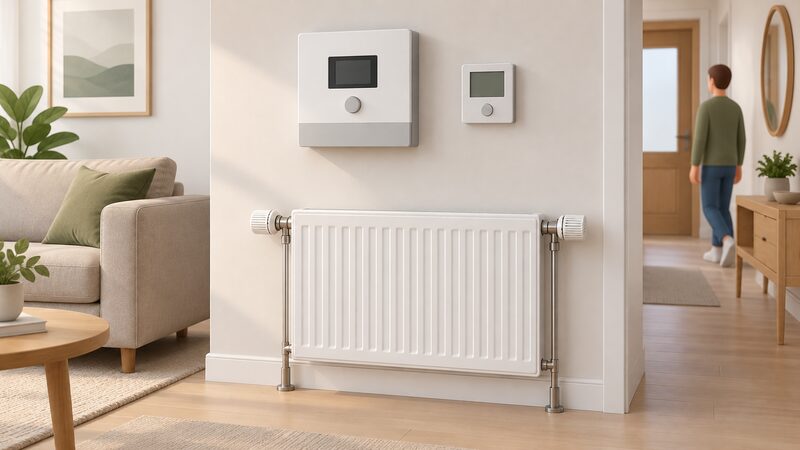
Weather compensation: lower flow temperature in mild weather, higher in cold
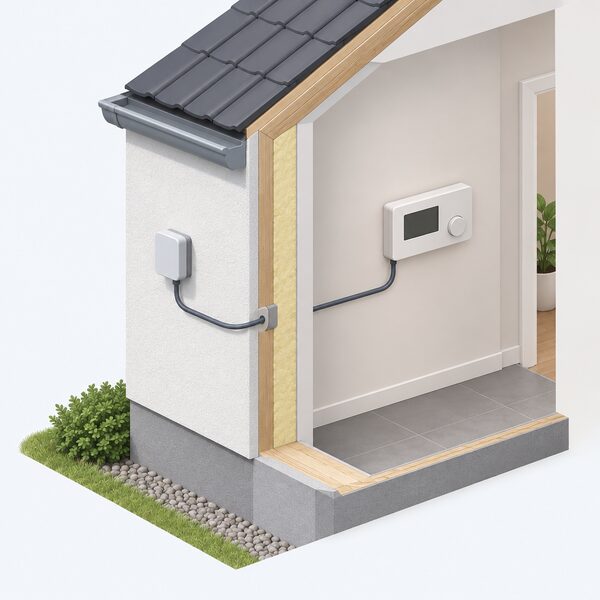
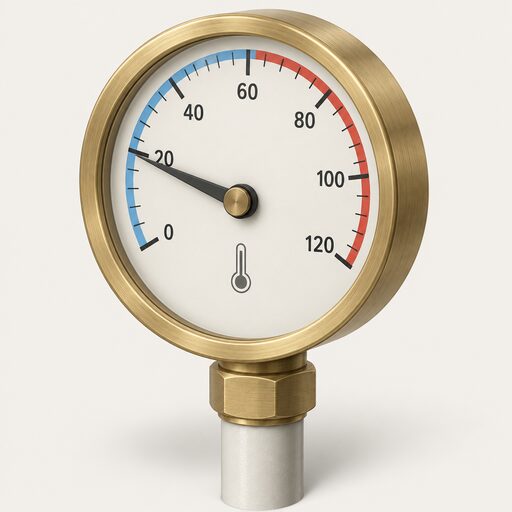
Weather compensation is the single most important control setting on a hydronic heat pump. Official guidance describes it as altering temperature flow from the boiler in relation to the measured outdoor temperature3. The same principle applies to a heat pump: the outdoor sensor tells the controller how hard the building is losing heat, and the controller sets the flow temperature accordingly. In mild weather the circuit might run at a low temperature; in a cold snap the controller raises it.
The reason this matters is that heat pump efficiency is temperature-dependent. Efficiency depends on system design, operating temperatures, building fabric performance, emitter sizing, controls strategy and commissioning quality2. A fixed high flow temperature wastes energy in mild weather, when a lower one would have kept the house warm. A curve that is set too low leaves the house cold on the coldest days. The curve is therefore a compromise tuned to the building, the emitters and the household's comfort expectation.
Emitters set the ceiling. Heat pumps can work with radiators or underfloor heating, but some types can work without either13. Underfloor heating typically allows lower flow temperatures than radiators, which is why it pairs well with weather compensation. Where radiators are undersized for a low flow temperature, the curve has to run hotter, and efficiency falls. That is a design question rather than a controls question, but the two are inseparable in practice.
Smart controls that learn the home
Smart heating controls are connected to the internet and offer more functionality than conventional controls9. That extra functionality takes several forms. They may interpret what is input, such as a preferred room temperature, learn from what the household does, react to other data such as weather forecasts, and some have a learning function that predicts behaviour from how heating is set and adjusted and how the home is occupied14. Ground source heat pumps can also be synced up with smart heating controls to create a system that benefits the household most15.
The distinction between a smart thermostat and a heat pump controller matters. A smart thermostat that simply switches the heat pump on and off can work against weather compensation, because it interrupts the steady low-temperature operation the machine is designed for. Independent guidance supports automated controls that optimise performance16. The better arrangement is a smart layer that adjusts the flow temperature or the schedule rather than one that cycles the compressor.
One documented example is the Passiv Smart Thermostat, described as new heat-pump controls to be launched in 2024, delivering an Energy Saving Trust validated COP improvement of 17%, with no service fee17. That is a maker-linked claim for a specific product, and the figure applies to that control rather than to smart controls generally.
Tariff optimisation and solar integration
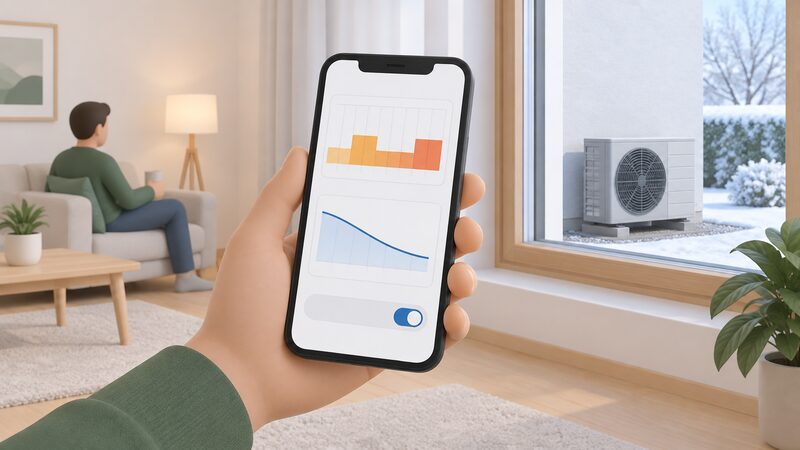
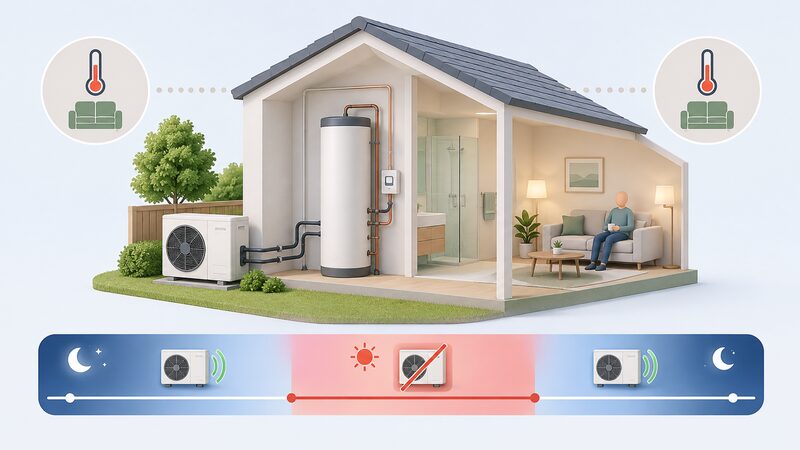
Running a heat pump on the cheapest electricity is a control problem as much as a tariff problem. Official guidance notes that additional savings are possible with flexible electricity tariffs, and that reducing the price of electricity relative to gas would make heat pumps more competitive18. Independent guidance frames the same point operationally: allowing heating to run at times when electricity is cheaper through time of use tariffs and the demand flexibility service, and minimising exposure to peak electricity prices16.
Apps and thermostats exist that automatically optimise a heat pump's schedule with the energy tariff12. Heat pumps can keep homes comfortable on smart tariffs by heating steadily at times when electricity is cheaper, without noticeable change for most households12. Heat pumps can also be remotely controlled to shift energy use and cut costs1. The mechanism is pre-heating the fabric and the cylinder during cheap hours rather than running hard during expensive ones.
Solar changes the calculation again. Some hybrid systems have controls that automate when and how the heat pump runs based on electricity costs, fossil fuel supply costs, time of day, and whether solar panels are generating or exporting electricity19. For a solar household, the cheapest kilowatt hour is the one that would otherwise have been exported, so a control that can see generation is worth more than one that only sees the clock.
Demand-side response and grid flexibility payments
Demand-side response exists to manage peak demand, to reduce the amount of network investment required to meet an increasing electricity demand caused by the electrification of heating and transportation, and to match demand with the output of renewable electricity generation, which tends to be intermittent20. A heat pump with a cylinder and a well-insulated building is a natural candidate: it can store heat as hot water or as warmth in the fabric, then stop drawing power at peak.
How a heat pump behaves under external control depends on its type. Fixed capacity control heat pumps cycle on and off in proportion to the energy demand and thermal capacity21. Variable capacity control heat pumps modulate, and official methodology sets a minimum modulation rate input temperature of 35°C for heat pumps with wet distribution as a required input21.
Scheme rules increasingly require controls that can prioritise the heat pump. For retrofit and packaged hybrids, the controls must be capable of prioritising heat pump utilisation, and the product must be listed on the MCS product directory and fulfil MIS 3005-D requirements22. That is a condition of support rather than a consumer choice, and it pushes the market towards controls that can demonstrate which source ran and when.
Thermostats, timers and zone control

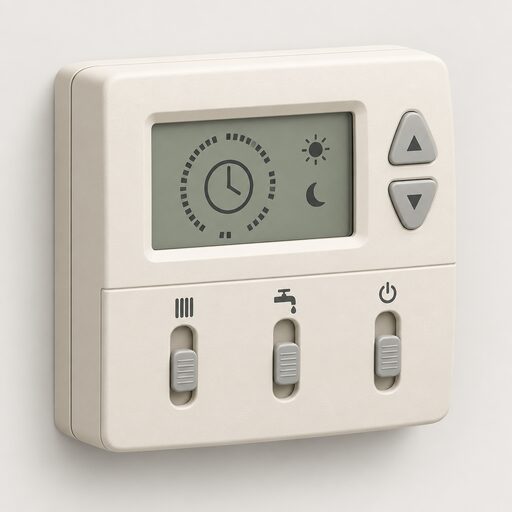
The conventional control set remains the baseline. Recommended controls are a time-controlled programmer, at least one room thermostat, thermostatic radiator valves if there are radiators, and a cylinder thermostat if the system has a hot water cylinder9. For central heating systems such as boilers, the minimum core controls are a programmer, at least one room thermostat and thermostatic radiator valves9. A heat pump system needs at least this much, plus the weather compensation sensor and a controller that understands the cylinder.
Zoning is where the two worlds diverge. Time and temperature zone controls enable independent programming of temperature and heating times in at least two different areas or zones of a premises23. Zoning can suit a house with distinct occupancy patterns, but on a heat pump it can also reduce the water volume available to the circuit and force higher flow temperatures in the zones that remain open. The controls are capable; whether zoning helps depends on the building.
Most smart heating controls link to a phone, and heating can be controlled via smartphone, tablet or laptop, or by telling a smart speaker what is wanted14. Remote control is convenient, but it is not the same as optimisation. A household that adjusts the thermostat by app several times a day is doing manually what a weather compensation curve and a schedule would do automatically.
Compatibility with heat pump makes and systems
Control compatibility is less about brand and more about architecture. Heat pumps can work with radiators or underfloor heating, but some types can work without either13. Ground source heat pumps can be synced up with smart heating controls15. Hybrid systems are the most control-dependent of all: a hybrid heat pump is the combination of an electric-driven air source heat pump with a new or existing gas condensing boiler alongside a single control that operates the full system24.
Independent guidance states that heat pump and hybrid controls can be fitted to different heat sources and boiler types such as regular or combination boilers24. Official guidance for Northern Ireland describes hybrid heat pumps as able to work with another heating system in a building, such as a gas boiler25. A hybrid system uses intelligent controls to determine the most efficient way to heat a home26. In one configuration, the existing heat generator is replaced with a hybrid heat pump and intelligent control, with hot water supplied by the boiler and the boiler supporting during cold periods24.
For a single-technology installation, the practical compatibility questions are whether the controller can manage a cylinder, whether it accepts an outdoor sensor, and whether it exposes a demand-response input. The Vaillant aroTHERM plus, Ideal Logic Air and Grant Aerona 290 pages cover the maker-side control options for those ranges, and the hybrid heat pumps page covers the two-source case in more detail.
Cost, installation and ongoing charges

Heat pump installation costs are higher than gas boilers, in part due to the need for additional retrofitting18. The cost of a heat pump installation also depends on the size of the property, whether it is a new build or an existing house, and how much work is needed to adapt the existing heating system10. Controls are part of that adaptation: a cylinder thermostat, a weather sensor, a new controller and any zoning hardware all sit inside the installation scope.
Official cost modelling includes one-off installation costs including some home retrofit costs such as replacing radiators27. Ground and water source heat pumps carry an average installation cost close to £25,000, reflecting the ground works rather than the controls15. For air source systems, the quoted range for installing a heat pump is between £8,000 and £15,000 depending on the work that needed to be done to the home6.
Ongoing charges vary by product. Some controls carry no service fee, as documented for the Passiv Smart Thermostat17. Others are sold alongside a tariff: one supplier offers heat pump installation plus a Heat Pump Plus add-on, giving cheaper electricity rates for the energy the heat pump uses28. That is a commercial arrangement rather than a control requirement, and it should be read as a tariff product.
What users report
Independent research gives a mixed but broadly positive picture, with controls the weakest spot. In a survey of heat pump users, respondents were satisfied with safety at 92%, reliability at 85% and hot water heating at 89%7. Satisfaction with ease of use and control was lower: heat pump users reported 74% fairly or very satisfied, against 88% of gas boiler users similarly satisfied7. The gap is about the interface and the mental model, not the heat.
| Measure | Heat pump users | Gas boiler users |
|---|---|---|
| Satisfied with safety | 92%7 | Not reported |
| Satisfied with reliability | 85%7 | Not reported |
| Satisfied with hot water heating | 89%7 | Not reported |
| Fairly or very satisfied with ease of use and control | 74%7 | 88%7 |
Continuous running suits the technology and the people living with it. Participants who adopted continuous heating patterns were consistently highly positive about their experience and levels of comfort32. That finding runs against the boiler habit of short morning and evening bursts, and it is the behaviour a weather compensation curve is designed to support.
Automation is accepted more readily than might be expected. In the HeatFlex trial, of the 15 interviewees, 14 reported being very comfortable with the remote automation of their heat pump8. A separate study interviewed 10 people who either had heat pumps or had seriously considered them, using mock-ups of guarantee arrangements33. A large-scale survey of 2,500 heat pump owners and 1,000 gas boiler owners was conducted by innovation agency Nesta and Eunomia Research and Consulting28.
What controls mean for energy independence
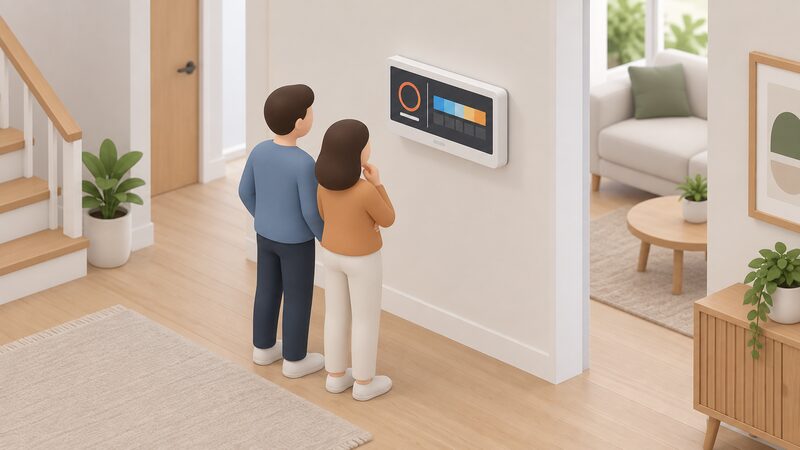
Controls are where a household's independence is won or lost, because they decide how much of the running cost is unavoidable. A well-set weather compensation curve, a schedule matched to the tariff and a cylinder that charges when electricity is cheap all reduce exposure to peak prices and to imported gas. Official guidance notes that additional savings are possible with flexible electricity tariffs18. Independent guidance frames the same lever as minimising exposure to peak electricity prices16.
The dependence that remains is real. A heat pump still draws grid electricity, still relies on a supplier and a tariff, and a smart layer still relies on a manufacturer's app and cloud service for remote functions. The controller and the outdoor sensor work locally, so heating continues without broadband, but tariff optimisation, learning functions and remote scheduling do not. Where a control is sold with a subscription or a bundled tariff, that is a continuing commercial relationship rather than a one-off purchase.
For a household weighing a hybrid, the control layer is the whole proposition. A hybrid heat pump is a system that uses a standard heat pump with another heat source, usually a gas, oil or LPG boiler19. Hybrid heat pumps combine two technologies in a single heating system: a heat pump and a gas boiler26. Independent guidance recommends that support should include both integrated and non-integrated appliances, and both new and existing gas condensing, LPG or oil boilers using a single hybrid intelligent control24. Hybrid heat pumps are recognised as a practical and affordable solution for both existing on-grid and off-grid homes24. The trade-off is that a hybrid keeps a gas or oil dependence in place, and the control decides how often that dependence is exercised.
Sources33 cited
- Does turning off the heat pump affect heating, Nesta, 2025
- Heat pumps campaign, CIBSE, 2026
- Thermostats and heating controls, Home Energy Scotland, 2026
- Heat pumps, New Forest District Council, 2026
- Energy in buildings and industry, Department for Energy Security and Net Zero, 2025
- Heat pump installation costs, Public Accounts Committee, 2024
- Heat pumps: a user survey, Nesta, 2023
- HeatFlex: the untapped potential of automated heat pump flexibility, Nesta, 2024
- Thermostats and heating controls, Energy Saving Trust, 2026
- In-depth guide to heat pumps, Energy Saving Trust, 2026
- Heat pumps, REA, 2026
- How smart meters work with heat pumps, Smart Energy GB, 2026
- Heating your home, Energy Saving Trust, 2026
- Smart homes and lower carbon footprint, Energy Saving Trust, 2026
- Ground and water source heat pumps, MCS Certified, 2026
- Smart meters, MCS Certified, 2026
- Heat Pump Ready Programme stream 2 wave 2 projects, Department for Energy Security and Net Zero, 2026
- Heat pumps and the grid, UK Parliament POST, 2026
- Hybrid heat pumps, Energy Saving Trust, 2026
- Demand-side response, UK Parliament POST, 2026
- HEM heat pump methodology, Department for Energy Security and Net Zero, 2026
- WHSHF wave 3 scheme guidance addendum, Department for Energy Security and Net Zero, 2026
- ECO4 new measures and products guidance, Ofgem, 2026
- Hybrid heat pumps guidance, HHIC, 2026
- Heat pumps, nidirect, 2025
- Hybrid heat pumps, SGN, 2026
- F-gas regulation de minimis assessment, Defra, 2025
- Heat pumps vs boilers, Which?, 2025
- Boiler Upgrade Scheme: installers, Ofgem, 2026
- Approved Document L Volume 1 consultation, Welsh Government, 2025
- Approved Document L Volume 1: Dwellings, Ministry of Housing, Communities and Local Government, 2026
- Heat pump transition report, Climate Change Committee, 2026
- Would performance guarantees increase consumer confidence in heat pumps, Nesta, 2026
 Weather Compensation ControlsDoes your boiler or heat pump run hotter on cold days and cooler when it is mild?
 Controls, Thermostats and TRVsWhich heating controls actually cut your bills, and what does each one do?
 Heat Pump Electricity TariffsA heat pump tariff gives you cheaper electricity for part of the day, so running your heating costs less than on a standard rate.
 Controls and Time-of-Use TariffsCheaper electricity at night only saves money if your heating actually uses it then.
 Servicing and MaintenanceHow often does a heat pump need servicing, and what actually happens during the visit?
 Installing Heating ControlsSwapping a thermostat or programmer looks simple, but which jobs can you safely do yourself and which need a registered installer?