In this guide
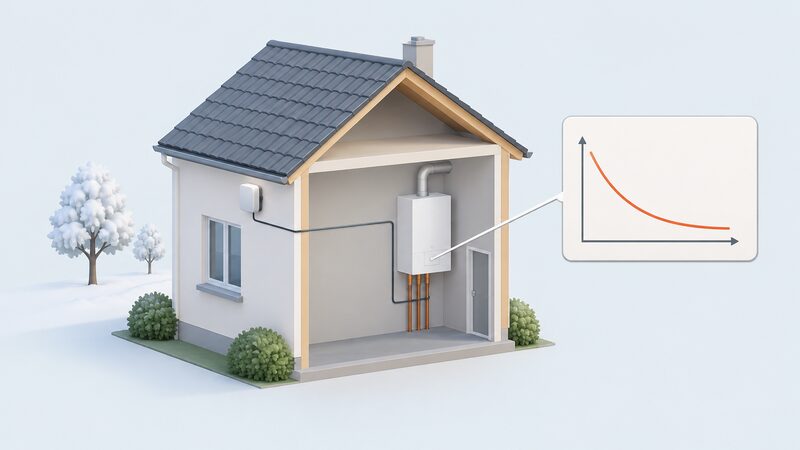
Weather compensation is a control function that measures the temperature outside a dwelling and varies the temperature of the water the boiler or heat pump sends to the radiators or underfloor circuits in response. When it is cold outside the flow temperature rises; when it is mild the flow temperature falls, because the building is losing less heat and needs less. The relationship between the two is set by a heating curve, sometimes called an outdoor reset curve, and it is that curve, not a simple on and off switch, that decides how hard the appliance works1.
For a household the practical point is flow temperature. Official guidance in England expects a newly installed or fully replaced wet heating system to be sized so it can operate at a maximum flow temperature of 55°C or lower2, while the 2026 Welsh Approved Document L sets 45°C or lower3. Heat pumps are commonly designed around a flow of 45°C with a return of 40°C4. Weather compensation is the mechanism that lets a system sit below its design flow temperature for most of the heating season rather than only at the coldest hour of the coldest day.
It is also a regulatory building block. Weather compensation is one of the additional energy efficiency measures a new combination boiler installation can use to satisfy Boiler Plus in England, and Approved Document L lists weather compensation or internal temperature control, plus a timer or programmer, as the minimum control provision for a heat pump2. Ofgem's ECO4 guidance defines it as altering temperature flow from the boiler in relation to the measured outdoor temperature, with a means for automatically measuring local outdoor temperature5.
What weather compensation does to the flow temperature
The function has two parts. The first is a means of automatically measuring local outdoor temperature. The second is control functionality that varies the boiler flow temperature in relation to that measured outside temperature8. Put together, they produce a heating system whose water temperature tracks the weather instead of sitting at a fixed setting all winter.
The Centre for Sustainable Energy describes the effect in the plainest terms: a weather compensator adjusts the boiler temperature in line with the outside temperature, so it uses less fuel when it is warmer outside9. The Heating and Hotwater Industry Council sets out the same mechanism as communication between the boiler and an outside temperature sensor, or internet weather data, adjusting the radiator circulating temperature to be hotter when the outside temperature is colder and lower in milder weather10. The aim is to match the heat supplied to the heat the building is losing11.
Three consequences follow. Flow temperature falls whenever outdoor conditions allow. Cycling reduces, because the appliance runs more steadily instead of firing hard and shutting off. And comfort becomes more stable, because heat supply is matched to heat loss rather than corrected after the room has already drifted12. One manufacturer summarises the practical result as improved efficiency through lower operating temperatures and reduced cycling13.
Weather compensation is a base control strategy, not a complete one. Control documentation for heat pumps lists it alongside room control or thermostat logic, time schedules, zoning, domestic hot water control, anti-cycling logic, pump and valve control, and backup heater logic12. It sets the temperature of the water; something else still decides when heating is called for and how individual rooms are trimmed, which is the job of a room thermostat and thermostatic radiator valves.
How the control senses the weather: outdoor probe or internet data
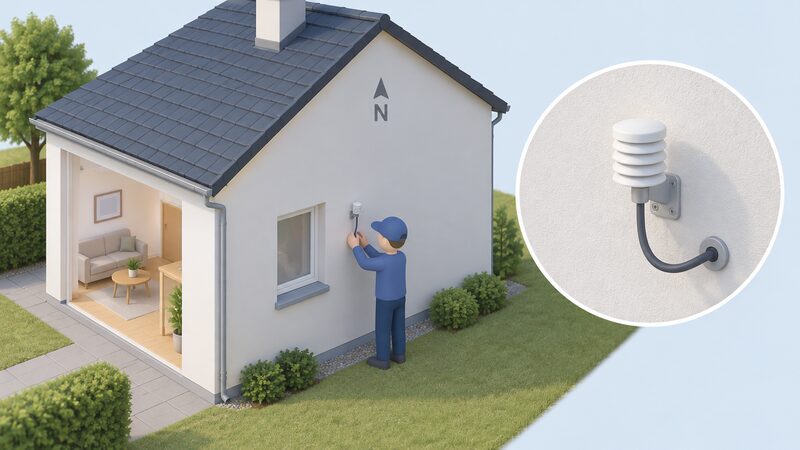
There are two ways to get the outside temperature. The traditional method is a small sensor fixed to an external wall, wired or linked back to the appliance or control. Manufacturers describe weather compensation as achievable when the boiler is fitted with an optional compatible outdoor sensor14, and outdoor sensor kits are sold as accessories that monitor external temperatures to offer weather compensation15. On some appliances the function is already present in the boiler and connecting the outside weather probe is what enables it.
The second method is internet weather data. Bosch's EasyControl uses local internet weather data rather than a wired external sensor, and responds automatically to changes in temperature16. Ideal's glossary makes the same distinction: smart systems use internet weather temperature and do not need an outside sensor14. Vaillant states that its whole systems can benefit from weather compensation taking the outdoor temperature from either an outdoor sensor or internet weather data1.
The two are not identical in accuracy. A wall-mounted probe reads the air at the building; an internet feed reads a forecast or observation for a wider area, which may not reflect wind, shade or a sheltered urban site. Vaillant notes that advanced systems can work more accurately because they can be fitted with an outside sensor, using live data for weather compensation17.
Why lower flow temperatures raise efficiency
Condensing boilers and heat pumps both reward lower water temperatures, for different physical reasons, and weather compensation is the control that delivers them for most of the year rather than only in mild spells. BEAMA's paper on low flow temperatures in existing systems is framed precisely around why operating an existing heating system at lower temperatures has the potential to improve its efficiency18.
For heat pumps the relationship is direct. Lower design flow temperatures generally result in higher seasonal coefficient of performance values, higher seasonal space heating energy efficiency and lower electricity consumption across the heating season. Energy Saving Trust notes that the heating curve for a heat pump is also known as outdoor weather compensation, and that lowering the flow temperature reduces the reaction time of the system, so rooms take longer to warm but running costs are strongly affected19. Underfloor heating, which can run at 35°C to 40°C, allows lower flow temperatures than radiators and therefore higher efficiency20.
For gas appliances, the gain comes from condensing. Dropping the flow temperature lets the return water fall far enough for flue gases to condense reliably, which is where a condensing boiler's extra efficiency lives. Energy Saving Trust's guidance on turning a boiler's flow temperature down notes that a weather compensation kit will give the maximum possible savings available from adjusting boiler temperature, and that on a combi this depends on having a weather compensation kit or a load compensator fitted21.
The limits are the building and the emitters. A home with small radiators sized for 70°C or more cannot simply be run at 45°C without either accepting cooler rooms or changing the emitters. That is the practical reason weather compensation is set up against the heating design conditions for the particular system rather than to a generic curve22.
Boiler Plus and the building regulations position
Boiler Plus increased minimum efficiencies for boilers, required time and temperature controls, and required an additional energy efficiency measure, the options being weather compensation, a smart thermostat, flue gas heat recovery or load compensation23. The industry announcement at the time put the same requirement on all those fitting new combination boilers7.
Guidance on the heating controls provisions describes the two accepted compensation routes side by side. Weather compensation requires both a means of measuring local outdoor temperature and control functionality that varies boiler flow temperature in relation to it. Load compensation operates in a similar way except that it measures the internal rather than the external temperature, varying flow temperature in relation to the difference between the measured room temperature and the room thermostat set point8.
For heat pumps, Approved Document L sets out the minimum controls as weather compensation or internal temperature control, together with a timer or programmer for space heating2. Weather compensation is therefore not compulsory on a heat pump in England; it is one of two acceptable ways of meeting the temperature control requirement.
Manufacturer claims of compliance carry conditions worth reading. One weather compensation probe is described as Boiler Plus compliant when fitted with a room thermostat24. One combi range is stated to be Boiler Plus compliant out of the box because a weather compensation kit is supplied as standard25. Another maker states that its app's weather compensation abilities and smart control compatibility mean boilers featuring it will achieve Boiler Plus compliance26. Vaillant's guidance says that to meet Boiler Plus requirements with a combi boiler a weather compensating room thermostat and an internet gateway must be installed17. Compliance rests on the installed combination, not on a single accessory. More detail sits on the page covering building regulations for heating controls.
Flow temperature limits differ across the four nations
| Nation | Requirement for a newly installed or fully replaced wet heating system |
|---|---|
| England | Sized so the space heating system can operate at a maximum flow temperature of 55°C or lower27 |
| Wales | Sized, including pipework and emitters, for a maximum flow temperature of 45°C or lower under the 2026 Approved Document L3 |
| Scotland | Design based on a mean water temperature of 50°C or lower, where the appliance and the majority of emitters are replaced or newly installed28 |
The Welsh figure is the tightest of the three and is the more recent document. England's Approved Document L Volume 1 states the 55°C maximum flow temperature where feasible for newly installed or fully replaced wet systems2. Northern Ireland is not covered by any of these three documents, and no separate figure is stated here for it.
These limits set the design point at the coldest condition, not the everyday running temperature. Weather compensation is what keeps the system below the design point for the large majority of hours in a heating season, which is why the two subjects are inseparable in practice.
Weather compensation on heat pumps: 45°C flow and 40°C return
An air source heat pump is commonly taken to use an optimal supply or flow temperature of 45°C and a return temperature of 40°C4. Independent guidance describes sizing a system to supply flow temperatures of only 40 to 45 degrees to radiators when it is minus 3 degrees outside, with underfloor heating an alternative at 35°C to 40°C20.
The curve that connects those points is what a householder actually experiences. Home Energy Scotland gives an illustrative example: if it is freezing outside the heat pump may circulate flows at 50°C to maintain an inside temperature of 20°C, and when the day warms to 5°C the flow may be 40°C29. Another worked example designs the heat pump circuit to operate at 45°C flow and 40°C return, with the emitters sized to match30. A third gives 40°C flow at minus 3°C outside13. The curves differ because the buildings and emitters differ, not because one is right.
"when it is -3℃ outside, the heat pump may deliver a flow temperature of 40℃, but when the outside temperature rises to 1"
Energy Saving Trust notes that a lower flow temperature slows the system's reaction time, so rooms take longer to come up to temperature, and that this has a large effect on running costs19. That trade is why heat pump systems are generally run continuously to a curve rather than in short bursts, and why the interaction with setback schedules needs care: a manufacturer's support guidance asks that weather compensation be set to the correct heating design conditions before setback is considered22. See also heating schedules and setback.
One further distinction: air to air heat pumps are commissioned as load compensated rather than weather compensated, because each internal head monitors its own room temperature directly31.
Controls and kits sold in the UK
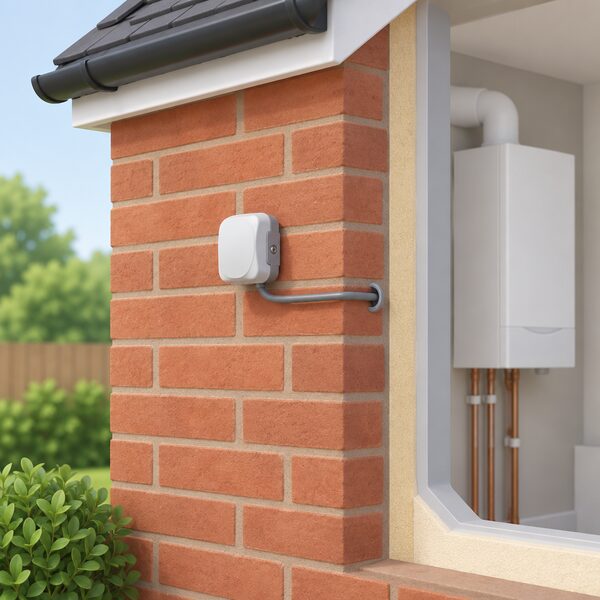
The facts below come from each manufacturer's own product information and describe only that maker's products. No ranking is implied.
| Control or kit | Sensing method | Stated function |
|---|---|---|
| Ideal Weather Compensation Kit | Outdoor sensor | Stated as Boiler Plus compliant and providing cost savings32 |
| Ideal external weather compensation device | Outdoor sensor | Available as an accessory to all Ideal domestic boilers33 |
| Alpha Weather Compensation Probe | Outdoor probe | Improves efficiency by adjusting the boiler's heat output according to outside temperature; Boiler Plus compliant when fitted with a room thermostat24 |
| Worcester Bosch outdoor sensor kit | Outdoor sensor fitted outside the property | Monitors external temperatures to offer weather compensation15 |
| Worcester Bosch Comfort+ Outdoor Weather Sensor | Outdoor sensor | Controls the temperature of the heating system in response to outdoor conditions34 |
| Bosch EasyControl | Local internet weather data, no wired external sensor | Automatically responds to changes in temperature16 |
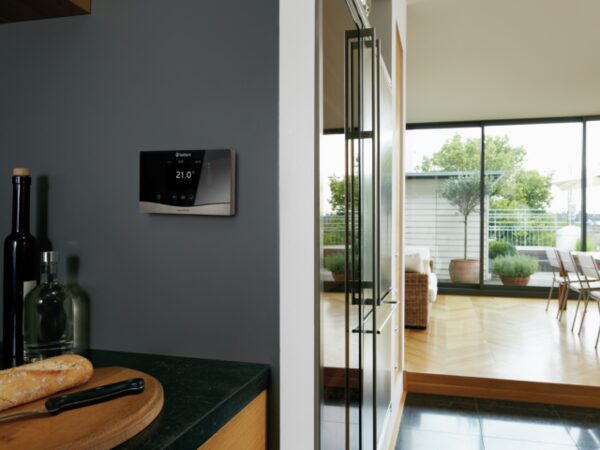
| Vaillant sensoCOMFORT | Outdoor sensor included in the box | Weather compensation control; can control boilers, heat pumps and hybrid systems35 |
| Vaillant VRC 700 | Can be fitted with an outside sensor for live data | Adjusts heating output using weather compensation technology36 |
| Keston Combi 2 C30 and C35 | Weather compensation kit supplied as standard | Stated as Boiler Plus compliant out of the box25 |
Vaillant states that the sensoHOME control requires an outdoor sensor to be installed for weather compensation, while the sensoCOMFORT includes one1. Combi boilers in several ranges are listed as weather compensation compatible through a simple external sensor connection. Further brand detail sits on the Vaillant controls, Worcester Bosch controls and Ideal controls pages.
Weather compensation set against load compensation and room control
The cleanest way to separate them is by what they measure. Load compensation adjusts the appliance's output based on the current temperature of the home; weather compensation uses the outdoor temperature1. Both replace crude switching with a proportional signal. Independent analysis of boiler behaviour describes compensating controls as interpreting the difference between actual and desired conditions and sending the boiler a signal of how hard to work rather than a simple on or off, which improves efficiency10. The mechanics of the boiler side are covered under load compensation and modulation and OpenTherm.
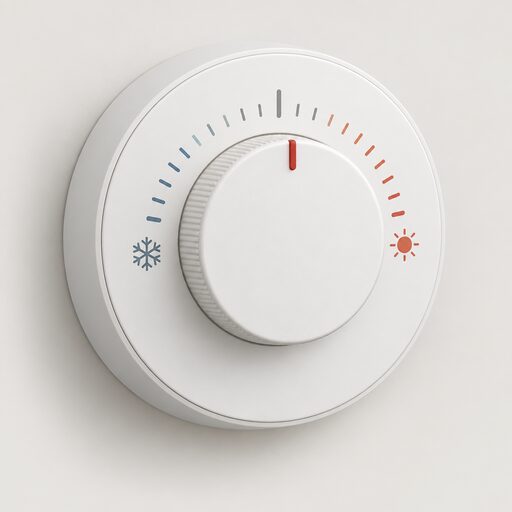
In practice the two are often combined, with the curve setting a target flow temperature and a room thermostat or room influence setting trimming it. That combination is also where installations go wrong. A government-commissioned study of heat pump home visits found that weather compensation was typically enabled, though in some cases it appeared to be in conflict with third party thermostat control37. A manufacturer's troubleshooting guidance describes the correct behaviour as increasing and decreasing the water temperature in the heating system depending on the outdoor air temperature to match the heat loss of the building11: a third party thermostat that switches the whole system off instead can defeat that.
What it can and cannot do for bills
Published savings figures for weather compensation vary and are not directly comparable. One independent advice organisation states that installing a weather compensator on a gas boiler can improve its energy efficiency by 10 to 15 per cent6. A manufacturer's technology brochure claims fuel savings of up to 35 per cent for weather compensated condensing boilers compared with conventional boilers, which is a comparison against old non-condensing plant rather than against a modern boiler without compensation38. Vaillant states that the amount saved depends on the home's insulation, the efficiency of the central heating system and energy usage habits1.
Energy Saving Trust treats compensation as one of the things that makes a smart control worthwhile, noting that load and weather compensation adjust the boiler flow temperature to maximise boiler efficiency and that a smart thermostat is probably the easiest way to add compensation to an existing system39. Whether the money follows depends on how far below the design flow temperature the system actually runs, which in turn depends on insulation, emitter sizing and commissioning. Where radiators are undersized, the curve will simply be set high and little will change. Costs of the controls themselves are covered under heating controls cost and the evidence on savings under do heating controls save money.
What it means for household energy independence
Weather compensation cuts the amount of fuel or electricity needed for a given level of comfort, and it does so by using the building's own physics rather than by importing anything. On a gas system that reduces gas volumes without removing the gas connection. On a heat pump it raises seasonal efficiency and therefore lowers the electricity drawn from the grid, which is the dependence that matters most for a home moving to low flow temperature heating.
The dependencies that remain are worth naming. A wired outdoor sensor is a passive component and keeps working with no network. A control that takes internet weather data depends on broadband, on the manufacturer's cloud service and on that service continuing to be supported, and it will typically need an app to change the curve. Proprietary controls are tied to the appliance maker's ecosystem, so a curve set through one manufacturer's control is not portable to another's appliance. And the function only reduces demand; it does not generate anything, does not store heat, and does not remove the need for a supplier, a tariff or a meter.
Sources39 cited
- Keep your home in balance: the benefits of weather compensation, Vaillant, 2026
- Approved Document L, Volume 1: Dwellings, GOV.UK, 2026
- Approved Document L Volume 1, Wales, Welsh Government, April 2026
- Edinburgh Local Heat and Energy Efficiency Strategy, City of Edinburgh Council, December 2023
- ECO4 New Measures and Products Guidance v3.0, Ofgem, March 2026
- No-cost and low-cost energy saving, Low Carbon Hub, August 2026
- Consumer guide to new legislation for boiler installations, HHIC, April 2018
- Part L 2022 Heating Controls Guidance, BEAMA, 2022
- Upgrading and replacing your boiler, Centre for Sustainable Energy, June 2026
- Heating controls guidance, HHIC, 2018
- Why heat pumps go wrong, Daikin, 2026
- Control strategy effect on heat pump efficiency, iDM Energiesysteme, July 2026
- The role of weather compensation, Alpha Innovation, 2026
- Heating glossary, Ideal Heating, 2026
- Outdoor sensor kit, Worcester Bosch, 2026
- Bosch EasyControl brochure, Worcester Bosch, April 2018
- Controls and frost protection, Vaillant, 2026
- Technology solutions for low flow temperatures in existing heating systems, BEAMA, 2026
- How to ensure a heat pump runs efficiently, Energy Saving Trust, May 2026
- Heat pumps information, Centre for Alternative Technology, June 2025
- Should I turn my boiler's flow temperature down?, Energy Saving Trust, May 2026
- Weather compensation and setback together, Grant UK, 2026
- Written evidence on heat policy, UK Parliament, 2026
- Weather Compensation Probe, Alpha Innovation, November 2023
- Keston Combi 2 C30 and C35, Keston, September 2026
- ON AI technology, Navien, 2026
- Approved Document L, Conservation of fuel and power, Volume 1: Dwellings, GOV.UK, 2021 edition incorporating 2023 amendments
- Domestic Building Services Compliance Guide 2022, Scottish Government, June 2022
- Living with a heat pump, Home Energy Scotland, February 2024
- Customer support FAQ, Alpha Innovation, October 2023
- Air-to-air heat pumps: a low carbon solution for UK homes, Nesta, February 2026
- Weather Compensation Kit, Ideal Heating, 2026
- Boiler Plus guidance for installers, Ideal Heating, 2026
- Greenstar Comfort range compatibility, Worcester Bosch, 2026
- sensoCOMFORT weather compensation control, Vaillant, 2026
- VRC 700 weather compensation control, Vaillant, 2026
- Consumer-focused report on the heat pump transition, GOV.UK, May 2026
- Weather compensation technology brochure, Viessmann, June 2016
- Smart homes and a lower carbon footprint, Energy Saving Trust, January 2026
 Controls and Smart OperationWhy does a heat pump need different controls from a boiler, and what does weather compensation actually do?
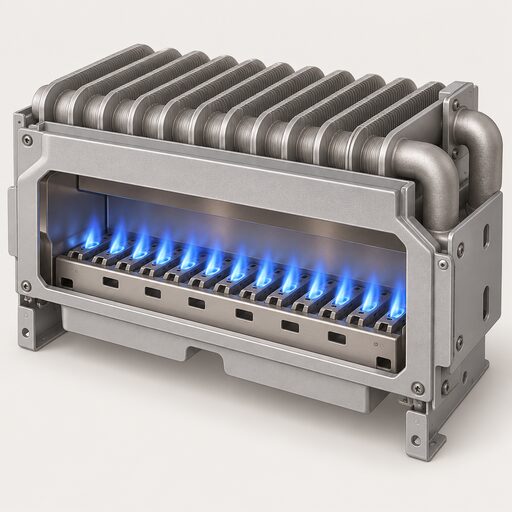 Load Compensation and ModulationA boiler that only switches on and off wastes money, because it runs too hot to work at its best.
 Using a Heat Pump for CoolingCan a heat pump cool your home in summer as well as heat it in winter?
 Heat Pump Electricity TariffsA heat pump tariff gives you cheaper electricity for part of the day, so running your heating costs less than on a standard rate.
 Radiators and EmittersWill your radiators still heat the house properly with a heat pump?
 Cooling and Heat PumpsCan an air conditioner heat your home as well as cool it?