
In this guide
The ErP control classes are a scale of eight control types, numbered I to VIII, used under the Energy-related Products framework to describe how much a heating control adds to a boiler's seasonal space heating efficiency. There are eight classes of control system, and each adds an efficiency percentage to the boiler seasonal space heating ErP efficiency figure when the two are assessed together as a package1.
The class is not a rating of the thermostat as a product in isolation. It describes a control arrangement: what the control senses, and whether it can modulate the boiler rather than simply switch it on and off. A weather compensator with a room sensor for use with modulating heaters sits at Class VI, while multi-sensor room temperature control for use with modulating heaters sits at Class VIII1.
For a household, the class is the mechanism by which better control turns into a better headline number on a package label. It is also the mechanism by which Boiler Plus in England is satisfied, because the additional energy saving measure required at the point of a combi installation is drawn from the same family of compensating and smart controls2.
What the ErP control classes are
The classes exist because a boiler's efficiency is not fixed. A condensing boiler is defined as one designed to make use of the latent heat released by the condensation of water vapour in the combustion flue products7. Whether that latent heat is actually captured depends heavily on the temperature of the water returning to the boiler, and that is what the control decides.
A control that simply switches the boiler on and off at a set room temperature lets the boiler run at whatever flow temperature its own settings dictate. A control that can tell the boiler what flow temperature to use, and vary it, keeps the return temperature low enough for condensing to happen for more of the year. The ErP class scale ranks control arrangements by how much of this capability they provide.
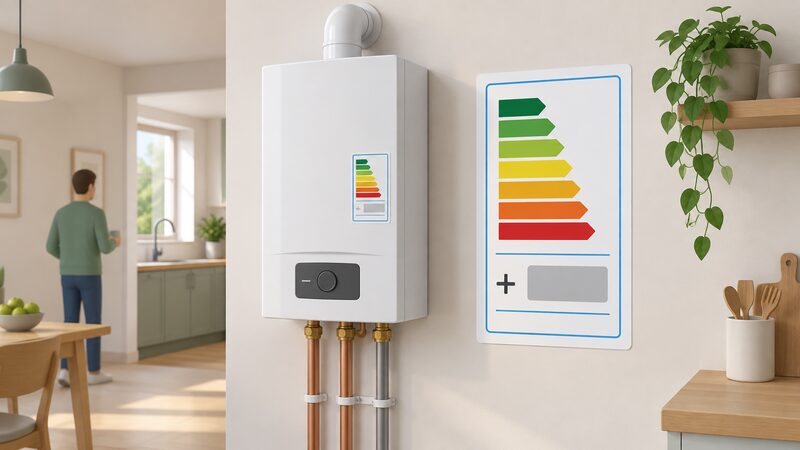
The class appears in the package label and fiche when a boiler and a control are placed on the market together. The boiler carries its own ErP label, and under the ErP standards boilers are labelled from A+++ to G, with A+++ being the most efficient8. The control class then adds its percentage to the seasonal space heating efficiency of that package. Nearly all modern gas condensing boilers available in the UK get an A rating on this label5, so the control is often the only part of the package where a meaningful difference can still be made.
It is worth separating the ErP control class from the ErP energy label itself. The energy label uses a seven-point colour scale, starting from dark green (A-rated and most efficient) and going down to red (G-rated and least efficient)9. The control class is a separate classification of the control arrangement, expressed in Roman numerals, and it feeds into the package calculation rather than appearing as a colour band.
The eight classes: how they differ
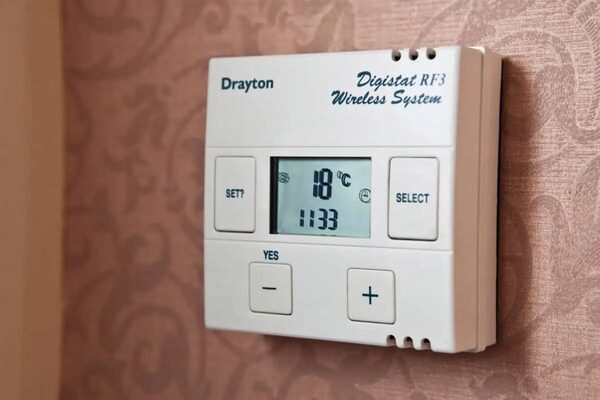
The classes divide along two axes: what the control senses, and what kind of heater it is designed to work with. The distinction between modulating and on/off output heaters runs through the whole scale, because a control that can only switch a boiler cannot exploit modulation even if the boiler supports it.
| Class | Control arrangement | Heater type |
|---|---|---|
| I | On/off room thermostat | On/off |
| II | Weather compensator control | Modulating |
| III | Weather compensator control | On/off output |
| IV | Weather compensator with room sensor | On/off output |
| V | Advanced thermostat with load compensation and direct boiler communication | Modulating |
| VI | Weather compensator and room sensor | Modulating |
| VII | Weather compensator and room sensor | On/off output |
| VIII | Multi-sensor room temperature control | Modulating |
The definitions for Classes II, III, VI, VII and VIII come from a controls manufacturer's own classification1. The Class V and Class VI entries for advanced thermostats with load and weather compensation and direct boiler communication come from BEAMA's buyer guidance4.
The pattern is that the same sensing capability is graded differently depending on the heater. A weather compensator with a room sensor is Class VI when paired with a modulating heater and Class VII when paired with an on/off output heater1. That is not a quirk: the higher class reflects the greater efficiency gain available when the control can actually modulate the heat source rather than just interrupt it.
The scale is not a ladder where every step is available in every home. A control can only reach a class its boiler can support. Direct boiler communication is the common thread in the upper classes, and it is what allows the control to set flow temperature rather than merely call for heat.
Why the control class matters: up to 13% extra efficiency from the right controls
The reason the classes carry percentages at all is that controls change how much fuel a heating system actually uses, not just how it is measured. The efficiency gain attributed to a control class is added to the boiler's seasonal space heating efficiency when the two are sold as a package, which is why a boiler and control bought together can carry a better package figure than the boiler alone.
The scale of the effect is contested and varies by control type. Multi-zonal controls have been shown to save significant amounts of energy, as much as 5% according to Delta Dore6. That figure is a maker's claim reported in a consultation response, and it sits well below the headline percentage that the top control classes can add to a package label. The gap is explained by what the two numbers measure: the package label percentage is a modelled contribution to seasonal space heating efficiency under the ErP methodology, while the 5% is an observed saving attributed to zoning.
Two figures for zone control savings are in circulation: 13% in one maker's guidance and 12% in another, both dated 2025-02-12. The two figures are not reconciled in the material available. A household reading a claim about control savings should treat the range as wide and the basis as differing between sources.
What is consistent is the direction. A control that modulates the boiler and compensates for conditions outside or inside the home will use less fuel than one that cycles the boiler on and off at a fixed flow temperature, because it keeps the boiler in its condensing range for longer. The class is the shorthand for that capability.
Modulation, weather compensation and load compensation: what moves a boiler up the classes
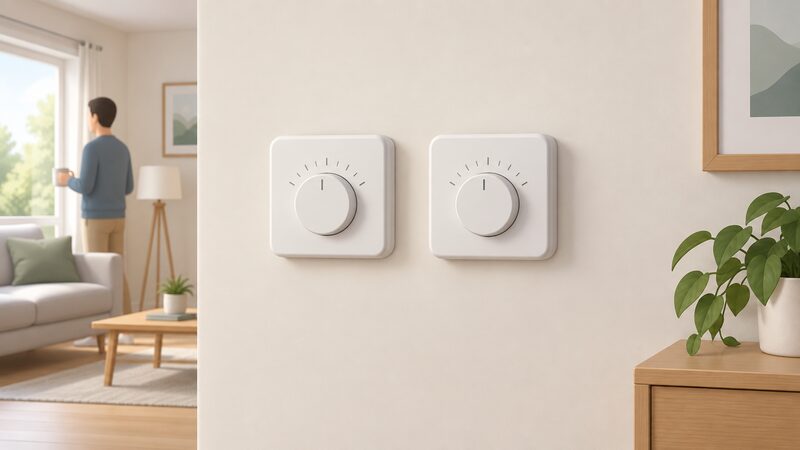
Three capabilities separate the lower classes from the upper ones: modulation, weather compensation and load compensation. Each is defined in official guidance, and each changes the relationship between the control and the boiler.
Weather compensation alters temperature flow from the boiler in relation to the measured outdoor temperature10. A weather compensator adjusts the boiler temperature in line with the outside temperature, so it uses less fuel when it is warmer outside11. The control is effectively running the heating system at a lower flow temperature on mild days, which is exactly the condition under which a condensing boiler recovers the most latent heat.
Load compensation alters the boiler flow temperature and prevents overheating10. Where weather compensation looks outward, load compensation looks at the effect the heating is having inside the home and trims the flow temperature accordingly. Both are described by Energy Saving Trust as adjusting the boiler flow temperature to maximise boiler efficiency, and a smart thermostat is probably the easiest way to add compensation to an existing system12.
Modulation is the boiler-side capability that makes either form of compensation worthwhile. A modulating boiler can vary its output rather than running flat out and stopping, and a control with direct boiler communication can instruct it to do so. This is why the class definitions repeatedly specify "for use with modulating heaters" at the top of the scale1.
The practical recommendation from independent guidance is that the best way to guarantee a new boiler is working in a way that delivers value for money is to have it installed with weather compensation or load compensation controls5. That is a statement about controls, not about boilers: the boiler is already efficient, and the control is what determines whether that efficiency is realised in the home.
For a household, the independence question here is straightforward. Compensation controls make the heating system's fuel use depend more on the building and the weather and less on a fixed schedule, which reduces the volume of gas drawn through the meter. They do not remove the gas connection, and they do not remove the supplier.
OpenTherm: the communication protocol behind modulating controls
The upper ErP classes depend on the control being able to talk to the boiler, and OpenTherm is the open protocol that carries that conversation. OpenTherm is a manufacturer-independent system of communication between modulating HVAC heating appliances and room thermostats13. It consists of a communication protocol and an interface specification13.
The protocol is a multi point to point communication protocol for use in HVAC systems, and it is primarily designed to control modulating heating appliances13. Physically it requires a standard type of connection like in any modern installation practice, a 2-wire low voltage and polarity-free connection13. That low voltage, polarity-free wiring is what allows a thermostat to send a flow temperature instruction rather than a simple call for heat.
Two features matter for the ErP classes. First, using OpenTherm guarantees a minimum level of compatibility13, which is what makes a Class V or Class VI declaration portable between a control and a boiler from different makers. Second, the same communication channel can be used to read appliance settings and other data like error and malfunction codes14, which is how a control can display boiler status rather than just a room temperature.
The limits are set by the manufacturers. The way the protocol is implemented, and any extra functionality resulting from the use of OpenTherm, is determined entirely by manufacturers of HVAC appliances and room thermostats13. A boiler can carry an OpenTherm connection and still be configured in a way that limits what the control can do with it.
Wireless operation is possible. OpenTherm can also be used as a wireless protocol13, and a remote control can be used to operate the appliance using the temperature controller in the living room and at the same time display other parameters and alarms14. Future expansion possibilities include connecting OpenTherm controllers to other smart energy systems like HEMS, grid control or other related systems13.

Boiler Plus: what the law requires in England

Boiler Plus is the English regulation that ties the control classes to a legal requirement at the point of installation. It was introduced in 2018, and it requires existing households in England to install an additional energy saving measure from a choice list at the point of installing a new or replacement combi gas boiler in an existing dwelling3. The measures were introduced in England in 201815.
The policy has three parts: increased minimum efficiencies for boilers, required time and temperature controls, and the additional energy efficiency measure16. The additional measure is drawn from weather compensation, smart thermostat, flue gas heat recovery and load compensation16. That is the same set of capabilities that lift a control up the ErP classes, which is why the two subjects are usually discussed together.
The efficiency floor is the other half of the rule. In 2018 the UK government introduced Boiler Plus legislation, which requires all boilers in England to have a minimum ErP efficiency of 92%5. Current Boiler Plus regulation means all gas boilers sold in England are at least A-rated for efficiency, which means at least 92% efficient17. All modern boilers sold in the UK must be A-rated18.
The requirement is not optional. These changes are not optional as they form part of the building regulations in England which must be adhered to by law19. Since 2018, the regulations in England have required that combination boilers are installed with one of four energy saving options, including load compensation and weather compensation20.
Two limits are worth stating plainly. Boiler Plus applies in England only; the other nations have their own building regulations, and BEIS decided not to take forward a proposal to make the English Boiler Plus standard a specific ECO requirement, so installations follow building regulations for each nation21. And the requirement bites at installation, not afterwards: it governs what is fitted when a combi is replaced, not what must be retrofitted to a working boiler.
Smart controls with automation and optimisation
Smart controls enter the ErP framework through the same door as compensating controls, but they are assessed on a wider set of capabilities. Under the Green Heat Network and Boiler Upgrade Scheme arrangements, smart thermostats must meet the criteria set out in the Boiler Plus Standard, covering automation, optimisation and wider connectivity enabling remote control22.
That is a meaningful definition, because it separates a smart thermostat that merely offers app control from one that automates and optimises. The Boiler Plus Standard criteria are the reference point, and a device that does not meet them is not a Boiler Plus measure regardless of how it is marketed.
At the top of the class scale, multi-sensor room temperature control for use with modulating heaters is Class VIII1. One manufacturer describes a two-zone combi pack with Wi-Fi and OpenTherm as classed ErP 8, and calls it the most efficient control on the market23. That last phrase is the maker's own claim about its own product, not an independent finding.
The distinction between automation and optimisation matters for what a household gets. Automation runs the heating to a schedule and adjusts it without intervention. Optimisation uses the control's knowledge of how the building heats up and cools down to reach the target temperature at the right time rather than starting early and overshooting. Both reduce fuel use relative to a fixed programme, and both depend on the control having direct communication with the boiler to act on what it decides.
Smart meters are a separate system. While independent of smart heating controls, combining the two can enhance the ability to manage a home's heating and energy use remotely24. That is a statement about convenience and visibility rather than about the ErP class, which is determined by the control's relationship with the boiler.
The dependence to note is the app and the cloud. A smart control that meets the Boiler Plus criteria still needs its manufacturer's servers and app for remote functions, and the local heating functions are what carry the ErP class. A household weighing independence should separate the two.
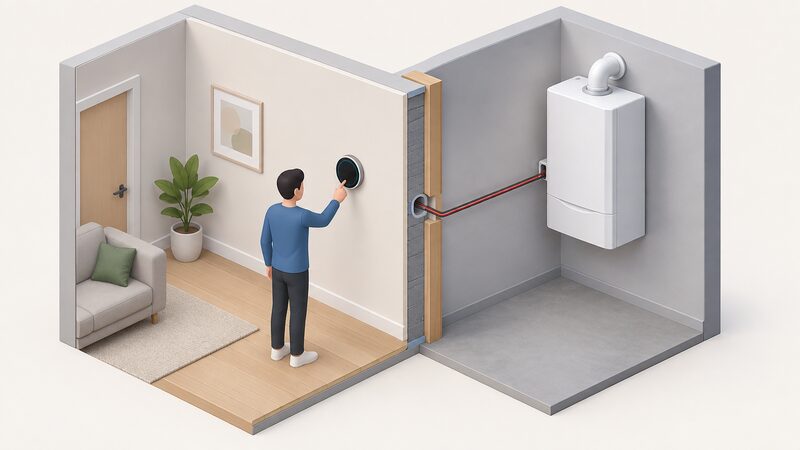
How the classes fit with condensing boilers and the 92% ErP standard
The control classes only make sense against the boiler they are paired with, and in the UK that boiler is almost always condensing. New boilers in the UK are all required to be condensing boilers, which are at least 90% energy efficient8. Condensing boilers are more efficient because they extract the heat from the hot exhaust gases, or flue gases, that would otherwise be lost, to pre-heat the water fed into the boiler11. They come in both combination and system models11.
The efficiency figures vary by source and by fuel. Condensing boilers are capable of using around 90% of their heat25. Modern condensing appliances can exceed 90% efficiency and are available as regular, system and combination boilers26. For oil-fired wet central heating systems, condensing regular boilers are rated at 91% ErP27. The 92% floor that Boiler Plus sets for gas boilers in England sits just above these figures, which is why the control contribution matters: the boiler is already close to the ceiling of what combustion alone can achieve.
This is where the class scale earns its place. A boiler at 92% with a basic on/off thermostat and a boiler at 92% with a Class VI weather compensator are the same boiler, but the package figure differs because the control changes how often the boiler actually condenses. The Approved Document L notional dwelling specification assumes boiler interlock at ErP Class V7, which shows that a compensating control is treated as the baseline expectation in the standard used for compliance modelling, not as an upgrade.
The condensing principle also explains why the class definitions specify modulating heaters so often. A boiler that can modulate can be held at a low flow temperature for long periods, which is the condition under which the flue gases condense and the latent heat is recovered. A control that cannot modulate can only interrupt the boiler, and interrupting a boiler does not lower its return temperature.
For a household, the practical expectation is that the control class is the lever still available after the boiler has been chosen. The boiler will be condensing and A-rated; the control determines how much of that rating is realised in the home. That is a gain in efficiency and a reduction in gas drawn, and it leaves the gas connection, the supplier and the grid exactly where they were.
Sources27 cited
- Controls and ErP classes, Vokera, 2026
- Five signs you need a new boiler, Which?, 2025
- Carbon Budget Delivery Plan, GOV.UK, 2023
- Heating controls buyers' guides, BEAMA, 2020
- Choosing the right heating controls, BEAMA, 2021
- Response to VAT relief consultation, Energy Saving Trust, 2025
- Approved Document L Volume 1, GOV.UK, 2021
- Boiler energy efficiency, Which?, 2025
- Boilers and heating sustainability, Planning Portal, 2026
- ECO4 new measures and products guidance, Ofgem, 2026
- Smart homes and lower carbon footprint, Energy Saving Trust, 2026
- Upgrading and replacing your boiler, Centre for Sustainable Energy, 2026
- What is OpenTherm, OpenTherm Association, 2026
- Why a communication protocol, OpenTherm Association, 2026
- Boiler Plus guidance, HHIC, 2018
- Written evidence on Boiler Plus, UK Parliament, 2026
- What type of boiler should your next one be, Which?, 2022
- New boiler guide, Uswitch, 2025
- ECO4 scoring methodology decision, Ofgem, 2022
- The power at our fingertips, BEAMA, 2021
- Two-zone combi pack with Wi-Fi OpenTherm, ESI Controls, 2026
- SAP 10.3 full specification, BRE Group, 2026
- Different boiler types, Uswitch, 2026
- Your home guide to liquid fuel heating, OFTEC, 2026
- Domestic Building Services Compliance Guide 2022, Scottish Government, 2022
- ECO4 and GBIS mid-scheme changes, Ofgem, 2025
- Heat pump questions answered, Energy Saving Trust, 2026
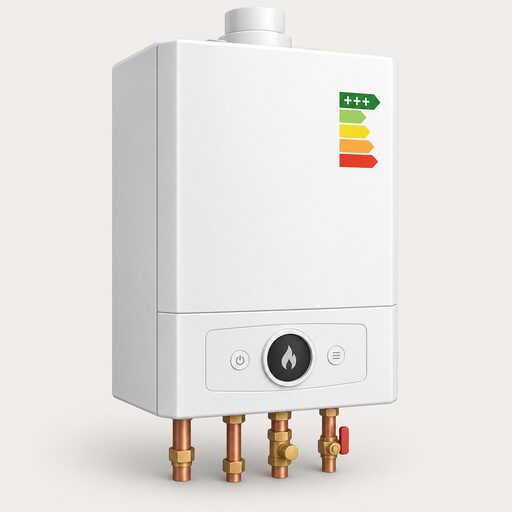 Efficiency and ErP RatingsWhat do boiler efficiency ratings like A to G actually mean, and how do they compare with the older SEDBUK scores?
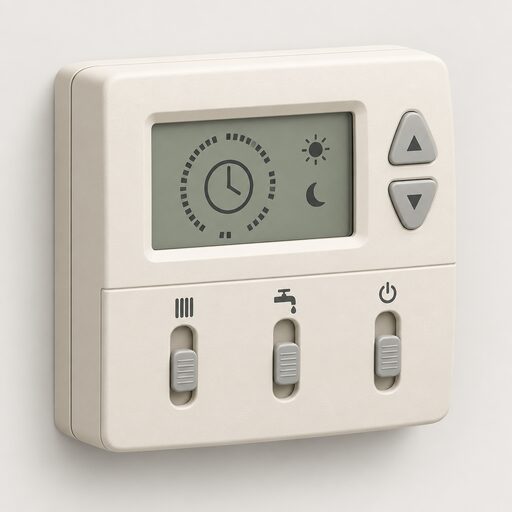 Controls, Thermostats and TRVsWhich heating controls actually cut your bills, and what does each one do?
 Boiler PressureIf the needle on your boiler has crept up or dropped, what should it read when the heating is off, and what counts as too high or too low?
 Boiler SizingWhat size boiler does your home actually need, and does the number of bedrooms or radiators decide it?
 The Full Boilers and Heating GuideWhich boiler suits your home, and when is it worth swapping the old one?
 Gas Boilers GuideMains gas boilers heat around 23 million UK homes.