
In this guide
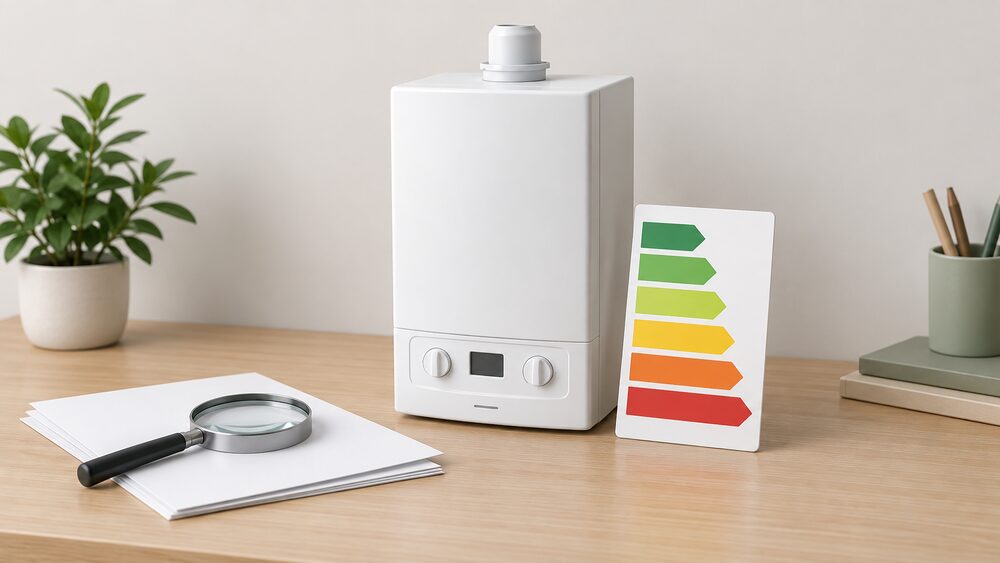
A boiler efficiency rating is a measure of how much of the fuel burned ends up as useful heat in the home over a whole heating season, rather than at a single test point. Two labelling systems are in circulation in Britain. Under the Energy-related Products rules, boilers are labelled from A+++ to G, with A+++ the most efficient1. Before that, seasonal efficiency was quoted as a SEDBUK percentage, and that system still applies to older boilers made before 20152.
The practical headline is narrow. Since 2015, all new gas boilers in the UK have had to be rated A by law, described as a minimum of 92 per cent ErP efficiency2. Building regulations work to the same number: the final Part L 2021 standard for England set a gas boiler minimum of 92 per cent ErP, replacing an earlier 88 per cent SEDBUK 2009 figure3. Older appliances are a long way behind. Models still in use in UK homes can fall as low as 60 per cent on the energy rating1, and one independent guide puts the worst at lower than 50 per cent efficiency against newest condensing boilers exceeding 90 per cent2.
The rating on the box is not what a household gets. It is a laboratory figure produced under a defined test, and the delivered seasonal efficiency depends on flow temperature, controls, system design and how the boiler is commissioned. That gap, not the letter on the label, is where most of the available saving sits.
What an efficiency rating actually measures
An efficiency figure is a ratio of useful heat out to fuel energy in, but the detail of how it is taken decides what the number means. The original British labelling instrument set out an optional star system under which a manufacturer could affix a label showing between one and four stars, reflecting the level of energy efficiency of that boiler5. It tested at two points, not one: a single star was awarded where efficiency at rated output and at part load were equal to or greater than the relevant values for standard boilers, and two stars where both were three or more points higher5. The two star threshold at nominal output was expressed as a formula, 87 plus 2 log Pn at an average boiler water temperature of 70 degrees Celsius5.
That two point structure survives in modern seasonal ratings for a reason. A boiler spends most of a British winter modulating at part load, not firing flat out, so a rating drawn only from full output would flatter the appliance. Seasonal efficiency blends the two, which is why a SEDBUK or ErP seasonal figure is always lower than the peak efficiency a manufacturer can demonstrate on a test rig.
Conformity is not self-declared. For series-produced boilers, the efficiency of a boiler type must be examined under module B of the older efficiency directive, with a declaration of conformity to the approved type under module C, D or E, and UK marking substituted for CE marking in Great Britain6. That is the chain behind the letter: a tested type, a declared production conformity, then a label. Related detail on marking and approval is set out in heating appliance standards and certification.
For a household, the consequence is simple. The rating describes the appliance, not the installation. A 92 per cent boiler run at a high return temperature will not condense reliably and will not deliver 92 per cent, which is why boiler flow temperature does more for a bill than the difference between two A rated models.
The ErP band: A+++ to G, and why almost everything is A
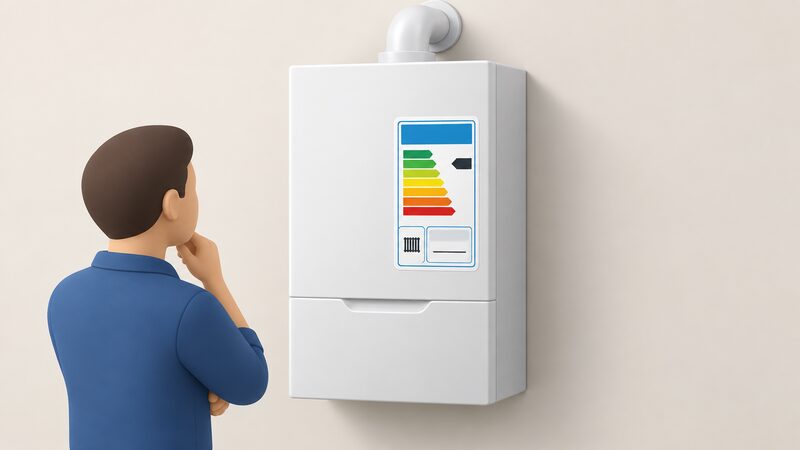
The Energy-related Product Directive of 2009 means all gas boilers have to be rated A to G for energy efficiency2, and the current label runs from A+++ to G with A+++ the most efficient1. The same ladder is used across regulated products generally: energy labels rate products from A to G in terms of energy use, with A the most efficient and G the least7.
The problem with the band is compression. Most modern condensing boilers hold an A rating1, so the label separates a new boiler from an old one but barely separates one new boiler from another. A householder comparing three combis in a showroom will usually see three identical letters. That is why some manufacturers and homeowners still find it preferable to compare on the SEDBUK percentage, which spans roughly 70 to 92 per cent1.
The higher bands on the scale are not reachable by a gas boiler working alone. They exist because the label covers space heaters as a class, including heat pumps, and because a package label can combine a heat generator with controls and solar contributions. A comparison of the underlying technologies is set out in heat pumps compared with boilers.
SEDBUK: the percentage system and where it still applies
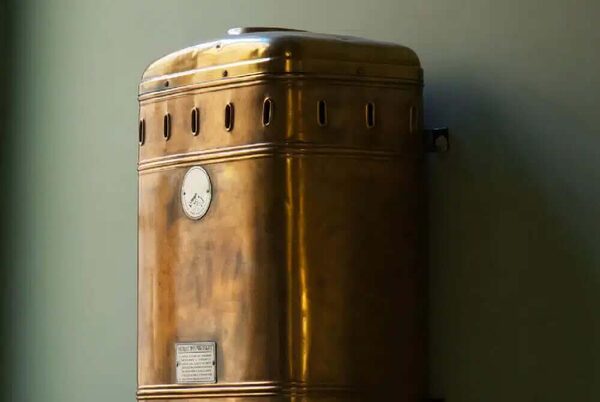
SEDBUK, the Seasonal Efficiency of a Domestic Boiler in the UK, was replaced by ErP ratings but still applies to older boilers made before 20152. It has not disappeared from regulation either. Building regulations and compliance guidance across the four nations still quote SEDBUK 2009 percentages for specific appliance types and for notional dwellings used in compliance calculations.
| Appliance or case | Minimum or specified efficiency | Nation and document |
|---|---|---|
| Notional dwelling boiler | SEDBUK 2009 = 89.5%8 | England, Approved Document L Volume 1 |
| Gas-fired range cooker with integral central heating boiler, existing dwellings | 75% as defined in SEDBUK 20099 | Wales consultation and England Approved Document L |
| Oil-fired regular boiler, exceptional circumstances in existing buildings | 84% SEDBUK 20099 | Wales consultation version |
| Oil-fired combination boiler, condensing | not less than 86% SEDBUK 200911 | Scotland, Domestic Building Services Compliance Guide 2022 |
| Notional dwelling combination boiler, proposed | SEDBUK 2009 89.5%4 | Northern Ireland discussion document |
| Scottish consultation preferred option | 89.5% SEDBUK12 | Scotland, modelling research report |
Two things follow from that table. First, the 89.5 per cent SEDBUK notional boiler recurs in England, Scotland and Northern Ireland alike, because it describes the reference dwelling against which a new home's carbon and energy performance is judged, not the appliance a builder must fit. Second, the exceptions carry lower numbers: a range cooker with an integral boiler is held to 75 per cent, far below the 92 per cent expected of an ordinary replacement gas boiler, because the appliance also does cooking work that the boiler test cannot credit.
For a householder with a boiler bought before 2015, the SEDBUK percentage is the figure that exists. There is no retrospective letter band, and converting one to the other is not possible from the published material.
Efficiency thresholds: the 90 per cent zone and what regulation actually demands
The minimum is set by building regulations rather than by the label. Building regulations specify that a replacement boiler must be A-rated for energy efficiency13, and the numeric backing differs slightly by fuel and by nation.
- Gas, England: 92 per cent ErP under the final Part L 2021 standard, up from 88 per cent SEDBUK 20093.
- Gas, Northern Ireland: a minimum ErP seasonal efficiency of 92 per cent for a new or replacement installation in an existing dwelling was put forward in the 2023 discussion document4.
- Oil, Northern Ireland: the proposal was to set the minimum seasonal efficiency at 91 per cent ErP4.
- Oil, Scotland: an oil-fired condensing combination boiler should have a SEDBUK 2009 efficiency of not less than 86 per cent11.
The oil figures sit below the gas figures, and the reason is physical rather than political: an oil condensing boiler condenses less readily in typical return temperature conditions, so the achievable seasonal number is lower. More on that appliance class is covered in oil boilers and heating oil.
A rating of E or worse on the current scale does not describe a compliant replacement gas boiler in a British home. It describes the appliance being taken out. Where an old boiler falls to 60 per cent1 or below 50 per cent2, roughly half the gas bought is lost up the flue and in standing losses. That is the arithmetic behind replacement programmes rather than any claim about a particular model.
Where the rating appears: label, data plate and database
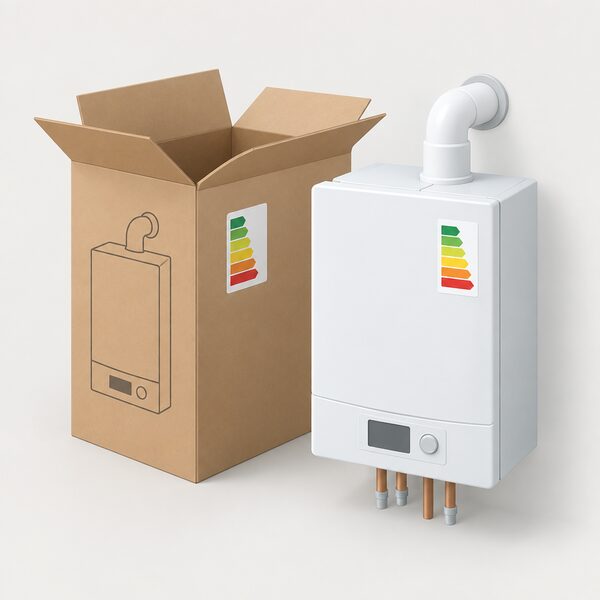
There are three places an efficiency figure is recorded, and they serve different purposes.
- The energy label on the appliance or its packaging, which carries the A+++ to G band1.
- The product information sheet supplied with the boiler, which carries the seasonal efficiency percentage and the sound power figure behind the band.
- The Product Characteristics Database, which supports the Standard Assessment Procedure for Energy Rating of Dwellings and the production of EPCs14. This is the reference set an assessor uses when a boiler's own paperwork has been lost.
Commissioning is where the label meets the installation. When works have been completed the installer should produce a commissioning certificate such as a Benchmark certificate and notify the local authority building control department, directly or via a scheme operator, and the local authority should supply a building regulations completion certificate17. Welsh guidance sets out the same sequence18. An installer registered with a competent person scheme can self-certify that the work complies with building standards19. The commissioning record is the only document that ties the rated appliance to the flow temperature, controls and setup it actually runs on, which is why it matters more than the sticker. The wider process is covered in boiler installation, and the control requirements in the Boiler Plus standard.
Package labelling and the system around the boiler
A boiler label rates a heat generator. A package label rates the combination actually installed: the heat generator plus temperature control, and any solar or secondary heat source. That distinction matters because controls change delivered efficiency without changing the appliance at all.
Where the components are bought separately, responsibility follows the person who puts the package together and offers it to the customer. In practice the paper trail that a British household will see is the commissioning certificate and the building control notification, which the installer produces and lodges17. Self-certification under a competent person scheme replaces the local authority notification step but not the certificate itself19.
The system effect is real and measurable in the assessment methodology. The space heating efficiency of a condensing boiler is increased by the applicable efficiency adjustment given in Table 4c of the SAP 2012 specification where the system has been designed to operate at a lower temperature20. The same low temperature calculation tool is explicitly not for determining the required power output of a boiler or heat pump20, so sizing remains a separate exercise, dealt with in boiler sizing. For the household, the lesson is that the credit for running cooler is earned by design of emitters and controls, covered in radiators and heat emitters and heating controls, thermostats and TRVs.
How the EPC turns a boiler rating into a home rating
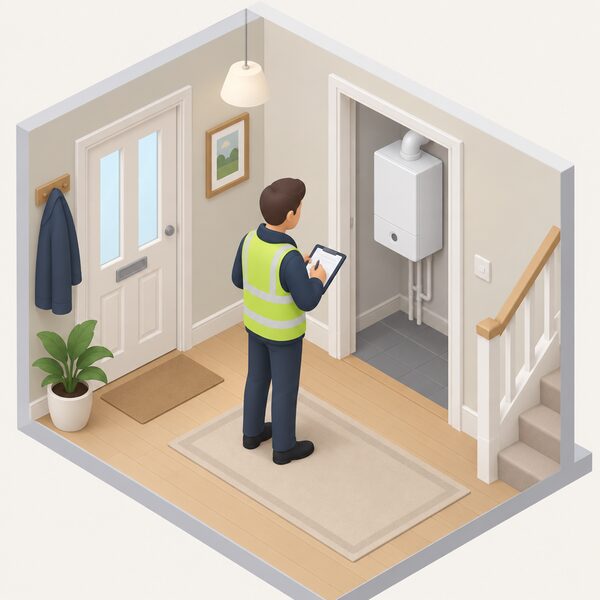
An Energy Performance Certificate provides an assessment of a home's energy efficiency21. To determine that rating, assessors use the Standard Assessment Procedure, with a reduced version, RdSAP, used for existing homes where information may not be available22. SAP is formally the Standard Assessment Procedure for Energy Rating of Dwellings14, and version 10.3 was approved for expressing the energy performance of new dwellings in England23.
The boiler enters the calculation as an efficiency figure drawn from the database, adjusted for controls and, where relevant, for low temperature operation20. It is one input among fabric, ventilation, hot water and lighting, which is why replacing a boiler moves an EPC band less than householders expect in a poorly insulated home and more than they expect in a well insulated one.
The national picture shows the spread. In Scotland in 2024, mean SAP 2012 ratings under RdSAP v9.93 ranged from 65.8 in dwellings owned outright to 73.5 in housing association dwellings24. By location, the mean was 69.5 for urban dwellings, with 60 per cent in band C or above, against 61.4 for rural dwellings24. Rural homes are more often off the gas grid and less often recently upgraded, which is the practical link between fuel, appliance efficiency and the certificate. Retrofit targets are set on the same scale: one high rise programme aimed at a minimum energy performance rating of EPC B or SAP 81 for each home bar a few exceptions25.
Biomass and solid fuel: separate thresholds, plus emissions
Solid fuel appliances are not covered by the gas and oil percentages. Approved Document L and the Welsh consultation version set category thresholds on gross calorific value.
| Appliance category | Minimum efficiency |
|---|---|
| Independent boiler, wood logs only (J2) | 75% gross CV9 |
| Open fire and high output boiler (D1/2/3/4) | 63% gross CV9 |
| Cooker with heating boiler exceeding 3.5 kW (G2) | 60% for wood fuels, gross CV8 |
Emissions sit alongside efficiency for this class. Biomass boilers are an eligible technology under the Boiler Upgrade Scheme26, and eligibility depends on an emissions certificate showing that NOx did not exceed 150 grams per gigajoule of net heat input and particulate matter did not exceed 30 grams per gigajoule27. For new stoves, Welsh guidance directs buyers to look for the Ecodesign standard, which ensures the appliance meets strict standards for emissions and efficiency28. Those rules apply to appliances placed on the market, not retrospectively to an appliance already in a hearth.
Where biomass output was metered for incentive purposes, the accuracy classes were specified rather than left to judgement: heat meters to Class 3 of the Measuring Instruments Directive, electricity meters to Class A, and any efficiency estimate done as accurately as possible, with better than 20 per cent recommended, based on metered fuel input or flue gas analysis29. That last figure is a reminder that real-world biomass efficiency is harder to pin down than a bench-tested gas boiler. Further detail is in biomass boilers and wood stoves.
What the ratings mean as fossil boilers are phased out
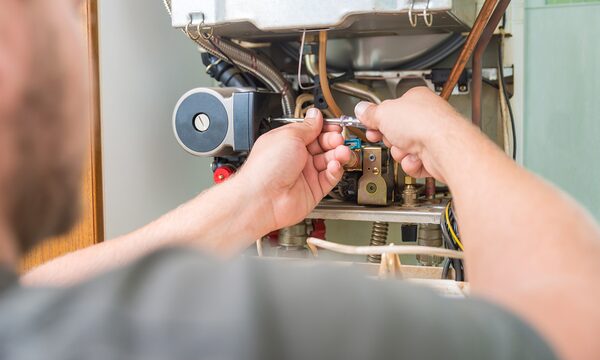
An A rating is now a floor, not a distinction. Since 2015 every new gas boiler sold in the UK has had to meet it2, so the label no longer separates good from bad within the category; it separates a new appliance from a pre-2015 one.
The direction of policy is away from the category altogether. Scotland's New Build Heat Standard prohibits polluting heating systems, like gas and oil boilers, in new buildings30. Support schemes point the same way: Boiler Upgrade Scheme eligibility rests on replacing a fossil fuel heating system31, while ECO4 still funds boiler repairs, replacement of broken efficient heating systems, first time central heating and a wide set of insulation measures for eligible households32. Background on the phase-out debate is in will gas boilers be banned in the UK, and on new build rules in the Future Homes Standard and new build heating.
For household energy independence the honest reading is limited. A 92 per cent boiler burns less gas for the same warmth, which reduces the volume of imported fuel a home draws and trims exposure to gas price movements, but it does not change the dependency itself: the meter, the supplier, the network and the fuel remain. Efficiency shrinks the bill; it does not move the home off the grid. The larger shift, and its own new dependencies on electricity supply and on manufacturers, is discussed in home heating and energy independence and across the boilers and heating guide. Where replacement is being weighed, a boiler more than ten years old is the usual trigger point for the question13.
Sources32 cited
- Boilers and heating: sustainability, Planning Portal, 2026
- New boiler cost guide, uSwitch, 2024-11-06
- Government response to the Future Homes Standard consultation, UK Government, 2021-01
- Building Regulations discussion document and pre-consultation, nidirect, 2023-10-11
- The Boiler (Efficiency) Regulations 1993, legislation.gov.uk, 1993-12-09
- Commission Regulation (EU) No 813/2013, legislation.gov.uk, 2013-08-02
- Choosing energy efficient products, nidirect, 2025-04-09
- Approved Document L Volume 1: Dwellings, 2021 edition incorporating 2023 amendments, UK Government, 2026-09-17
- Approved Document L Volume 1, consultation version, Welsh Government, 2026-09-17
- Approved Document L Volume 1: Dwellings, UK Government, 2026
- Domestic Building Services Compliance Guide 2022, Scottish Government, 2022-06
- Modelling proposed energy improvements for new domestic buildings, Scottish Government, 2021-07-23
- Upgrading and replacing your boiler, Centre for Sustainable Energy, 2026-06
- Product Characteristics Database, NCM PCDB, 2026-09-17
- Tax on shopping: energy saving products, GOV.UK, 2026-09-17
- VAT on energy saving materials, HMRC, 2026-09-20
- Boilers and heating: building regulations, Planning Portal, 2026
- Building regulations: boilers and heating, Welsh Government, 2026-09-17
- Use a competent person scheme, GOV.UK, 2026-09-17
- Low-temperature domestic heating systems calculation tool, NCM PCDB, 2026-09-17
- Energy efficiency advice and assessment, London Borough of Bromley, 2026-09-17
- Energy Performance Certificates research briefing, House of Commons Library, 2026-09-17
- Notice of approval of the methodologies of calculation of the energy performance of new buildings, GOV.UK, 2026-03-24
- Scottish House Condition Survey 2024: key findings, Scottish Government, 2024
- High Rise Retrofit and Upgrade Programme Phase 1, City of Edinburgh Council, 2026-04-20
- Boiler Upgrade Scheme: information for installers, Ofgem, 2026-09-17
- Boiler Upgrade Scheme guidance for installers v5.1, Ofgem, 2026-07-02
- Smoke control area guidance for homes and businesses, Welsh Government, 2025-07-30
- Domestic RHI: guide to metering, Ofgem, 2026
- Heat in Buildings progress report 2025, Scottish Government, 2025-10-02
- Getting help with your energy bills, Birmingham City Council, 2026-04-15
- ECO4 delivery guidance version 4.0, Ofgem, 2026-03-26
 ErP Control Classes I to VIIIWhich boiler control class is yours, and what does the number actually mean?
 Efficiency RatingsWhich air conditioning numbers actually tell you what it will cost to run?
 The Full Boilers and Heating GuideWhich boiler suits your home, and when is it worth swapping the old one?
 Energy Performance CertificatesAn Energy Performance Certificate rates how energy efficient your home is, from A down to G.
 New Build Energy PerformanceHow energy efficient are new build homes compared with older ones?
 Efficiency of UK HomesMost UK homes now score better on energy than they did a decade ago, but older houses still lag well behind new builds.