In this guide
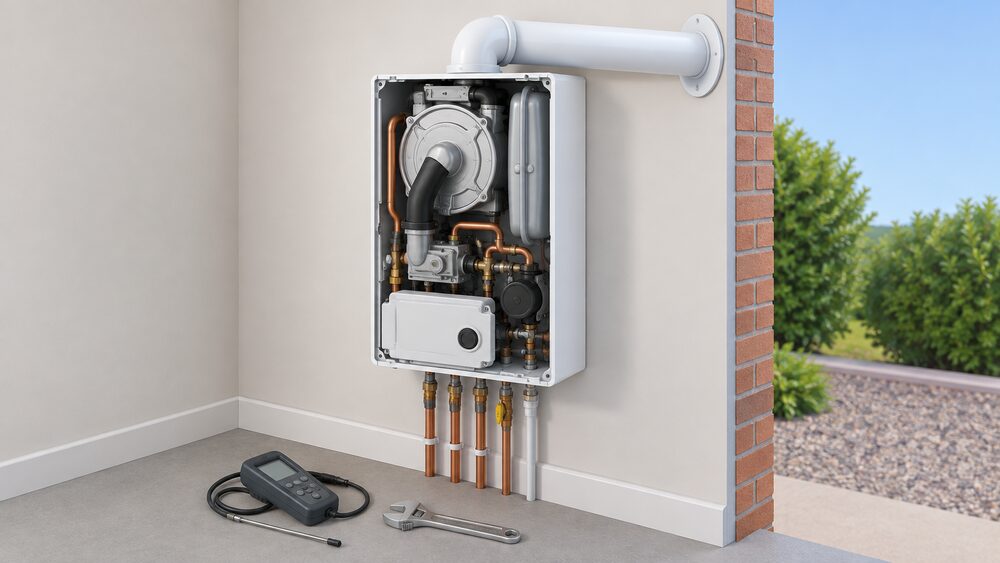
A hydrogen-ready boiler is a gas boiler that runs on natural gas today and can later be converted to run on 100% hydrogen. That is the whole of the claim. It is not a hydrogen boiler, it is not a low-carbon appliance as installed, and it is not yet on sale in the UK. The government's own public attitudes tracker states plainly that "This technology is not yet available"1.
The distinction matters because three different things are sold under similar language. A hydrogen-ready boiler is capable of burning either natural gas or 100% hydrogen, with the switch made by an engineer2. A hydrogen boiler runs on 100% hydrogen with no alterations and cannot run on natural gas at all. A hydrogen-blend boiler is technically identical to a natural gas boiler but marketed as capable of running a blend of up to 20% hydrogen3. Only the first of these is the subject of the proposed mandate.
What a household is being promised, then, is optionality rather than a fuel. The boiler burns methane on day one. Whether it ever burns hydrogen depends on strategic decisions the government intends to take in 2026, on whether a hydrogen network ever reaches the street, and on a conversion that has not yet been standardised for homes4.
What "hydrogen-ready" actually means
The definition used in the government's own consultation work is precise: "Capable of taking up to a 20% hydrogen blend immediately, with the potential to run on 100% hydrogen following an alteration by an engineer. The type of boiler that would be mandated."3 Every part of that sentence carries weight.
"Immediately" refers to the blend, not to hydrogen. A hydrogen-ready boiler arrives set up for natural gas and tolerates a modest hydrogen admixture without modification. "Following an alteration" is the 100% hydrogen step, and it is a change to the appliance rather than a replacement of it. "The type of boiler that would be mandated" is the policy hook: the proposal was never to require households to buy hydrogen, only to require that new boilers be capable of accepting it later.
The three categories are worth keeping apart, because marketing blurs them3:
| Term | Runs on natural gas | Runs on 20% blend | Runs on 100% hydrogen |
|---|---|---|---|
| Hydrogen-ready boiler | Yes | Yes, immediately | Yes, after engineer alteration |
| Hydrogen boiler | No | No | Yes, with no alterations |
| Hydrogen-blend boiler | Yes | Yes | No |
A hydrogen-blend boiler is, on the evidence, a natural gas boiler with different wording on the box. That is not a criticism of the appliance, which may be perfectly good, but it is a reason to read the specification rather than the badge.
How the conversion works
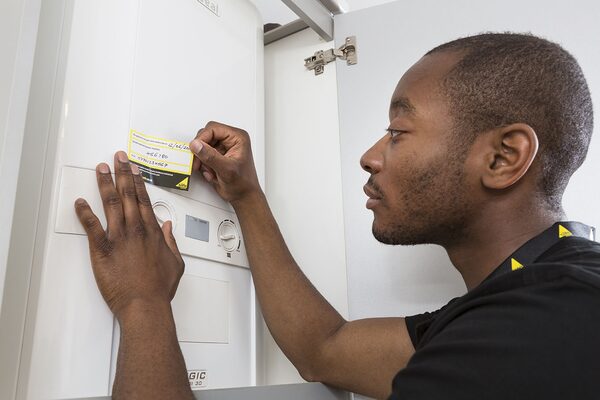
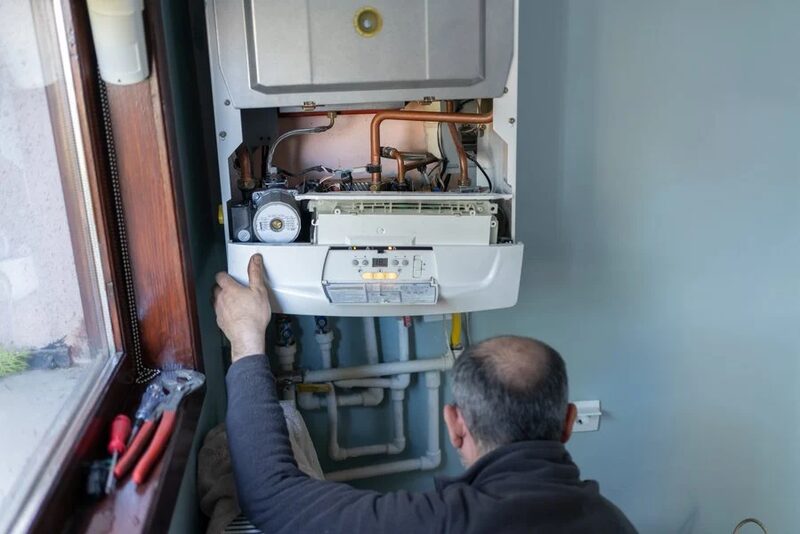
The conversion from natural gas to 100% hydrogen is described by manufacturers as a small adjustment carried out by a registered Gas Safe engineer, once the blended or pure gas is being provided through the gas system2. It is not a new boiler, and it is not a change of heating system. The appliance stays on the wall.
What that adjustment involves in detail is not set out in the public material, and it would in any case be defined by the manufacturer for each model. What can be said is that the work is of the same order as a service visit rather than an installation. For comparison, a boiler installation proper involves turning off the gas and water supply, a period with no water or heat, and in some conversions the removal of a cold water storage tank that is no longer needed7. None of that applies to a fuel conversion.
The practical consequence for a household is that the disruption of going hydrogen-ready, if it ever happens, is small. The disruption of the decision is not: the conversion only becomes possible if hydrogen arrives at the property, and that is a network question rather than an appliance question.
"all it takes is a small adjustment from a registered Gas Safe engineer once the mixed blend is provided through the gas system"
Who makes them, and the price promise
Baxi Heating and Worcester Bosch are named in an official case study as the leading manufacturers of hydrogen-ready boilers8. Alpha Heating Innovation states that it is developing boilers which are hydrogen-ready9. The government's consultation on the mandate names Ideal and Vaillant among the manufacturers engaged with the proposal3. Development, demonstration and certification are not the same as retail availability, and none of these appliances is on general sale in the UK.
On price, the position is unusual. There is no published UK price for a hydrogen-ready boiler, because there is nothing to buy. What exists instead is a commitment: the government's proposal includes a non-binding price parity pledge made by major boiler manufacturers, under which the cost of hydrogen-ready boilers should be at no additional cost once sales reach comparable levels to gas boilers3. Two words in that sentence do the work. "Non-binding" means it is not enforceable. "Once sales reach comparable levels" means parity is a destination, not a starting point.
For context on what a boiler replacement costs today, replacing a G-rated gas boiler with an A-rated boiler and thermostatic radiator valves averages £3,500 in Great Britain10. That figure is for a conventional replacement and is not a hydrogen-ready price. Where no published price exists, hydrogen-ready pricing would be installer-quoted.
Availability: not yet, and conditional

The technology is not yet available, and hydrogen boilers are not currently available in the UK1. That is the starting point for any household considering the question, and it is stated by government statistics rather than by a competitor.
The policy timeline is a sequence of intentions rather than a schedule. The Heat and Buildings Strategy says the government intends to take strategic decisions on the role of hydrogen in heating buildings in 20264. A hydrogen heating village trial was to begin by 202511. Baxi Heating told a parliamentary committee that the next phase in the UK's development of 100% hydrogen heating must take place over the next five years12. The proposed mandate for all newly installed domestic-scale boilers was consulted on with an opening from 20263.
Each of those is conditional on the one before it. A mandate without a hydrogen network delivers nothing; a network without a strategic decision will not be built; a strategic decision in 2026 comes after the point at which many households will next replace a boiler.
What they burn before conversion
Before any conversion, a hydrogen-ready boiler burns natural gas. That is the fuel it is designed around, and it is the fuel the gas grid supplies.
The blend question is where most confusion sits. Existing boilers and cooking appliances can run on a blend of up to 20% hydrogen with natural gas with no disruption to the home5. Natural gas boilers can use a blend of up to 20% hydrogen, and have been able to for many years3. The blend should not require a change to appliances used in the home, such as boilers and gas hobs5.
The consequence is that a 20% blend is not a reason to buy a hydrogen-ready boiler. Any modern gas boiler already handles it. The blend is a decarbonisation measure for the gas network, not a product feature, and it delivers a modest reduction in the carbon intensity of the gas rather than a change of fuel.
The proposed mandate and replacement time
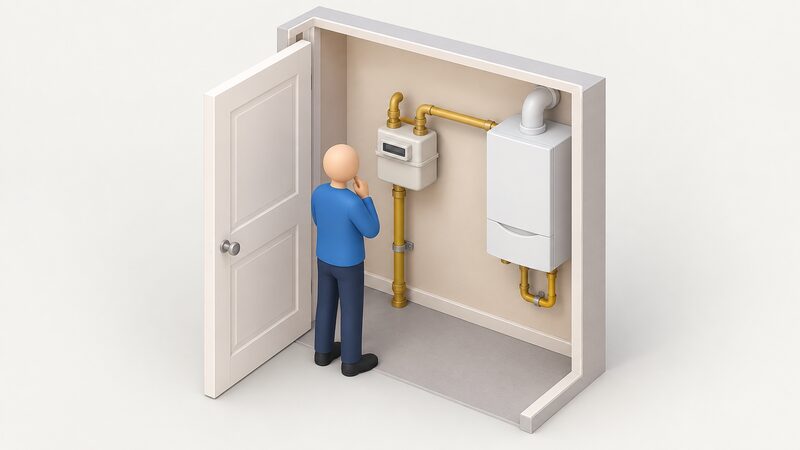
The mandate proposal is the part of this subject with the most direct bearing on a household's next boiler. Baxi Heating's recommendation to Parliament was for a mandate that all boiler installations from 2025 are hydrogen ready, on the basis that this would mean a significant proportion of the existing boiler stock could later be converted rather than replaced12. A respondent to the Welsh Government's Part L consultation proposed mandating hydrogen ready boilers from 2025 in existing dwellings13. The Scottish Government noted a UK Government commitment to consult on encouraging or requiring new gas boilers to be hydrogen-ready by 202614.
The government's own assessment is that the mandate is a "low-regret action" in terms of impact to consumers, assuming the conditions set out in the consultation are met3. That is the argument for it: if hydrogen never arrives, the household has lost nothing but a slightly different appliance; if it does arrive, the conversion is cheap.
Against that sits a hard fact about the Future Homes Standard. Fossil fuel heating will not meet the standard, including hydrogen-ready and hybrid boilers15. Gas boilers, including hybrid and hydrogen-ready boilers, will not meet the proposed standards15. For new build, the hydrogen-ready route is closed regardless of the mandate.
For existing homes, the position is permissive. There is currently no legal requirement for existing homes to be retrofitted or for low-carbon heating technologies to be installed in existing homes, with exceptions for privately rented homes and homes owned by local authorities and housing associations in some parts of the UK16. A working boiler does not have to be replaced early.
The Climate Change Committee's position

The Climate Change Committee has been consistent and blunt. Its advice for Wales states: "However, we see no role for hydrogen in heating for buildings."17 Its advice for Northern Ireland states: "However, we see no role for hydrogen in buildings heating."18 Its seventh carbon budget advice says there is no role in buildings heating and only a very niche, if any, role in surface transport6, and its public position calls for confirming that there will be no role for hydrogen in home heating19.
The committee's alternative is electrification. It models that emissions must fall by 87% compared to 1990 levels by 2040, and that electrification makes up 60% of emissions reductions by 204019. Its number one recommendation is to make electricity cheaper by taking policy costs off electricity bills20. It notes some encouraging signs of progress in delivery indicators but says a significant increase in roll-out rates is needed in many areas in the next few years20.
The committee's role in the devolved nations is formal: it provides regular advice, including an annual Scottish progress report on reducing emissions, advice on emissions reduction targets and regular independent assessments of Scotland's adaptation programmes21. Its assessments carry weight in the decisions that will determine whether hydrogen reaches homes at all.
"However, we see no role for hydrogen in buildings heating and only a very niche, if any, role in surface transport"
The Energy and Utilities Alliance and the gas case
The Energy and Utilities Alliance is the trade body that argues the case for gas in UK heating, and it is the organisation behind the hydrogen-ready boiler mandate proposal put to Parliament12. Its argument is structural rather than technical: a mandate that all boiler installations from 2025 are hydrogen ready would mean that a significant proportion of the existing boiler stock could later be converted rather than replaced12. On that reasoning, the cost of the transition falls on the appliance rather than on the home.
The counter-argument is the one the Climate Change Committee makes: if there is no role for hydrogen in buildings heating, a hydrogen-ready boiler is a gas boiler with an unused capability, and the conversion it promises never happens6. Both positions are held by credible organisations, and the disagreement is unresolved. The government's own position is that the mandate is low-regret assuming its conditions are met3, which is a way of saying the case depends on decisions not yet taken.
For a household, the practical reading is that the trade body's case is about preserving optionality for the gas network, and the committee's case is about not spending on an option that may never be exercised. Neither is a statement about whether a hydrogen-ready boiler works. Both work as gas boilers.
How this fits the wider phase-out of gas boilers

The phase-out is about installation, not about existing appliances. The British Energy Security Strategy set the ambition to end the installation of gas boilers by 2035 at the latest11. The Heat and Buildings Strategy set the ambition of phasing out the installation of new natural gas boilers from 20354.
That distinction is the one households most often miss. A boiler installed today is not scheduled for removal in 2035. What changes in 2035 is what can be installed new. The Scottish Heat in Buildings Bill will not be introduced during this Parliamentary session22, and the Scottish Government has consulted on a public sector replacement duty that would, from 2025, prevent public sector organisations from replacing a polluting heating system with another unless impractical23. Those are devolved variations on the same direction of travel.
Building standards already constrain what can be fitted. In Wales, each boiler must have a minimum efficiency of 86% for gas and 85% for oil, an installer should be Gas Safe Registered from 1 April 2009, and the replacement of a gas boiler will probably have to be a condensing boiler unless there is sufficient reason why one cannot be installed24. In Scotland, the boiler size may not need to be replaced, provided it was correctly sized originally25.
For a household with a working boiler, the sequence is therefore: no requirement to replace it early, no hydrogen-ready model to buy yet, and a 2035 date that governs new installations rather than existing ones. Where a replacement is due, the choice is between the appliances actually available, which are covered in gas boilers and condensing boilers.
What it means for household energy independence
A hydrogen-ready boiler does very little for a household's energy independence, and it is worth being exact about why.
It does not change where the energy comes from. A hydrogen-ready boiler burns natural gas from the gas grid, supplied by a supplier, and the household remains connected to both10. If hydrogen ever arrives, it would arrive through the same network, under the same arrangements, from the same kind of supplier. The dependence shifts fuel, not structure.
It does not remove dependence on electricity. Gas boilers and heating, along with electrical appliances and home internet and landline connections, stop working in a power cut26. A hydrogen-ready boiler has the same pumps, fans and controls as any other gas appliance, so a power cut stops it just as it stops a conventional boiler.
It does not remove dependence on a manufacturer. The conversion to 100% hydrogen would be defined by the maker of the appliance, and the availability of parts, engineers and instructions over the life of the boiler rests with that company. That is the same position as any gas boiler, and it is the reason boiler warranties and registration matter more than the fuel label.
What it does offer is a hedge against a decision not yet taken. If hydrogen reaches a street, a hydrogen-ready boiler can be converted rather than replaced. If it does not, the household has a gas boiler. Alpha Heating Innovation's own advice is that a household does not need to install a hydrogen-ready boiler immediately2, and that if a replacement is due in the next year to five years it is worth speaking to an installer about a hydrogen-ready option9. That is a manufacturer's view of its own product category, and it is consistent with the policy position: the option is worth having if it costs nothing, and it is not worth paying a premium for.
For households weighing the wider question of how much of their heating they control, home heating and energy independence sets out the options that reduce reliance on a network rather than change the fuel running through it.
Sources26 cited
- DESNZ Public Attitudes Tracker: Heat and Energy Use in the Home, Winter 2025, GOV.UK, 2026-03-12
- Should I switch to a hydrogen-ready boiler now?, Alpha Heating Innovation, 2023-11-08
- Understanding the public view on hydrogen boilers, Nesta, 2023
- Heat and Buildings Strategy, GOV.UK
- Hydrogen blending, Cadent Gas, 2026-09-20
- The Seventh Carbon Budget, Climate Change Committee, 2025-02-26
- How long does it take to fit a boiler?, Uswitch, 2026-09-16
- Case study: UK hydrogen heated homes of the future, Ofgem, 2021-07-29
- What is a hydrogen-ready boiler and do I need to get one?, Alpha Heating Innovation, 2025-07-16
- Boilers, Energy Saving Trust, 2026-05-20
- British Energy Security Strategy, GOV.UK, 2022
- Written evidence to the Business, Energy and Industrial Strategy Committee, Baxi Heating UK Ltd, 2026
- Part L and F Review Stage 2A: Government Response, Welsh Government, 2021-10
- Heat in Buildings Strategy: Achieving Net Zero Emissions in Scotland's Buildings, Scottish Government
- The Future Homes and Buildings Standards 2023 Consultation, GOV.UK, 2026-09-17
- Research briefing: Heat and building decarbonisation, House of Commons Library, 2026-09-17
- Wales Fourth Carbon Budget, Climate Change Committee, 2025-05-14
- Northern Ireland's Fourth Carbon Budget, Climate Change Committee, 2025-03-19
- End the fossil fuel age for a secure and prosperous future, Climate Change Committee, 2025-02-26
- Response to the government's Carbon Budget and Growth Delivery Plan, Climate Change Committee, 2025-10-29
- Climate change policy, Scottish Government, 2026-09-17
- Heat in Buildings Bill: consultation analysis report and response, Scottish Parliament, 2026-01-29
- Delivering net zero for Scotland's buildings: Heat in Buildings Bill consultation, Scottish Government, 2023-11
- Building regulations: boilers and heating, Welsh Government, 2026-09-17
- Building Standards Technical Handbook 2020: Domestic, 3.13 Heating, Scottish Government, 2020-12-02
- Storms and bad weather, Energy Networks Association, 2026-09-17
 Hydrogen Appliance TestingHow domestic hydrogen boilers, hobs and fires are tested and certified in the UK, the hydrogen content covered, the bodies involved, and the standards work still outstanding before general sale.
 The Full Brands GuideWhich boiler, heat pump or solar brand can you trust, and who actually owns it?
 Boiler Manufacturers in the UKCovers the manufacturers supplying gas, oil, LPG and electric boilers to UK homes, their main ranges and where they are made.
 Hydrogen Heating PolicyWill hydrogen ever heat your home, and when will the government decide?
 Hydrogen in the Gas GridHydrogen might be mixed into the gas you already use, but what would that actually mean for your bills, your boiler and your safety?
 Hydrogen Safety in the HomeCan hydrogen actually be used to heat UK homes, and is it safe?