
In this answer
Short answer
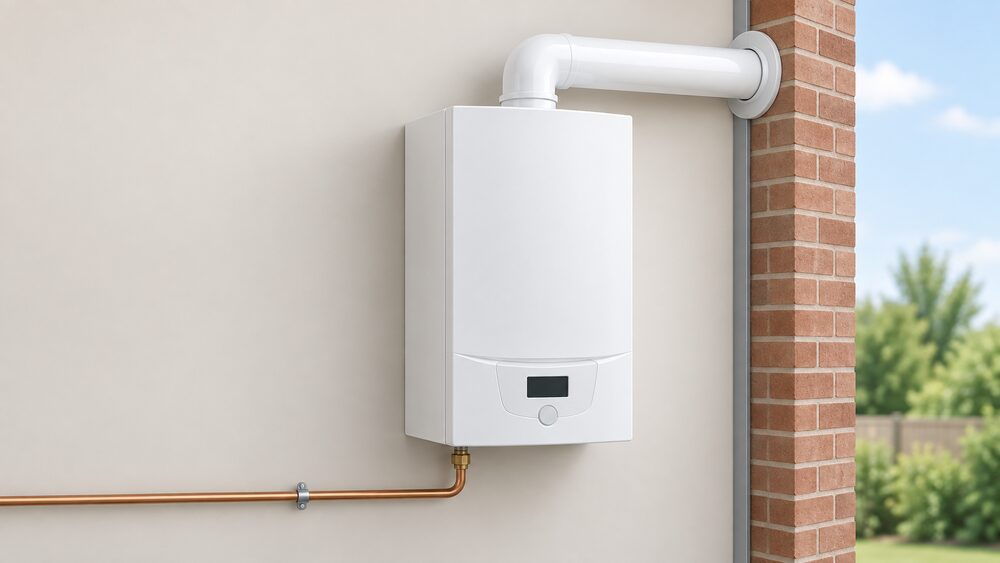
Yes. Existing boilers and cooking appliances can run on a blend of up to 20% hydrogen with natural gas with no disruption, and the blend should not require a change to appliances used in the home, such as boilers and gas hobs1. Most modern condensing boilers in the UK have been manufactured and tested to run on a blend of 80% natural gas and 20% hydrogen, and a current modern gas boiler will operate as usual on that blend2.
The reason is certification rather than conversion. All existing gas appliances are certified to run on a 23% hydrogen blend, which sits above the 20% level used in network blending4. Nothing is added to the appliance, no flue is changed and no new commissioning is needed for the blend itself. The hydrogen arrives already mixed into the gas in the pipework5.
What the blend does not do is end a household's dependence on the gas network. A 20% blend delivers carbon savings of around 7%, and the home remains connected to a supplier, a meter and a pipe6. Hydrogen-ready appliances are a separate, forward-looking label, and the policy position on hydrogen for home heating remains unsettled7.
What a 20% blend actually is: 80% natural gas, 20% hydrogen
A 20% hydrogen blend is exactly what the name suggests: natural gas and 20% hydrogen introduced into the gas pipework, so that every appliance drawing from that pipe receives the mixture rather than pure methane5. The proportion is by volume, and the blend is delivered through the existing network rather than by any change at the property boundary.
The composition matters because it explains why the appliance question is largely a non-question. Most modern condensing boilers in the UK have been manufactured and tested to run on a blend of 80% natural gas and 20% hydrogen2. The appliance is not being asked to do anything new; it is burning a slightly different mixture of gases through the same burner, at the same pressure, with the same controls.
Blending is one of several approaches under discussion. Trials of a blended approach, using small quantities of hydrogen usually at 20% by volume, have been conducted10. The blend is a marginal decarbonisation measure rather than a replacement of the fuel: it reduces the carbon intensity of the gas burned without changing the fact that the home is burning a fossil-derived gas for most of its heat.
For a household, the practical meaning is that the gas arriving at the meter may change in composition without any visible change at the boiler, hob or fire. The blend is a network-level intervention, and the household experiences it as the same gas supply with a different mix behind it.
Why existing boilers can take it without modification

The compatibility of existing appliances rests on certification that predates the blending rollout. All existing gas appliances are certified to run on a 23% hydrogen blend, which is above the 20% used in network blending4. That headroom is why the blend can be introduced without a per-appliance assessment.
Cadent states that the blend should not require a change to appliances used in the home, such as boilers and gas hobs1. Alpha's guidance for householders is that a current modern gas boiler will operate as usual with a 20% hydrogen blend3. Neither statement depends on the age of the boiler beyond it being a modern condensing appliance.
The wider policy context reinforces the point. The Heat and Buildings Strategy states that no-one will be forced to remove their existing boilers7. Given the average lifespan of boilers in the UK is 15 years, most hydrogen-ready boilers installed in 2026 would never use hydrogen at all on current trajectories11. The blend is designed to work with the installed base, not to require its replacement.
"For householders, a current modern gas boiler will operate as usual with a 20% hydrogen blend."
There is a limit to how far blending can go. Some boilers could be converted to run on hydrogen, but this is unlikely to account for more than 10% of the total due to supply constraints12. Blending is therefore a partial measure, and the conversion of individual appliances to pure hydrogen is a much smaller story than the blend itself.
Hydrogen-ready boilers: what the label means
A hydrogen-ready boiler is built and tested to run on a blend of up to 20% hydrogen, and the label describes that capability rather than a different fuel4. Which? defines a hydrogen-blend boiler as technically identical to a natural gas boiler, but marketed as being capable of running a blend of up to 20% hydrogen13. The distinction between the marketing and the engineering is worth holding on to.
The Kiwa 20% Hydrogen Mark exists to certify exactly this. It is intended for boiler manufacturers wanting to future-proof their natural gas appliances, for gas network operators planning blending pilot projects and for householders14. A mark of this kind gives a household a way to check a claim rather than take it on trust.
Policy has pushed in the same direction. The government consultation on improving boiler standards and efficiency included proposals to mandate that from 2026 all newly-installed gas boilers are hydrogen-ready15. Baxi Heating UK submitted that a mandate that all boiler installations from 2025 are hydrogen ready would mean that a significant proportion of the existing stock would be covered16. The direction of travel is toward the label becoming standard rather than optional.
One financial detail is easy to miss. Energy efficient boilers do not qualify for the reduced rate of VAT and are charged at 20%17. A hydrogen-ready boiler is a gas boiler for tax purposes, and the blend does not change that.
Which boilers and water heaters are compatible: maker positions
Maker statements are the definitive source for an individual model, and several UK ranges carry a 20% blend position. The table below sets out what each maker states for its own product.
| Product | Maker's stated position on a 20% blend |
|---|---|
| Worcester Bosch boilers | able to run on a blend of up to 20% hydrogen9 |
| Viessmann Vitodens 200-W combi | hydrogen ready, up to 20% blend, no modification required18 |
| Vaillant ecoTEC Plus Combi Boiler 2023 | prepared for use with up to 20% hydrogen blend19 |
| Navien NCB300 | hydrogen-ready (20% blend) technology for futureproofing20 |
| Intergas HRE Combi | 20% hydrogen ready21 |
| Rinnai continuous flow water heater | can run on hydrogen blends up to 20%22 |
The pattern across makers is consistent: the blend capability is stated as a property of the appliance as supplied, not as an upgrade. The Viessmann Vitodens 200-W combi is described as designed to run on a blend of up to 20% hydrogen mixed with natural gas, requiring no modification18. The Vaillant ecoTEC Plus is listed as prepared for use with up to 20% hydrogen blend19.
Water heaters follow the same logic. A hydrogen blend ready gas combustion continuous flow water heater can run on hydrogen blends up to 20%22. For a home with a combi boiler, the hot water function is part of the same appliance and inherits the same blend position.
Two adjacent points are worth separating from the blend question. The Vaillant ecoTEC sustain combi boiler range is compatible with the aroTHERM air-to-water heat pump hybrid system, which is a different route to lower carbon heat23. And a smart prepayment gas meter such as the Liberty Gas 220 supports greener energy by handling up to 20% hydrogen and 10% biomethane blending in natural gas, which shows the blend reaching the metering layer as well as the appliance24.
Is a hydrogen-ready boiler the same as a hydrogen boiler?
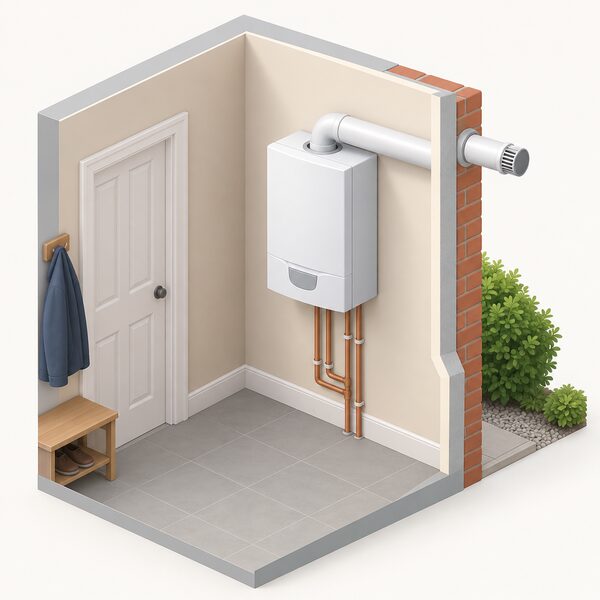
No, and the difference is the whole point of the label. A hydrogen-blend boiler is technically identical to a natural gas boiler, but marketed as being capable of running a blend of up to 20% hydrogen13. A hydrogen boiler in the full sense would run on 100% hydrogen, which is a different appliance, a different network question and a different timeline.
The conversion path exists in principle. Should hydrogen become available in the area where a hydrogen-ready appliance is located, a simple conversion of the appliance is undertaken and in less than an hour the boiler is running on 100% carbon free hydrogen25. That is a statement about what the appliance is designed to allow, not a statement that hydrogen will arrive.
The cost of the full hydrogen route is estimated rather than quoted. Hydrogen boilers are estimated to be in the range of £2,300 to £3,800 to install8. That figure is an estimate for a technology not yet deployed at scale in UK homes, and it sits alongside the blend, which requires no new appliance at all.
The policy picture is contested. Nesta has argued that hydrogen is not the solution to decarbonising our homes11, and public understanding of hydrogen boilers is limited13. The blend and the hydrogen boiler are often discussed together, but they are separate propositions with separate evidence bases.
What a blend does and does not change for household energy independence
The blend's benefit is stated narrowly and should be read narrowly. Hydrogen blending in gas networks offers a reduction in carbon emissions without the cost and disruption to customers of changing their appliances14. A 20% blend delivers carbon savings of around 7%6. That is the whole of the gain at the appliance level.
What it does not change is the structure of the household's energy supply. The home remains connected to the gas network, to a supplier and to a meter. The blend is delivered through the same pipework by the same network, so the dependence on imported gas and on a billing relationship is unchanged. A 20% blend reduces the carbon intensity of each unit burned; it does not reduce the number of units a home needs, and it does not make the home self-sustaining.
The comparison with other routes makes the scale clear. If all oil heated homes made the transition to a 20% HVO blend, it would have a similar impact on reducing carbon emissions to installing 347,000 heat pumps26. An HVO blend would work seamlessly in the existing heating system, with no upfront cost or disruption27. The pattern is the same across liquid and gaseous fuels: a blend is a low-disruption, partial measure.
For a household thinking about independence, the blend is best understood as a change to the fuel's carbon content rather than to the home's relationship with energy. The gas still arrives from outside. The boiler still needs a supplier. The 7% saving is real and it is small, and it does not substitute for insulation, for a heat pump, or for any measure that reduces the quantity of energy a home draws in the first place.
Sources27 cited
- Hydrogen blending, Cadent Gas
- Should I switch to a hydrogen ready boiler now, Alpha Innovation, 2023-11-08
- Hydrogen for homeowners, Intergas Heating
- Hydrogen boilers: what you need to know, Which?
- Hydrogen for trade, Intergas Heating
- HHIC response document, HHIC
- Heat and Building Strategy, GOV.UK, 2021-10
- Savanta Cadent consumer choice, Cadent Gas
- RECC Autumn Newsletter 2024, RECC
- Starting a hydrogen dialogue, Energy Systems Catapult, 2023-12-06
- Why hydrogen is not the solution to decarbonising our homes, Nesta, 2023-07-27
- New boiler ban within 14 years, Carbon Brief, 2021-05-25
- Understanding the public view on hydrogen boilers, Nesta, 2023
- Kiwa 20% Hydrogen Blend Mark, Kiwa
- Boiler consultation, CIPHE
- Written evidence, UK Parliament
- Tax on shopping: energy saving products, GOV.UK
- Viessmann Vitodens 200-W combi boiler review, Boiler Central, 2026-07-14
- Vaillant ecoTEC Plus Combi Boiler 2023, Quiet Mark
- NCB300 gas condensing combi boiler, Navien
- Intergas datasheets, Intergas Heating
- Carbon economic comparison of hot water systems, Rinnai UK, 2022-10-27
- Vaillant ecoTEC sustain combi boilers, Quiet Mark
- Liberty Gas 220, Secure Meters, 2025-12-17
- What are the main barriers to decarbonisation of heat, BESA, 2023-09-05
- Andy Burnham urged not to forget previous commitments to oil heated households, OFTEC, 2026-07-07
- Last chance for oil heated homes as consultation responses hit 12,000, OFTEC, 2026-02-03
 Hydrogen Safety in the HomeCan hydrogen actually be used to heat UK homes, and is it safe?
 Hydrogen Appliance TestingHow domestic hydrogen boilers, hobs and fires are tested and certified in the UK, the hydrogen content covered, the bodies involved, and the standards work still outstanding before general sale.
 Hydrogen-Ready BoilersWhat manufacturers mean by hydrogen-ready and hydrogen-blend-capable, what conversion would require, and the state of UK hydrogen heating trials and decisions.
 Hydrogen in the Gas GridHydrogen might be mixed into the gas you already use, but what would that actually mean for your bills, your boiler and your safety?
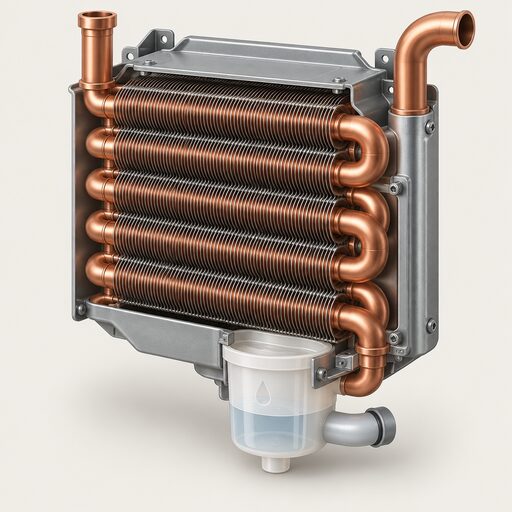 Gas Boilers GuideMains gas boilers heat around 23 million UK homes.
 Hybrid Heat PumpsHow hybrid systems pair a heat pump with a gas, oil or LPG boiler, what decides which appliance runs, what they cost, how much gas they displace, and why the Boiler Upgrade Scheme will not fund them.