

In this guide
Hydrogen in the gas grid is a live policy question, not a product a household can buy. The level under assessment is blending up to 20 per cent hydrogen by volume into the existing gas network, and the government has said it intends to take strategic decisions on the role of hydrogen in heating buildings in 20261. No hydrogen boiler is currently available in the UK2.
The case for blending rests on emissions. Introducing a mix at the proposed level would reduce carbon emissions by about six million tonnes a year, and the government's own assessment puts the potential at up to 7 per cent emissions reductions from the grid2. Against that sits efficiency: using green hydrogen for heat would require 4 to 6 times more renewable energy per unit of heat than a heat pump3.
What follows sets out the blending limit, the trials that ran and the ones that did not, the production routes being funded, and the safety and cost limits that remain. It also sets out what this means for a household's energy independence, which is less than the headlines suggest: a blend still arrives through the same pipes, from the same networks, under the same supplier.
What hydrogen blending is: up to 20% by volume in the existing network
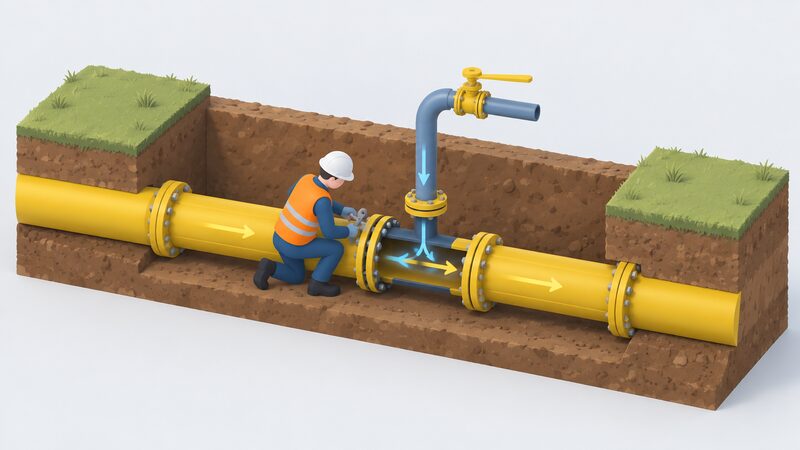
Blending means putting hydrogen into the gas that already flows through the distribution network, rather than replacing the network or the fuel. The government's working figure is blending up to 20 per cent hydrogen by volume into the existing gas network, and that is the ceiling the engineering evidence has been built around1. The Scottish Government's hydrogen policy statement records that blending at up to 20 per cent by volume in the gas distribution network can be accommodated within the network and used by existing appliances4.
The gas grid itself is a network of gas pipelines across Great Britain, so a blend decision is a decision about a single connected system rather than a series of local choices5. Scotland has set a broader ambition: by 2030 it would like at least 20 per cent of the volume of the gas in the GB gas grid to be alternatives to natural gas, which is a wider category than hydrogen alone and would include biomethane6.
Two things follow from the 20 per cent figure. First, it is a volume limit, not an energy limit, and hydrogen carries less energy per unit of volume than methane, so the emissions benefit is smaller than the headline percentage suggests. Second, it is a blend limit, not a conversion: a home on a blend still burns mostly natural gas, still depends on the same network and still buys from the same supplier.
| Feature | Natural gas today | Up to 20% hydrogen blend |
|---|---|---|
| Fuel in the pipes | Methane | Mostly methane, with hydrogen added |
| Network | Existing distribution network | Unchanged4 |
| Appliances | Existing boilers | Existing appliances can be used4 |
| Household's supplier | Unchanged | Unchanged |
| Carbon intensity per unit burned | Higher | Lower2 |
The distinction matters for anyone weighing up where Britain's gas comes from and how much of it is imported. A blend reduces the carbon intensity of each unit burned without changing the volume of gas the country needs or where it is sourced from.
Why blend: the emissions reduction blending can deliver

The emissions case is the strongest part of the blending argument, and it is also the most modest. Introducing a mix at the proposed level would reduce carbon emissions by about six million tonnes a year, and the government's own assessment puts the potential at up to 7 per cent emissions reductions from the grid2. Those are the two figures that carry the policy, and they should be read together: a national-level saving measured in millions of tonnes, against a grid-level reduction in single digits.
The context is that heating homes accounts for around 14 per cent of the UK's total greenhouse gas emissions, and heating with fossil fuels like gas and oil contributes 17 per cent of the UK's total emissions7. The two figures come from different documents and measure slightly different things, so they are not directly comparable, but both establish that domestic heat is a large share of the problem.
Blending is attractive because it uses infrastructure that already exists and appliances that, at blend level, already work. The Green Gas Support Scheme was set up with the same logic for a different gas: it was intended to increase the proportion of green gas in the grid, decarbonising the gas supply and continuing the transition to net zero9. That scheme closes to new applications in March 2028, with supported projects required to be commissioned by March 2030, so the green gas route has a defined end point even as the hydrogen question stays open.
For a household, the emissions argument does not translate into anything controllable. A blend would lower the carbon content of the gas burned in a home without the household choosing it, paying for it separately, or being able to opt out. It is a grid-level measure delivered through the gas distribution networks that serve each street.
Trials and the road to a hydrogen-heated town
The trial programme was designed as a ladder: neighbourhood scale, then village scale, then a town. The government set out a neighbourhood trial by 2023 and a village scale trial by 2025, and a later briefing described a village scale trial by 2025 and a potential hydrogen heated town before the end of the decade1. The village trial was scoped at 1,000 to 2,000 properties10.
Redcar, Teesside was considered by the government as a potential location for the hydrogen heating trial, a position recorded in 2023 and repeated in later briefing material5. The ladder has not been climbed as set out. The neighbourhood and village dates have passed without a village trial of the kind described, and the strategic decision that was to follow the evidence has moved to 20261.
Smaller blending work has gone ahead. A trial at Centrica's Brigg Power Station successfully completed blending 2 per cent of green hydrogen into the gas grid in October 202512. The Acorn Hydrogen project examined blending hydrogen at 1 to 2 per cent by volume with the natural gas injected into the national transmission network from St Fergus, near Peterhead in Aberdeenshire4. These are transmission and generation-side demonstrations at low blend levels, not domestic heating conversions.
| Stage | Announced | Delivered |
|---|---|---|
| Neighbourhood trial | By 20231 | Not delivered as described |
| Village scale trial | By 2025, 1,000 to 2,000 properties1 | Not delivered as described |
| Hydrogen heated town | Potential, before end of decade5 | No commitment |
| Low-level blending demonstrations | Not part of the ladder | 2% at Brigg, October 202512; 1 to 2% at Acorn4 |
The gap between the announced ladder and the delivered programme is the single most important fact about hydrogen heating in the UK. It is why the policy position is best read as undecided rather than pending.
The strategic decision on hydrogen's role in heating buildings

The decision point is 2026. The government has said it intends to take strategic decisions on the role of hydrogen in heating buildings in 2026, a commitment that traces back to the October 2021 Heat and Buildings Strategy and its programme of developing the evidence base to inform strategic decisions in 2026 on the future role of hydrogen in home heating1. A 2025 consultation on the role of hydrogen in home heating was due, which places the decision after the consultation rather than before it11.
The Committee on Climate Change assessed the Heat and Buildings Strategy as having laid out important high-level decisions on the UK's approach to reducing emissions from heating buildings, but found that plans are not yet comprehensive or complete and significant delivery risks remain13. It also identified a priority the strategy had not resolved: taking major strategic decisions, particularly addressing the relative costs of electricity and gas13. That cost relationship is the hinge on which hydrogen heating turns, because hydrogen is modelled as more expensive than natural gas while electricity for a heat pump is compared on a different basis entirely.
The devolved position differs. Scotland's Heat in Buildings Strategy states that the country will have to stop using natural gas and that it might be able to use other kinds of gas, working with the UK Government and other organisations to understand what role those could play14. The draft strategy behind it recognised that hydrogen could play a potential role in the longer term15. That is a more cautious formulation than a target, and it places hydrogen as a possibility rather than a plan.
For a household, the practical reading is that no decision has been taken, the decision has a date, and the date has already moved once. Nothing about a home's heating should be planned around hydrogen arriving in a particular area.
How hydrogen heating works and what it emits
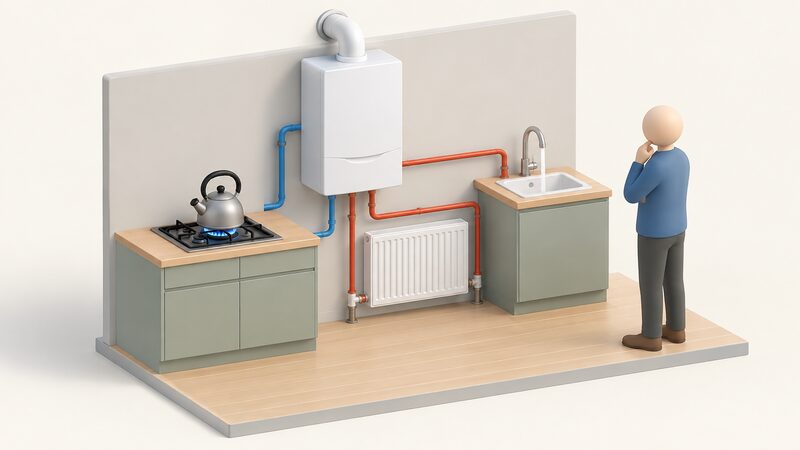
A hydrogen boiler burns hydrogen instead of methane. The combustion product is water rather than carbon dioxide, which is the source of the emissions claim. What it does not remove is the other products of combustion: burning hydrogen still produces some of the other pollutants that are a by-product of burning natural gas, such as nitrogen oxides, the group which includes nitrogen dioxide2.
That distinction matters for air quality and for ventilation. Nitrogen oxides are formed when nitrogen and oxygen in the air react at high temperature, so they are a function of the flame rather than the fuel, and a hydrogen flame hot enough to heat a home will produce them. Carbon monoxide is a different matter: burning hydrogen does not produce it, because there is no carbon in the fuel. Carbon monoxide remains a hazard from other sources, including burning charcoal, running cars and cigarette smoke, so the standard safety advice is unchanged16.
The appliance side has been developed through the Hy4Heat programme, which set out to develop domestic hydrogen appliances demonstrating the safe use of hydrogen as a fuel for domestic heating, hot water and cooking17. Alongside it, the Hydrogen Energy and Utility Skills programme was established to develop a common competency framework for the training, accreditation and registration of gas engineers working with hydrogen4. Both are prerequisites rather than products: appliances that can be demonstrated and engineers who can be registered.
"heating appliance manufacturers are developing domestic hydrogen appliances to demonstrate the safe use of hydrogen as a fuel in providing domestic heating, hot water and cooking requirements"
The emissions benefit of hydrogen heating therefore depends entirely on how the hydrogen was made. A hydrogen boiler burning hydrogen produced from fossil gas without carbon capture delivers little or nothing.
Green, blue and grey hydrogen: how the fuel is made and what it costs
The colour labels describe production routes, and the route determines whether hydrogen heating reduces emissions at all.
- Green hydrogen: made using renewable electricity.
- Blue hydrogen: made from fossil gas with carbon capture.
- Grey hydrogen: made from fossil gas without carbon capture.
The British Energy Security Strategy set an ambition for hydrogen production capacity by 2030 with at least half coming from green hydrogen and utilising excess offshore wind power to bring down costs18.
Cost is where the domestic case weakens. Imperial College London modelled that hydrogen would be three times more expensive than natural gas for heating2. That is a modelled comparison rather than a market price, and it reflects the conversion losses in making hydrogen, the cost of the plant, and the fact that the network and appliances would handle a different fuel. No domestic hydrogen tariff exists, because no domestic hydrogen supply exists.
The comparison a household can actually make is between fuels it can buy. Gas costs are recovered through the price cap, and Ofgem's consultation on wholesale cost adjustment recorded shaping and imbalance costs of £43 per customer for gas during cap period nine19. That is a network and balancing cost rather than a unit price, but it illustrates the kind of cost that sits on the gas side of the bill and would have to be rebuilt around a different fuel.
The production picture is also international. A green hydrogen production facility in Wilbarger County, Texas is due to begin commercial operations in 2027, and INEOS has announced plans for a world-scale low-carbon hydrogen plant expected to be operational by 203020. Those are supply-side projects outside the UK, and they indicate where the capital is going: industrial and export-scale production, not domestic heating.
The efficiency problem: hydrogen versus heat pumps

The efficiency comparison is the strongest argument against hydrogen for home heating, and it comes from an official source. Using green hydrogen would require 4 to 6 times more renewable energy per unit of heat than a heat pump3. That is a statement about the renewable electricity needed to deliver the same warmth, and it is the reason the Committee on Climate Change's pathway places up to 10 million homes on the gas grid in the UK transitioning to heat pumps and hybrid heat pumps by 203521.
The heat pump side of the comparison is well evidenced. Heat pumps can usually deliver three units of heat for every unit of electricity used, and a Welsh Government guide puts the figure at three to four units of heat per unit of electricity22. The government's own press material describes heat pumps as three times more efficient than gas boilers24. Those figures are for the appliance, not the whole system, and real performance depends on the fabric of the building and the emitter temperatures.
The methodology for comparing the two is set out in the government's heat pump methodology for the Home Energy Model, which states that for a hybrid heat pump the ratio of the heat pump COP to the boiler efficiency must be greater than the ratio of the unit costs of the heat pump's energy source and the boiler's energy source25. In plain terms, a hybrid system only saves money when the heat pump is efficient enough relative to the boiler to overcome the price difference between electricity and gas. That is the same cost relationship the Committee on Climate Change flagged as unresolved.
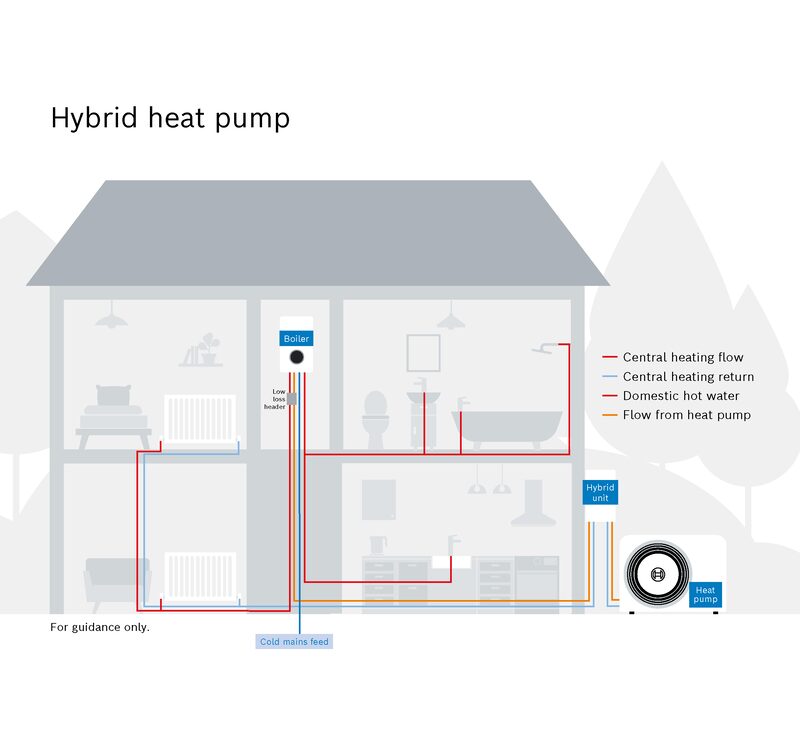
Hybrid heat pumps are described as suitable for buildings with existing heating systems, or buildings needing significant fabric, energy efficiency and pipework upgrades for a standalone heat pump22. They are also described as offering better choice and adapting the home for both low-electricity and low-carbon gas technologies, including 100 per cent hydrogen2. That framing keeps a gas route open, but it does not make hydrogen competitive on energy input.
Safety, retrofit and infrastructure challenges
Safety work has run in parallel with the policy question. The Hy4Heat programme's purpose was to demonstrate safe use of hydrogen for domestic heating, hot water and cooking, and the engineer competency framework covers training, accreditation and registration for work with hydrogen17. Those are the two conditions any rollout would need: appliances that can be certified and a workforce that can be registered to install and service them.
Retrofit is the harder constraint. The Future Homes Standard consultation states that gas boilers, including hybrid and hydrogen-ready boilers, will not meet the proposed standards26. That is a significant limit: a hydrogen-ready boiler is not a route to compliance with the proposed future standard for new homes, which points new build towards electric heating rather than a gas appliance of any kind.
The wider retrofit evidence base shows what a fabric-first approach involves. Edinburgh's High Rise Retrofit and Upgrade Programme sets out that all retrofits should align with current best practice guidelines to maximise sustainability, safety and inclusivity, naming standards including LETI, AECB, EnerPHit, PAS 2030, EESSH2/SHNZS and the UK Net Zero Carbon Building standard27. That list is a measure of how much work sits between a home as built and a home ready for a low-temperature heat source, whether that source is a heat pump or hydrogen.
There is also a restriction that shows how the gas grid and low-carbon heating interact. Under the Boiler Upgrade Scheme, biomass boilers must not be installed in properties connected to the gas grid28. The rule exists because a grant-funded renewable heating system on a property that could use the gas network is not a sensible use of public money, and it illustrates the assumption running through current policy: a home on the gas grid is expected to move to a heat pump, not to a different gas.
Where hydrogen heating falls short today: cost and availability
The availability position is unambiguous. Hydrogen boilers are not currently available in the UK2. There is no domestic hydrogen tariff, no hydrogen connection, and no area where a household can buy hydrogen for heating. Everything else in this article is about a future that has not been decided.
Cost is the second limit. The modelled figure of three times the cost of natural gas for heating is the only published comparison, and it is a model rather than a price2. The efficiency figure of 4 to 6 times more renewable energy per unit of heat than a heat pump is the reason the cost gap is structural rather than temporary3. Making hydrogen cheaper means making renewable electricity cheaper and the conversion process more efficient, and neither closes a gap of that size on its own.
The policy direction points the same way. The Future Homes Standard excludes gas boilers, hybrid and hydrogen-ready boilers from the proposed standards26. The Committee on Climate Change pathway has up to 10 million gas-grid homes moving to heat pumps and hybrid heat pumps by 203521. The government's own heat pump messaging describes them as three times more efficient than gas boilers24. None of that rules hydrogen out for industry, shipping or heavy transport, where electrification is harder, but it does place homes low in the queue.
For a household's energy independence, the honest summary is that hydrogen changes very little. A blend would still arrive through the gas distribution network and the national transmission system, still be bought from a supplier, and still leave the home exposed to wholesale gas prices and to where Britain's gas comes from. A heat pump, by contrast, moves the household's heating onto electricity it can increasingly generate itself. The energy security and household independence page sets out what a home can actually control, and hydrogen in the gas grid is not on that list.
Sources28 cited
- Heat and Buildings Strategy, GOV.UK, 2021
- Hydrogen boilers: what you need to know, Which?, 2026
- Written evidence on hydrogen and heat, UK Parliament, 2023
- Scottish Government hydrogen policy statement, Scottish Government, 2020
- Research briefing on hydrogen heating, House of Commons Library, 2023
- Heat in Buildings Strategy, Scottish Government, 2021
- Domestic Renewable Heat Incentive annual report, Ofgem, 2025
- Your essential guide to heat pumps, Welsh Government, 2025
- Key Green Heat Scheme closes and what comes next, Ofgem, 2021
- Hydrogen heating village trial briefing, UK Parliament, 2022
- Research briefing on hydrogen heating, House of Commons Library, 2025
- Clean Flexibility Roadmap, GOV.UK, 2026
- Independent assessment of the UK's Heat and Buildings Strategy, Climate Change Committee, 2022
- Heat in Buildings Strategy easy read, Scottish Government, 2022
- Heat in Buildings Strategy strategic environmental assessment, Scottish Government, 2021
- Carbon monoxide poisoning, nidirect, 2026
- Written evidence on the Hy4Heat programme, UK Parliament, 2020
- Major acceleration of homegrown power, GOV.UK, 2022
- Price cap consultation on possible wholesale cost adjustment, Ofgem, 2022
- Written evidence on hydrogen production, UK Parliament, 2026
- Heat pump sector deal expert advisory group final report, Scottish Government, 2021
- Heat pumps, nidirect, 2025
- Heat pumps: expert guide for homeowners, Development Bank of Wales, 2024
- Demand for heat pumps rises following increase in applications to the Boiler Upgrade Scheme, GOV.UK, 2024
- Home Energy Model: heat pump methodology, GOV.UK, 2026
- The Future Homes and Buildings Standards consultation, GOV.UK, 2023
- High Rise Retrofit and Upgrade Programme Phase 1, City of Edinburgh Council, 2026
- Boiler Upgrade Scheme guidance for installers, Ofgem, 2026
 Hybrid Heat PumpsHow hybrid systems pair a heat pump with a gas, oil or LPG boiler, what decides which appliance runs, what they cost, how much gas they displace, and why the Boiler Upgrade Scheme will not fund them.
 Hydrogen Safety in the HomeCan hydrogen actually be used to heat UK homes, and is it safe?
 Hydrogen-Ready BoilersWhat manufacturers mean by hydrogen-ready and hydrogen-blend-capable, what conversion would require, and the state of UK hydrogen heating trials and decisions.
 Hydrogen Heating PolicyWill hydrogen ever heat your home, and when will the government decide?
 Will Gas Boilers Be Banned?What has actually been legislated, proposed or dropped on gas and oil boiler phase-out across the four UK nations, and the difference between new build rules and replacement in existing homes.
 Replacing a Gas or Oil BoilerSwapping a gas, oil or LPG boiler for a heat pump changes how your home is heated and how much it costs.