
In this guide
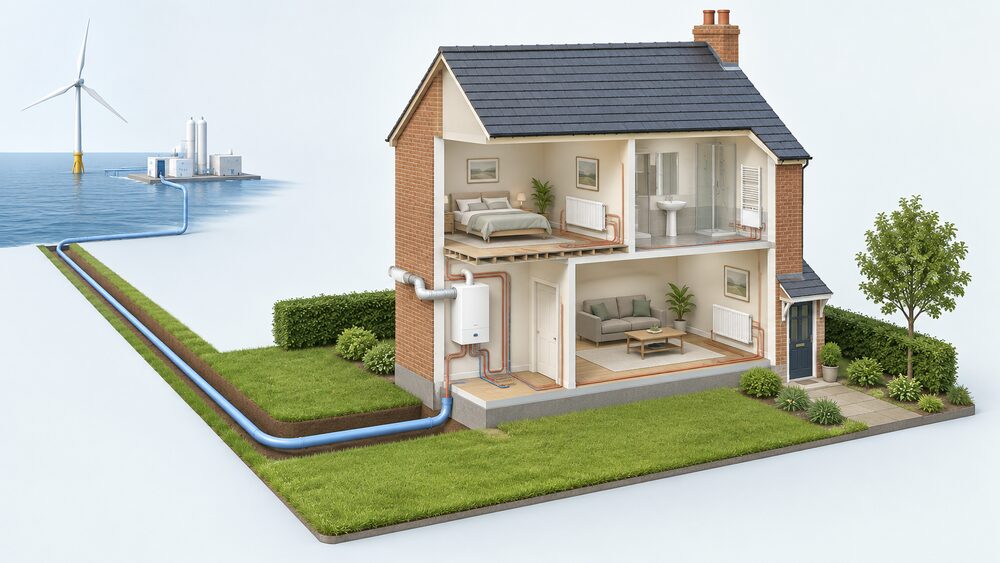
Hydrogen home heating in the UK is, as of September 2026, a demonstration subject rather than a product. No hydrogen boiler is on sale to householders, and the Government has said it does not expect to make a strategic decision on the role of hydrogen in heating until 20261. What exists is a set of trials: a live hydrogen heat network in Fife serving around 300 houses, a cancelled village programme, and a body of appliance testing carried out under the Hy4Heat programme2.
The timetable that was set out in the early 2020s has not held. The Heat and Buildings Strategy promised a neighbourhood trial by 2023 and a village scale trial by 20251. A parliamentary committee later reported that the department's work to test hydrogen for heating had been "beset by problems, with key trials cancelled"4. Redcar, Teesside was under consideration as a potential location for the village trial5.
For a household, the practical position is simple. Hydrogen heating is not something to plan a boiler replacement around. The evidence base is still being assembled, the decision date keeps moving, and the appliance that would burn the hydrogen does not yet exist in a form a UK household can buy3.
What the UK hydrogen heating trials are and where they stand
The trials exist to answer a single question: can hydrogen be delivered to ordinary homes through pipes and burned in ordinary kitchens, safely and at acceptable cost? The work splits into two strands. The first is appliance and safety testing, largely done through Hy4Heat, which set out to develop domestic hydrogen appliances and demonstrate the safe use of hydrogen as a fuel for heating, hot water and cooking8. The second is network demonstration, of which H100 Fife is the surviving large example2.
The policy context is a heating system that carries a heavy emissions load. Heating and hot water for buildings accounts for 20% of UK greenhouse gas emissions, a figure the Climate Change Committee has used consistently since 20189. More recent official statistics put the share attributable to heating our homes at around 14% of the UK's total greenhouse gas emissions11. The two figures measure different things, one covering all buildings and their hot water, the other homes alone, and both appear in government and committee publications.
Against that, the alternatives have moved faster than hydrogen. The Boiler Upgrade Scheme has seen demand for heat pumps rise following an increase in applications12, and the Heat Pump Ready Programme has been supporting high-density deployment of heat pumps in the UK through the development and trial of innovative approaches13. Hydrogen is no longer the only candidate for decarbonising heat, and the trials are now being judged against a technology that is already being installed.
How hydrogen heating works in a home
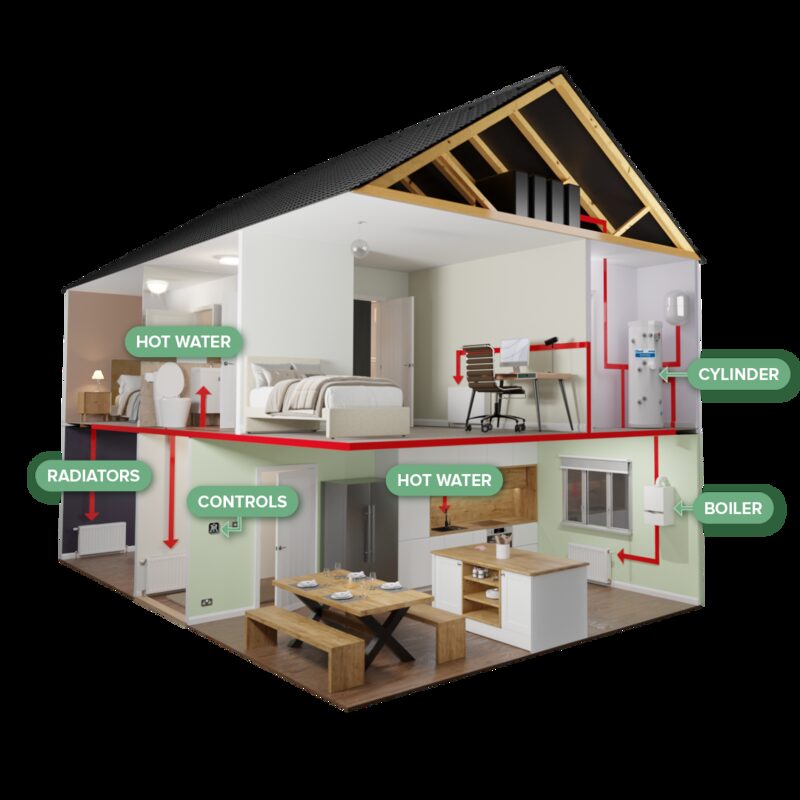
A hydrogen heating system is not a different kind of heating. It is the same wet central heating that most UK homes already have, with a different gas in the pipe and a different appliance at the end of it. Hydrogen appliances can be retrofitted to the over 85% of UK domestic properties which have hydronic (water-based) central heating systems14. That compatibility is the whole argument for hydrogen: it reuses radiators, pipework and, in principle, the street main.
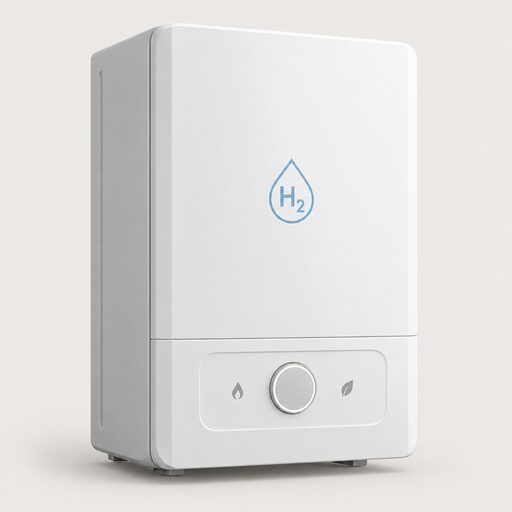
The appliance side is where the work sits. Hy4Heat was set up with heating appliance manufacturers developing domestic hydrogen appliances to demonstrate the safe use of hydrogen as a fuel in providing domestic heating, hot water and cooking requirements8. That programme has successfully proven that hydrogen boilers can operate safely within a test environment, according to official guidance3. A test environment is not a home, and the gap between the two is what the network trials are meant to close.
There is a precedent for trialling a hybrid approach in real homes. British Gas ran a detailed trial where ten systems were installed at the homes of staff members and the performance was monitored over 12 months14. That was a hybrid heat pump trial rather than a hydrogen one, but it established the model the hydrogen trials follow: a small number of instrumented homes, monitored over a fixed period, with the results feeding a policy decision.
H100 Fife: the world-first green hydrogen heating trial

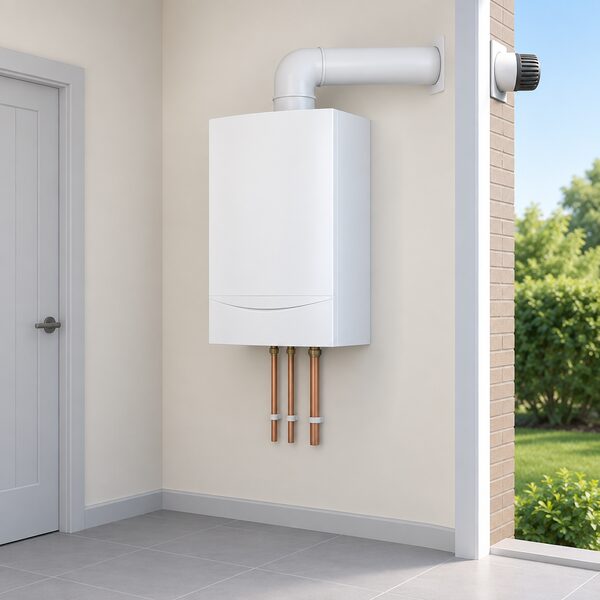
H100 Fife is the demonstration that has actually been built. The project constructs and operates a hydrogen heat network system in Fife able to service around 300 houses2. The Scottish Government's draft Heat in Buildings Strategy described the same project as constructing and operating a hydrogen network in Fife able to service around 300 houses15.
The supply side is what makes it a green hydrogen trial rather than a grid conversion test. The project connects with the existing 7MW wind turbine situated off the coast of Leven in Fife to directly supply power for electrolysis15. Hydrogen is made at the point of use from renewable electricity, rather than delivered by pipeline from a distant reformer.
The emissions arithmetic is set out in phases. Phase 1 will enable the decarbonisation of 300 homes saving 662 tonnes of CO2 a year2. Phase 2 will offer opportunities to expand H100 Fife to 1000 properties2. Those are the project's own modelled figures, not measured outcomes.
The project's role in policy is explicit. It is recognised as a key building block in the strategic Gas Quality Decarbonisation Pathway set out by UK gas distribution network operators and adopted by the Energy Networks Association2. It also offers an important validation of the evidence base carried out by the UK Government in their Hy4Heat Programme2. Funding partners include Ofgem, SGN themselves, Cadent, and Northern Gas Networks Wales and West Utilities2.
"The project will construct and operate a hydrogen heat network system in Fife able to service around 300 houses"
Safety measures in the trial homes
Safety in a hydrogen trial rests on three things: the properties of the gas, the design of the appliance, and the legal powers the operator holds over the homes it serves.
On the gas itself, the relevant comparison is with what households already have. Carbon monoxide can be produced by any combustion appliance, including those that burn fossil fuels such as oil, wood and coal16. The safety regime for a hydrogen appliance therefore follows the established pattern for gas: correct installation, adequate ventilation, and detection where appropriate. Hydrogen burns with a flame that is difficult to see in daylight, which is a design problem for the appliance rather than a hazard in itself, and it is why the testing programme exists.
The legal position in a trial is unusual and worth stating plainly. Powers of entry in the Energy Bill [HL] 2022-23 would allow the person running the hydrogen village trial to enter private properties to carry out essential works, including safety measures and checks and to disconnect the gas supply5. A household on a trial network therefore gives up a degree of control over access to its own home that it would not give up to an ordinary supplier.
The wider evidence base on domestic heating trials is thin and skewed towards heat pumps. The Energy Saving Trust heat pump field trial had 83 homes participating in the study17, and later research on households at risk of fuel poverty combined in-depth interviews, technical home audits, analysis of monitored heat pump performance data, cost modelling and a review of existing evidence18. Hydrogen trials are working from a smaller base of monitored domestic data.

The trial timetable: neighbourhood, village and hydrogen-heated town
The published timetable has been revised repeatedly, and the revisions matter more than any single date.
The original sequence was set out in the Heat and Buildings Strategy: a neighbourhood trial by 2023 and a village scale trial by 20251. The Scottish Government's draft Heat in Buildings Strategy recorded its support for industry to begin a Neighbourhood trial by 2023 and a large Hydrogen Village trial by 2025, as well as a Hydrogen Town before the end of the decade15. A parliamentary committee in 2022 stated that critical trials of hydrogen for heat at a neighbourhood and village scale would take place in 2023 and 2025 respectively19.
The scale of the village trial was defined. The legislation enabling it noted that the trial involves only 1,000-2,000 properties6. Funding for community trials of hydrogen heating technology was expected to cover 2-3 years8.
What happened next is the part that determines the current position. The department's work to test hydrogen for heating has been beset by problems, with key trials cancelled4. Redcar, Teesside was being considered by the Government as a potential location for the hydrogen heating trial5. The strategic decision on the role of hydrogen in heating buildings is now expected in 20261.
| Milestone | Published date | Status |
|---|---|---|
| Neighbourhood trial | 2023 | Not delivered as scheduled1 |
| Village scale trial | 2025 | Key trials cancelled4 |
| Village trial scale | 1,000 to 2,000 properties | Defined in enabling legislation6 |
| Hydrogen town | Before the end of the decade | Stated in Scottish draft strategy15 |
| Strategic decision | 2026 | Expected1 |
The hydrogen supply problem behind the trials
The trials test demand. The harder question is supply, and it is where the case for hydrogen heating is weakest.
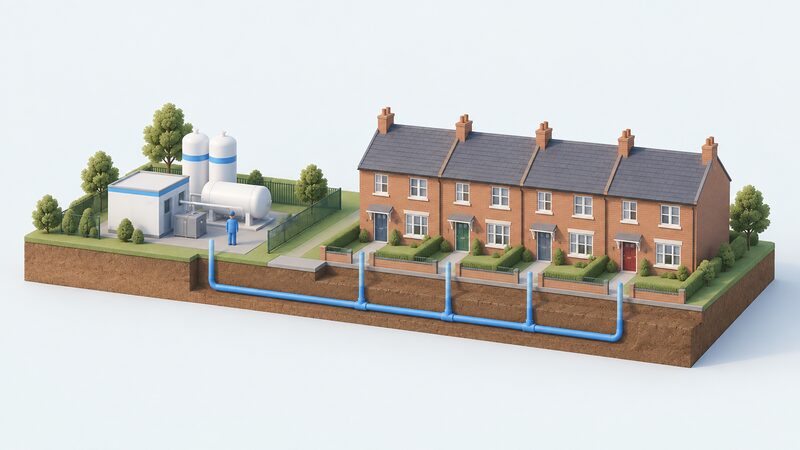
Hydrogen for a converted gas grid would have to be produced at a scale no UK project has yet demonstrated. H100 Fife sidesteps this by making hydrogen locally from a single 7MW wind turbine15, which is workable for 300 houses and not a model for a city. The strategic Gas Quality Decarbonisation Pathway assumes production and blending at network scale, which is a different proposition2.
The wider delivery constraints are the same ones that affect every clean heating technology. A lack of qualified heat pump installers is a further potential barrier to rollout, as are constraints imposed by planning rules and the need for electricity infrastructure upgrades21. The Heat in Buildings Bill consultation in Scotland recorded concerns about a lack of skilled people to install and maintain clean heating systems, a lack of a developed supply chain, and the need for electricity infrastructure upgrade22. Those constraints apply to hydrogen installation too, and the hydrogen supply chain is less developed than the heat pump one.
There is also a competition question. The Domestic Renewable Heat Incentive, which ran across England, Scotland and Wales, supported renewable heat technologies directly23. The support framework that has replaced it, the Boiler Upgrade Scheme, is built around heat pumps12. Hydrogen has no equivalent consumer incentive, and without one the economics of a hydrogen boiler for a household are undefined.
Hydrogen boilers versus heat pumps: what the comparison shows
The efficiency comparison is the single most important number in this subject, and the sources are consistent about it.
Heat pumps are typically over three times more efficient than the most efficient gas boilers or electric heaters, according to official guidance from April 20257. The Climate Change Committee puts heat pumps at around three-to-four times more efficient than gas boilers, which should lead to lower household energy bills24. The Department for Energy Security and Net Zero has stated that heat pumps are three times more efficient than gas boilers, reducing home emissions12. Welsh Government guidance says heat pumps are up to 3 times more efficient than other heating systems25.
The comparison with direct electric heating is starker still. Heat pumps are around three times more efficient than direct electric heating26. Direct electric panel heaters and night storage heaters are at least three times less efficient than heat pumps, which makes them very expensive to run27.
What this means for hydrogen is a matter of arithmetic that the trials have not yet answered. A hydrogen boiler is a combustion appliance, so its efficiency at the point of use is comparable to a gas boiler rather than to a heat pump. The case for hydrogen rests on the cost and carbon intensity of producing the gas, not on the efficiency of burning it. Where the electricity that would run a heat pump is itself renewable, the efficiency gap is difficult to close.
| Technology | Efficiency position | Source basis |
|---|---|---|
| Heat pump | Typically over three times more efficient than the best gas boilers or electric heaters | Official guidance, April 20257 |
| Heat pump | Around three-to-four times more efficient than gas boilers | Climate Change Committee24 |
| Heat pump | Up to 3 times more efficient than other heating systems | Welsh Government guidance25 |
| Direct electric panel and night storage heaters | At least three times less efficient than heat pumps | Bristol City Council27 |
What hydrogen heating could mean for household energy independence
The independence question for hydrogen is genuinely different from the one for heat pumps, and it cuts both ways.
On the positive side, a hydrogen home connected to a network fed by local renewable electricity is not dependent on imported gas. H100 Fife makes its hydrogen from an existing 7MW wind turbine situated off the coast of Leven in Fife15, which means the fuel is generated within the same area that consumes it. A household on such a network would be insulated from international gas prices in a way that a natural gas household is not.
On the negative side, the dependence does not disappear, it changes shape. A hydrogen household depends on the network operator for production, storage and delivery, on the trial operator for access and maintenance, and on a supply chain that does not yet exist at scale. The powers of entry that let the trial operator enter private properties to carry out essential works, including safety measures and checks and to disconnect the gas supply, are a formal statement of that dependence5. A household with a heat pump and its own solar array has a different relationship with its energy supplier than a household on a hydrogen main.
The wider context is that home heating carries around 14% of the UK's total greenhouse gas emissions11, and the technology chosen to decarbonise it will determine what a household can and cannot do for itself. Independent advice on solar panels, heat pumps and other energy efficiency measures is available to homeowners through organisations such as the NI Energy Advice service in Northern Ireland28, and equivalent guidance exists in the other nations. The choice between a networked fuel and a self-generated one is the choice that matters most for independence, and the hydrogen trials have not yet produced the evidence to make it.
Sources28 cited
- Heat and Buildings Strategy, GOV.UK, 2023
- Scottish Government hydrogen policy statement, Scottish Government, 2020
- Hy4Heat programme evidence, UK Parliament, 2026
- DESNZ hydrogen heating trials, UK Parliament, 2024
- Hydrogen village trial research briefing, House of Commons Library, 2026
- Hydrogen heating village trial legislation, UK Parliament, 2022
- Carbon Budget and Growth Delivery Plan: heat and buildings factsheet, GOV.UK, 2026
- Hy4Heat programme evidence, UK Parliament, 2020
- Next Steps for UK Heat Policy, Climate Change Committee, 2019
- Lord Deben welcomes the Government's commitment, Climate Change Committee, 2018
- DRHI Annual Report Scheme Year 11, Ofgem, 2025
- Demand for heat pumps rises, GOV.UK, 2024
- Heat Pump Ready Programme: Stream 1, Phase 2, GOV.UK, 2022
- Domestic Hybrid Heat Pumps, GOV.UK, 2016
- Draft Heat in Buildings Strategy, Scottish Government, 2021
- Carbon monoxide in the home, Health and Safety Executive, 2026
- Energy Saving Trust heat pump field trial, GOV.UK, 2012
- Transition to heat pumps for households at risk of fuel poverty, GOV.UK, 2026
- Hydrogen trials evidence, UK Parliament, 2022
- Hydrogen village trial research briefing, House of Commons Library, 2023
- Heat pumps rollout barriers, UK Parliament, 2026
- Heat in Buildings Bill consultation analysis, Scottish Government, 2026
- Domestic Renewable Heat Incentive quarterly report, Ofgem, 2022
- The Seventh Carbon Budget, Climate Change Committee, 2025
- Your essential guide to heat pumps, Welsh Government, 2025
- Bristol Warm Homes Plan, Bristol City Council, 2025
- Bristol Warm Homes Plan, Bristol City Council, 2025
- Support to generate your own electricity, nidirect, 2025
 Hydrogen Heating PolicyWill hydrogen ever heat your home, and when will the government decide?
 Hydrogen Safety in the HomeCan hydrogen actually be used to heat UK homes, and is it safe?
 Demonstration and Test HomesBefore new heating systems reach your home, they get tested in real houses with real people living in them.
 Hydrogen Appliance TestingHow domestic hydrogen boilers, hobs and fires are tested and certified in the UK, the hydrogen content covered, the bodies involved, and the standards work still outstanding before general sale.
 Heat Battery Trials and ResultsDo heat batteries actually work in real UK homes, and what did the trials find?
 Fuel Cell Cars as Home PowerCan you really run your home from a hydrogen car?