

In this answer
Short answer
SGN states that it has received a Letter of Assistance (LoA) for H100 Fife from the Health and Safety Executive, following independent assessment of the project's Safety Dossier1. That is the clearest published answer to whether the HSE has approved the trial. The letter is not a licence, a planning consent or a construction approval. It records that the safety regulator has reviewed the safety case and is content for the work to proceed on the basis set out in that case.
The distinction matters for anyone reading the project as a householder. H100 Fife is a hydrogen neighbourhood trial in Fife, led by SGN, that would supply 100% hydrogen to homes through a dedicated local network built alongside the existing natural gas main2. Before it can go ahead, SGN states that the HSE needs to be satisfied that the trial will be run safely1. The Letter of Assistance is where that satisfaction is recorded.
What follows is what the approval covers, why the HSE is the body that grants it, what the assessment examines, and what the letter does and does not unlock.
What HSE approval means for H100 Fife
The Letter of Assistance is a safety instrument, not a general permission to build. It sits at the point where the technical case for running a 100% hydrogen network through occupied streets meets the regulator's judgement about whether that case holds. SGN describes the sequence directly: the letter followed independent assessment of the Safety Dossier, which details how 100% hydrogen will be produced, stored, distributed and used safely in homes for the trial1.
That scope is wider than a single appliance or a single property. It covers the production and storage of the hydrogen, its movement through the dedicated local network, and its use at the point of combustion inside homes. A safety case that addressed only the boiler, or only the pipework, would not answer the question the HSE is being asked. The dossier is the whole chain.
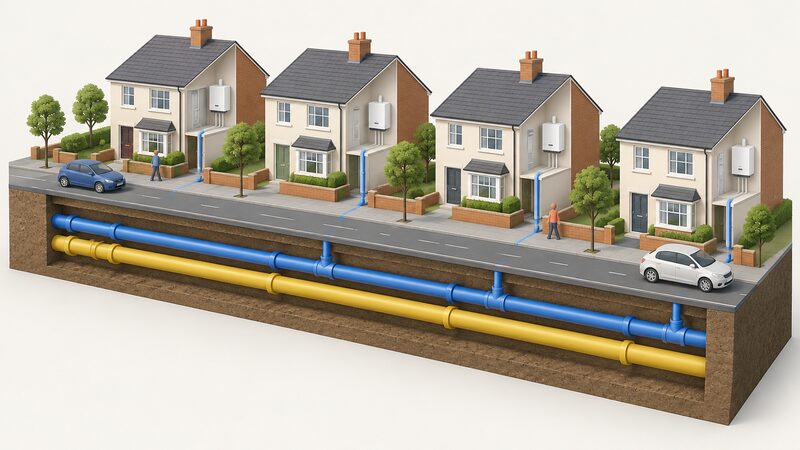
The network itself is a new build. SGN states that the hydrogen gas network for H100 Fife has been constructed alongside its existing natural gas network in the same streets2. That parallel construction is what allows the trial to run without converting the wider gas grid, and it is also what makes the safety case tractable: a dedicated network can be specified, tested and isolated on its own terms.
For a household, the practical meaning is narrow but real. The letter is the gate that allows hydrogen to be put into a domestic network at all. It does not tell a resident what their bills will be, what happens at the end of the trial, or whether hydrogen heating will be rolled out beyond Fife. Those are policy questions, and they sit elsewhere.
Why the HSE must be satisfied before the trial can go ahead

SGN's own wording is unambiguous: before H100 Fife can go ahead, the Health and Safety Executive needs to be satisfied that the trial will be run safely1. That is a condition on the project, not a courtesy. A gas network operator cannot put a novel gas into domestic properties on its own assessment alone, and the HSE is the body whose satisfaction the project depends on.
The HSE's role in hydrogen work is established beyond this one project. It independently reviewed the Hy4Heat Safety Assessment and wrote a letter of assistance to BEIS confirming the assessment's relevance to gas network operator future duty holders for trials4. That earlier review set the pattern: the regulator examines the safety assessment, then writes to the sponsoring department or the network operator to confirm that the assessment is relevant to those who will hold the safety duties when the trial runs.
There is also a timing dimension. The H100 Fife neighbourhood trial was originally planned for 2023 and was subsequently described in parliamentary material as planned to start in 2024 with around 300 interested participants in domestic properties in Fife5. The gap between those dates is the space in which safety assessment, network construction and regulatory sign-off had to be completed. Approval is not a formality that runs alongside construction; it is the thing that determines whether construction can be used.
"Before H100 Fife can go ahead, the Health and Safety Executive (HSE) needs to be satisfied that the trial will be run safely."
What the HSE assesses: running the trial safely
The Safety Dossier is the document under review. SGN describes it as detailing how 100% hydrogen will be produced, stored, distributed and used safely in homes for the trial1. Read that list as the assessment's structure: each stage has to be shown to be safe, and the interfaces between them have to be shown to be safe as well.
At the property level, safety measures are not uniform. SGN states that measures will be identified during home surveys and will vary by property1. That is a recognition that the housing stock differs: a Victorian terrace and a modern semi present different leakage, ventilation and containment characteristics, and the safety case has to accommodate both rather than assume a single template.
Ventilation is one of the named measures. SGN states that it may need to add ventilation to homes in the trial to allow potential small leaks to disperse safely1. This is a physical alteration to the property, made for the trial, and it follows from the properties of hydrogen rather than from any defect in the network. Hydrogen disperses differently from natural gas, and the safety case is built around that behaviour rather than against it.
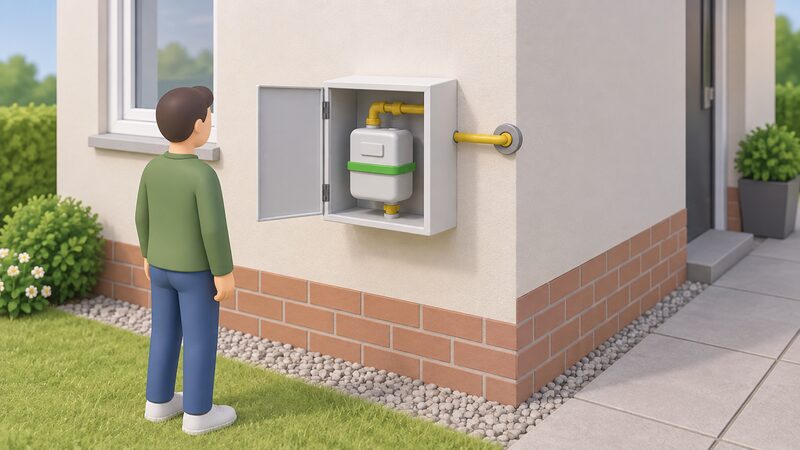
The meter arrangement is part of the same design. Hydrogen meter boxes will be installed outside1. Moving the meter point out of the building removes an ignition and accumulation risk from the interior and puts the boundary between network and property at a point that can be isolated and inspected.
Comparable hydrogen domestic projects describe the same regulatory footing. The Cartrefi Hydrogen Homes project states that works at the site have been carried out following HSE regulations and guidance6. That is a different project in a different nation, but it shows the same pattern: hydrogen domestic work is done under the HSE's framework, not outside it.
Approval as the gate: what happens before and after sign-off
The Letter of Assistance sits in a sequence. Before it, the work is assessment: the Safety Dossier is prepared, the network is designed and built, and the safety case is put to the regulator. After it, the work is delivery: homes are surveyed, property-specific measures are identified, and the trial can proceed on the basis the regulator has accepted.
The general shape of approval regimes is useful for understanding what the letter is not. In construction, approval is typically applied for before work begins, and approved work must conform with any conditions placed on the application7. A registered building control approver in England will tell the local authority about the work by giving an initial notice9. These are procedural consents about the built work. The HSE's Letter of Assistance is a different kind of instrument: it addresses the safety of the operation, not the lawfulness of the construction.
That separation is why the two can coexist without one substituting for the other. A project can hold planning consent and building control approval and still not have a safety case the regulator accepts. Equally, a Letter of Assistance does not confer planning permission or discharge building regulation duties.
What the letter does not do is settle the policy question. Government decisions about hydrogen heating, about which locations are taken forward, and about funding sit with departments and ministers. Parliamentary material records that the Government was considering Redcar, Teesside as a potential location for the hydrogen heating trial10, a separate strand from the Fife neighbourhood trial. The HSE's role is confined to safety; it does not choose sites or set policy.
For a household in the trial area, the practical position is that the safety gate has been passed on the terms described in the dossier. The dependence that remains is on the network operator, on the continued validity of the safety case as the trial runs, and on policy decisions taken outside the regulator's remit. The letter is a milestone, not a guarantee of what comes after.
Where the approval sits in the wider hydrogen programme

H100 Fife is one project in a programme that has changed shape more than once. The neighbourhood trial in Fife was originally planned for 2023 and was later described as planned to start in 2024 with around 300 interested participants in domestic properties5. The hydrogen village strand, which would have involved a larger existing settlement, was considered at Redcar, Teesside10. These are separate exercises with separate approval paths, and progress on one does not imply progress on another.
The HSE's involvement runs across them. Its review of the Hy4Heat Safety Assessment, and the letter of assistance written to BEIS confirming that assessment's relevance to gas network operator future duty holders for trials, established the framework that later projects draw on4. That is why the H100 Fife Letter of Assistance is described as following independent assessment of a Safety Dossier rather than as a standalone decision: it applies an established approach to a specific project.
For households watching hydrogen as a possible route to lower-carbon heating, the approval status is a signal about readiness, not about suitability. A project with a Letter of Assistance has cleared the safety gate. Whether hydrogen heating is the right answer for a given home, and whether it will be available at scale, depends on evidence from trials like this one and on decisions that have not yet been taken.
The related questions of what hydrogen conversion involves at the property level, and how hydrogen safety is handled in the home, are covered in what changes are needed to convert a home to hydrogen heating and hydrogen safety in the home. The wider trial picture, including the projects that did not proceed, is set out in hydrogen home heating trials in the UK and the cancelled hydrogen village trials.
Sources10 cited
- H100 Fife safety information, SGN, 2026
- Ensuring a safe hydrogen gas network, SGN, 2026
- H100 NIA stakeholder and customer strategy, SGN, 2026
- Hy4Heat safety, Hy4Heat, 2026
- Hydrogen heating trials: research briefing, UK Parliament, 2024
- Cartrefi Hydrogen Homes project, Wales & West Utilities, 2026
- Prior approval, Planning Portal, 2026
- Householder planning consent, Planning Portal, 2026
- Building regulations approval: how to apply, GOV.UK, 2026
- Hydrogen heating in the UK, House of Commons Library, 2026
 Hydrogen Home Heating TrialsHydrogen home heating is still being tested, not sold.
 Hydrogen Heating PolicyWill hydrogen ever heat your home, and when will the government decide?
 Hydrogen Safety in the HomeCan hydrogen actually be used to heat UK homes, and is it safe?
 Hydrogen Appliance TestingHow domestic hydrogen boilers, hobs and fires are tested and certified in the UK, the hydrogen content covered, the bodies involved, and the standards work still outstanding before general sale.
 Building Regulations EnglandAdding a heat pump, solar panels or an extension usually needs building regulations approval, and it is separate from planning permission.
 High-Rise Flats and SafetyWho signs off new insulation, cladding or heating in a high-rise flat?