
In this answer
Short answer
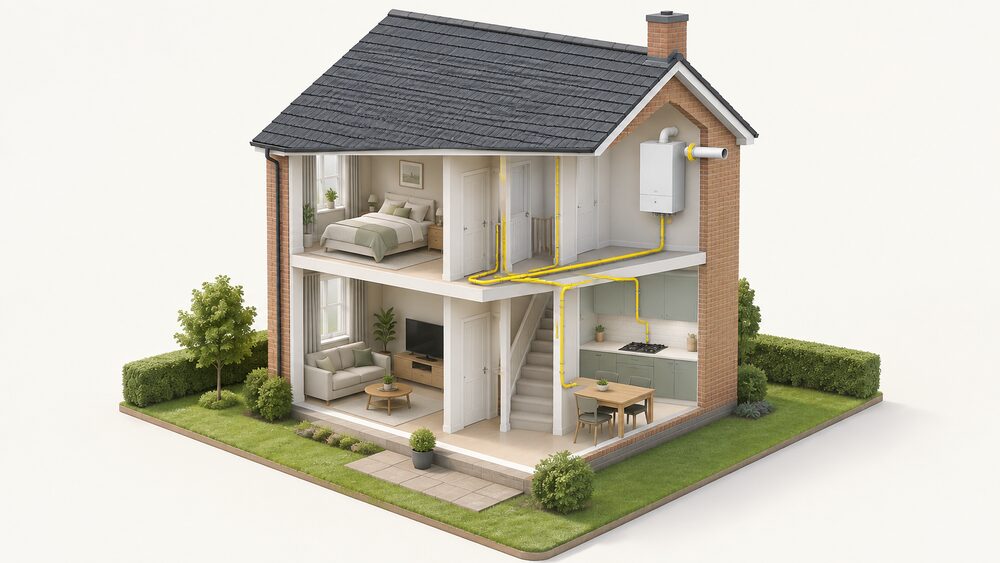
Converting a home to hydrogen heating is not a like-for-like fuel swap. A 100% hydrogen conversion would mean a new appliance and, on independent guidance, new gas pipework: "Specifically, you'd need to swap out your gas pipes for new ones"1. No household can buy a hydrogen heating system today, because truly hydrogen-ready boilers are not something consumers can readily buy at the moment1.
What does exist is hydrogen blending. Existing boilers and cooking appliances can run on a blend of up to 20% hydrogen with natural gas with no disruption to the home, and a blend should not require a change to appliances such as boilers and gas hobs2. That is a change made at network level, not by the householder.
The wider picture is unsettled. The government intended to take strategic decisions on the role of hydrogen in heating buildings in 20263, and the Energy Saving Trust describes hydrogen for home heating as marginal under virtually all realistic decarbonisation scenarios4. Hydrogen is not widely used to heat homes at present5.
What converting to hydrogen heating actually involves
A conversion is a network project before it is a household one. The evidence purpose behind the abandoned village trial was to gather evidence on the possible total costs of supplying hydrogen to domestic homes, including wholesale, distribution and conversion costs7. Conversion cost is therefore a recognised line item in the economics, not a figure a household can look up.
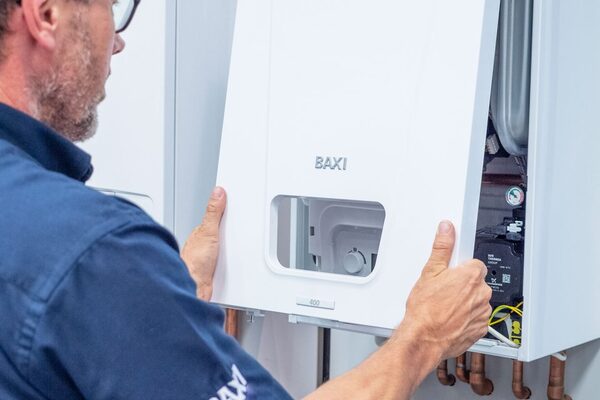
For the home itself, the work is comparable in scale to a heating system replacement plus pipework. Independent guidance on hydrogen boilers states plainly that gas pipes would need to be swapped for new ones1. Appliances would change too: the largest work package in the Hy4Heat programme covered development of a range of domestic hydrogen appliance types including boilers, cookers, fires and innovative domestic hydrogen gas appliances8. A hydrogen home would therefore need a hydrogen boiler, a hydrogen hob and, if fitted, hydrogen fires.
The strategic case is contested. The UK Green Building Council concluded there is limited rationale for the use of hydrogen to heat buildings, with a clear role for high temperature industrial processes and some transport9. The Energy Saving Trust's assessment is that hydrogen's role in home heating is marginal under virtually all realistic decarbonisation scenarios provided by the Climate Change Committee, Energy Systems Catapult, National Grid and others4.
Where hydrogen is considered plausible, it is geographically narrow. The regions most likely to see hydrogen used this way are those situated proximate to hydrogen production facilities with relatively small populations, where residential heating could be provided by hydrogen if electrification is difficult4. For a household's energy independence, that matters: a hydrogen home would still depend on a gas network, a hydrogen producer and a supplier, and would not generate or store its own heat.
What would need replacing: boiler, pipework and appliances

The replacement list has three parts, and only one of them is the boiler.
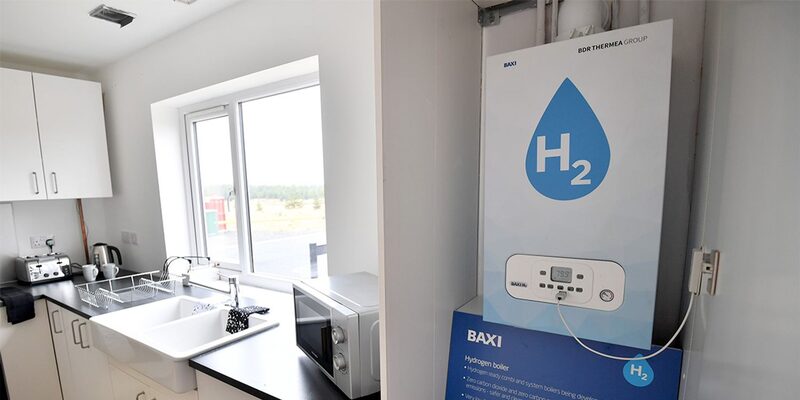
The boiler. A 100% hydrogen appliance is a different product from a natural gas boiler. Hy4Heat's appliance work covered boilers, cookers and fires as separate development streams8.
The pipework. Independent guidance states that gas pipes would need to be swapped for new ones for a hydrogen conversion1. This is the most disruptive element, because it touches floors, walls and possibly communal supply arrangements.
The other gas appliances. A gas hob and any gas fire would be in scope alongside the boiler, since the appliance development programme covered cookers and fires as well as boilers8.
There is a counterpoint on pipework and appliances that applies to blending rather than full conversion. A natural gas and hydrogen blend should not require a change to appliances used in the home, such as boilers and gas hobs2. The distinction is the hydrogen concentration: a blend is a network-level change, while 100% hydrogen is a property-level rebuild of the gas installation.
For comparison, the disruption of an electrified retrofit can be substantial in its own right. One Oxfordshire renovation found the property had smaller pipework and radiators to suit a higher temperature fossil fuelled system, which meant it was not possible simply to swap the boiler for a heat pump with the upgraded cylinder10. Older housing stock creates work whichever low-carbon route is taken.
Hydrogen-ready boilers: what the label does and does not mean
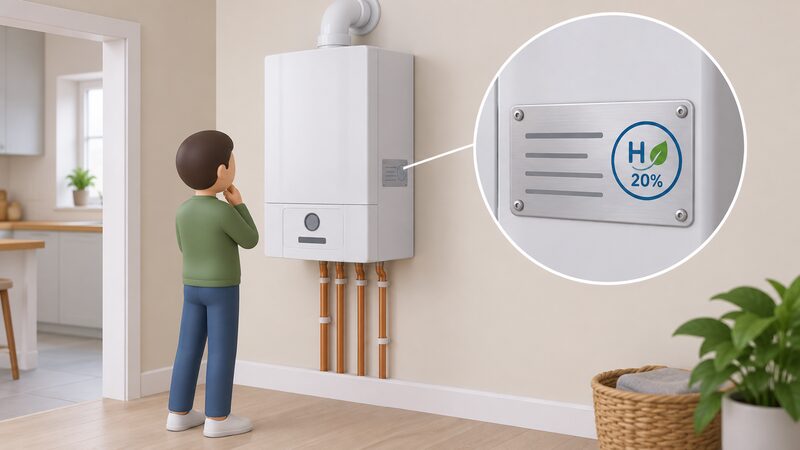
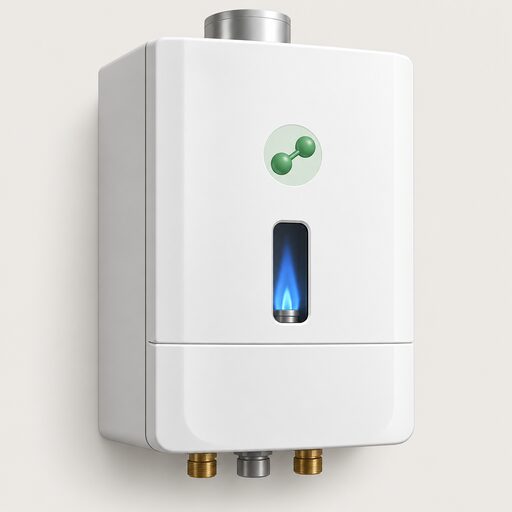
The label describes a conversion path, not a fuel. A hydrogen-blend-ready boiler is able to run with a mixture of 20% hydrogen fuel and 80% natural gas1. That is the blend specification, and it is the only hydrogen proportion a domestic appliance is currently specified to accept.
Availability is the practical limit. Truly hydrogen-ready boilers are not something consumers can readily buy at the moment1. A number of leading boiler manufacturers have made a joint price-promise commitment that a hydrogen-ready boiler will cost no more than a gas boiler does today1, but a price promise is not a product on a merchant's shelf.
Policy has moved against the label in new build. The Future Homes Standard consultation states that fossil fuel heating will not meet the standard, including hydrogen-ready and hybrid boilers11. CIBSE strongly supports the clear statement that new build homes with a gas boiler, even a hydrogen-ready one, will not be able to comply12. Scotland's New Build Heat Standard applies to the conversion of existing buildings where the conversion involves a change in occupation or use of the part of the building in which an existing direct emission heating system is located, and it is reasonably practicable to do so13.
There is a certification route for the blend case. The Kiwa 20% Hydrogen Mark is aimed at boiler manufacturers wanting to future-proof their natural gas appliances, gas network operators planning blending pilot projects and householders14. A mark of that kind tells a household that an appliance has been tested for a 20% blend, not that it can run on 100% hydrogen.
Where hydrogen heating trials stand in the UK
Trials are underway to assess the safety and performance of hydrogen-based heating5. The most advanced is H100 Fife, a world-first green hydrogen heating trial in Levenmouth, Fife, where up to 300 homes will use green hydrogen for heating and cooking6.
The larger village trial has not proceeded as originally planned. The government is considering Redcar, Teesside as a potential location for the hydrogen heating trial15, and the Heat and Buildings Strategy set out a village scale trial by 20253. The evidence purpose behind the trial consultation was to gather evidence on the possible total costs of supplying hydrogen to domestic homes, including wholesale, distribution and conversion costs7.
The decision timetable has slipped. The government intended to take strategic decisions on the role of hydrogen in heating buildings in 20263. The Energy Saving Trust noted that a consultation was needed around the role of hydrogen in home heating, which was currently not expected until 202616, and separately that the government must follow through on its promise to consult on the role of hydrogen for domestic heating in 2025, with a clear decision before 202617. Those two statements do not sit comfortably together: one places the consultation in 2026, the other in 2025.
For households outside a trial area, the practical answer is that hydrogen heating is not available. The areas most likely to see it first remain those close to hydrogen production with small populations where electrification is difficult4.
The alternative: electrification with a heat pump
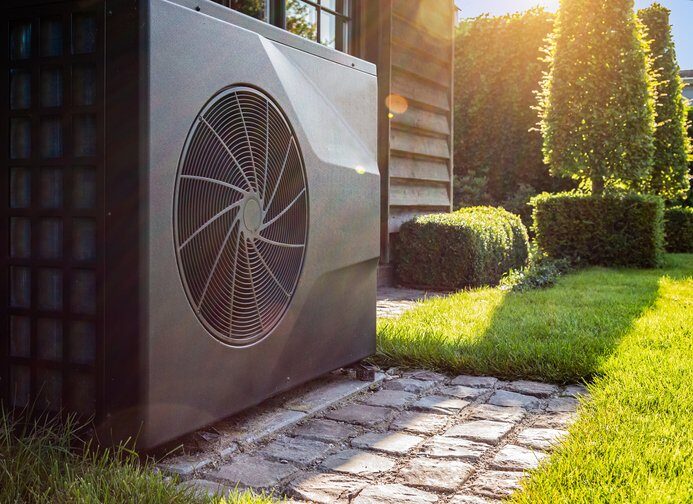
The route a household can actually take now is electrified heat. In homes, this means switching to electric, low carbon heating, such as heat pumps18. Electric heating uses electricity to warm your home19.
Heat pumps are not a universal fit, and the sector acknowledges it. A hybrid heat pump system might be an option if a standard heat pump installation is not suitable, but a lower carbon heating system is still wanted20. Systems running on electric along with natural gas, LPG or oil are described as an effective and immediate interim solution21, and hybrid heat pumps are said to offer better choice and adapt the home for both low-electricity and low-carbon gas technologies, including 100% hydrogen, making it easier to introduce future strategy and policy21.
Cost competitiveness is a live issue. Public attitudes research found eight benefits offered by a switch to electric heating, including improving air quality in the home, not paying gas bill standing charges, moving away from unpredictable gas prices, no gas leaks, self-sufficiency with battery, solar and heat pump, a consistent comfortable temperature, preventing damp and mould, and the ability to both cool and heat22.
For off-gas homes, the options are a heat pump or other home energy upgrades which can reduce energy costs23. In Scotland, support for rural homes covers options like installing a heat pump or other home energy upgrades23. The technical reference for this work is the Guide to Implementing Electrified Heat in Domestic Properties, which covers all forms of electrified heat including heat pumps, plus heat recovery, renewables and energy storage, and draws on building fabric, thermal comfort, electrical system considerations and domestic hot water24.
Cost, disruption and what a household can do now
There is no published household price for a hydrogen conversion, and none should be assumed. The village trial's evidence purpose was to establish the possible total costs of supplying hydrogen to domestic homes, including wholesale, distribution and conversion costs7. On the modelling side, one study took a balanced approach in which legacy transition costs are spread equally between hydrogen and electrified heating users, with new costs allocated to respective user groups25. That is an assumption about who pays, not a price.
The scale of the hard-to-treat problem is a driver of the hydrogen argument. Between 20 to 40% of homes are considered hard or costly to electrify, equivalent to between 4 and 8 million homes out of the 24 million currently connected to the gas network25. Those homes are the constituency for a hydrogen or hybrid route.
Disruption is a real barrier. Research found that concerns around cost, disruption and practicality remain important factors for many households considering lower-carbon heating options21. Over the next ten to twenty years, the UK government is encouraging all households to consider switching from gas and oil boilers to new electrified heating systems such as a heat pump26.
For a household whose boiler needs replacing now, the immediate choice is between a gas appliance and an electrified system. Installers can still fit and retrofit combi gas boilers27. Where a boiler is replaced, the ErP label is worth reading carefully: heat-only and regular boilers only have the space-heating part of the ErP label28. On the wider transition, the changes most households will have to make will include switching to low carbon heat technologies, installing energy efficiency measures and using smart energy products and services29.
Sources29 cited
- Hydrogen boilers: what you need to know, Which?, 2026-09-17
- Hydrogen blending, Cadent Gas, 2026-09-20
- Heat and Buildings Strategy, GOV.UK, 2026
- Response to SSAC questionnaire on hydrogen's role, Energy Saving Trust, 2026-04-23
- Hydrogen heat: could it be the future of home heating?, Elmhurst Energy, 2025-07-04
- Ensuring a safe hydrogen gas network, SGN, 2026
- NEA response to the hydrogen for heat consultation, National Energy Action, 2021-10-18
- Hy4Heat appliances, Hy4Heat, 2026-09-20
- UKGBC responds to hydrogen boiler consultation, UK Green Building Council, 2023-03-23
- Grant property renovation, Oxford, Heat Pump Association, 2022-05-17
- The Future Homes and Buildings Standards 2023 consultation, GOV.UK, 2026-09-17
- The Future Homes and Buildings Standards, CIBSE, 2026-09-17
- New Build Heat Standard part two, Scottish Government, 2026-09-20
- Kiwa 20% Hydrogen Blend Mark, Kiwa, 2026-09-17
- Research briefing on hydrogen heating trials, House of Commons Library, 2026-09-20
- The role of gas heating in homes, Energy UK, 2025-04-15
- What the UK needs from the Warm Homes Plan, Energy Saving Trust, 2026-07-13
- Response to the Clean Power Action Plan, Energy Saving Trust, 2025-09-22
- Renewable heat: right for your home, Energy Saving Trust, 2026-05-19
- Hybrid heat pumps, Energy Saving Trust, 2026-07-16
- Hybrid heat pumps, SGN, 2026-09-17
- How the British population views heat pumps, Nesta, 2026-07-02
- Support for people in rural homes, Home Energy Scotland, 2026-09
- Guide to Implementing Electrified Heat in Domestic Properties, IET, 2022
- Economics of hydrogen for heat, Cadent Gas, 2025-04
- Engaging homeowners on earlier boiler replacement, Which?, 2026-01-28
- Installers can still fit and retrofit combi gas boilers, CIPHE, 2026-09-17
- Boiler energy efficiency, Which?, 2025-09-19
- The net zero protections puzzle, Citizens Advice, 2021-10-21
 Hydrogen-Ready BoilersWhat manufacturers mean by hydrogen-ready and hydrogen-blend-capable, what conversion would require, and the state of UK hydrogen heating trials and decisions.
 Hydrogen Safety in the HomeCan hydrogen actually be used to heat UK homes, and is it safe?
 Hydrogen Home Heating TrialsHydrogen home heating is still being tested, not sold.
 Demonstration and Test HomesBefore new heating systems reach your home, they get tested in real houses with real people living in them.
 Hydrogen Heating PolicyWill hydrogen ever heat your home, and when will the government decide?
 The Full Boilers and Heating GuideWhich boiler suits your home, and when is it worth swapping the old one?