
In this guide
Heating a UK home is not a private arrangement between a household and a boiler. It is a national emissions problem and a household running cost problem at the same time. Heating our homes accounts for around 14% of the UK's total greenhouse gas emissions, and heating with fossil fuels like gas and oil contributes 17% of the UK's total emissions1. Those two figures describe the same activity from different angles, and they explain why policy has moved toward electrified heat.
Energy independent heating, in the sense a household can actually act on, means reducing the amount of imported, price-volatile fuel a home needs to stay warm. It does not usually mean disconnection. A heat pump still runs on grid electricity, a storage heater still draws from a supplier, and a thermal store still needs a heat input. What changes is the quantity and the type of dependence: less gas, more electricity, and a greater ability to shift demand into cheaper hours or to pair the system with generation on the roof.
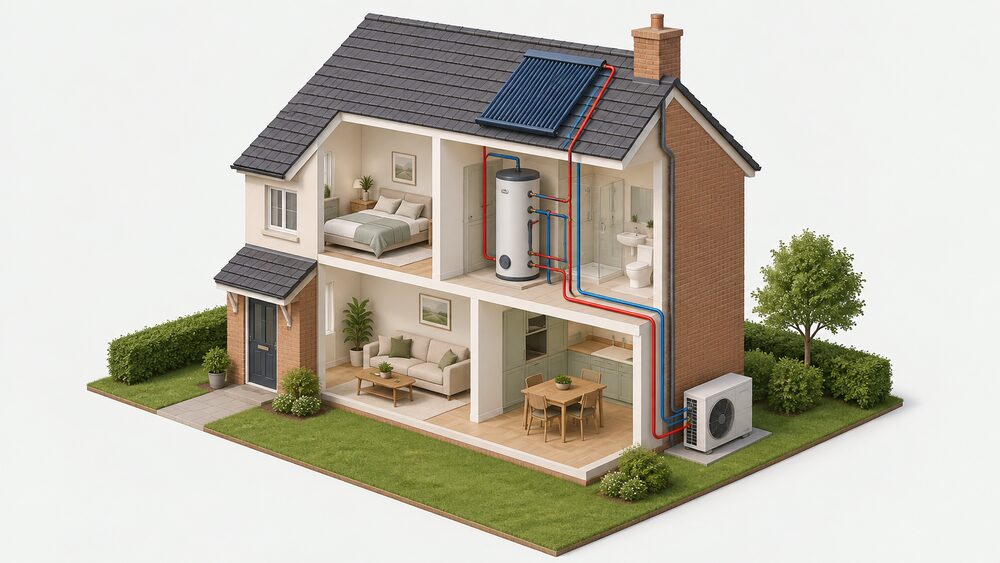
The practical routes are four. An air source heat pump replaces a boiler and runs at roughly three to four times the efficiency of a gas boiler3. Storage heaters charge overnight on an off-peak tariff and release heat the next day4. Solar thermal with a thermal store captures free heat and holds it5. Dynamic tariffs price electricity every half-hour, so a flexible household can buy at the cheap end6. Each has a different relationship with the grid, and none removes it entirely.
What energy independent heating actually means for a UK home
The phrase is used loosely, so it is worth separating three things a household can control: the fuel it burns, the time it buys electricity, and the equipment it owns.
Fuel switching is the largest single change. A home on gas or oil that installs a heat pump stops burning fuel on site entirely. The emissions and the price exposure move to the electricity system, which is why the Committee on Climate Change frames heat pumps as around three to four times more efficient than gas boilers, which should lead to lower household energy bills3. That is a statement about efficiency, not a guarantee about bills, because the price of electricity per unit is higher than gas. Energy Saving Trust makes the same point from the other direction: even though electric heating is more efficient than using a boiler, the higher cost of electricity more than offsets that advantage4. Independence from gas is not the same as a lower bill.
Timing is the second lever. A household that can choose when to draw power, whether through storage heaters on an off-peak tariff or a heat pump on a dynamic tariff, is less exposed to peak prices. This is the part of independence that does not require new equipment, only a tariff and a willingness to let the heating run at different hours.
Ownership is the third. Solar thermal, solar panels and a thermal store put some of the heat supply on the property. Self-build guidance advises considering solar panels to generate electricity or solar water heating systems for hot water needs, and installing smart systems that control lighting, heating and cooling based on occupancy and time of day10. Those measures reduce the volume of bought energy, not the need for a connection.
What remains is a grid connection, a supplier, and in most cases a manufacturer whose app or controls the system depends on. Independence here is a matter of degree.
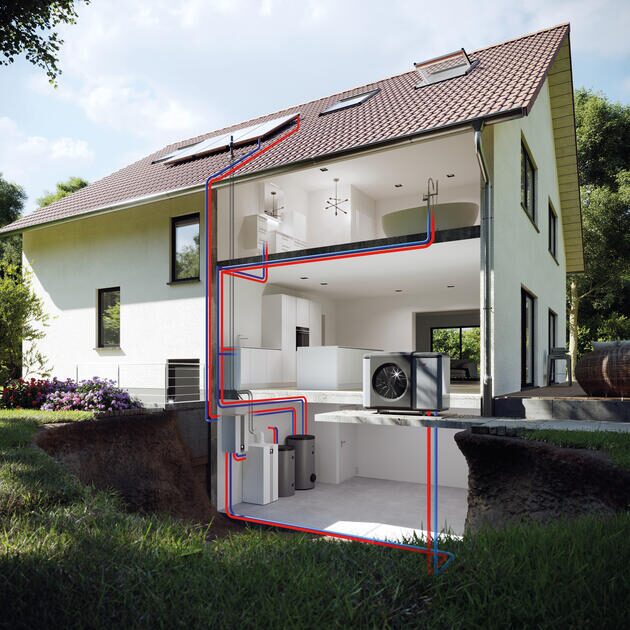
Air source heat pumps: the most common route, at around £12,000 to £13,000
The air source heat pump is the default replacement for a fossil fuel boiler in UK policy and in most retrofit advice. An air-to-water system transfers heat drawn from surrounding air to water in a wet central heating system, which means it can use the radiators and pipework already in the house11. An air-to-air system, which blows warmed air directly, is not considered to be a renewable system in ECO411.
Cost is the first obstacle. Official figures put the average installation cost for off gas grid households at £12,0007. Council guidance states £10,000 or more12. Independent sources give around £11,000 to £12,000, and other guidance puts total installed cost between £7,000 and £13,000. Prices are installer-quoted, and the spread between quotes for the same property can be wide.
Scottish Government analysis adds a nuance that matters for anyone comparing options. The ASHP was shown to consistently result in the lowest discounted energy demand reduction across the archetypes modelled, and for houses the ASHP had the lowest capital cost under the business as usual specification, though for a block of flats it was the highest13. In other words, the case for a heat pump is strongest in houses and weaker in flats, where the capital cost is higher and the demand reduction less pronounced.
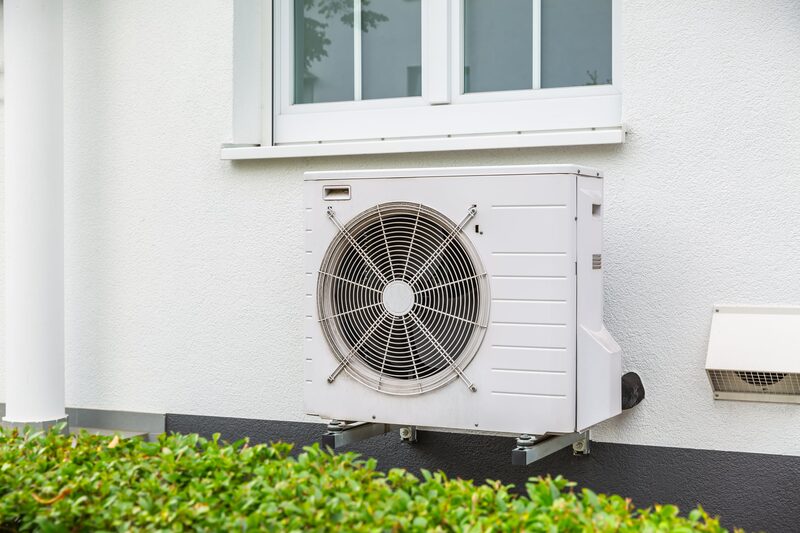
Efficiency: three to four times more heat out than electricity in
The efficiency claim is the reason heat pumps are central to low-carbon heating policy, and it is repeated consistently across official sources. The government's clean energy campaign states that heat pumps are 3x more energy efficient than traditional boilers14. Welsh Government guidance states that heat pumps are three times more energy efficient than traditional boilers15. The Committee on Climate Change gives a slightly wider band: around three-to-four times more efficient than gas boilers3.
The mechanism is that a heat pump moves heat rather than creating it by combustion. That is why the ratio can exceed one, and why the figure is a coefficient of performance rather than an efficiency in the boiler sense. It also explains the seasonal variation. Official guidance states that an air source heat pump will be less efficient in the winter when the air temperature is colder16. The unit still runs, but the ratio falls as the gap between outdoor air temperature and the flow temperature needed by the radiators widens.
That has two consequences for a household. First, the annual average performance depends heavily on how cold the local winter is and how well the building retains heat. Second, the system should be sized and the emitters specified for the coldest design condition, not the mildest, or the household will rely on a backup immersion heater in a cold snap. Fabric measures, including insulation and draught proofing, raise the effective performance of any heat pump by lowering the flow temperature required.
The efficiency advantage is real and well evidenced. It is also the reason the running cost question is not settled by efficiency alone: a unit of electricity costs more than a unit of gas, so a heat pump at three to four times the efficiency of a boiler may or may not produce a lower bill depending on the tariff and the fabric.
Storage heaters: off-peak charging for homes without gas mains
For homes with no gas connection, storage heaters remain a practical electrified option, and they have a specific relationship with energy independence: they store heat bought at the cheapest hours and release it later. Energy Saving Trust describes the mechanism plainly: storage heaters work by charging up when electricity is cheaper, then releasing heat gradually through the next day, and they are often used with special energy tariffs that offer lower rates during off-peak times, helping to lower heating costs4.
Building regulations set a control requirement that separates modern high heat retention models from older ones. Automatic control of input charge should be provided, along with an adjustable heat release rate17. A manual storage heater that requires the household to guess the next day's weather does not meet that standard of control, and it is the main reason older storage heating has a poor reputation for comfort.
Replacement is electrical work and falls to a competent electrician working to the wiring regulations. The practical questions are whether the existing off-peak supply and consumer unit can carry the load, and whether the tariff remains worthwhile. Economy 7 tariffs are typically used with electric storage heaters but they are available to anyone6. A household replacing storage heaters should check the tariff alongside the hardware, because the running cost depends on both.
Storage heating does not remove grid dependence, and it does not remove supplier dependence. What it does is shift the timing of purchase, which is a genuine form of resilience against peak prices. It also has no outdoor unit, no refrigerant and no compressor noise, which matters in flats and in conservation areas.
Solar thermal and thermal stores: free heat with built-in storage
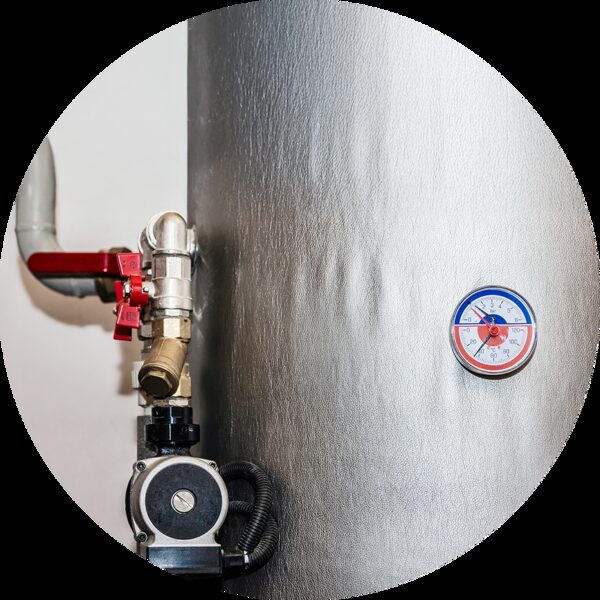
Solar thermal is the only route on this list that generates heat on the property rather than converting bought electricity. Its limitation is that it produces most when heat is least needed, which is why it is almost always paired with storage. A thermal store can hold heat from a biomass boiler, a solar water heating system, or a heat pump, provided it is designed and sized to work with them all5. It can also be used as a renewable technology with a conventional boiler or immersion heater5.
The control logic is what makes a thermal store useful for independence. A thermal store can be designed to prioritise solar thermal heat above all other sources, and if solar heat is available, no other heat source will come on5. That means the household is genuinely using free heat first and buying only the shortfall, rather than running a boiler alongside a solar panel.
The economics are less certain. Independent guidance gives annual savings from a solar thermal system of around £275 in one place and around £160 in another, and the two figures are not reconciled. What is not in dispute is the storage principle: a cylinder or thermal store turns an intermittent source into a usable one, and it also provides a buffer that a heat pump can charge at cheap hours.
For a household already planning a heat pump, the cylinder decision is the moment to consider solar thermal, because both need the same store. For a household on a combi boiler with no cylinder, adding solar thermal means adding a cylinder first, which changes the cost picture substantially.
Dynamic tariffs: paying the half-hour price for the electricity you use
A dynamic tariff is the mechanism that turns a flexible heating system into a cheaper one. Energy Saving Trust states that dynamic tariffs charge a different amount every half-hour based on what it costs to generate electricity at that time6. Parliamentary research describes the same product from the consumer side: with dynamic time-of-use tariffs, energy prices can vary continually and are calculated in real-time depending on various factors18.
The distinction from Economy 7 matters. Economy 7 gives a fixed cheaper rate during set off-peak hours, typically overnight, and is typically used with electric storage heaters but available to anyone6. A dynamic tariff has no fixed cheap window; the cheap periods move with wholesale prices and weather. A household with a battery is advised to choose either a dynamic tariff or Economy 7, depending on how the battery is used6.
For heating, the practical implication is that a heat pump with a thermal store, or a storage heater with a high retention core, can be charged when the half-hour price is low and the heat used later. That is a real reduction in exposure to peak prices, and it is available without any change to the heat source. It does require controls that can respond to a price signal, and it requires the household to accept that the heating will sometimes run at hours it would not otherwise choose.
The dependence that remains is on the supplier and on the tariff remaining available. A dynamic tariff is a commercial product, not a right, and a household that has rebuilt its heating around half-hourly pricing is exposed if the product is withdrawn or the price spread narrows.
Planning permission and permitted development: where a heat pump can go
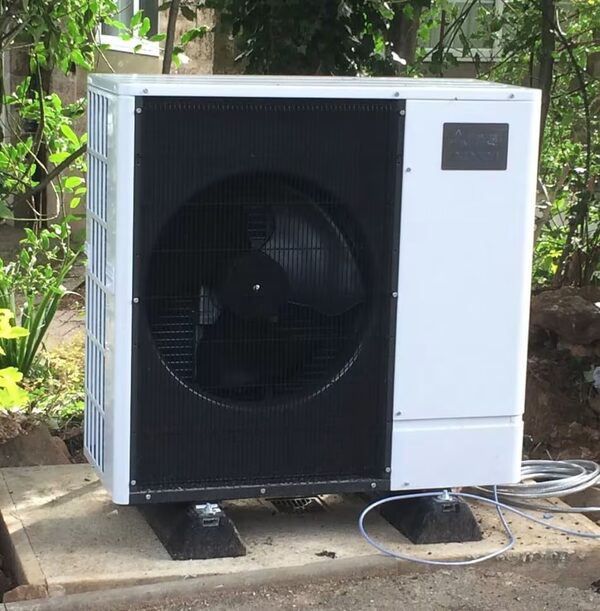
Domestic heat pumps benefit from permitted development rights, which means that in most cases planning permission is not required, subject to certain limitations and conditions8. The rights for air source heat pumps in England sit in Part 14 (Renewable Energy) of The Town and Country Planning (General Permitted Development) (England) Order 201519. Ground source and water source heat pumps on domestic premises are usually considered to be permitted development, not needing an application for planning permission20.
The conditions are where installations go wrong. Development is permitted only if the installation complies with the Microgeneration Certification Scheme Planning Standards (MCS 020a)21. The volume of the outdoor compressor unit, including housing, must not exceed 1.5 cubic metres on a house or 0.6 cubic metres for a block of flats21. Installations on pitched roofs are not permitted development, and on a flat roof all parts of the unit must be at least one metre from the external edge of that roof21. Only the first installation is permitted development on a house which is not detached or a block of flats; for detached houses, the first two air source heat pumps are considered permitted development21. Additional units require a planning application21.
In a conservation area or World Heritage Site, development is not permitted if the heat pump would be installed on a wall or roof fronting a highway, or nearer to a bounding highway than the nearest part of the building22. Permitted development rights can also be removed through a planning condition, an Article 4 Direction or another restriction, so a household should check the local position rather than assume23. In Northern Ireland, separate permitted development for domestic air-source heat pumps applies24. In Wales, permitted development for domestic heat pumps applies in most cases, subject to limitations and conditions8.
Costs, savings and funding: what you might pay and get back
The cost picture is fragmented across nations and schemes, and the figures do not reconcile into a single number. For air source heat pumps, official figures give £12,000 on average for off gas grid households7, council guidance gives £10,000 or more12, and independent sources give around £11,000 to £12,000, with total installed cost between £7,000 and £13,000.
Funding is devolved, so the scheme that applies depends on where the household is.
| Nation | Scheme position | Detail |
|---|---|---|
| Northern Ireland | Better Energy Homes Cashback | 40% financial contribution required by applicant for heating only, remainder funded under NISEP25 |
| Northern Ireland | Housing Association Efficient Electric | 50% off an air source heat pump installation; £1,200 off electric high heat retention storage heaters; £200 for cavity wall or loft insulation26 |
| Scotland | Standalone grant | Retains the focus on energy efficiency measures and zero emissions heating27 |
| England | ECO4 | Air-to-air systems are not considered a renewable system under ECO411 |
The Northern Ireland figures are the most specific in the available material. The 40% contribution requirement and the £1,200 storage heater grant are scheme rules, not estimates, and they apply to the named schemes25. The Scottish standalone grant replaced an earlier cashback approach and keeps its focus on energy efficiency and zero emissions heating27.
For households seeking advice rather than funding, Northern Ireland operates an advice service: homeowners should seek independent advice on solar panels, heat pumps, and other energy efficiency measures from organisations offering it28. A new Home Energy Advice service is intended as a single-entry point for consumer home energy advice on GOV.UK, helping homeowners, landlords and tenants find tailored, impartial and trusted advice on how to heat their homes and make them more energy efficient29.
Historic payment schemes show how metering works where grants are tied to output. Under the Domestic Renewable Heat Incentive, payments for most installations were based on the annual heat demand of the property, taken from the EPC, with quarterly payments for seven years, except for solar thermal, which used an MCS certificate estimate, and installations metered for payment1. Metered installations received payments based on the amount of renewable heat produced, up to the annual heat demand on the EPC or the relevant heat demand limit, whichever was lower30. Those schemes are closed to new applicants, but the metering principle still shapes how output-based support is designed.
The policy timeline shaping low-carbon heating
Policy is the main reason a household's heating decision is not purely financial. The direction of travel is set, and the dates are published.
The Committee on Climate Change projects that from 2035 onwards, all new heating systems installed in homes will be low carbon31. Its seventh carbon budget states that all new and replacement heating systems become low carbon after 2035 to ensure a fully decarbonised housing stock by 20503. Parliamentary material records the same milestone: from 2035 onwards, it projects that all new heating systems installed in homes will be low carbon31.
Earlier milestones shape the market before then. The Government consulted on the introduction of a market-based mechanism for low carbon heating from 2024, and set an ambition that by 2030, low carbon heating systems are no more expensive to buy and run than existing natural gas systems7. That cost parity target is the pivot on which household economics depend: if it is met, the efficiency advantage of a heat pump translates into a running cost advantage; if it is not, the case rests on carbon and on independence rather than on bills.
Building standards move in parallel. Approved Document L sets minimum efficiency requirements for fixed independent space heating, including 60% for oil-fired systems in existing dwellings, converted using Table E4 of the Standard Assessment Procedure17. Scottish building regulations work on a separate track, with research into the identification and assessment of improvements to the energy standard for new domestic buildings32.
For a household, the practical reading is that a boiler installed today will not be the last heating system the property has, and that the replacement will be low carbon. The decision about whether to add a cylinder, upgrade radiators or improve fabric now is therefore a decision about the cost of that later replacement.
Choosing a system: which option fits which home
The choice is driven by three variables: whether the property has a gas connection, whether it has space for a cylinder and an outdoor unit, and how much the household can shift its demand in time.
| Home type | Likely route | Why |
|---|---|---|
| House with gas, good fabric | Air source heat pump | Lowest capital cost for houses under the modelled specification13 |
| House off gas grid | Air source heat pump or high heat retention storage heaters | No gas connection; storage heaters avoid an outdoor unit4 |
| Flat or block | Storage heaters or a heat pump with care | ASHP capital cost was highest for the block of flats in the modelled specification13 |
| Home with a cylinder already | Heat pump plus solar thermal | Thermal store can prioritise solar heat above all other sources5 |
| Home with a battery | Dynamic tariff or Economy 7 | Either suits a battery, depending on use6 |
For a household that wants the greatest reduction in bought energy, the combination of fabric improvement, a heat pump and a thermal store charged on a flexible tariff covers the most ground. For a household that wants the least disruption, high heat retention storage heaters on an off-peak tariff avoid outdoor equipment and refrigerant. For a household with a cylinder and a south-facing roof, solar thermal with a store is the only option that produces heat without buying energy at all.
The limits are consistent. A heat pump needs a well-insulated property and correctly sized emitters to perform at its rated efficiency in cold weather16. Storage heaters need a tariff that makes overnight charging worthwhile4. Solar thermal needs a store and produces least in the season it is needed most. Dynamic tariffs need controls and a supplier that offers them6. None of these routes removes the grid connection, and none removes the need for a supplier.
Independent advice is available and is worth taking before committing, particularly on the interaction between fabric, system sizing and tariff28. Quotes from at least three installers are recommended for any new electric heating system4.
Sources32 cited
- Domestic RHI Annual Report, Scheme Year 11, Ofgem, July 2025
- Your essential guide to heat pumps, Welsh Government Climate Action, 2025
- The Seventh Carbon Budget, Climate Change Committee, February 2025
- Electric heating, Energy Saving Trust, July 2026
- Thermal energy stores, Energy Saving Trust, May 2025
- Tariffs for renewable technology, Energy Saving Trust, August 2026
- Heat pumps and energy independence, Business, Energy and Industrial Strategy Committee, May 2022
- Planning permission for heat pumps, Welsh Government, 2026
- Air source heat pumps, Westmorland and Furness Council, 2026
- ECO4 new measures and products guidance, Ofgem, March 2026
- Domestic RHI essential guide, Ofgem, June 2024
- Air and ground source heat pumps, London Borough of Croydon, 2026
- Identification and assessment of improvements to the energy standard for new domestic buildings, Scottish Government, July 2026
- Heat pump, UK Government Clean Energy Campaign, September 2026
- Heat pumps, Welsh Government, November 2025
- Air source heat pumps fact sheet, Pendle Borough Council, 2026
- Self-build homes: sustainability, Planning Portal, 2026
- Dynamic time-of-use tariffs, Parliamentary Office of Science and Technology, 2026
- Planning guidance: heat pumps, London Borough of Richmond upon Thames, April 2026
- Planning permission: heat pumps, Planning Portal, 2026
- Planning permission: air source heat pump, Planning Portal, 2026
- Class G: installation of air source heat pumps on domestic premises, legislation.gov.uk, 2026
- Air source heat pumps, Cornwall Council, 2026
- The Planning (General Permitted Development) Order (Northern Ireland) 2015, legislation.gov.uk, 2026
- NISEP List of Schemes 2024-25, Utility Regulator Northern Ireland, October 2024
- Support to generate your own electricity, nidirect, September 2025
- NISEP List of Schemes 2026-27, Utility Regulator Northern Ireland, April 2026
- Reforming consumer protection for home upgrade schemes, UK Government, June 2026
- Approved Document L: Conservation of fuel and power, Volume 1, UK Government, 2026
- Domestic RHI guide to metering, Ofgem, 2026
- Decarbonising heat in homes, Environmental Audit Committee, 2025
- Heat pump sector deal: expert advisory group, Scottish Government, November 2022
 Energy IndependenceA heat pump runs your heating on electricity instead of gas or oil, so how much does that really cut what you pay and how exposed you are when fuel prices jump?
 Grants and Energy IndependenceCan you get a grant for solar panels or a battery?
 Cost of Energy IndependenceA heat pump and better insulation are the usual starting point, but what does the whole job really cost, and what help is there with the bill?
 Suppliers and IndependenceCan you really cut your energy bills by making your own power, and how much of your supplier do you still need?
 Planning Energy IndependenceCutting what you use, moving heating off gas, putting solar on the roof and adding a battery all help, but none of them takes you off the grid completely.
 Household Resilience and RiskWhat happens to your heating and lights if the power goes off for days?