
In this guide
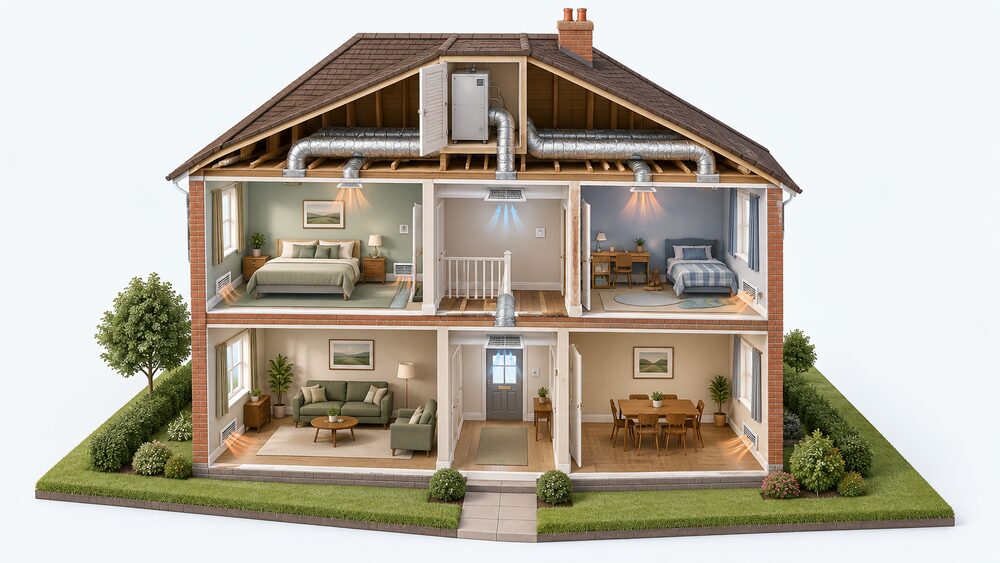
A warm air heating system heats a home by burning gas in a central unit and pushing the warmed air through a network of ducts to outlets in each room. There is no boiler, no radiators and no hot water cylinder in the heating circuit: the unit is the boiler, the ducts are the radiators, and the air itself is the heat carrier. Most of the units still running in UK homes date from the 1960s and 1970s, when ducted warm air was a common choice for new estates.
The technology never fully disappeared, but it stopped being installed at scale, and the reasons matter to anyone living with it. Ductwork is bulky, it has to be sized and routed room by room, and the guidance on insulating it assumes ducts are insulated to 50mm within conditioned space and 25mm within unheated space1. Retrofitting that network into a finished house is disruptive in a way that hanging radiators is not.
The practical questions for a household are narrower than the history. A gas warm air unit is a gas appliance, so it falls under the same servicing and safety rules as any boiler: the Health and Safety Executive advises that all gas appliances, flues and pipework are installed, regularly maintained and serviced at least annually by a Gas Safe registered engineer2. When the unit reaches the end of its life, the choice is between replacing it and converting to a wet system, and that decision is mostly about the ductwork already in the house.
What a warm air heating system is and how it works
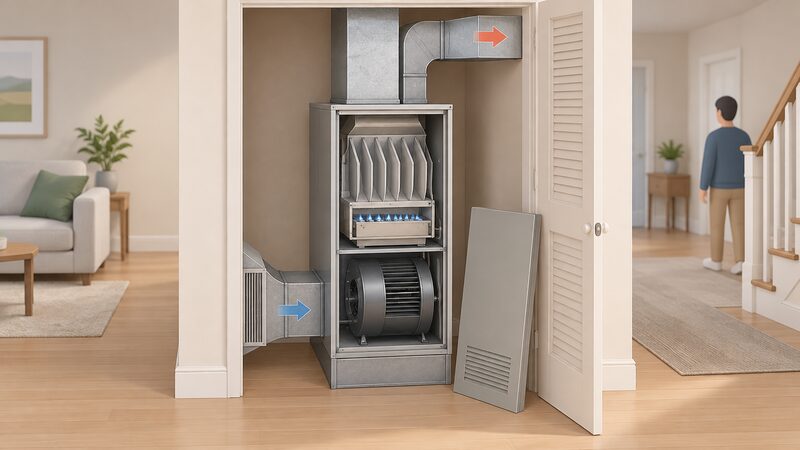
A warm air system is a central heater with a distribution network rather than a central boiler with a water circuit. The unit sits in a cupboard, a loft or a dedicated compartment, draws in air, heats it over a gas burner and a heat exchanger, and a fan pushes it through ducts to floor or wall outlets. Return air comes back to the unit, often through a grille in a hallway or landing, and the cycle repeats. Controls are typically a room thermostat and a time switch, sometimes with a summer setting that runs the fan alone for air circulation.
The closest modern relative is not a boiler at all but mechanical ventilation with heat recovery, which also moves air through ducts. MVHR draws air out of warm, moist rooms such as kitchens and bathrooms, transfers heat from the exhaust air to incoming fresh, filtered air in a heat exchanger, and blows pre-warmed fresh air into habitable rooms such as living rooms and bedrooms6. The difference is that MVHR moves air for ventilation and recovers heat that is already there, while a warm air unit creates the heat in the first place.
Warm air is also distinct from community heating, which is sometimes confused with it because both involve a central plant. A community heating system supplies heat from a central source to more than one dwelling or premises within a single building7. A warm air unit serves one dwelling only; the centralisation is inside the home, not across a block.
A 1960s and 1970s technology that never fully went away
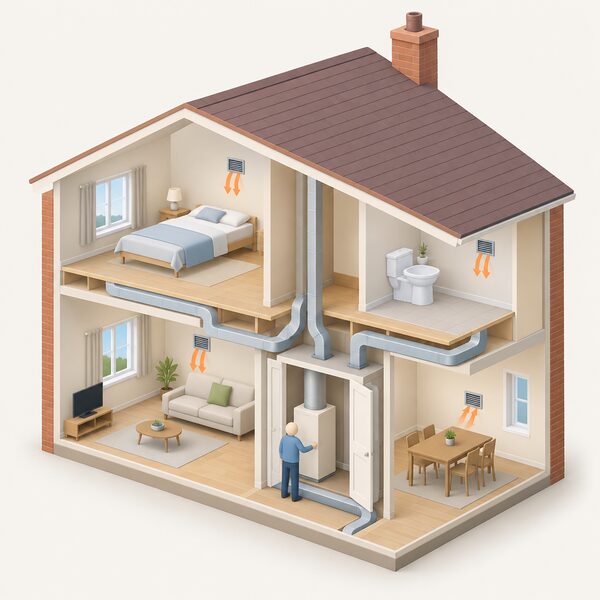
Ducted warm air was installed in large numbers during the post-war housebuilding decades, and a significant stock of it survives because the ductwork is buried in the fabric of the house. Replacing a unit is straightforward; removing the ducts is not, so many households have simply kept the system running, unit by unit, for fifty years or more.
The convention that governs how such systems are assessed in energy calculations still carries a trace of that era. Under the reduced data standard assessment procedure conventions, system 1 always heats the living area8. That convention exists because warm air systems, and the heating patterns built around them, commonly delivered heat to the main living space first and treated the rest of the house as secondary.
The technology has not been extended into new housing. In Scotland, the New Build Heat Standard will prohibit the use of heating and cooling systems, located within the curtilage of any new building, which produce more than a negligible level of greenhouse gas emissions at the point of combustion9. A gas warm air unit is a combustion appliance, so it falls on the wrong side of that rule in new buildings. The same direction of travel applies across the UK, where the proposed phase-out of new fossil fuel boiler sales from 2035 is the headline policy signal, though no legally binding decision has been made.
For a household, the practical consequence is that warm air is a legacy system with a shrinking supply chain. Parts and engineers who know the units are fewer than for boilers, and the system cannot be extended into a new extension or conservatory without triggering building regulation requirements for independent heating controls10.
Why ductwork makes warm air hard to retrofit
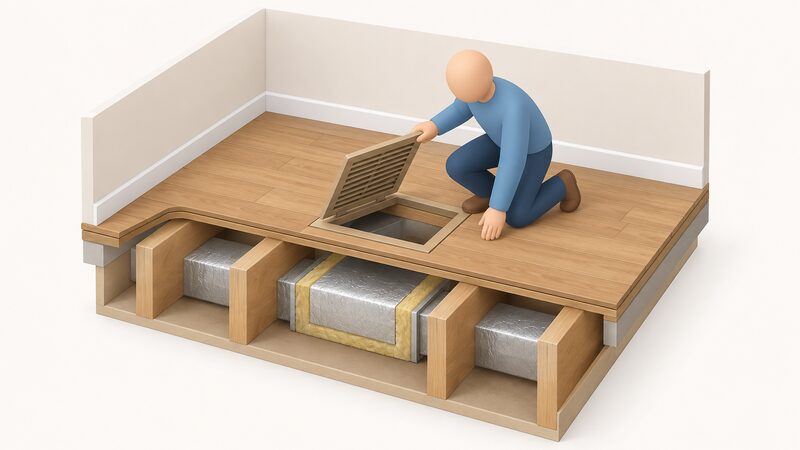
The ductwork is the reason warm air is a replacement market rather than a growth market. Ducts need cross-sectional area, they need routes through floors and ceilings, and they need insulation to stop the heat they carry being lost before it reaches the room. The Future Homes and Buildings Standards consultation response retains a ductwork insulation approach of 50mm within conditioned space and 25mm within unheated space, on the grounds that there is a significant risk of condensation and resulting mould growth on poorly insulated ducts1.
That is the technical statement of a simple problem: a duct running through a cold loft or a ventilated void will lose heat and can condense moisture. Insulating it properly takes space that a finished house does not have. The same constraint shows up in ventilation design, where centralised mechanical extract ventilation draws moist air from wet rooms through ducts to a central unit, often in a loft, and is described as complex and expensive to install, and only suitable where there is sufficient space for ductwork12.
Compare that with the alternatives. Underfloor heating is expensive and disruptive to retrofit, and is usually only a good option if significant building work is already under way13. Radiators and pipework are far easier to route into an existing house. That asymmetry explains why a household with a failed warm air unit usually faces a choice between a like-for-like unit and a wet system, not between warm air and a new ducted design.
Warm air central heating compared with a wet radiator system
The two systems differ in almost every practical respect: what carries the heat, how fast the house responds, what can be zoned, and what happens when the heat source fails.
| Feature | Warm air (ducted) | Wet radiator system |
|---|---|---|
| Heat carrier | Air through ducts | Water through pipes and radiators |
| Heat source | Gas warm air unit | Boiler, heat pump or electric boiler |
| Stored hot water | None in the heating circuit | Cylinder or combi, depending on type |
| Retrofit difficulty | High, ducts must be routed and insulated1 | Lower, pipework follows existing routes |
| Response time | Fast, air heats quickly | Slower, water and metal must warm |
| Zoning | Limited by duct layout | Room by room with TRVs and controls |
Wet systems themselves vary widely in response. Wet underfloor heating generally takes much longer to heat up and cool down than traditional radiators, partly because of the screed or concrete in which most systems are embedded, though these systems tend to have lower running costs than dry electric versions13. A warm air system sits at the fast end of that spectrum, closer to radiators than to underfloor heating, because air has little thermal mass.
The independence question is where the two diverge most sharply. A warm air system depends on mains gas, a gas safe engineer, and a manufacturer's parts supply for a unit that may be decades old. A wet system can be paired with a heat pump, an electric boiler or a cylinder with an immersion heater, which gives a household more than one way to make heat. That flexibility is the real argument in the comparison, and it is a matter of what the household wants to be able to do later, not of which system heats a room better today.
Gas-fired warm air units: safety and carbon monoxide
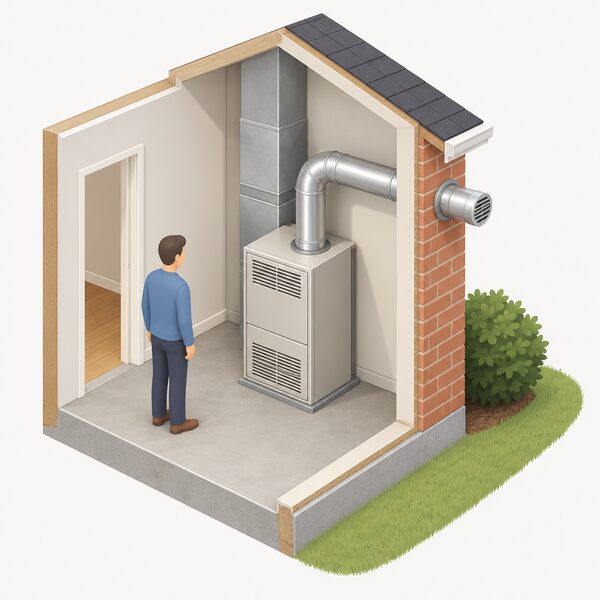
A gas warm air unit is a combustion appliance, and the risks are the same as for any other. Incorrectly installed, poorly maintained or poorly ventilated household appliances, such as cookers, heaters and central heating boilers, are the most common causes of accidental exposure to carbon monoxide14. Common sources of carbon monoxide include a blocked chimney or flue, a furnace or boiler, exhaust fumes, a range or cooker, a portable heater or fireplace, a clothes dryer or water heater, and barbecues or grills15.
The failure modes that matter for a warm air unit are the flue and the ventilation. Requirement J2 of the building regulations guidance is blunt: combustion appliances shall have adequate provision for the discharge of products of combustion to the outside air4. A warm air unit with a blocked or deteriorated flue, or one starved of combustion air because a room has been sealed up, is a carbon monoxide risk.
Carbon monoxide poisoning is not confined to the home. Incidents and fatalities because of carbon monoxide can also occur in holiday homes, caravans and on board boats where faulty gas cookers, appliances or petrol-powered generators have led to poisoning, and poisoning can also occur when people bring gas and charcoal barbecues into tents and other small enclosed spaces to try to keep warm15. The pattern is the same in each case: a combustion appliance, a space that is too enclosed, and no working alarm.
Servicing: an annual check by a Gas Safe registered engineer
The servicing rule is not specific to warm air, and that is the point. The Health and Safety Executive strongly advises that all gas appliances, flues and pipework should be installed, regularly maintained and serviced at least annually by a Gas Safe registered engineer2. The same advice applies to domestic gas appliances, flues and pipework generally16. Independent guidance repeats it: arrange an annual service for your boiler or other gas appliances with a Gas Safe registered engineer3.
For a warm air unit, an annual visit covers more than the burner. The engineer checks the heat exchanger for cracks, the flue for spillage and blockage, the combustion air path, the fan and the ductwork connections, and the safety devices. A boiler service is recommended at least once a year, in other words every 12 months17, and the same interval is the working standard for a warm air heater.
In a rented home the legal position is separate from the servicing recommendation. A landlord must ensure an annual gas safety check is carried out within 12 months of the installation of each appliance and every 12 months thereafter2. Any gas appliance that the landlord owns and provides for the tenant's use is included in those legal duties18. Where a tenant has their own gas appliance that the landlord did not provide, the landlord is responsible for parts of the associated installation and pipework but not for the appliance itself, and the tenant is responsible for the gas safety checks of their own appliances and the flue if the flue only services their appliance18. Once a tenant has bought an appliance from the landlord, the tenant is responsible for the annual gas safety check and maintenance18.
Gas work must be done by someone on the Gas Safe Register. Poorly maintained, badly installed or faulty gas appliances can cause gas leaks, fire, explosions and carbon monoxide poisoning19.
Warning signs your gas warm air unit is unsafe
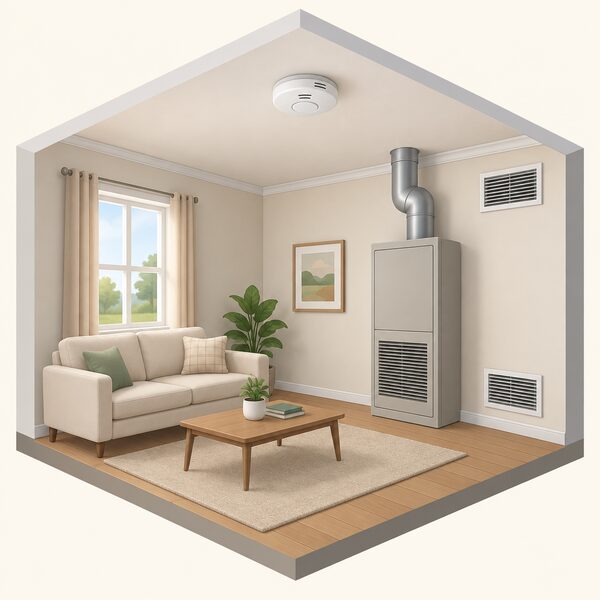
The clearest visible signal is the flame. A healthy gas flame should burn blue3. A yellow, orange or sooty flame indicates incomplete combustion, and so does black staining or scorching around the unit, the flue or the outlet grilles.
Symptoms in people are harder to read because they mimic other illnesses. Carbon monoxide poisoning symptoms tend to be seasonal14, which is why they are often attributed to winter colds, and they ease when the person leaves the building. Headaches, dizziness, nausea and tiredness that improve away from home are the pattern to watch for.
When an engineer finds a problem, the classification matters. If an appliance or installation is found by a gas engineer to be either at risk or immediately dangerous, both will carry the same message on the warning label: Danger Do Not Use2. There is no softer category that allows continued use.
Ventilation and extraction: what the rules require
Ventilation is where a warm air system and a modern, sealed house come into conflict. In places where lots of moisture is produced, such as kitchens, bathrooms and utility rooms, extractor fans are required to remove the excess moisture, and if there is no extractor fan, opening a window will help12. Intermittent extract ventilation, meaning individual extractor fans in bathrooms, kitchens and utility rooms usually controlled by a light switch, a timer or a humidity sensor, is relatively cheap to install and reasonably effective, but not always sufficient for very air-tight or damp-prone properties12.
The interaction with a combustion appliance is a hard limit. Where a kitchen contains an open-flued appliance, the extract rate of the kitchen extract fan should not exceed 20 litres per second (72m³/hour)4. An extract fan that is too powerful can depressurise a room and pull combustion products back down a flue instead of letting them escape.
Adding double glazing, draught-proofing or a new extractor fan changes the air balance of a house, and an open-flued appliance depends on that balance. This is why a gas appliance should be checked after such work. For a well-insulated and air-tight building, mechanical heat recovery ventilation is described as an efficient way to provide ventilation6, but it is a designed system, not a retrofit afterthought.
Where a conservatory is involved, the rules tighten further. A thermal break must remain between the dwelling and the extension, and no heating can be extended into or installed in the conservatory without an application being made11. Where a conservatory is exempt from building regulations, there should be an independent heating system with separate temperature and on/off controls10. If the heating system is to be altered or extended into the conservatory, it must comply with the building regulations, including independent temperature and on/off controls20. A warm air duct run into a conservatory is exactly the kind of alteration these rules catch.
What happens when a warm air system reaches the end of its life
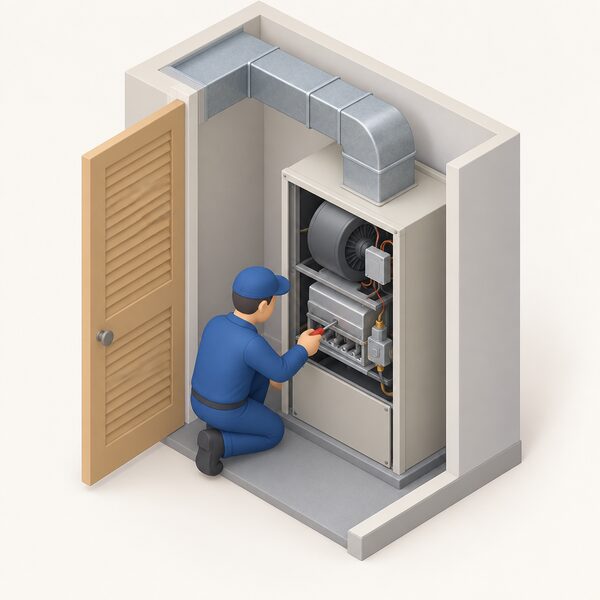
The decision point is usually a failed unit, and the choice is between a replacement warm air unit and conversion to a wet system. The ductwork already in the house is the main factor: if it is sound and accessible, a replacement unit reuses it; if it is not, the case for conversion strengthens because the ducts become dead space either way.
Age is a reasonable trigger for assessment. The current lifespan of a boiler is around 15 years5, and warm air units in service are typically far older than that. For comparison, a well-maintained heat pump should last for 20 years or longer, and most systems come with a two to three-year warranty5. Those figures describe different technologies, but they set expectations for what a replacement might reasonably deliver.
Where a household converts, the grant landscape is worth understanding even though none of it is aimed at warm air. The Warm Homes: Local Grant funds insulation, energy-efficient heating systems and renewable energy installations21. Retrofit and packaged hybrid heating systems are eligible for homes currently heated by mains gas only, and where a new gas boiler is fitted only the heat pump component can be funded22. In Wales, the New Warm Homes Programme applies a fabric-first condition: heating and ventilation measures would be available only when the thermal efficiency of the dwelling has been improved to a satisfactory standard to accommodate them23. In Northern Ireland, the Affordable Warmth Scheme is open to households including those who rent from a private landlord24.
VAT treatment is a separate consideration. Heating equipment and connection of the gas supply attract a 5% rate to the extent they are grant-funded by certain funders to people aged over 60 or in receipt of certain benefits, covering items including gas-fired boilers, gas room heaters with thermostatic controls, radiators, and the installation, repair and maintenance of a boiler, radiators, pipework and controls forming a central heating system25.
For a household thinking about independence, the honest summary is that a warm air system ties the home to mains gas, to a shrinking pool of engineers familiar with the units, and to a parts supply that depends on a manufacturer continuing to support an old product. A wet system does not remove dependence on a supplier, but it widens the set of heat sources that can be attached to it later, including a heat pump or an electric boiler. That is the trade a household is making when the unit finally fails.
Sources27 cited
- Future Homes and Buildings Standards consultation response, Ministry of Housing, Communities and Local Government, 2026-03
- Gas safety in the home: frequently asked questions, Health and Safety Executive, 2026
- Take no chances with gas safety, Northern Gas Networks, 2026-09-14
- Building Regulations guidance Part J: heat producing appliances, Welsh Government, 2026-09-17
- Heat pumps advice, Home Energy Scotland, 2026-09-20
- Ventilation systems, nidirect, 2026-09-17
- Approved Document L: Conservation of fuel and power, Volume 1, Dwellings, Department for Levelling Up, Housing and Communities, 2021
- RDSAP conventions v12, BRE Group, 2025-05-15
- New Build Heat Standard consultation, Scottish Government, 2026-09-20
- Conservatories: building regulations, Planning Portal, 2026
- Building control frequently asked questions, Building Control Northern Ireland, 2026
- Ventilation advice, Centre for Sustainable Energy, 2025-07
- Underfloor heating advice, Centre for Sustainable Energy, 2025-11
- Carbon monoxide poisoning, nidirect, 2026-09-17
- Gas safety and carbon monoxide, nidirect, 2025-11-24
- Gas safety in the home: advice for owner occupiers, Health and Safety Executive, 2026
- Boiler maintenance guide, Uswitch, 2026-09-03
- Landlords: what safety checks are required, Health and Safety Executive, 2026
- Gas Safe Register, nidirect, 2025-10-29
- Replacement conservatory roofs guidance, Building Control Northern Ireland, 2026-04
- Home and business grants, schemes and advice, East Hertfordshire District Council, 2026-09-17
- Warm Homes: Local Grant policy guidance, Department for Energy Security and Net Zero, 2026-07
- New Warm Homes Programme policy statement, Welsh Government, 2023-06-15
- Affordable Warmth Scheme, Northern Ireland Housing Executive, 2026-09-17
- VAT rates on different goods and services, HM Revenue and Customs, 2026-07-10
- Warm Home Discount Scheme, House of Commons Library, 2026-02-26
- Warm Home Discount eligibility statement, England and Wales 2026 to 2027, Department for Energy Security and Net Zero, 2026-09-17
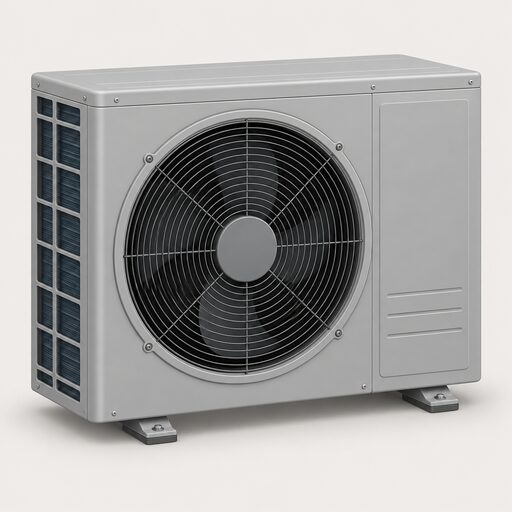
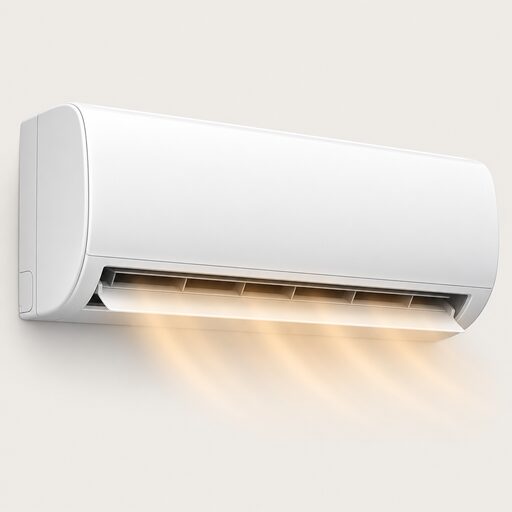 Air-to-Air Heating and CoolingAir-to-air heat pumps deliver warm air through indoor fan units rather than hot water to radiators.
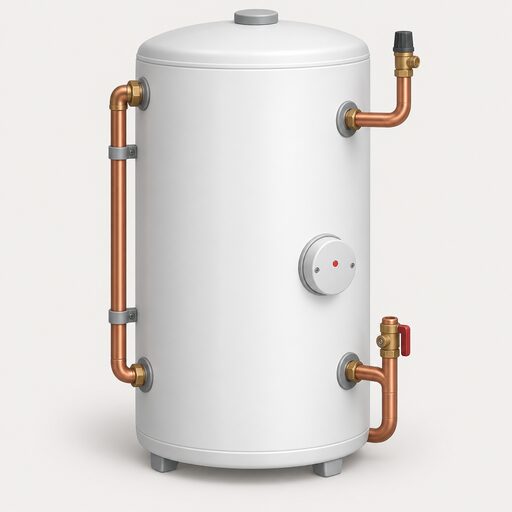 Air-to-Water Wet SystemsAir-to-water heat pumps feed radiators, underfloor heating and a hot water cylinder, and are the most common domestic heat pump in the UK.
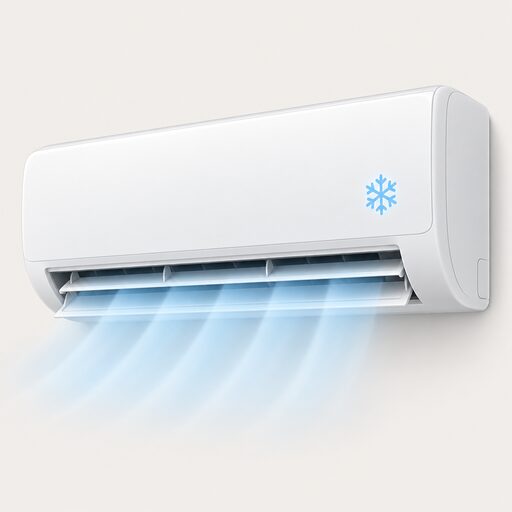
 Cooling and Heat PumpsCan an air conditioner heat your home as well as cool it?
 Using a Heat Pump for CoolingCan a heat pump cool your home in summer as well as heat it in winter?
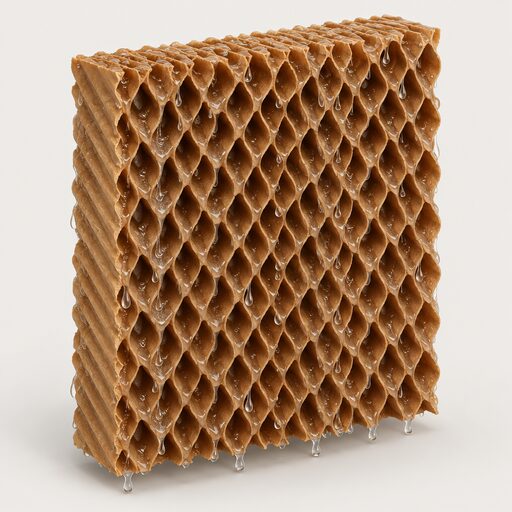 Evaporative Air CoolersHow evaporative coolers lower air temperature by evaporating water, why humidity limits the cooling they give in the UK, and what to know about water tanks, running power, prices and hygiene.
 Radiators and EmittersWill your radiators still heat the house properly with a heat pump?