In this guide
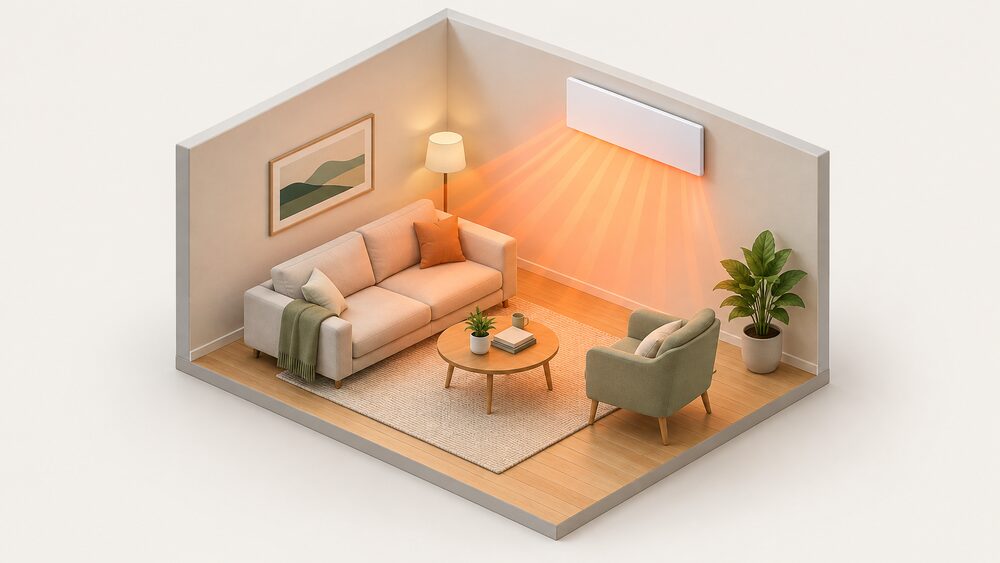
Infrared heating panels are flat electric heaters that transfer heat by radiation. Instead of warming a volume of air and letting convection currents distribute it, the panel radiates outwards and warms any surface it reaches: floors, walls, furniture and the people in the room1. Every panel is a direct-acting electric heater, so all of the electricity drawn is delivered as heat, and none of it is lost up a flue. That is the technical basis of the "100% efficient" claim made across the industry.
The cost picture is less simple than the efficiency claim. An independent estimate puts installation at £100 to £200 per heater, with running costs for a flat put at around £1080 a year, similar to conventional electric panel heaters, read in June 20262. A worked example from a distributor gives an 800W panel at a tariff of £0.30 per kWh costing approximately £0.24 per hour while it is actively heating3. The headline constraint is the fuel: electricity costs about four times as much as gas for the same amount of energy, so a panel that converts every watt to heat still runs on the most expensive fuel in the house1.
For a household thinking about independence, infrared sits in a particular place. There is no gas connection, no flue, no pipework, no water and no annual service, which removes several dependencies at once4. What remains is complete dependence on the electricity supply and on the price of grid power, plus, where smart controls are used, a dependence on an app and a manufacturer's service.
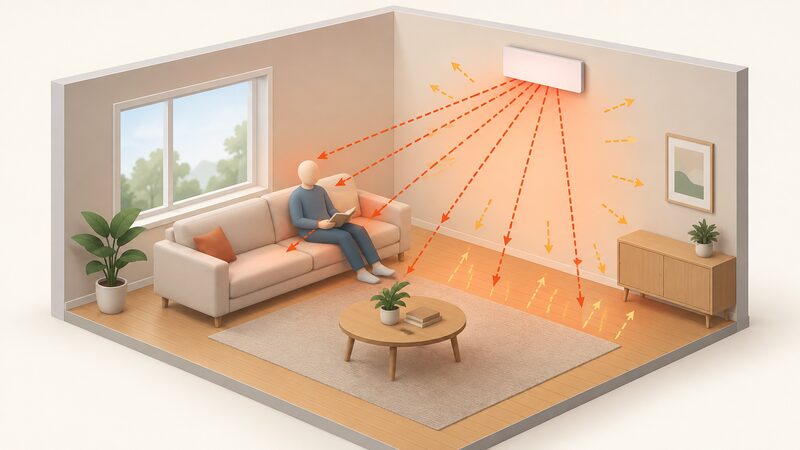
Radiant heat, not warm air: how a panel actually works
An infrared panel transmits heat through thermal radiation, emitting infrared rays that heat objects and surfaces directly rather than the air between them8. Herschel describes the mechanism as transferring heat to objects and people directly, "without heating something else in between (air, water, metal etc.)"9. The same source describes the second stage: the panel heats the walls, floor and ceiling to build up thermal mass, which then radiates back into the room9.
That second stage matters more than the marketing usually admits. A radiator or a fan heater warms air, which rises, stratifies and leaks out of every gap. A panel loads the fabric, and the fabric returns heat slowly. Surya states that the temperature gap between the top and bottom of a room is much smaller with panels, and that the absence of convection currents removes stuffiness and reduces the risk of mould and dampness in walls8. Herschel makes a similar claim, that infrared is non-convective and so does not create the airflows on which allergens travel9. These are manufacturer claims about their own products. The independent guidance is more restrained, describing the radiant principle without endorsing the condensation and health benefits1.
Far infrared is the band used in panel heating. Near infrared produces intense, penetrating heat and is described as potentially unsafe, which is why it is not used for this purpose10. Infrared radiation itself is described as safe in the same way visible light is, and the human body emits infrared10.
Instant warmth: what "instant" means in a real room
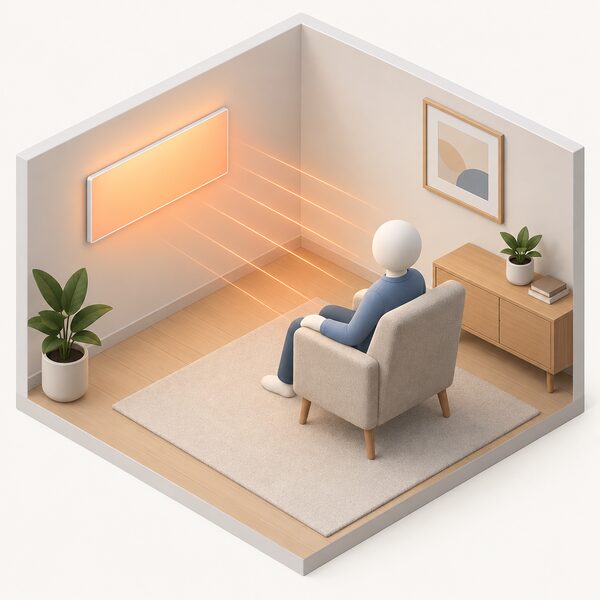
The claimed advantage over convection is speed. Because the panel does not wait for a volume of air to reach temperature, warmth is felt almost immediately after switch-on11. Tansun states that its heaters give instant heat as soon as they are switched on, with a comfortable temperature enjoyed within a few seconds12. A Herschel case study from a bedsit renovation reports that a room is warm within five to ten minutes, where gas took "thirty, forty, fifty minutes"13.
The qualification is distance. The effective range of a panel is approximately 3m, with optimal warmth felt within the first 2m14. Beyond that, the sensation of radiant warmth falls away and the room relies on the slower fabric-warming effect. This is why panel placement is more consequential than radiator placement: a radiator in the wrong corner still heats the air, whereas a panel aimed at the wrong wall warms that wall first and the occupants later.
In practice a household should expect two different experiences from the same product. Sitting within the panel's line of sight, the effect is quick and noticeable. Returning to a cold, poorly insulated room and expecting whole-space comfort in minutes is a different proposition, and the fabric-loading stage takes considerably longer. In an intermittently used space, a bathroom or a home office, the instant-on characteristic is the genuine benefit. In a continuously occupied living room, the heat-up figures matter far less than the steady running cost.
Efficiency: 100% at the point of use, and what it does not tell you
Every source in the industry converges on the same number. Herschel states that infrared heaters are 100% efficient, with every watt converted into radiant warmth4, and that they are classed as direct-acting electric heaters and assumed under SAP to be 100% efficient, meaning 1kW in equals 1kW out7. Tansun gives a slightly lower figure, describing energy conversion rates of around 98%11, and elsewhere states that more than 85% of consumed energy is transferred into infrared heat6. The documents therefore disagree at the margin, between 85% and 100%, depending on whether the measure is total heat output or the radiant fraction specifically.
None of this makes infrared cheaper than another form of electric heating at the same output. Every direct electric heater, including a fan heater, an oil-filled radiator and a storage heater, is essentially 100% efficient at converting electricity to heat. The efficiency claim distinguishes electricity from combustion, not one electric heater from another. The genuine question is whether radiant delivery lets a household achieve comfort at a lower air temperature, and therefore with less energy. The Energy Saving Trust puts this carefully: a well-controlled infrared system will probably cost less to run than standard electric panel heaters, but there is little research available to confirm it1.
Maker claims about savings run well ahead of that evidence. Kiasa states that panel efficiency "can also provide a saving of up to 60% on your heating bills"15, and Tansun states that a 400W infrared heater will produce the same amount of heat as a 1kW conventional heater11. Both are manufacturer claims with no independent confirmation in the record. A household comparing options should weigh the metered figures in electric heating running costs more heavily than percentage claims.
Running costs: an 800W panel, hour by hour
The arithmetic is straightforward because the panel is either drawing its rated power or it is off. The table below sets out published figures alongside the fuel comparison.
| Figure | Value | Source type |
|---|---|---|
| 800W panel at £0.30/kWh | approximately £0.24 per hour when actively heating3 | distributor |
| 600W panel, 25p/kWh, 6 hours | 0.6kW x 25p x 6 hours = 90 pence per day, September 202416 | maker |
| 300W panel | 8p per hour17 | maker |
| 700W panel | 18p per hour17 | maker |
| 1100W panel | 29p per hour17 | maker |
| Flat, annual | around £1080 a year, June 20262 | independent |
| Electricity vs gas | electricity costs about four times as much as gas per unit of energy1 | independent |
The maker per-hour figures assume different unit rates from one another and none states the tariff, so they are not directly comparable with the distributor example, which does. The independent annual figure of around £1080 for a flat is the one that carries most weight, and it is explicitly described as similar to panel heaters2.
For context on other electric heat, independent testing reports fan heaters at 60p per hour on average and convector heaters at 48p per hour on average18. Against gas central heating, the four-times fuel differential dominates every other variable. Against storage heaters, the comparison turns on tariff: storage heating charges on cheap off-peak units, while panels draw power at the moment heat is wanted, often at peak rates, unless the household is on a time-of-use tariff and willing to shift demand. The side-by-side treatment is in infrared panels vs storage heaters.
Sizing: wattage, insulation, ceiling height and open plan
Two sizing conventions appear in the sources and they measure different things. The first is heat requirement: approximately 50 to 60 watts per square metre of floor area in a well-insulated room, increasing for poorly insulated spaces6. The second is panel construction: an infrared panel requires between 900 and 1000 watts per square metre of panel surface area to produce panel temperatures of 90 to 100°C19. The first tells a household how much total wattage a room needs; the second tells it how large a panel of that wattage will physically be.
Sizing by floor area alone is unreliable. Surya's method calculates length, width and height to give room volume in cubic metres, then assesses the level of insulation20. Kiasa is explicit that a room size guide is only a starting point, and that insulation, glazing, ceiling height and target temperature must also be considered21. The Energy Saving Trust notes that some rooms will need more than one panel where panels are the main heat source1.
Practical consequences follow:
- High ceilings raise the volume to be conditioned and lengthen the fabric-loading stage, even though radiant delivery reduces stratification.
- Large glazed areas are cold surfaces that absorb radiant energy and lose it, so glazing usually pushes the requirement above the baseline figure.
- Open plan rooms exceed the roughly 3m effective range of a single panel14, so multiple panels placed over the areas people actually occupy will generally be needed rather than one large unit.
- Poor insulation pushes the requirement above 60 watts per square metre6, which is exactly where the running cost problem becomes severe.
On a whole-house retrofit, panel counts are usually worked out by the supplier. One Herschel case study describes the manufacturer calculating the number of panels of each wattage from the architect's plans, allowing panels bought for the pre-renovation house to be reused in the finished property22. Related principles are covered in boiler sizing for wet systems.
Wall, ceiling, freestanding or picture: forms and mounting
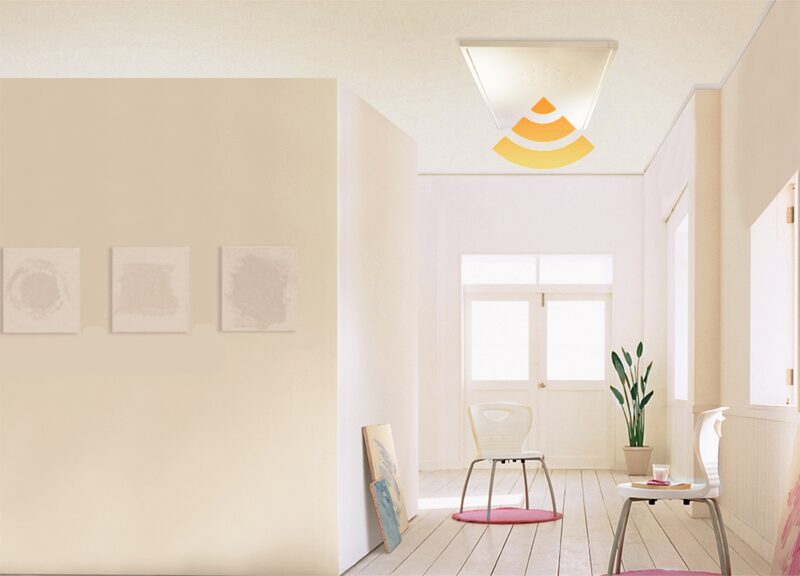
Panels are mounted on walls or ceilings23, and one maker compares the process to hanging a flat screen television24. Dimplex states that its far infrared panel heater can be wall or ceiling mounted, giving more usable space and directing heat more efficiently25. Ceiling mounting appears frequently in case studies where wall space is at a premium, and radiant ceiling heating comes in two forms: plasterboard panels, or modules mounted onto a frame26.
Freestanding panels are also sold. These are usually wired into the electricity supply by an electrician, although portable panels that plug into the mains are available1. Beyond panels, infrared appears as underfloor heating and as a fabric-like wallpaper that can be plastered over and decorated, though independent guidance notes there is little conclusive research about the effectiveness of electric wallpaper and infrared heating27.
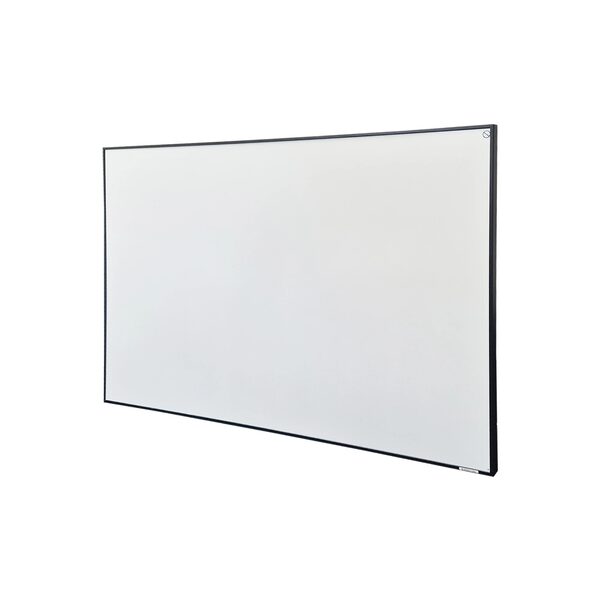
Picture panels are a finish, not a separate technology. Ranges are sold from 300W in 600 x 400mm up to 900W in 1200 x 600mm and 1100W in 1100 x 700mm, with printed images or, in some ranges, a customer's own photograph or a child's artwork28. Installation of a picture panel is described as taking less than an hour29. Output is set by wattage and panel area, so a decorative panel correctly sized for the room heats as a plain white one does.
Published prices
| Product | Price | Notes |
|---|---|---|
| 900W Classic infrared heating panel, white frame | £228.35, reduced from £285.4430 | maker price list, September 2026 |
| 700W Classic infrared heating panel, white frame | £186.56, reduced from £233.2030 | maker price list, September 2026 |
| Herschel Comfort infrared panel heater | from £309.0031 | maker product page |
| Average home installation of panels | around £80032 | maker claim |
| Installation per heater | £100 to £2002 | independent, June 2026 |
Prices are as listed by the seller and the VAT position is not stated on these listings. Installation labour is quoted by the installer.
Installation, maintenance and the covering rule

Panels do not require pipework, and an electrician can install them11. There is no digging up of floors and no additional pipework, so the work is quick and disruptive to a limited extent24. Herschel states plainly:
"Herschel Far Infrared panel heaters require no maintenance or servicing."
The heaters are solid state with no moving parts, which means no annual service, no certificate and no risk of leaks7. For a household, that removes an annual cost and an annual appointment that a gas appliance requires, and it removes the flue and combustion risks entirely. What it does not remove is the electrical installation: fixed panels involve fixed wiring, and the rules on that are set out in electrical safety and supply for electric heating.
Warranty terms vary by model and range: the Herschel Comfort panel carries a ten year warranty, while the Select XLS carries five years, according to the manufacturer. Registration conditions follow the same pattern as other heating products, covered in boiler warranties.
Where infrared fits: off-gas homes, retrofits and zoned control
Infrared is commonly considered for off-gas homes and modern all-electric developments34, and appears in rural and older properties, open-plan spaces, renovation and retrofit projects, extensions and conservatories, and homes replacing gas where a heat pump will not work35. It is frequently specified in refurbishment because it can often be installed with less disruption than a traditional wet system34. One independent assessment concludes that panels are most practical as a gas boiler replacement in off-gas properties, in well-insulated new builds, or in properties with solar panels, and otherwise as supplementary heating in homes with modern gas boilers36.
Zoning is the strongest practical argument. Each panel is independently controlled, making it easier to optimise the temperature of each room33, and panels can be installed only in the rooms that are actually occupied. Control may be a simple dial on the heater or a smart control from a phone app1, and app control with independent regulation of each panel is offered by several makers33. The broader options are set out in heating controls and thermostats.
For solar pairing, panels are ordinary electrical loads. Herschel states that infrared heating can be powered by solar panels and linked with battery storage to reduce reliance on the grid37, and Kiasa states that many modern homes combine infrared with rooftop solar as part of an all-electric strategy34. Independent guidance on electric underfloor heating makes the same point about solar and adds that a battery to store excess solar electricity would make the arrangement more efficient38. The limit is seasonal and is not a matter of opinion: UK solar output is lowest when heating demand is highest, so winter heat is overwhelmingly imported from the grid regardless of how large the array is. Panels advance a household's independence from gas and from the gas network; they deepen its exposure to electricity prices. That trade is the subject of home heating and energy independence and, for properties without a gas connection, heating a home off the gas grid.
Whether panels can replace a boiler outright is answered differently by different parties. Herschel states that its infrared heating can replace a gas boiler39, and Kiasa states that in most situations it can, although suitability depends on the property and heating requirements35. Both are maker positions. The Energy Saving Trust adds the cost frame: infrared could be less expensive to install than a boiler or heat pump with radiators for a whole house, but will cost more than simply replacing an existing boiler1. Panels also heat space only, so domestic hot water requires a separate cylinder or immersion, covered in hot water cylinders.
Limits, and the gap in the evidence
The honest summary is that the physics is well understood and the household economics are not well documented. The Energy Saving Trust is direct that there is little research available to confirm the running cost savings claimed for infrared1, and states separately that there is little conclusive research about the effectiveness of electric wallpaper and infrared heating27. An independent report notes that panels have higher efficiencies than condensing gas boilers40, which is true at the point of use and says nothing about the price of the fuel each burns.
The specific limitations a household should expect:
- Uneven heat. Optimal warmth is within the first 2m of a panel and the range is approximately 3m14. Areas outside that line of sight rely on the slower re-radiation from the fabric.
- Fuel price. Electricity costs about four times as much as gas for the same energy1. No efficiency figure closes that gap.
- Insulation dependence. The 50 to 60 watts per square metre guide applies to well-insulated rooms and increases for poorly insulated ones6. In a leaky house, panels are expensive heat.
- Immaturity. One maker describes infrared as "very much in its infancy in terms of where it is in the heating market"8.
- Consumer information. Official tracking found that among owner-occupiers unlikely to install low carbon heating, a lack of sufficient knowledge was cited by 29%, with 30% saying they did not know enough about air source heat pumps to decide and 33% saying the same about ground source, in winter 202541. Regulator research in June 2025 found cost remains the main barrier to adopting heat pumps and solar panels42.
Infrared panels therefore make most sense where the alternative is another form of direct electric heat, where the building fabric is good, and where the household values simplicity, zoning and the absence of pipework and servicing more than the lowest possible unit cost of heat. They make least sense as a replacement for a working gas boiler in a poorly insulated house, where the fuel differential will show up on every bill.
Sources42 cited
- Infrared heating explained, Energy Saving Trust, 13 March 2026
- Electric heating advice, Centre for Sustainable Energy, June 2026
- Infrared heating guide, Infrared Heating Supplies, 2026
- Infrared heating panels, Herschel Infrared, 2026
- Infrared heaters compared with heat pumps, Herschel Infrared, 17 October 2025
- Buying genuine far infrared heating, Tansun, 15 June 2026
- Do infrared heaters use a lot of electricity, Herschel Infrared, 25 September 2024
- How does infrared heating work, Surya Heating, 2026
- How is infrared heating different to convection, Herschel Infrared, 26 November 2025
- Infrared heating panels, HIES Scheme, 24 July 2018
- Advantages of infrared heat panels, Tansun, 15 June 2026
- Uninsulated shed heating, Tansun, 15 June 2026
- Future ready heating for a 12 bedsit renovation, Herschel Infrared, 21 April 2026
- Calculating heated areas, Surya Heating, 2026
- Infrared heating panels and bars, KIASA, 2026
- Herschel Infrared home page, Herschel Infrared, September 2024
- Kore infrared panel collection, KIASA, 2026
- Best electric heaters and oil-filled radiators, Which?, 29 June 2026
- Customer service FAQs, Herschel Infrared, 24 February 2026
- Choosing the right infrared heating panel for a room, Surya Heating, 2026
- Kore Hex infrared heating panel, KIASA, 2026
- Customer experience with Herschel, Herschel Infrared, 8 December 2025
- Electrify your heating, Herschel Infrared, 10 February 2026
- Home extensions, Herschel Infrared, 2026
- IRP far-infrared panel heater, Dimplex, 17 September 2026
- Installing ceiling heating at home, Netatmo, 2026
- Electric wallpaper explained, Energy Saving Trust, 26 March 2026
- Herschel Inspire range, Herschel Infrared, 2026
- Image IR panel heaters, Surya Heating, 2026
- Classic infrared heating panel listings, Surya Heating, 2026
- Infrared heaters, Herschel Infrared, 22 October 2025
- Infrared heating facts versus fiction, Tansun, 15 June 2026
- Is infrared heating a good idea, Trianco, 9 December 2024
- Is infrared right for your property, KIASA, 2026
- Infrared heating for homes, KIASA, 2026
- Infrared heating panels, Boiler Central, 14 July 2026
- Are infrared heaters a low carbon heating solution, Herschel Infrared, 5 March 2025
- Underfloor heating advice, Centre for Sustainable Energy, November 2025
- Can infrared heating replace a gas boiler, Herschel Infrared, 12 May 2022
- Adopting intelligent infrared heating technologies in social housing, Nesta, 30 August 2023
- Public Attitudes Tracker: heat and energy use in the home, winter 2025, DESNZ, 2025
- Tracking energy consumers' use of low carbon and flexible products and services 2025, Ofgem, June 2025
 Electric Heating CostsHow to work out what electric radiators, panel heaters, infrared and storage heaters cost to run per hour and per season.
 Electric Radiators and PanelsDo electric radiators cost more to run than gas heating, and are they worth it for one room or a whole house?
 Electric Radiator ControlsElectric heaters cost far more to run than gas, so the controls really matter.
 Heating Films and WallpaperCan electric wallpaper really heat a whole room, and what does it cost to run compared with a gas boiler or heat pump?
 Energy IndependenceA heat pump runs your heating on electricity instead of gas or oil, so how much does that really cut what you pay and how exposed you are when fuel prices jump?
 Underfloor Heating SystemsWhich rooms suit electric underfloor heating and which need a wet system?