
In this guide
Tansun is a British manufacturer of infrared heaters, based in the UK and making its products here rather than importing them. The company states that it has been manufacturing infrared heating solutions in the UK for over four decades, and elsewhere that it has been established for 35 years and pioneered the concept of radiant electric heaters alongside Philips technology1. Those two figures sit side by side on its own pages and are not reconciled.
The range covers quartz shortwave heaters for terraces, awnings and parasols, and infrared panel heaters for indoor rooms, including a hidden wall version that can be mounted within walls or ceilings3. Tansun describes its heaters as operating silently, with no fans or moving parts, and as virtually maintenance free1.
For a household, the appeal is a heater that runs on electricity, produces no combustion gases, and can be zoned room by room. The dependence is equally clear: an infrared heater is only as low carbon as the electricity feeding it, it does not replace a gas boiler for hot water, and the running cost is set by the electricity price rather than by the heater.
Tansun: a British infrared maker, and what that changes
Tansun's central commercial claim is that it manufactures in the UK. Its pages state that all Tansun products are made in the UK and designed using premium components, that its heaters are manufactured in the UK with the highest quality, and that they are made from quality British components to prevent rusting10. The Rio IP is named specifically as a heater Tansun manufactures in the UK13. The company also states that its products are not outsourced around the world5.
The experience claims vary by page. One page says over four decades of manufacturing infrared heating solutions in the UK, another says 40+ years of manufacturing experience and British-engineered, a third says 40+ years of experience in the heating game, and a fourth says the company has been established for 35 years1. What is consistent is the claim of UK production.
That matters for energy independence in a limited but real way. A heater built in the UK has a shorter supply chain for spares and service than an imported panel, and the maker's own technical guidance argues that imported imitation infrared heaters are a different proposition5. It does not change the fuel: the heater still runs on grid electricity from a supplier, and the household remains exposed to electricity prices. UK manufacture shortens the parts chain, not the energy chain.
Tansun also claims the largest range of commercial, industrial and domestic infrared heaters in the world, and separately the largest range of radiant heaters2. These are the maker's own claims and are not independently verified.

What infrared heating does differently

Infrared heating works by radiation rather than convection. Tansun states that its panels heat the people and objects directly in their paths instead of warming the air like conventional heaters, and that its electric infrared heaters heat objects, people and surfaces which in turn radiate the heat back16. The company describes its short wave heaters as providing high intensity radiant heat similar to sunshine from the sun, heating objects and people rather than the air around them7.
The practical consequence is speed. Tansun states that its infrared heaters provide instant heat as soon as they are switched on, with a comfortable temperature enjoyed within a few seconds, that its conservatory heaters have no pre-heating times, and that its electric infrared heaters provide necessary heat within one second of switching on12. Its garage heaters are described the same way, with no pre-heating times and instant heat for draughty areas18.
Because the heat is directed, it is less affected by air movement. Tansun states that its heaters deliver targeted heat directly to people and objects without being affected by air changes such as draughts or winds, and that directed focused infrared heat warms everything in its range without losing heat to other spaces12. The independent picture is consistent on the mechanism: Which? describes infrared heating as using radiant infrared heat to warm people or objects rather than the air, which it says uses energy more efficiently than traditional heating, and the HIES scheme describes radiation as heating people and furnishings rather than warming an entire area20.
The trade-off is that a radiant heater does not warm the fabric of a room. A wall left cold stays cold, and a person who moves out of the heater's path leaves the warmth behind. That is the difference between heating a space and heating a person, and it is why infrared suits some rooms and not others.
The range: quartz, terrace and panel heaters
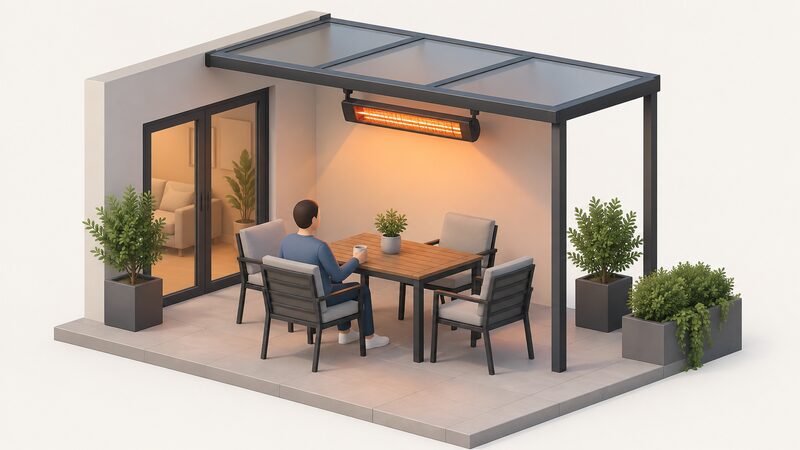
Tansun's domestic and commercial output splits into quartz shortwave heaters for outdoor and semi-outdoor use, and panel heaters for indoor rooms. The terrace range is described as suited to terrace heating for both commercial and domestic use, using shortwave infrared technology, and can be wall mounted or chain hung from above so it takes up no floor space4. The awning range is designed specifically for the area underneath retractable awnings, again for domestic and commercial use22.
Indoor, the company sells infrared panel heaters for small domestic rooms, and a hidden wall heater that can be mounted within walls or ceilings so it is virtually invisible8. Its modular wall heating range requires no maintenance or servicing24. The Linea is listed for awning heating, restaurant heating, bar heating, retractable awning heaters and terrace heating25.
| Product | Type | Key figure | Source |
|---|---|---|---|
| Rio IP | Infrared heater | 1.5 kW, for parasols and awnings | 5 |
| Riviera Elite | Standing infrared heater | 3.0 kW, for large outdoor areas | 5 |
| Linea | Infrared heater | IP rated, contact 0121 580 6200 | 25 |
| Eclipse Double | Infrared heater | IP rated, adjustable brackets | 26 |
| Sorrento Ceramic Triple | Infrared heater | Wide selection of switches and controls | 15 |
Tansun notes that its quartz infrared heaters contain a halogen lamp, which is why they are sometimes referred to as halogen heaters, but states they are not halogen heaters7. The naming confusion is worth knowing when comparing products, because a halogen heater and a quartz infrared heater are described differently in the same technical guidance.
Efficiency: 100% at source, and what that does not mean
Tansun states that its infrared heating offers 100% efficiency at source, not impacted by draughts or changes in air movement, and repeats the figure across its pages: up to 100% efficiency at source for its heating panels, 100% energy efficiency for the Linea comfort heat range, and 100% efficiency at source for its shortwave heaters18. One page gives a lower figure, describing its infrared heating panels as up to 98% energy efficient28. Its short wave heaters are stated to emit 92% of the energy as heat7.
Efficiency at source is a statement about the heater, not the system. An electric resistance heater converts essentially all the electricity it draws into heat at the element; the losses in an electric heating system happen upstream, at the power station and in transmission, and in the building itself. That is why the same heater can be described as 100% efficient and still cost more to run than a gas boiler per unit of heat delivered, depending on the price of electricity against gas.
On running costs, Tansun's claims are broad and inconsistent. One page states savings of over 30% compared to gas heaters, another states savings of approximately 30 to 70% in heating costs, and a third states that its domestic infrared heaters save up to 70% on heating bills compared to some other heating sources5. The company also states that electric systems last an average of 50% longer than a gas system or heater12. These are the maker's figures, given without the assumptions behind them, and the range from 30% to 70% is wide enough that the comparison basis clearly differs between pages.
Where Tansun heaters can be mounted and used
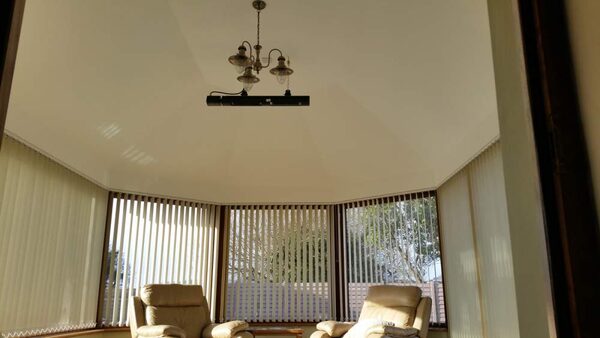
Tansun states that its heaters can be mounted on walls or ceilings, and its panel heaters can be mounted within walls or ceilings to be virtually invisible1. Its infrared heat panels can be wall or ceiling mounted to save floor space16. The Eclipse Double is mounted on adjustable brackets that allow the heat to be directed exactly where it is required26.
For outdoor use, the guidance is about placement rather than fixing. Tansun advises placing the heater in a central covered location to ensure even heat distribution across the entire outdoor patio space, and adjusting the height to direct heat where it is needed most, around seating areas under canopies or parasols30. The terrace range can be wall mounted or chain hung from above4.
The company lists ceiling-mounted heaters for space-saving, wall-mounted heaters for convenient installation, and portable heaters12. Its domestic range is described as suitable for a single room or an entire home31.
On water resistance, Tansun describes its weatherproof terrace heaters as fully IP rated, its heating panels as IP55, and states that its heaters can be IP-rated and built to last in external environments4. The Rio IP, Riviera Elite, Linea and Eclipse Double are all described as IP rated on their product pages13. The maker does not publish one figure covering every outdoor model.
Controls, zoning and solar compatibility
Tansun offers a wide selection of switches and heater controls that it says are suited to almost any situation and need, and its heaters are compatible with its range of energy efficient controllers and receivers15. The company states that its controllers can adjust the heaters from 0% to 50% to 75% to 100% of power, and that a heater can be switched down to 75% or 50% with the click of a remote button5.
Zoning is the point of the control range. Tansun states that combining its heaters with a time lag switch or motion detector gives zoning and control to optimise energy efficiency, and that its ambient range can be adjusted in heat output and energy consumption when combined with a presence detector (PIR) or a remote control19. The same control compatibility is stated for the Eclipse Double and the Riviera Elite26. Its domestic installation service describes advanced controllers and thermostats providing precise control over heating31.
On solar, Tansun states that infrared panel heaters can be easily integrated into buildings powered by solar panels, and that the versatility and compatibility of its panels with renewable energy sources makes them an excellent choice1. This is a compatibility claim, not a performance figure: an infrared panel runs on whatever electricity it is given, so a household with solar generation can run panels from its own output when the sun is shining. The National Energy Action solar PV report notes separately that installing infrared heating panels can be a lower cost option than installing an air-source heat pump and wet central heating system when replacing storage heaters34.
The dependence that remains is the grid. Unless a household has generation and storage sized to cover the heating load, an infrared panel draws from the grid at whatever the electricity price is at the time it runs. Zoning reduces the hours of draw; it does not remove the supply.
Iridium panel heaters: the voluntary replacement programme

Tansun has announced a precautionary voluntary replacement programme for Iridium panel heaters bought in 2019 to 2020. The notice cites a component that can fail and cause overheating, and invites owners to exchange their units for free updated replacements9.
This is the maker acting on a known fault in a defined batch, and it is the most concrete safety information on the page. It is also a reminder that an electric heater has no combustion risk but does have an electrical one, and that a product recall or replacement programme is the mechanism by which that risk is managed.
The Iridium Series is also where Tansun's colour options are set out: standard panel colours are white or black, but the company states it can create panels in most RAL colour options to help blend them into a room6. Its domestic infrared heaters are offered in a variety of styles and RAL colours, its terrace heaters in a range of RAL colours, and its hidden wall heaters can be RAL painted to match surrounding decor3.
Buying and installing: design service, installers and availability
Tansun offers a free design scheme to support with optimal heat output using its radiant panel heaters, and states that its large network of qualified and reputable installers is ready to take the stress out of the installation process1. Its domestic installation service covers infrared panels for a single room or an entire home31. For product information, the Linea page gives a contact number, 0121 580 620025.
The company's positioning on new build is that all Tansun products are made in the UK and designed using premium components, and it has published on the government's move to ban fossil fuel heating in new homes10. That is context for why an electric infrared panel might be specified in a new property, not a statement about any grant or scheme.
On cost, Tansun publishes no list price for its heaters on the pages reviewed here, and no installed price. Prices are installer-quoted, and the design service exists to size the heat output before a quote is given. A householder comparing infrared against a boiler should weigh the capital cost against the running cost, because the two are set by different things: the heater by its purchase price, the running cost by the electricity tariff.
For a household's energy independence, the position is straightforward. A Tansun heater removes combustion from the home, produces no carbon monoxide, needs no flue and no gas connection, and can be zoned room by room or run from on-site solar generation1. What it does not do is remove the dependence on electricity supply and price, or provide hot water. A home heated entirely by infrared panels is a home with no gas standing charge and no flue, and with a heating bill that moves with the electricity market.
Sources35 cited
- Large domestic room heating, Tansun, 2026-06-15
- Health benefits of infrared heating, Tansun, 2026-06-15
- Domestic heating, Tansun, 2026-06-15
- Terrace heating, Tansun, 2026-06-15
- Technical heating comparison, Tansun, 2026-06-15
- Advantages of infrared heat panels, Tansun, 2026-06-15
- Advantages and disadvantages of halogen heaters, Tansun, 2026-06-15
- Small domestic room heating, Tansun, 2026-06-15
- Precautionary voluntary action: Iridium, Tansun, 2026-06-15
- Government set to ban fossil fuel heating in new homes, Tansun, 2026-06-15
- Home heating, Tansun, 2026-06-15
- Gas heaters vs electric heaters, Tansun, 2026-06-15
- Rio IP, Tansun, 2026-06-15
- Best way to heat a patio, Tansun, 2026-06-15
- Sorrento Ceramic Triple, Tansun, 2026-06-15
- Hidden wall heaters, Tansun, 2026-06-15
- Uninsulated shed heating, Tansun, 2026-06-15
- Garage heating, Tansun, 2026-06-15
- Controllability is it the future of infrared heating, Tansun, 2026-06-15
- Electric central heating, Which?, 2025-09-22
- Infrared heating panels, HIES, 2018-07-24
- Retractable awning heaters, Tansun, 2026-06-15
- Modular wall heating, Tansun, 2026-06-15
- Passive house heating, Tansun, 2026-06-15
- Linea infrared heater, Tansun, 2026-06-15
- Eclipse Double, Tansun, 2026-06-15
- Tansun infrared heat panels are the future of indoor heating, Tansun, 2026-06-15
- Conservatory heating, Tansun, 2026-06-15
- Heat pump vs infrared heating, Tansun, 2026-06-15
- Domestic heating installation, Tansun, 2026-06-15
- Riviera Elite, Tansun, 2026-06-15
- Electric heating advice, Centre for Sustainable Energy, 2026-06
- Solar PV report, National Energy Action, 2025-02-19
- Adopting intelligent infrared heating technologies in social housing, Nesta, 2023-08-30
- 2024-25 NISEP Annual Report, Utility Regulator Northern Ireland, 2024