
In this answer
Short answer
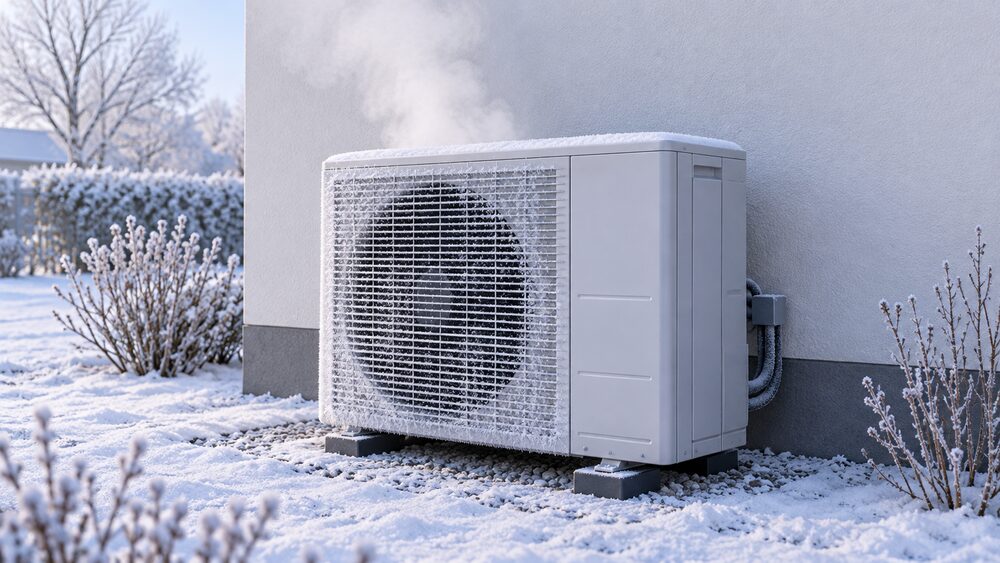
Most air source heat pumps sold in the UK will run at outdoor temperatures well below freezing. Independent guidance puts the working range of most current models at about -25°C, with some advanced cold-climate units rated to -35°C1. A common figure quoted for the UK market is -15°C, and several sources use exactly that number when describing what an air source heat pump can do2.
The headline minimum is not the whole answer. A heat pump does not switch off at a set temperature; its output and efficiency decline gradually as the air gets colder, and the practical question is whether the installed system can still meet the home's heat demand on the coldest day of the year. That depends on sizing, emitters and controls as much as on the unit's rated range.
The short answer: -15°C for most UK units, -20°C or lower for some
The figure a household is most likely to see quoted is -15°C. Northern Powergrid states that an air source heat pump can get heat from the air even when the temperature is as low as -15°C2. The Energy Saving Trust says heat pumps can perform down to -15°C or lower, but notes there may come a point when the heat pump's output is not enough for the home3. Its installer-facing guidance repeats the -15°C figure for drawing heat from the air7.
Other sources go further. Nesta reports that the majority of air source heat pumps in the UK market are capable of operating even when outdoor temperatures reach -15°C8. Welsh Government guidance states that heat pumps work efficiently even on cold days, down to temperatures as low as -20°C9. The Chartered Institute of Plumbing and Heating Engineering gives -25°C as a working minimum for air source heat pumps10.
Which? takes a more conservative line, describing air source heat pumps as designed to work down to minus 10°C, which it calls sufficient for most parts of the UK, while noting that models designed for colder parts of the country can work down to minus 25°C6. The spread between -10°C and -35°C reflects different things being measured: the temperature at which a unit still produces useful heat, the temperature at which it produces its rated output, and the temperature at which a particular installation can still meet demand.
For a UK household, the practical point is that the coldest design conditions in the British Isles sit inside the operating range of every current model. The variation that matters is in how much heat the unit can deliver at that temperature, not whether it runs at all.
Why heat pumps keep working in cold weather
A heat pump does not generate heat by burning fuel. It moves heat from one place to another, and it does so through the refrigerant cycle, the same process a refrigerator uses11. The European Heat Pump Association describes the principle as the refrigeration cycle: a refrigerant is compressed, condensed, expanded and evaporated in a loop, absorbing heat at low temperature outdoors and releasing it at higher temperature indoors12.
Because the cycle depends on a temperature difference rather than on combustion, it works in air that feels bitterly cold. There is still thermal energy in air at -20°C, and a refrigerant with a sufficiently low boiling point will absorb it. The Energy Saving Trust notes that heat pumps absorb heat from the air even when outside temperatures are as low as -15°C13.
Cold-climate design extends the range further. Which? reports that models designed for colder parts of the country can work down to minus 25°C6. ClimateXchange, reviewing field evidence, states that with proper design heat pumps maintain efficiency even at temperatures as low as -10°C, and can still be effective in conditions down to -30°C14.
"Field studies, however, demonstrate that with proper design, heat pumps maintain efficiency even at temperatures as low "
The phrase "with proper design" carries the weight. A unit rated to -25°C will only deliver what a home needs at that temperature if the system around it has been specified for the load.
Efficiency in cold weather: what happens to COP and running costs
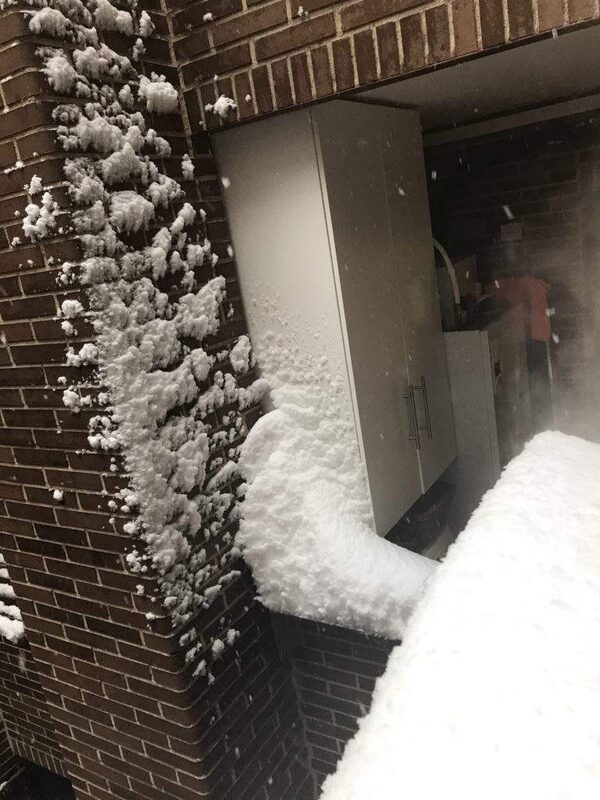
Efficiency falls as the outdoor temperature drops. Pendle Borough Council's fact sheet states plainly that an air source heat pump will be less efficient in the winter when the air temperature is colder5. The CPA makes the same point, noting that efficiency can drop in extremely cold conditions15.
The reason is the temperature difference the system has to work across. Independent guidance describes the key factor influencing the efficiency of a heat pump system as the temperature difference between the source temperature entering the heat pump and the distribution temperature exiting it: the smaller that difference, the more efficient the system16. In cold weather the source temperature falls, widening the gap and reducing the coefficient of performance.
This is why flow temperature matters so much. Heat pumps are more efficient when running at a lower temperature17, and standard or low temperature heat pumps are at their most efficient when running at 35 to 45°C4. Lowering the flow temperature reduces the reaction time of the heating system, so it takes longer to bring a cold house up to temperature, but it has a big impact on running costs3.
The effect on bills is twofold. The heat pump is less efficient in cold weather, so each unit of delivered heat costs more electricity. The home also loses heat faster, so more heat is needed. Both push consumption up in winter, and both are reduced by insulation and by a system designed to run at low flow temperatures.
Defrost cycles: the cold-weather behaviour households notice
In cold, damp conditions the outdoor coil can drop below the dew point and gather frost. Frost blocks airflow across the coil, which would progressively reduce performance, so the heat pump periodically reverses its cycle to melt it. During defrost the unit temporarily takes heat from the system rather than from the outdoor air, and households notice a pause in heating, a fan stopping, or a puff of vapour from the outdoor unit.
Defrost is normal behaviour, not a fault, and it is most frequent in the temperature band around freezing where air is damp. It is one reason a heat pump performs differently from a boiler in a cold snap: the boiler runs continuously, while the heat pump may spend short periods clearing its coil.
The behaviour also explains why heat pumps work best running longer at a lower temperature, keeping the house warm all the time rather than reheating a cold building18. A home that is held at a steady temperature has thermal mass to ride through a defrost pause. A home that is allowed to cool and then reheated hard will feel the interruption more.
What flow temperature should the system run at?
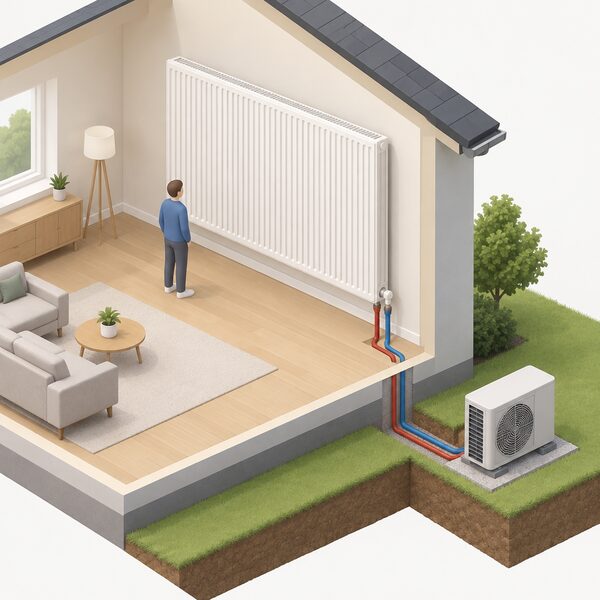
Flow temperature is the temperature of the water the heat pump sends to the emitters, and it is the single biggest lever on efficiency. Official guidance for Northern Ireland states that air source heat pumps usually run at lower flow temperatures of around 45°C19. An Edinburgh study uses an optimal supply or flow temperature of 45°C with a return temperature of 40°C20.
BEAMA, in work on the Future Homes Standard, describes air-to-water heat pumps as operating with a flow temperature of up to 55°C as per Part L requirements, but performing best when run at lower temperatures such as 35°C21. The gap between 35°C and 55°C is the gap between a system designed around low temperature emitters and one that has been asked to work like a boiler.
| Source | Flow temperature guidance |
|---|---|
| Northern Ireland guidance | around 45°C19 |
| Edinburgh study | 45°C supply, 40°C return20 |
| BEAMA | up to 55°C per Part L, best at 35°C21 |
| Which? | 35 to 45°C for standard low temperature heat pumps4 |
Emitters determine what flow temperature is achievable. Existing radiators may need upgrading or resizing, and underfloor heating systems work particularly well with heat pumps because they provide consistent warmth at lower temperatures22. A ground source heat pump produces low temperature heat and is best connected to a system designed for it, such as underfloor heating23.
Sizing and weather compensation matter more than the headline minimum
The minimum operating temperature is a property of the unit. Whether the home stays warm on the coldest day is a property of the system. Government guidance is explicit that sizing heat pump systems correctly is vital to reduce the risk of inefficiency and high operating costs24.
Approved Document L sets the rule: a primary heating system containing heat pumps should be selected to meet the full space heating requirement at the design condition chosen for heat loss calculations, and it should not be assumed that any heat will be supplied by additional secondary heaters25. The same requirement appears in the 2021 edition incorporating 2023 amendments, which states that heat pumps should be selected to meet the full space heating requirement at the design condition chosen for heat loss calculations26.
CIBSE frames the consequence: heat pumps work most efficiently when they are precisely sized for the home, and a system that is too big is expensive to run while one that is too small feels the chill on the coldest days27. The same principle applies to fabric: when a heating system is replaced or upgraded it should be sized to suit the reduced level of heat demand, and a lower heat output system is likely to be cheaper to buy and install with lower running costs28.
Weather compensation is the control strategy that ties this together. Approved Document L lists weather compensation or internal temperature control, plus a timer or programmer for space heating, among the minimum controls29. The Energy Saving Trust describes weather compensation as the system varying the flow temperature according to the season17. A heating curve is the setting that defines that relationship.
Higher flow temperatures mean increased energy consumption and lower efficiency, because heat pumps operate efficiently at lower temperatures and the higher the flow temperature the harder they have to work30. A well-set heating curve finds the lowest flow temperature that still keeps the house comfortable, which is where the running cost benefit sits.
What this means for a household's energy independence
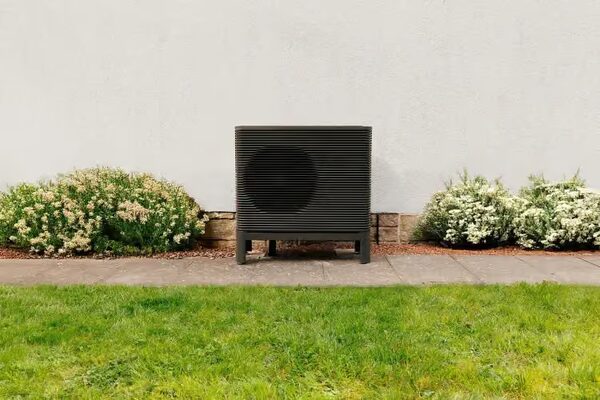
A heat pump's cold weather performance is central to what it does for energy independence. A unit that runs at -15°C or below removes the need for a gas connection, an oil tank or an LPG store, and with it the exposure to fuel deliveries, tank refills and the price of imported gas. The electricity it uses can increasingly be met from a home's own generation.
The dependence that remains is on the electricity grid and an electricity supplier. A heat pump does not store energy; it converts it, and it needs a live supply to run. In a power cut the heating stops, where a solid fuel stove or a standby generator would not. Cold weather also raises consumption at the point when the home most needs the heat, so the household's exposure to electricity prices is highest in winter.
There is a design dependence too. The unit's rated minimum is only realised if the system has been sized to the design condition, the emitters can deliver heat at a low flow temperature, and the controls are set to a sensible heating curve. A well-installed system will hold a house through a UK cold snap; a poorly specified one may struggle well before the outdoor temperature reaches the unit's limit.
Sources30 cited
- Heat pump fact check, Energy Saving Trust, 2026-07-01
- Air source heat pumps, Northern Powergrid, 2026-09-19
- How to ensure a heat pump runs efficiently, Energy Saving Trust, 2026-05-19
- An introduction to heat pumps, Which?, 2025-09-22
- Fact sheet 5: air source heat pumps, Pendle Borough Council, 2026-09-17
- Air source heat pumps explained, Which?, 2026-04-14
- Heat pump myths, Energy Saving Trust, 2025-09-02
- Reduce the cost of heat pumps, Nesta, 2022-03-02
- Your essential guide to heat pumps, Welsh Government, 2025-02-20
- Air source heat pumps, CIPHE, 2022-09-28
- Heat pumps, CIBSE, 2026-09-17
- Heat pump technology, European Heat Pump Association, 2022-11-10
- Renewable heating: what are the options for your home, Energy Saving Trust, 2024-03-01
- The suitability of clean heating options for challenging dwelling types, ClimateXchange, 2024-09-20
- Heat pumps vs boilers, The CPA, 2025-02-18
- Introduction to water source heat pumps, Renewables First, 2026-04-08
- Heat pump questions answered, Energy Saving Trust, 2026-05-27
- Does turning off the heat pump affect heating, Nesta, 2025-01-21
- Heat pumps, nidirect, 2025-02-24
- Edinburgh LHEES, City of Edinburgh Council, 2023-12
- Future Homes Standard Phase 1: network to emitter impact report, BEAMA, 2023-04
- Is your home suitable for a heat pump?, The CPA, 2026-02-18
- Installing a ground source heat pump, Which?, 2025-09-22
- Future Homes and Buildings Standards consultation response, MHCLG, 2026-03
- Approved Document L Volume 1 (2026), Welsh Government, 2026-04
- Approved Document L Volume 1, 2021 edition incorporating 2023 amendments, DLUHC, 2026-09-17
- Is your home heat pump ready?, CIBSE, 2026-05-07
- How to make your home more energy efficient, Which?, 2026-05-05
- Approved Document L Volume 1 Dwellings, MHCLG, 2026
- Avoiding costly mistakes: why heat pump installations must be done right, Flexi-Orb, 2025-02-11
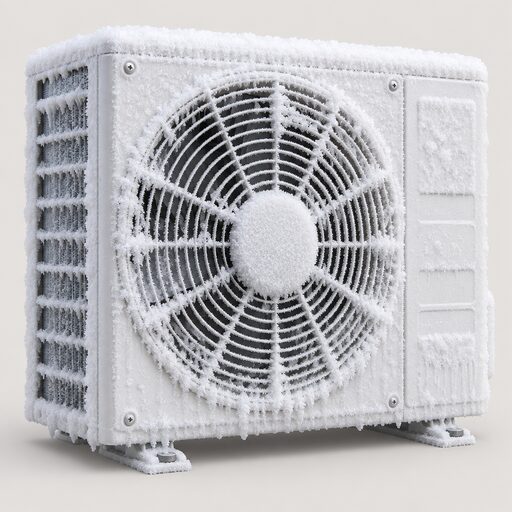 Heat Pumps in Cold WeatherDo heat pumps still work when it is freezing outside, and will one keep your home warm in a cold snap?
 How They Perform in UK HomesHow well do heat pumps really work in UK homes, and why do some run far better than others?
 Using a Heat Pump for CoolingCan a heat pump cool your home in summer as well as heat it in winter?
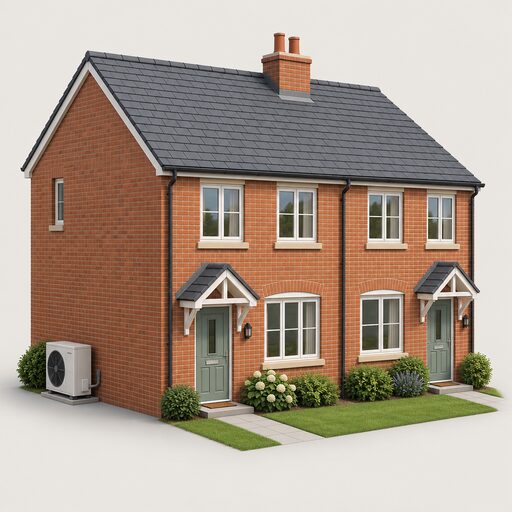 Which Homes Suit a Heat PumpMost UK homes can have a heat pump fitted, so the real question is whether yours makes it easy or expensive.
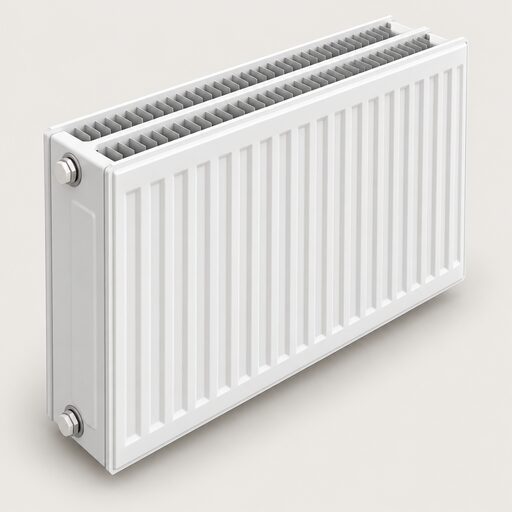 Radiators and Heat EmittersA radiator's real heat output depends on how hot the water inside it is compared with the room, so the figure in a catalogue often overstates what you will actually get.
 The Full Heat Pumps GuideWill a heat pump keep my house warm in winter, and what does one cost to buy and run?