
In this guide
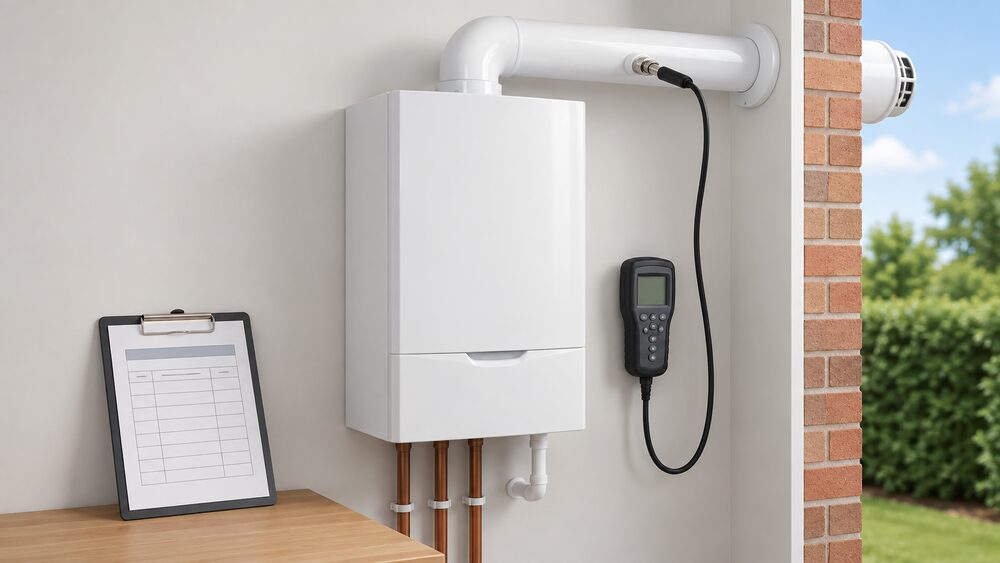
A boiler installation is not a purchase, it is a regulated building project. Work to install a new boiler, or a cooker that also supplies central heating such as an Aga or Raeburn, needs Building Regulations approval because of the safety issues and the need for energy efficiency1. In practice that approval is usually obtained by employing an installer who is registered under an approved scheme, who self-certifies the work and notifies the local authority2.
The rules are national, not optional, and they apply whether the boiler is gas, oil, LPG or electric. Installers must follow the guidelines set out in Approved Document J, which shows what is necessary for air supplies, hearths, flue linings and chimney labelling where the flue outlet can be positioned1. Planning permission, by contrast, is not normally required for the installation or replacement of a boiler or heating system if all the work is internal3.
What follows is the process, the notification routes, the paperwork a household should end up holding, and the point at which a boiler installation stops being a simple swap and becomes a project with its own consents.
What a boiler installation involves
A like-for-like replacement and a full system change are different jobs with different regulatory weight. The Planning Portal is explicit that if a new system is to be installed then the installer should proceed as if the work is being carried out in a new building1. That single sentence explains why a replacement combi in the same position is a day's work, while a change of fuel or boiler type pulls in flue design, condensate routing, controls and, often, a cylinder.
The governing document for the combustion side is Approved Document J, covering air supplies, hearths, flue linings and chimney labelling where the flue outlet can be positioned1. For the energy side, Approved Document L sets the conservation of fuel and power standards that a new installation must meet6. Where the work touches the electrical installation, the Building Regulations set standards for electrical installation work in dwellings, including houses and flats4.
The sequence a household should expect runs roughly as follows.
- A survey and heat loss assessment, which fixes the output and the emitter sizes.
- A check of flue route, air supply and condensate disposal against Approved Document J1.
- Notification to the building control body before the work starts, where the installer is not a registered competent person6.
- Installation, including flushing and water treatment.
- Commissioning, with the benchmark or equivalent record completed.
- Self-certification or building control sign-off, and the certificate to the householder.

Who can legally install a boiler
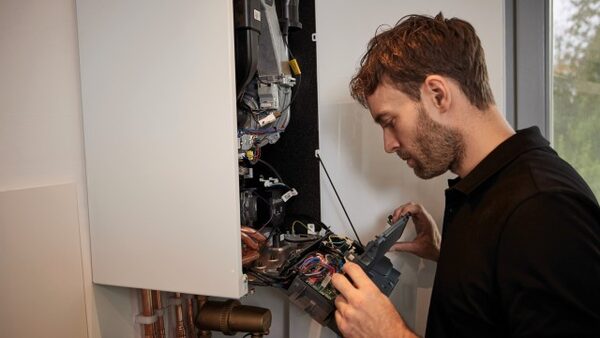
The short answer is that the person doing the work must be able to demonstrate compliance, and the usual route is scheme registration. Building Regulations approval for a new boiler is generally achieved by employing an installer who is registered under an approved scheme2. That registration is what allows the installer to certify their own work and tell the council that the work has been properly installed and tested7.
For gas work the relevant register is Gas Safe, and for oil work it is OFTEC. The principle is the same: the scheme member carries the competence and the notification duty. It is advisable to contact an installer who can provide the necessary advice, preferably one who belongs to the relevant Competent Person Scheme8. TrustMark operates as a government endorsed quality scheme and a competent person register for finding an installer that will assess your circumstances and property to identify suitable measures9.
The distinction matters for the household because it changes who carries the risk. With a registered installer, the compliance route is closed out by the installer. Without one, the household is exposed to an inspection regime it did not choose and a fee it did not budget for.
Notification: Competent Person Scheme or building control
There are two routes to Building Regulations approval, and they are not interchangeable in effort.
Under a Competent Person Scheme, work carried out under the scheme does not need notification to Building Control7. The member self-certifies and the local authority is told. For electrical work, the competent person is to send to the local authority a self-certification certificate within 30 days of the electrical works' completion4. The client must receive both a copy of the self-certification certificate and a BS7671 Electrical Installation Test Certificate4.
Where the installer is not a registered competent person, the building control body must be notified before the work starts, and again once the work is complete6. A building control body can be either the local authority to the site or a registered building control approver10. The two types are a local authority building control body and an approved inspector6. Once it has decided that the work meets all the Building Regulations requirements, it will issue a Building Regulations completion certificate if it is a building control authority, or a final certificate if it is a registered building control approver6.
The BCB must be given a notice that commissioning has been done, or a copy of the certificate, again within 30 days of the completion of the work11. Contact a building control body for advice if unsure which route applies10.
Relocation, listed buildings and other consents
Moving a boiler is where a straightforward installation becomes a consenting exercise. Planning permission is not normally required for the installation or replacement of a boiler or heating system if all the work is internal3. That is the general position, and it holds for most relocations inside the same building.
Two exceptions bite. First, installing boiler flues will require listed building consent12. A flue is an external alteration even when the boiler itself sits inside, so a listed property needs consent for the flue before the installation proceeds. Second, Building Regulations approval is needed for the boiler and flue work regardless of planning status12.
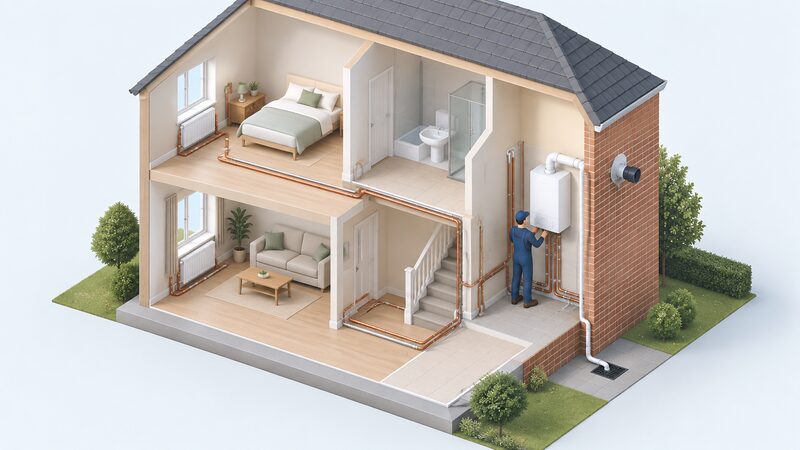
Relocation also changes the technical envelope. A new flue position must satisfy Approved Document J on air supplies, hearths, flue linings and chimney labelling1. Condensate disposal has to be re-routed. If the boiler moves to a different part of the house, pipework runs change and the system may need rebalancing, which is covered in more detail in heating system design and balancing.
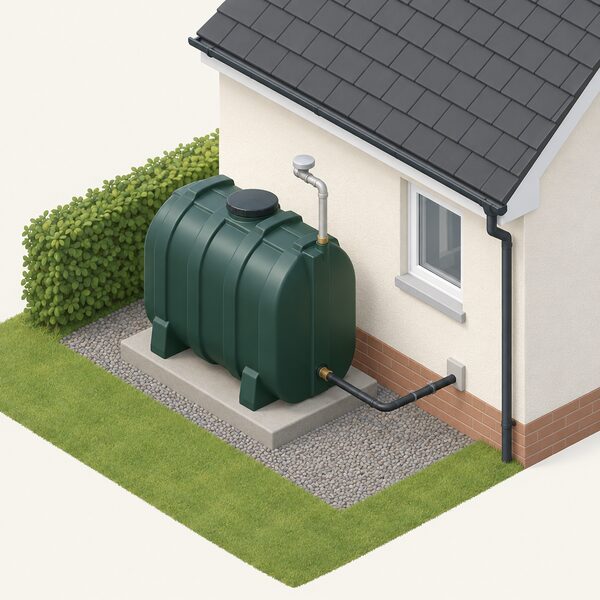
For oil installations, siting rules are separate and stricter. In Northern Ireland there are building control regulations about boilers and stoves and about siting an oil tank13. The same separation of boiler and tank rules applies across the UK, and the tank side is set out in domestic heating oil tanks.
Standards the installed system must meet

Approval is not only about safety. The Boiler Upgrade Scheme requires that the system installed must meet certain standards, such as minimum efficiency levels, with the installer advising on what those are14. The standards themselves are published for the purposes of Regulation 4 of The Boiler Upgrade Scheme (England and Wales) Regulations 202215, and the 2024 amendment regulations amended Regulation 17, which sets obligations on installers16.
The scheme is installer-led, meaning the application is made by the registered installer rather than the householder17. Installations under it are in domestic properties and small non-domestic properties, and the scheme covers England and Wales18. The installation size limit for the scheme is up to 45kWth19.
Efficiency requirements for new hot water boilers fired with liquid or gaseous fuels trace back to The Boiler (Efficiency) Regulations 1993, which implemented Council Directive 92/42/EEC and Council Directive 93/68/EEC20. Those regulations contained a transitional provision: nothing in them prevented the supply or putting into service before 1st January 1998 of boilers or appliances complying with national rules and schemes in force within the United Kingdom on 21st May 199220. That date has long passed, but it explains why the current standards framework is layered rather than single-source.
For biomass installations supported under the Domestic RHI, the fuel rule was that equipment must be designed and installed to burn solid biomass only, including wood pellets, and must not use fossil fuels except for ignition21. That is a useful illustration of how an installation standard can constrain operation, not just construction.
What it means for energy independence
A boiler installation is the point at which a household locks in its heating fuel and its servicing relationship for the next decade or more. The regulatory framework is designed to make that lock-in safe and efficient, not to make it independent. A gas boiler still depends on the gas grid and a supplier. An oil boiler still depends on deliveries and a tank. An electric boiler still depends on the grid and a tariff.
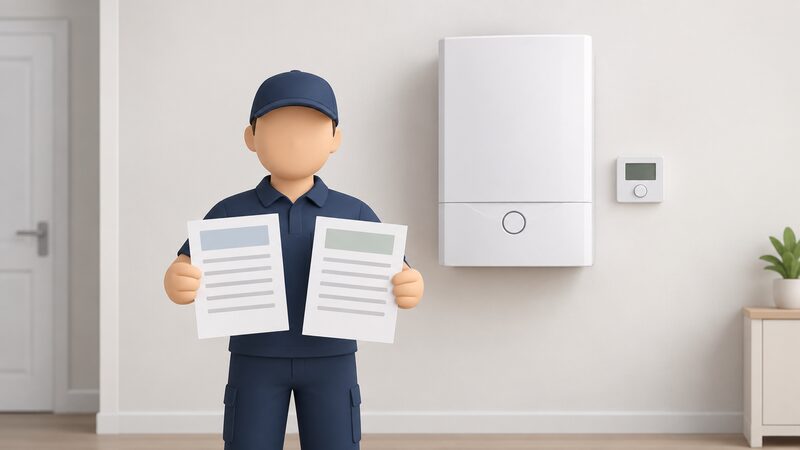
What the installation rules do deliver is a documented, certified system. The completion certificate or final certificate is the household's evidence that the work met Building Regulations6. The self-certification certificate and the BS7671 test certificate are the electrical equivalent4. Without those documents, a household has a boiler but no proof of compliance, which matters at sale and at any future grant application.
There is also a direction of travel to weigh. The choice of system, and the space left for a cylinder or a heat pump, matter as much as the installation itself, because the appliance fitted now will shape what is possible later. The wider picture is set out in home heating and energy independence.
Grants, VAT and the paperwork trail
Cost relief on a boiler installation comes through two separate mechanisms, and they are often confused.
On VAT, the supplies of equipment and its installation are standard-rated, unless they qualify for zero rating under the provisions of Buildings and construction (VAT Notice 708)5. Energy-saving materials installed in residential accommodation can qualify for relief, so the VAT position depends on the measure and the property rather than on the boiler alone.
On grants, the Boiler Upgrade Scheme is the main current support for low carbon heating in England and Wales, and it is installer-led17. The Warm Home Discount (England and Wales) Regulations 2022 require certain boilers and central heating systems under Schedule 2 Part 2 to be installed or repaired by a person registered with TrustMark for that purpose, with a TrustMark Certificate of Lodgement issued, or under equivalent quality assurance and consumer protection arrangements22. That is a quality-assurance condition attached to a scheme, not a general installation rule.
The Energy Company Obligation has changed in a way that affects what an installer must fit. The requirement for a full set of heating controls in the property following a boiler installation was removed under ECO4 Delivery Guidance version 3.023. BEIS had earlier decided not to take forward a proposal to make the English Boiler Plus standard a specific ECO requirement, so installations follow building regulations for each nation25.
For households in England, grant routes are set out in boiler and heating grants in England, with parallel pages for Scotland, Wales and Northern Ireland.
How the rules differ across the UK nations
Building Regulations are devolved, so the same installation is governed by different documents depending on where the property sits.
In England, the two types of building control body are a local authority building control body and an approved inspector6. The building control body must be notified before the work starts and once the work is complete6. The same completion certificate and final certificate distinction applies6.
In Wales, work to install a new boiler, or a cooker that also supplies central heating such as an Aga or Raeburn, needs Building Regulations approval because of the safety issues and the need for energy efficiency2. The Building Control Body may be either the local authority or an Approved Inspector11. The BCB must be given a notice that commissioning has been done, or a copy of the certificate, again within 30 days of the completion of the work11. Wales has also consulted on an updated Approved Document L Volume 1, which would set pre-construction and completion notification duties covering target and dwelling performance rates, fabric performance values and specifications28.
In Northern Ireland, there are building control regulations about boilers and stoves and about siting an oil tank13. Oil is a significant heating fuel there, so the tank siting rules carry more weight than in most of England.
In Scotland, building standards apply, and the notification route runs through the local authority's building standards service rather than through the building control bodies described for England and Wales.
| Nation | Approval route | Notification timing |
|---|---|---|
| England | Local authority building control body or approved inspector6 | Before work starts and once complete6 |
| Wales | Local authority or Approved Inspector11 | Before work starts and once complete; commissioning notice within 30 days11 |
| Northern Ireland | Building control regulations cover boilers, stoves and oil tank siting13 | Per local building control |
| Scotland | Building standards, administered by the local authority | Per local building standards |
Sources28 cited
- Boilers and heating: building regulations, Planning Portal, 2026
- Building regulations: boilers and heating, Welsh Government, 2026-09-17
- Boilers and heating: planning permission, Planning Portal, 2026-09-17
- Building regulations and electrical works, Richmond Council, 2026-06-02
- VAT on fuel and power (Notice 701/19), GOV.UK, 2016-04-28
- Approved Document L Volume 1: Dwellings, GOV.UK, 2026-09-17
- Building control application guidance notes, Bromley Council, 2026-09-17
- Building regulations: micro combined heat and power, Welsh Government, 2026-09-17
- Energy Company Obligation scheme: home energy efficiency, Leeds City Council, 2026-09-20
- Planning permission and building regulations approval, Planning Portal, 2026-09-17
- Building regulations guidance Part J: heat producing appliances, Welsh Government, 2026
- Permitted development checklist, Bath and North East Somerset Council, 2015-01
- Domestic oil installation and boiler servicing, nidirect, 2024-08-27
- Boiler Upgrade Scheme: what you can get, GOV.UK, 2026-09-17
- Boiler Upgrade Scheme: notice of standards, GOV.UK, 2026-07-21
- The Boiler Upgrade Scheme (England and Wales) (Amendment) Regulations 2024, legislation.gov.uk, 2026-09-17
- Boiler Upgrade Scheme guidance for installers, Ofgem, 2023-05-18
- Get a grant or loan to improve your home energy efficiency, Bristol City Council, 2026
- Heat pump deployment quarterly statistics: UK 2024 Q4, GOV.UK, 2025-03-06
- The Boiler (Efficiency) Regulations 1993, legislation.gov.uk, 1993-12-09
- Domestic RHI essential guide, Ofgem, 2024-06
- The Warm Home Discount (England and Wales) Regulations 2022, legislation.gov.uk, 2022-07-06
- ECO4 delivery guidance v3.2: summary of updates, Ofgem, 2025-08-07
- Summary of updates to ECO4 delivery guidance and measures table, Ofgem, 2025-08-07
- ECO4 consultation: scoring methodology decision, Ofgem, 2022-04-12
- Written statement: support for householders impacted by closure of the Energy Company Obligation scheme, Welsh Government, 2026-03-13
- Public Accounts Committee report, UK Parliament, 2026-01-23
- Approved Document L Volume 1: consultation version, Welsh Government, 2026-09-17
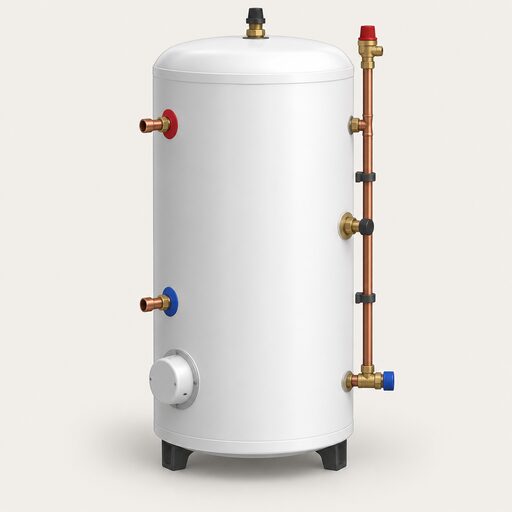 Building RegulationsReplacing a boiler or heating system usually needs building regulations approval, and the rules differ across England, Scotland, Wales and Northern Ireland.
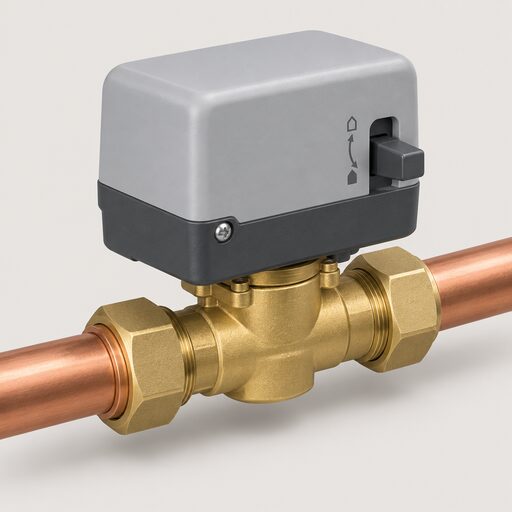 Heating Controls Building RulesWhat heating controls must you fit by law when you replace a boiler?
 Overheating StandardsScotland and Northern Ireland handle overheating in new homes differently from England and Wales.
 Installer in Northern IrelandHow do you check an installer in Northern Ireland is properly registered, and who do you complain to if the work goes wrong?
 Registering a WarrantyGetting a new boiler covered for longer usually means registering it quickly, often within a month of installation, or the long guarantee drops to a year.
 Building Regulations EnglandAdding a heat pump, solar panels or an extension usually needs building regulations approval, and it is separate from planning permission.