
In this guide
VAT on home energy installations in the UK is not one rate but three, and which applies depends on what is being installed, how it is supplied, and when. For an installed supply of energy-saving materials in residential accommodation, the rate is 0% until 31 March 20271. That covers solar panels, heat pumps, insulation, heating controls, electrical storage batteries and smart diverters, among other technologies1. Where a job falls outside the relief, the reduced rate of 5% or the standard rate of 20% can apply instead.
The distinction that matters most to a household is between an installed supply and a supply-only purchase. The relief attaches to the installation of energy-saving materials, so a unit bought loose and fitted by the householder does not qualify. HMRC states that it is not possible to get the zero rate if, for example, heating controls were purchased from a DIY shop, and that a customer must pay for both supply and installation to benefit2. The installer is responsible for charging the correct rate of VAT1.
The temporary zero rate is the reason a solar or heat pump quote can look lower than the headline price of the equipment suggests. It is also time-limited, and the date is fixed. This page sets out which products and jobs qualify, which do not, how the rate appears on a quote and invoice, and what changes when the zero rate ends.
What VAT applies to home energy installations
Three rates are in play. The standard rate of 20% applies to most goods and services. The reduced rate of 5% applies to a defined list that includes the installation of certain energy-saving materials, and to household energy itself. The zero rate applies to the same energy-saving materials while the temporary relief runs.
HMRC's guidance for consumers puts it plainly: a rate of either 5% or 0% VAT applies when certain energy-saving products are installed in a home, if the householder is eligible1. The reduced rate of 5% applies to the installation of certain energy-saving materials in residential accommodation3. The zero rate is the temporary version of that relief, and it is the one that currently applies to the installed supply.
The list of qualifying technologies has been widened twice. The original relief covered insulation, central heating system controls, hot water system controls, solar panels, wind turbines, water turbines, ground source heat pumps, air source heat pumps, micro combined heat and power units and wood-fuelled boilers7. Later legislation added electrical batteries that store electricity generated by energy-saving materials and from the grid, water source heat pumps and diverters, and certain preparatory groundworks for ground and water source heat pumps7. Water source heat pumps revert to the reduced rate after the temporary zero rate ends9.
The relief is not a household benefit that has to be claimed. It is a rate the installer applies to the supply. That is why the same equipment can carry different VAT depending on whether it arrives as part of an installation or as a box.
The 0% VAT rate on solar panels and batteries
Solar panels are the clearest case. A single supply of the installation of solar panels qualifies for relief, either at the reduced rate or at the zero rate10. In Northern Ireland, installations of energy-saving materials including solar panels and heat pumps benefit from a zero rate11.
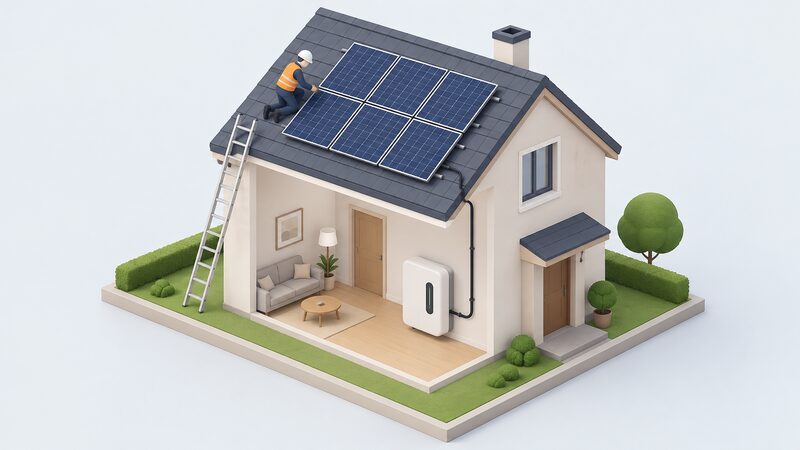
Batteries are where the treatment becomes specific. Where solar panels and a battery are installed together, HMRC treats the job as a single supply of an installation of solar panels, with the battery ancillary to it, and that single supply qualifies for the relief10. The conditions are that the installation is carried out at the same time, that the customer perceives a single supply, and that the battery is a better means of enjoying the principal supply of solar panels12. The combined installation of solar panels with battery storage in residential accommodation continues to benefit from the relief13.
The position is different for a battery bought on its own. Batteries sold separately and retrofitted to an existing solar system would most likely attract the standard rate of VAT, while batteries sold alongside a new solar photovoltaic system will most likely be eligible for the reduced rate14. That distinction has been the source of most of the confusion in this area, and it turns on whether the battery is part of an installed supply or a standalone purchase.
For a household, the practical effect is that the timing and packaging of a battery purchase can change the VAT treatment. A battery added at the same time as the panels sits inside the single supply. A battery added years later to an existing array is a separate transaction, and the relief is unlikely to reach it.
The 5% VAT rate on household energy and what it covers

The 5% rate on domestic energy is separate from the installation relief, and it is worth keeping the two apart. Ofgem's explanation of how an electricity or gas bill is calculated lists VAT at 5%4. Its guidance on understanding bills shows the same figure15, as does its page on checking whether money is owed on an energy bill16. Domestic energy is a reduced-rate supply, not a zero-rated one.
That 5% is charged on the energy a household consumes, including the electricity a heat pump or a home chargepoint draws. The same rate applies to home charging of an electric vehicle, which is charged at 5% VAT17. The rate on the fuel is unaffected by how the equipment that uses it was installed or what VAT applied to that installation.
The 5% rate also appears in the installation rules, in a different role. Where heating equipment work is funded through an energy efficiency grant, 5% VAT applies to that grant-funded work in Great Britain and Northern Ireland1. The work covered includes the installation of heating appliances, the installation, repair and maintenance of central heating systems, and the installation, repair and maintenance of renewable source heating systems1.
So a household can meet 5% VAT in three places: on the energy bill, on grant-funded heating work, and on the installation of energy-saving materials once the temporary zero rate ends. None of these is the standard rate, and none is the zero rate either.
Which installations qualify for the reduced rate, and which do not
Qualification turns on three things: the material, the building, and the purpose the installation serves.
On materials, the list is set out in legislation and has been extended. Water source heat pumps, certain electrical batteries and certain smart diverters were added to the list of energy-saving materials that can qualify for the reduced rate8. Groundworks preparatory to a ground or water source heat pump installation were added at the same time7.
On buildings, the relief is for residential accommodation and certain charitable buildings1. The reduced rate does not apply if the energy-saving materials are installed exclusively to serve an indoor or outdoor swimming pool9. That exclusion is about the purpose the installation serves rather than the technology itself.
On exclusions, wind and water turbines were removed from the reduced rate. The reduced rate of 5% no longer applies to the installation of wind and water turbines7. Earlier explanatory material confirms that the reduced rate of 5% is no longer available for the installation of wind or water turbines3. Solar panels, by contrast, remain within the relief10.
| Installation | VAT treatment on the installed supply |
|---|---|
| Solar panels | Qualifies for relief, at the reduced or zero rate10 |
| Solar panels with battery, same contract | Single supply of the installation of solar panels, qualifies for relief10 |
| Battery retrofitted to an existing system | Most likely standard rate14 |
| Air source, ground source, water source heat pumps | On the qualifying list; water source reverts to reduced rate after the zero rate7 |
| Wind and water turbines | No longer within the reduced rate7 |
| Materials serving a swimming pool exclusively | Reduced rate does not apply9 |
| Heating controls bought from a DIY shop | Zero rate not available; supply and installation both required2 |
When the 0% rate ends and what changes for households
The zero rate on energy-saving materials is subject to VAT relief at 0% until 31 March 20271. The temporary VAT cut on the installation of energy efficiency projects such as solar panels, insulation and heat pumps was set to be in place for five years to 202718. The scheme opened on 1 April 2022 and closes in March 202719.
After that date the materials revert to the reduced rate. Water source heat pumps, for example, revert to the reduced rate thereafter9. The reduced rate of 5% is the rate that applies to the installation of certain energy-saving materials in residential accommodation3, so the change is from 0% to 5% on the qualifying installed supply, not from 0% to 20%.
What that means in cash depends on the size of the job, and no worked example of the difference is published. What can be said is the direction and the date. A household commissioning work before 31 March 2027 is charged at the zero rate on the qualifying supply; one commissioning the same work afterwards is charged at 5% on that supply.
How VAT fits into the total cost of a solar installation
The headline figures for solar are published. A typical solar panel installation costs around £6,100 for a house6. The average system is around 3.5 kilowatt peak, covering between 10 and 20 square metres of roof and using between six and 12 panels6. A typical home without electrical heating or an electric vehicle saves between £530 and £650 a year on electricity bills, and solar panels usually pay for themselves in 10 to 12 years6.
Those figures are for the installed job, which is the supply the VAT relief reaches. The system produces direct current, which passes through a solar inverter to become alternating current for use in the home6. The inverter is part of the installation, not a separate purchase, and it sits inside the same VAT treatment as the panels.
Where the relief does not reach, the arithmetic changes. HMRC's own worked example covers a Northern Ireland case where materials are more than 60% of the total cost: an installer charges £5,385 excluding VAT, made up of £3,500 for materials and £1,885 for labour, and because materials are 65% of the total, standard rate VAT at 20% applies to the materials and 5% to the labour20. That example shows how the split between materials and labour can drive the rate when the relief does not apply to the whole supply.
For a household, the VAT position is one line in a quote that also carries scaffolding, an inverter, a battery if specified, and the labour to fit them. The relief applies to the installed supply as a whole, which is why a combined solar and battery job is treated as one supply rather than two.
How VAT fits into the total cost of a heat pump installation
Heat pump installations benefit from being exempt from VAT, so the rate charged is 0%21. Air source, ground source and water source heat pumps all appear on the qualifying list7. The relief covers the installed supply, which is why the grant-funded route and the self-funded route can produce different VAT outcomes.
Where heating equipment work is funded through an energy efficiency grant, 5% VAT applies to that grant-funded work in Great Britain and Northern Ireland1. The work covered includes the installation of heating appliances and the installation, repair and maintenance of renewable source heating systems1. So a grant-funded heat pump job can carry 5% VAT on the funded element even while the general relief for energy-saving materials is at 0%.
Costs for the equipment itself vary by source and are not settled. One official Scottish publication estimates a small home and apartment heat pump combined with installation at around £6,000 to £8,000, depending on whether any radiators need to be replaced22. That is a modelled estimate rather than a quoted price, and it is dated 2023.
The VAT treatment also interacts with what kind of heat pump is fitted. An air-to-water system transfers heat drawn from surrounding air to water in a wet central heating system23. An air-to-air system is not considered to be a renewable system in ECO423. That distinction matters for grant eligibility, and grant eligibility in turn affects which VAT rate applies to the funded work.
Grants and schemes that sit alongside the VAT treatment
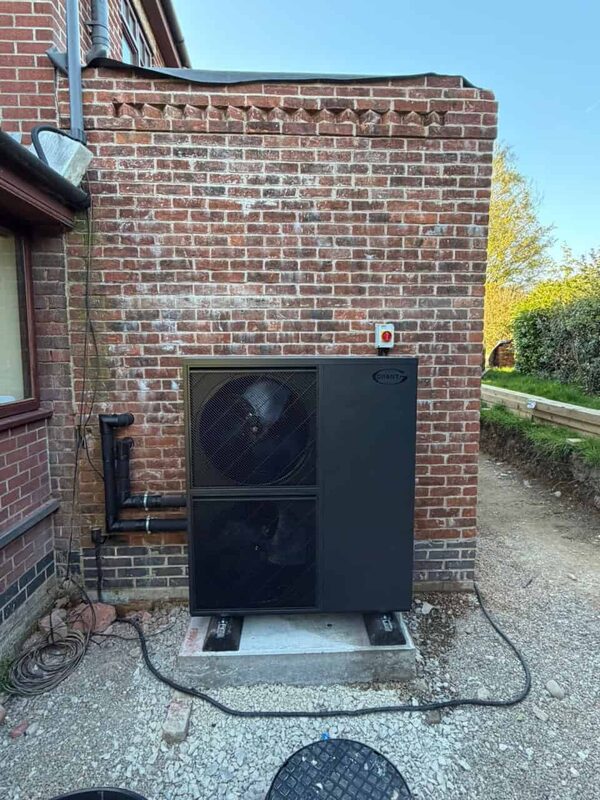
The Boiler Upgrade Scheme is the main grant running alongside the VAT relief. It offers £7,500 off the cost and installation of air-to-water heat pumps, ground source heat pumps and water source heat pumps, and £2,500 off the cost and installation of air-to-air heat pumps for residential properties only5. A separate government grant listing describes £7,500 off the cost and installation of a ground source heat pump, and £7,500 off an air source heat pump24.
The application is made by the installer, not the householder. The installer applies for the grant on your behalf through Ofgem, and a quote can be obtained through the MCS find a heat pump installer tool or by contacting an energy supplier21. The scheme is currently set to end in 20285.
The VAT treatment of grant-funded work is set out separately from the grant itself. Where heating equipment work is funded through an energy efficiency grant, 5% VAT applies to that work in Great Britain and Northern Ireland1. The grant reduces the amount paid, but it does not remove the VAT from the funded element.
| Scheme or relief | What it provides | VAT position |
|---|---|---|
| Boiler Upgrade Scheme | £7,500 off air-to-water, ground source and water source heat pumps; £2,500 off air-to-air in residential properties5 | 5% VAT on grant-funded heating equipment work1 |
| Zero rate on energy-saving materials | 0% on the installed supply until 31 March 20271 | 0% while the relief runs |
| Reduced rate | 5% on the installation of energy-saving materials3 | 5% |
| Household energy | Domestic electricity and gas supply4 | 5% |
What the Future Homes Standard means for new-build homes
The Future Homes Standard changes the baseline for new homes rather than the VAT treatment of work on existing ones. New rules mean every new home will come with solar panels by default25. That is a change to what is built in, not to what a householder buys and has fitted.
The VAT relief described on this page applies to the installation of energy-saving materials in residential accommodation1. A new-build home with solar panels fitted as part of construction is a different supply chain from a retrofit, and the relief is framed around installation in existing residential accommodation and certain charitable buildings.
For a household in an older property, the practical relevance of the standard is indirect. It signals that solar is becoming the default on new homes, which affects how the technology is specified and priced across the market. It does not change the rate that applies to a retrofit, and it does not extend the zero rate beyond 31 March 2027.
How to confirm the VAT treatment with your installer

The installer is responsible for charging the correct rate of VAT1. That is the starting point, and it means the householder's role is to check rather than to calculate.
The relief is applied automatically by installers and helps reduce upfront costs significantly26. There is no household registration, application or certificate for the VAT relief itself. Registration does arise in two other places: a solar photovoltaic installation must be registered with the distribution network operator, usually done by the installer6, and grant applications are made by the installer on the householder's behalf21.
On the paperwork, the useful checks are these:
- The quote should show the rate of VAT applied and the amount it produces.
- Where the job is a combined solar and battery installation, the quote should treat it as one supply rather than splitting the battery out.
- Where the job is grant-funded, the quote should show the 5% treatment on the funded work.
- Where the work is due to complete after 31 March 2027, the quote should state which rate it assumes.
Getting several quotes to compare prices from different installers is standard practice27. Comparing them on the VAT line as well as the total makes the treatment visible before anything is signed. If a quote shows no VAT at all on a job that does not qualify for relief, or standard rate VAT on a job that does, that is worth raising with the installer before paying.
Sources27 cited
- Tax on shopping: energy-saving products, GOV.UK, 2026-09-17
- Heating controls eligible for 0% VAT, BEAMA, 2022-07-04
- VAT rates on different goods and services, GOV.UK, 2026-07-10
- How your electricity or gas bill is calculated, Ofgem, 2026
- Boiler Upgrade Scheme, Ofgem, 2026-09-17
- Solar panels, London Borough of Hammersmith and Fulham, 2026-09-17
- Explanatory memorandum: VAT (Energy Saving Materials) Order 2024, legislation.gov.uk, 2026-09-17
- VAT (Energy Saving Materials) Order 2024: made note, legislation.gov.uk, 2026-09-17
- VAT Energy Saving Materials: reduced rate scope, HMRC, 2026-09-17
- VAT Energy Saving Materials: single supplies, HMRC, 2026-09-17
- Support to generate your own electricity, nidirect, 2025-09-22
- VAT Energy Saving Materials: batteries and single supply, HMRC, 2026-09-17
- VAT Energy Saving Materials: solar and battery storage, HMRC, 2026-09-17
- VAT clarity for solar storage, RECC, 2017-08-04
- Understand your electricity and gas bills, Ofgem, 2026
- Check if you are owed money on your energy bill, Ofgem, 2026
- EVs: the facts, SMMT, 2025-09-22
- Major acceleration of homegrown power, GOV.UK, 2027
- How much do solar panels cost, EcoFlow, 2025-06-16
- Energy saving, HMRC, 2026-09-20
- Heat pump installation, GOV.UK, 2026-09-10
- Heat buildings: energy retrofit possibilities, Scottish Government, 2023-11-28
- ECO4 new measures and products guidance, Ofgem, 2026-03-26
- Boiler Upgrade Scheme, Find government grants, 2026-09-18
- Families to save in biggest home upgrade plan, GOV.UK, 2026-01-20
- Solar heating, MCS Certified, 2026-08-17
- Solar photovoltaic panels, London Borough of Bromley, 2026-09-17
 Installation Cost TrendsTracks the published median and average installed costs of domestic solar, heat pumps and batteries and how they have moved.
 Air Conditioning CostPublished UK equipment prices and the parts of an installed price for portable, single split, multi-split and whole-house air conditioning.
 Public EV Charging PricesCovers the published price series for public charging, how per-kWh rates differ by network and speed, and how they have moved over the past year.
 Reducing Your BillRanks household electricity and gas uses by share of the bill and sets out what each measure changes, from heating settings and insulation to appliance use and tariff choice.
 EV Tariffs and Home ChargingHow EV-specific import tariffs and charging bolt-ons work, including supplier-controlled charging where the energy company decides when the car draws power, which charge points each scheme supports, and what a household needs in place.
 The Full Where to Start GuideWhich home improvements actually cut your bills, and which should you do first?